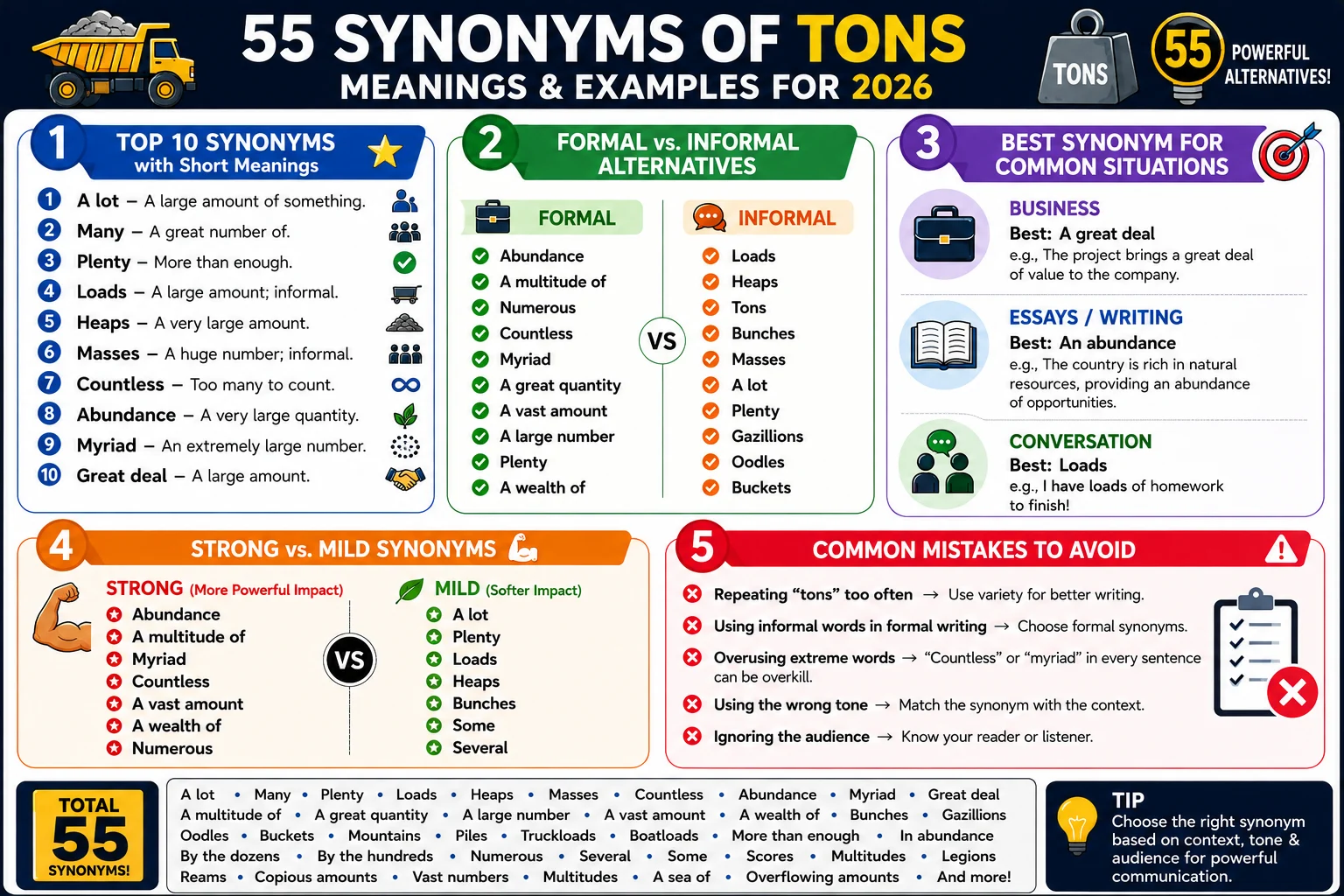
“Tons” means a very large amount of something, often used informally. The best synonyms are loads, heaps, masses, piles, and bunches. “Loads” is the most common natural alternative. Each synonym has a slightly different meaning and context where it fits best.
Top 10 Synonyms
- Loads
- Heaps
- Masses
- Piles
- Bunches
- Lots
- Plenty
- Stacks
- Oodles
- Scads
“Tons” is a word we use constantly in everyday English. We have tons of work, tons of ideas, tons of food, and tons of things to do. It’s a great, casual word, but using it too often can make your English feel repetitive and informal.
Think about it. You can have tons of homework, tons of emails, tons of friends, or tons of questions. Each situation might need a different word that captures the exact meaning of “a large amount.
In this guide, you’ll learn 30 powerful synonyms for “tons.” You’ll discover exactly when to use each one, how formal they are, and what common mistakes to avoid. Let’s begin!
What Does “Tons” Mean?
Definition
Tons” means a very large amount or number of something. It comes from the word “ton,” which is a unit of weight equal to 2,000 pounds. But in everyday speech, we use it to mean “a lot” of anything—not just weight. When you have tons of something, you have plenty of it.
Pronunciation
| Feature | Value |
|---|---|
| US IPA | /tʌnz/ |
| UK IPA | /tʌnz/ |
| Syllables | 1 |
| Tip | Rhymes with “runs” and “buns” |
Grammar
| Grammar Feature | Information |
|---|---|
| Part of Speech | Noun (plural) |
| Common Position | After “of” or before a noun |
| Typical Pattern | Tons + of + something |
Examples:
- “I have tons of homework tonight.”
- “There were tons of people at the concert.”
- “She has tons of talent.”
Grammar Note: “Tons” is always followed by “of” when used before a noun. It’s informal and used in casual conversation.
Word Family
| Word | Part of Speech | Meaning |
|---|---|---|
| Ton | Noun | A unit of weight or a large amount |
| Tons | Noun (plural) | A very large amount |
| Ton (figurative) | Noun | A large amount (singular) |
| Tonne | Noun | Metric ton (1,000 kg) |
15 Synonyms of “Tons”
Loads
Meaning: A very large amount of something.
Best Used For: Casual conversation, everyday situations.
Formality: Informal
Tone: Casual, Friendly
Frequency: ⭐⭐⭐⭐⭐ (Very Common)
CEFR Level: A2
Example Sentence 1: “I’ve got loads of work to do this weekend.”
Example Sentence 2: “We had loads of fun at the party.”
Usage Tip: “Loads” is the most common and natural synonym. Use it in almost any casual situation.
Common Confusion: Loads vs Tons. “Loads” is slightly less exaggerated than “tons.” Both are informal.
Heaps
Meaning: A large amount of something, often piled up or gathered.
Best Used For: Casual conversation, describing collections or piles.
Formality: Informal
Tone: Visual, Friendly
Frequency: ⭐⭐⭐⭐ (Common)
CEFR Level: B1
Example Sentence 1: “She has heaps of books in her room.”
Example Sentence 2: “There’s heaps of food left from the party.
Usage Tip: “Heaps” suggests something is piled up. It’s a very visual word.
Masses
Meaning: A large number or amount of people or things.
Best Used For: Groups of people, large quantities.
Formality: Neutral
Tone: Large-scale, Impersonal
Frequency: ⭐⭐⭐ (Moderate)
CEFR Level: B2
Example Sentence 1: “Masses of people attended the concert.”
Example Sentence 2: “There are masses of data to analyze.”
Usage Tip: “Masses” often refers to groups of people or large amounts of abstract things like data.
Piles
Meaning: A large amount of things, usually stacked or gathered.
Best Used For: Physical objects, tasks, mail.
Formality: Informal
Tone: Visual, Organized
Frequency: ⭐⭐⭐⭐ (Common)
CEFR Level: B1
Example Sentence 1: “I have piles of laundry to do.”
Example Sentence 2: “There are piles of paperwork on his desk.”
Usage Tip: “Piles” suggests things are stacked up. It’s great for physical objects and tasks.
Bunches
Meaning: A large number or group of people or things.
Best Used For: Groups of people, casual situations.
Formality: Informal
Tone: Friendly, Casual
Frequency: ⭐⭐⭐ (Moderate)
CEFR Level: B1
Example Sentence 1: “There were bunches of kids at the park.”
Example Sentence 2: “She’s got bunches of friends.”
Usage Tip: “Bunches” is often used for groups of people. It has a friendly tone.
Lots
Meaning: A large amount or number.
Best Used For: Everyday conversation, general use.
Formality: Informal
Tone: Casual, Simple
Frequency: ⭐⭐⭐⭐⭐ (Very Common)
CEFR Level: A2
Example Sentence 1: “We have lots of time to finish.”
Example Sentence 2: “She got lots of presents for her birthday.”
Usage Tip: “Lots” is a very common, simple alternative. It’s less exaggerated than “tons.”
Plenty
Meaning: More than enough; a large amount.
Best Used For: Resources, time, food.
Formality: Neutral
Tone: Abundant, Reassuring
Frequency: ⭐⭐⭐⭐⭐ (Very Common)
CEFR Level: A2
Example Sentence 1: “There’s plenty of food for everyone.”
Example Sentence 2: “We have plenty of time to get there.”
Usage Tip: “Plenty” suggests you have enough and more. It’s a reassuring word.
Stacks
Meaning: Large amounts of things, often neatly arranged.
Best Used For: Books, paper, money, organized piles.
Formality: Informal
Tone: Neat, Organized
Frequency: ⭐⭐⭐ (Moderate)
CEFR Level: B1
Example Sentence 1: “She has stacks of books to read.”
Example Sentence 2: “He made stacks of money in his career.”
Usage Tip: “Stacks” suggests things are neatly arranged in piles.
Oodles
Meaning: A very large amount, often used for intangible things.
Best Used For: Talent, money, charm, abstract things.
Formality: Informal
Tone: Playful, Exaggerated
Frequency: ⭐⭐ (Rare)
CEFR Level: B2
Example Sentence 1: “She has oodles of talent.”
Example Sentence 2: “He inherited oodles of money.”
Usage Tip: “Oodles” is a playful, informal word. Use it for abstract things like talent or charm.
Scads
Meaning: A large number or amount.
Best Used For: Casual conversation, exaggerated amounts.
Formality: Informal
Tone: Playful, Exaggerated
Frequency: ⭐⭐ (Rare)
CEFR Level: B2
Example Sentence 1: “There were scads of people at the mall.”
Example Sentence 2: “She’s got scads of ideas for the project.”
Usage Tip: “Scads” is an informal, somewhat old-fashioned word for a large amount.
A mountain of
Meaning: A very large amount, often overwhelming.
Best Used For: Work, debt, problems, physical piles.
Formality: Informal
Tone: Overwhelming, Dramatic
Frequency: ⭐⭐⭐ (Moderate)
CEFR Level: B2
Example Sentence 1: “I have a mountain of work to finish.”
Example Sentence 2: “They face a mountain of debt.”
Usage Tip: “A mountain of” suggests an overwhelming amount that feels difficult to handle.
A wealth of
Meaning: A large amount of valuable things.
Best Used For: Knowledge, information, opportunities.
Formality: Formal
Tone: Valuable, Abundant
Frequency: ⭐⭐⭐ (Moderate)
CEFR Level: B2
Example Sentence 1: “The library has a wealth of information.”
Example Sentence 2: “She has a wealth of experience.”
Usage Tip: “A wealth of” is a formal synonym. Use it for valuable, intangible things.
Countless
Meaning: Too many to count.
Best Used For: Things, opportunities, reasons.
Formality: Formal
Tone: Numerous, Abundant
Frequency: ⭐⭐⭐⭐ (Common)
CEFR Level: B2
Example Sentence 1: “There are countless reasons to learn a language.”
Example Sentence 2: “She has countless friends around the world.”
Usage Tip: “Countless” suggests the number is too large to count. It’s a formal alternative.
Abundance
Meaning: A very large amount of something.
Best Used For: Formal writing, nature, resources.
Formality: Formal
Tone: Plentiful, Generous
Frequency: ⭐⭐⭐ (Moderate)
CEFR Level: B2
Example Sentence 1: “The garden has an abundance of flowers.”
Example Sentence 2: “There is an abundance of resources available.”
Usage Tip: “Abundance” is a formal word for a large supply. Use it in formal writing.
A sea of
Meaning: A very large amount that looks like a sea.
Best Used For: People, faces, color.
Formality: Literary
Tone: Poetic, Vast
Frequency: ⭐⭐ (Rare)
CEFR Level: C1
Example Sentence 1: “He looked out at a sea of faces.”
Example Sentence 2: “The field was a sea of flowers.”
Usage Tip: “A sea of” is a poetic metaphor. Use it in creative writing for a visual, dramatic effect.
Synonyms Comparison Table
| Synonym | Best Context | Formality | Tone | Frequency |
|---|---|---|---|---|
| Loads | General casual | Informal | Casual | ⭐⭐⭐⭐⭐ |
| Lots | General casual | Informal | Simple | ⭐⭐⭐⭐⭐ |
| Plenty | Enough and more | Neutral | Reassuring | ⭐⭐⭐⭐⭐ |
| Heaps | Physical piles | Informal | Visual | ⭐⭐⭐⭐ |
| Piles | Stacked things | Informal | Organized | ⭐⭐⭐⭐ |
| Countless | Too many to count | Formal | Numerous | ⭐⭐⭐⭐ |
| Stacks | Neat piles | Informal | Organized | ⭐⭐⭐ |
| Masses | Groups, data | Neutral | Impersonal | ⭐⭐⭐ |
| Bunches | Groups of people | Informal | Friendly | ⭐⭐⭐ |
| Oodles | Intangible things | Informal | Playful | ⭐⭐ |
Best Synonyms by Situation
| Situation | Best Synonym | Why It Works |
|---|---|---|
| Daily Conversation | Loads / Lots | Natural and casual |
| Business Email | Countless | Professional |
| Academic Writing | Abundance | Formal and precise |
| School Assignment | Lots / Plenty | Clear and simple |
| Professional Meeting | Countless | Professional |
| Presentation | Abundance | Formal and impressive |
| Creative Writing | A sea of / Oodles | Adds literary flair |
| Social Media | Loads / Tons | Casual and engaging |
| Informal Writing | Heaps / Piles | Casual and visual |
Formal vs Informal Synonyms
Formal Alternatives
| Synonym | Best Used For |
|---|---|
| Abundance | Formal writing, resources |
| Countless | Numbers too large to count |
| A wealth of | Valuable intangible things |
| Masses | Groups, data, large quantities |
Neutral Alternatives
| Synonym | Best Used For |
|---|---|
| Plenty | Enough and more |
| Lots | General use |
| Many | Simple and clear |
Informal Alternatives
| Synonym | Best Used For |
|---|---|
| Loads | Most casual situations |
| Heaps | Physical piles |
| Piles | Stacked things |
| Oodles | Playful, exaggerated talk |
| Stacks | Neat piles |
Choosing the Right Level: Use “abundance” and “countless” for formal writing. Use “plenty” and “lots” for most everyday situations. Use “loads” and “heaps” for casual conversation with friends.
Strong vs Mild Synonyms
Mild
Suitable for everyday situations with less exaggeration.
- Lots
- Plenty
- Many
Moderate
More expressive or visual alternatives.
- Loads
- Heaps
- Piles
- Bunches
Strong
High-intensity alternatives suggesting huge amounts.
- Countless (too many to count)
- Oodles (playful exaggeration)
- Scads (large amounts)
- A mountain of (overwhelming)
How Intensity Changes Meaning: “We have lots of work” is mild. “We have a mountain of work” sounds overwhelming. Choose stronger words when you want to emphasize how much.
Real-Life Examples
School: “I have loads of homework this weekend.”
Office: “There are countless emails to answer.”
Business Email: “We have an abundance of resources available.”
Meetings: “We’ve received stacks of applications.”
Presentations: “The company has a wealth of experience.”
Daily Conversations: “We had tons of fun at the park!”
Social Media: “There are loads of great deals today.”
Academic Writing: “The study shows an abundance of evidence.”
Common Collocations
| Common Phrase | Better Alternative |
|---|---|
| Tons of work | Loads of work |
| Tons of fun | Loads of fun |
| Tons of food | Plenty of food |
| Tons of people | Countless people |
| Tons of money | Stacks of money |
Common Phrases
A ton of: A large amount. (e.g., “That weighs a ton!”)
Tons of stuff: A lot of things. (e.g., “We have tons of stuff to move.”)
Loads of fun: Very enjoyable. (e.g., “The party was loads of fun.”)
A mountain of: An overwhelming amount. (e.g., “He has a mountain of debt.”)
A wealth of: A valuable supply. (e.g., “She has a wealth of knowledge.”)
Context Guide
| Situation | Best Synonym | Reason |
|---|---|---|
| Essay | Abundance | Formal and academic |
| Speech | Countless | Strong and clear |
| Business Email | Countless | Professional |
| Novel | A sea of | Literary and visual |
| Presentation | Abundance | Formal and impressive |
| Conversation | Loads | Natural and casual |
| Academic Writing | Abundance | Precise and formal |
| Marketing Copy | Loads | Engaging and casual |
Related Words
Near Synonyms
- Numerous: Many. (e.g., “There are numerous options.”)
- Countless: Too many to count.
- Infinite: Without end.
- Limitless: Without limits.
Antonyms
- Few: Not many.
- Limited: Small in amount.
- Scarce: Not enough.
- Sparse: Thinly distributed.
- Lacking: Not having enough.
Related Adjectives
- Abundant: Present in large quantities.
- Plentiful: Available in large amounts.
- Numerous: Many.
- Copious: Large in quantity.
- Ample: Enough or more than enough.
Related Nouns
- Abundance: A large quantity.
- Plenty: Enough or more than enough.
- Excess: More than needed.
- Surplus: Extra beyond what is needed.
- Overflow: Too much of something.
Related Verbs
- Abound: To exist in large numbers.
- Overflow: To fill beyond capacity.
- Swarm: To be full of moving things.
- Teem: To be full of.
Frequently Asked Questions
What is another word for tons?
Common synonyms include loads, heaps, masses, piles, bunches, and lots. “Loads” and “lots” are the most common and natural alternatives.
Which synonym sounds the most professional?
Countless and abundance sound the most professional. “A wealth of” is also excellent for formal contexts.
What is the strongest synonym for tons?
Countless is one of the strongest synonyms—it suggests something is impossible to count. “A mountain of” is also strong for overwhelming amounts.
Which synonym is best for essays?
Abundance is the best choice for academic essays. It’s formal and precise.
What’s the difference between tons and loads?
“Tons” and “loads” are very similar in meaning. Both are informal. “Tons” is slightly more exaggerated. “Loads” is slightly more common.
Which synonym is most common in everyday English?
“Lots” and “loads” are the most common in everyday speech. “Plenty” is also very common.
What is the opposite of tons?
Common opposites are few, scarce, limited, and sparse. These words describe small amounts.
Conclusion
“Tons” is a useful and friendly word, but now you have 30 fantastic alternatives. Each synonym adds a different shade of meaning to your language.
Remember, the key is understanding the context. Use “loads” and “lots” for everyday casual conversation. Use “abundance” and “countless” for formal writing. Use “heaps” and “piles” for visual descriptions. Use “oodles” and “scads” for playful exaggeration.
The best way to improve is practice. Try using one or two new synonyms each day. Listen for these words in conversations and books. Your vocabulary will become richer and more expressive with time.
