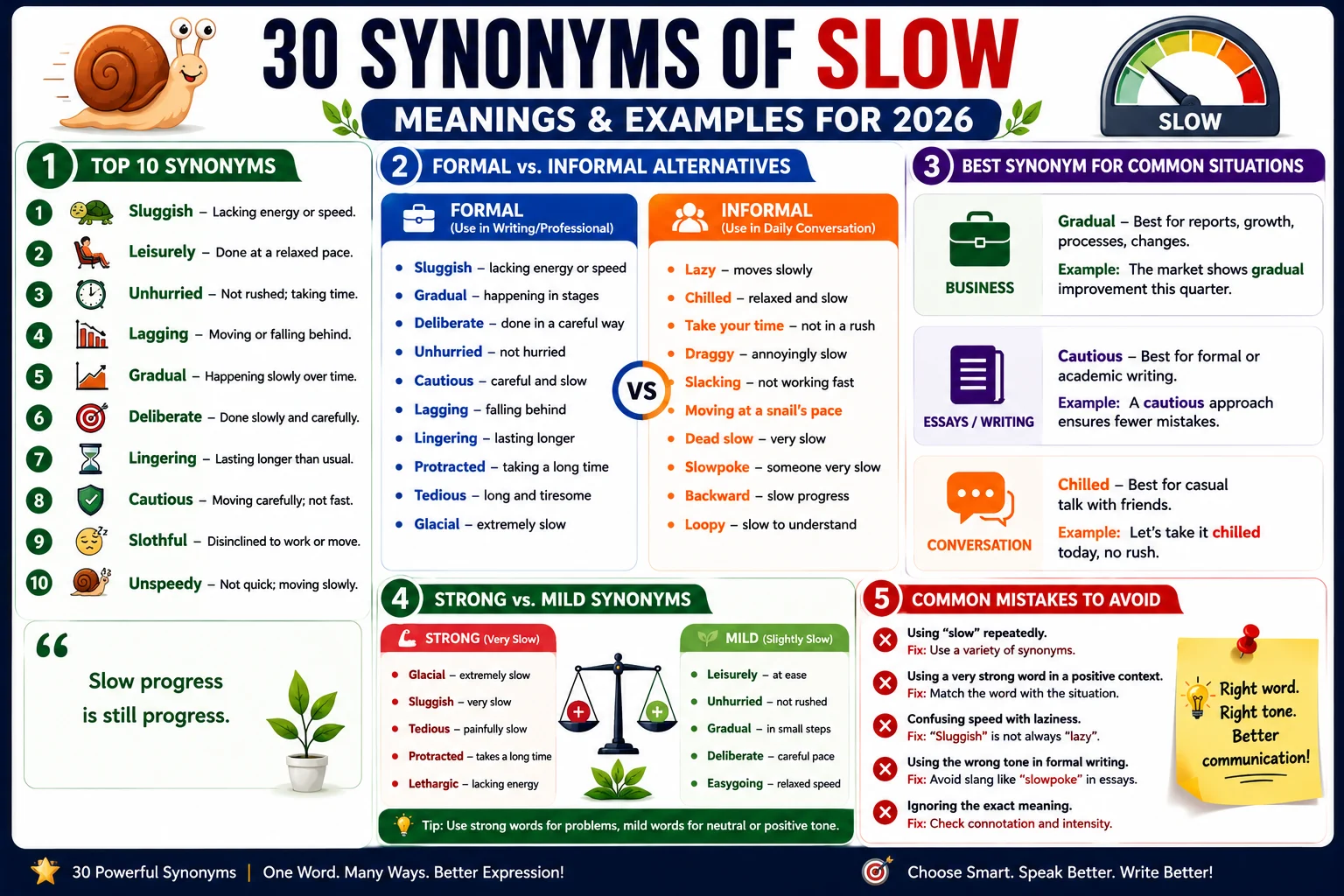
Slow” means moving or happening at a low speed, or taking more time than usual. The best synonyms are gradual, leisurely, sluggish, steady, and moderate. “Gradual” is a great formal alternative. Each synonym has a different meaning and context.
Top 10 Synonyms
- Gradual
- Leisurely
- Sluggish
- Steady
- Moderate
- Gentle
- Easy
- Slow-moving
- Deliberate
- Measured
“Slow” is a simple word, but it’s incredibly useful. We use it all the time. However, using it too often can make your English feel repetitive and basic.
Think about it. You have slow traffic, slow progress, a slow person, or a slow process. Each situation might need a different word that captures the exact type of slowness.
In this guide, you’ll learn 35 powerful synonyms for “slow.” You’ll discover exactly when to use each one, how formal they are, and what common mistakes to avoid. Let’s begin!
What Does “Slow” Mean?
Definition
Slow” means moving or happening at a low speed. It can describe movement, like a slow car. It can describe time, like a slow day. It can describe progress, like slow growth. It can also describe someone who learns or understands things more gradually.
Pronunciation
| Feature | Value |
|---|---|
| US IPA | /sloʊ/ |
| UK IPA | /sləʊ/ |
| Syllables | 1 |
| Tip | Say it with a long “oh” sound |
Grammar
| Grammar Feature | Information |
|---|---|
| Part of Speech | Adjective |
| Common Position | Before a noun or after a linking verb |
| Typical Pattern | Slow + noun / Subject + be + slow |
Examples:
- “The slow traffic made us late.” (before noun)
- “The progress was extremely slow.” (after verb)
- “He is a slow learner.” (before noun)
Grammar Note: “Slow” can also be an adverb in informal English, as in “Drive slow.” In formal writing, use “slowly.”
Word Family
| Word | Part of Speech | Meaning |
|---|---|---|
| Slow | Adjective | Moving at a low speed |
| Slowly | Adverb | In a slow manner |
| Slowness | Noun | The quality of being slow |
| Slow-moving | Adjective | Moving slowly |
| Slow-paced | Adjective | Happening at a slow speed |
15 Synonyms of “Slow”
Gradual
Meaning: Happening slowly over a period of time, not suddenly.
Best Used For: Changes, progress, processes.
Formality: Formal
Tone: Smooth, Steady
Frequency: ⭐⭐⭐⭐ (Common)
CEFR Level: B2
Example Sentence 1: “The country experienced gradual economic growth.”
Example Sentence 2: “She made gradual improvements in her English.
Usage Tip: “Gradual” suggests slow and steady change over time. It’s a positive, formal alternative to “slow.”
Common Confusion: Gradual vs Slow. “Gradual” implies steady progress. Slow” can mean not moving at all.
Leisurely
Meaning: Done without hurry, relaxed and slow.
Best Used For: Pace, activities, vacations.
Formality: Neutral
Tone: Relaxed, Comfortable
Frequency: ⭐⭐⭐ (Moderate)
CEFR Level: B2
Example Sentence 1: “We enjoyed a leisurely walk through the park.”
Example Sentence 2: “He ate his lunch at a leisurely pace.”
Usage Tip: “Leisurely” has a positive, relaxed feeling. It suggests you’re taking your time and enjoying it.
Sluggish
Meaning: Slow and lacking energy or activity.
Best Used For: Economy, traffic, people, processes.
Formality: Neutral
Tone: Lethargic, Slow
Frequency: ⭐⭐⭐ (Moderate)
CEFR Level: B2
Example Sentence 1: “The economy has been sluggish this year.”
Example Sentence 2: “I felt sluggish after eating a big meal.”
Usage Tip: “Sluggish” has a slightly negative feeling. It suggests something should be faster but isn’t.
Steady
Meaning: Gradually and consistently doing something.
Best Used For: Progress, growth, movement.
Formality: Neutral
Tone: Consistent, Reliable
Frequency: ⭐⭐⭐⭐⭐ (Very Common)
CEFR Level: B1
Example Sentence 1: “There has been a steady increase in sales.”
Example Sentence 2: “He walked at a steady pace.”
Usage Tip: “Steady” suggests consistent, reliable movement or progress, not jerky or unpredictable.
Moderate
Meaning: Average, not extreme; not fast.
Best Used For: Speed, pace, activity.
Formality: Formal
Tone: Balanced, Reasonable
Frequency: ⭐⭐⭐⭐ (Common)
CEFR Level: B1
Example Sentence 1: “She drives at a moderate speed.
Example Sentence 2: “We need moderate growth, not rapid expansion.
Usage Tip: “Moderate” suggests a reasonable, balanced speed. It’s neither too fast nor too slow.
Gentle
Meaning: Not strong or violent; soft and slow.
Best Used For: Movements, sounds, rain.
Formality: Neutral
Tone: Soft, Calm
Frequency: ⭐⭐⭐⭐ (Common)
CEFR Level: B1
Example Sentence 1: “The gentle breeze cooled us down.”
Example Sentence 2: “She made a gentle movement toward the door.”
Usage Tip: “Gentle” suggests a soft, careful slowness. It’s often used for movements and sounds.
Easy
Meaning: Without hurry; relaxed.
Best Used For: Pace, movements, lifestyle.
Formality: Informal
Tone: Relaxed, Effortless
Frequency: ⭐⭐⭐⭐⭐ (Very Common)
CEFR Level: A2
Example Sentence 1: “Take it easy—there’s no rush.”
Example Sentence 2: “He walked at an easy pace.”
Usage Tip: “Easy” is informal and suggests a relaxed, unhurried pace. It’s very common in everyday speech.
Slow-moving
Meaning: Moving at a slow speed.
Best Used For: Traffic, people, animals.
Formality: Neutral
Tone: Direct, Descriptive
Frequency: ⭐⭐⭐ (Moderate)
CEFR Level: B1
Example Sentence 1: “The slow-moving traffic frustrated the drivers.”
Example Sentence 2: “Slow-moving animals like sloths are fascinating.”
Usage Tip: “Slow-moving” is a direct, descriptive alternative. Use it for physical movement.
Deliberate
Meaning: Done slowly and carefully, with thought.
Best Used For: Actions, movements, decisions.
Formality: Formal
Tone: Careful, Thoughtful
Frequency: ⭐⭐⭐ (Moderate)
CEFR Level: B2
Example Sentence 1: “She made deliberate, careful movements.”
Example Sentence 2: “He walked with a deliberate pace.”
Usage Tip: “Deliberate” suggests slowness because of careful thought, not laziness.
Measured
Meaning: Slow and careful, with control.
Best Used For: Speech, movements, actions.
Formality: Formal
Tone: Controlled, Calm
Frequency: ⭐⭐ (Rare)
CEFR Level: C1
Example Sentence 1: “He spoke in measured tones.”
Example Sentence 2: “She made measured, thoughtful decisions.”
Usage Tip: “Measured” is formal and suggests controlled slowness, often in speech or actions.
Lethargic
Meaning: Lacking energy and feeling slow.
Best Used For: People, animals, feelings.
Formality: Formal
Tone: Tired, Unenergetic
Frequency: ⭐⭐⭐ (Moderate)
CEFR Level: B2
Example Sentence 1: “The heat made everyone feel lethargic.”
Example Sentence 2: “He was lethargic and couldn’t get out of bed.”
Usage Tip: “Lethargic” suggests slowness caused by tiredness or lack of energy.
Dilatory
Meaning: Slow to act, often because of laziness.
Best Used For: People, actions, delays.
Formality: Very Formal
Tone: Negative, Delaying
Frequency: ⭐ (Very Rare)
CEFR Level: C1
Example Sentence 1: “His dilatory behavior frustrated the team.”
Example Sentence 2: “The dilatory response caused more problems.”
Usage Tip: “Dilatory” is very formal and negative. Use it for people who delay on purpose.
Tardy
Meaning: Slow and late.
Best Used For: People, responses, deliveries.
Formality: Formal
Tone: Late, Delaying
Frequency: ⭐⭐ (Rare)
CEFR Level: B2
Example Sentence 1: “He was tardy for the meeting.”
Example Sentence 2: “The tardy delivery disappointed the customer.”
Usage Tip: “Tardy” is formal and means late. It’s often used for being late to school or work.
Crawling
Meaning: Moving extremely slowly.
Best Used For: Traffic, progress.
Formality: Informal
Tone: Frustrated, Slow
Frequency: ⭐⭐⭐ (Moderate)
CEFR Level: B1
Example Sentence 1: “The traffic was crawling during rush hour.”
Example Sentence 2: “My internet is crawling—it’s so slow!”
Usage Tip: “Crawling” is informal and suggests very slow movement, like a crawl.
Plodding
Meaning: Moving slowly with heavy steps or effort.
Best Used For: Walking, progress, work.
Formality: Neutral
Tone: Heavy, Effortful
Frequency: ⭐⭐ (Rare)
CEFR Level: C1
Example Sentence 1: “He made plodding progress through the mud.”
Example Sentence 2: “The project was plodding along.”
Usage Tip: “Plodding” suggests slow, heavy, effortful movement.
Synonyms Comparison Table
| Synonym | Best Context | Formality | Tone | Frequency |
|---|---|---|---|---|
| Gradual | Changes, progress | Formal | Smooth | ⭐⭐⭐⭐ |
| Steady | Consistent progress | Neutral | Reliable | ⭐⭐⭐⭐⭐ |
| Moderate | Speed, pace | Formal | Balanced | ⭐⭐⭐⭐ |
| Leisurely | Relaxed activities | Neutral | Relaxed | ⭐⭐⭐ |
| Sluggish | Economy, traffic | Neutral | Lethargic | ⭐⭐⭐ |
| Gentle | Movements, rain | Neutral | Soft | ⭐⭐⭐⭐ |
| Easy | Pace, lifestyle | Informal | Relaxed | ⭐⭐⭐⭐⭐ |
| Deliberate | Careful actions | Formal | Thoughtful | ⭐⭐⭐ |
| Lethargic | Tiredness | Formal | Tired | ⭐⭐⭐ |
| Tardy | Lateness | Formal | Late | ⭐⭐ |
Best Synonyms by Situation
| Situation | Best Synonym | Why It Works |
|---|---|---|
| Daily Conversation | Easy / Leisurely | Natural and casual |
| Business Email | Gradual / Moderate | Professional and clear |
| Academic Writing | Gradual / Deliberate | Formal and precise |
| School Assignment | Steady / Gradual | Shows careful progress |
| Professional Meeting | Gradual / Moderate | Sounds measured |
| Presentation | Deliberate | Shows thoughtfulness |
| Creative Writing | Gentle / Deliberate | Adds literary depth |
| Social Media | Sluggish / Crawling | Casual and relatable |
| Traffic Report | Slow-moving | Descriptive and clear |
Formal vs Informal Synonyms
Formal Alternatives
| Synonym | Best Used For |
|---|---|
| Gradual | Changes, progress |
| Deliberate | Careful actions |
| Measured | Controlled actions |
| Dilatory | Slow to act |
| Tardy | Being late |
Neutral Alternatives
| Synonym | Best Used For |
|---|---|
| Slow-moving | Physical movement |
| Steady | Consistent progress |
| Moderate | Balanced speed |
| Gentle | Soft movements |
Informal Alternatives
| Synonym | Best Used For |
|---|---|
| Easy | Relaxed pace |
| Crawling | Very slow movement |
| Plodding | Heavy, slow movement |
| Pokey | Very slow (US slang) |
Choosing the Right Level: Use “gradual” and “deliberate” in formal writing. Use “moderate” and “steady” in most professional contexts. Use “easy” and “leisurely” with friends.
Strong vs Mild Synonyms
Mild
Suitable for everyday situations with less intensity.
- Easy
- Gentle
- Leisurely
- Moderate
Moderate
More specific or formal alternatives.
- Gradual
- Steady
- Sluggish
- Slow-moving
Strong
High-intensity alternatives suggesting very slow movement.
- Crawling (extremely slow)
- Plodding (heavy, slow effort)
- Lethargic (lacking energy)
- Dilatory (delaying on purpose)
How Intensity Changes Meaning: “He walks slow” is simple. “He plods along” suggests heavy effort. “He’s lethargic” suggests tiredness. Choose based on how much slowness you want to emphasize.
Real-Life Examples
School: “The students made gradual progress in their studies.”
Office: “The project is moving at a steady pace.”
Business Email: “We expect moderate growth this quarter.”
Meetings: “The discussion was slow and deliberate.”
Presentations: “We need to take a measured approach to this problem.”
Daily Conversations: “Let’s take a leisurely walk in the park.”
Social Media: “This week is going by so slowly!”
Academic Writing: “The researchers observed gradual changes in the data.”
Common Collocations
| Common Phrase | Better Alternative |
|---|---|
| Slow progress | Gradual progress |
| Slow speed | Moderate speed |
| Slow growth | Steady growth |
| Slow traffic | Slow-moving traffic |
| Slow walk | Leisurely walk |
| Slow response | Tardy response |
Common Phrases
Take it slow: To relax and not hurry. (e.g., “Let’s take it slow and enjoy the day.”)
Slow and steady wins the race: Consistent effort succeeds. (e.g., “Remember, slow and steady wins the race.”)
At a snail’s pace: Extremely slowly. (e.g., “The project is moving at a snail’s pace.”)
In slow motion: Moving very slowly. (e.g., “The scene played in slow motion.”)
Slow on the uptake: Slow to understand. (e.g., “He’s a bit slow on the uptake.”)
Context Guide
| Situation | Best Synonym | Reason |
|---|---|---|
| Essay | Gradual | Academic and formal |
| Speech | Deliberate / Measured | Thoughtful and controlled |
| Business Email | Moderate | Professional and balanced |
| Novel | Leisurely | Adds literary quality |
| Presentation | Measured | Controlled and professional |
| Conversation | Easy | Natural and relatable |
| Academic Writing | Gradual | Precise and formal |
| Traffic Report | Slow-moving | Clear and descriptive |
Related Words
Near Synonyms
- Pokey: Very slow (informal US slang).
- Dawdling: Moving slowly, wasting time.
- Lagging: Falling behind, moving slowly.
- Tortoise-like: As slow as a tortoise.
Antonyms
- Fast: Moving at high speed.
- Quick: Done quickly.
- Rapid: Very fast.
- Swift: Fast and smooth.
- Speedy: Fast.
Related Adjectives
- Gradual: Happening slowly over time.
- Leisurely: Relaxed and unhurried.
- Sluggish: Slow and lacking energy.
- Steady: Consistent and reliable.
- Moderate: Not too fast or slow.
Related Nouns
- Slowness: The quality of being slow.
- Delay: A period of being slow.
- Lag: A delay or gap.
- Pace: The speed of movement.
Related Verbs
- Decelerate: To slow down.
- Delay: To make late or slow.
- Lag: To fall behind.
- Dawdle: To waste time by moving slowly.
- Crawl: To move very slowly.
Frequently Asked Questions
What is another word for slow?
Common synonyms include gradual, leisurely, sluggish, steady, and moderate. “Gradual” is a great formal alternative, while “easy” is common in casual speech.
Which synonym sounds the most professional?
Gradual and deliberate sound the most professional. “Measured” is also excellent for formal contexts.
What is the strongest synonym for slow?
Crawling is one of the strongest, suggesting extremely slow movement. “Lethargic” is strong for people lacking energy.
Which synonym is best for essays?
Gradual is the best choice for academic essays. “Deliberate” is also excellent for describing careful actions.
What’s the difference between slow and sluggish?
“Sluggish” suggests a lack of energy or activity. “Slow” is more general and can be neutral or negative.
Which synonym is most common in everyday English?
“Easy” and “leisurely” are common in everyday speech for relaxed pace. “Slow” itself is still the most used word.
What is the opposite of slow?
Common opposites are fast, quick, rapid, and swift. These words describe high speed.
Conclusion
“Slow” is a simple but essential word. Now you have 35 fantastic alternatives to choose from. Each synonym adds a different shade of meaning to your language.
Remember, the key is understanding the context. Use “gradual” for slow change over time. Use “leisurely” for relaxed activities. Use “sluggish” for lack of energy. Use “steady” for consistent progress. Use “deliberate” for careful actions.
The best way to improve is practice. Try using one or two new synonyms each day. Listen for these words in conversations, books, and movies. Your vocabulary will become richer and more expressive with time.
