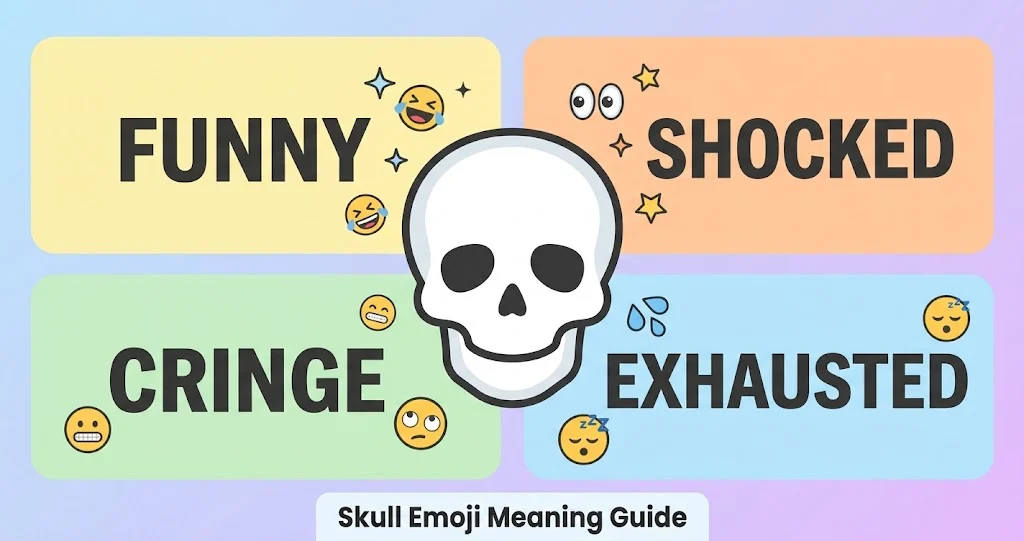
The skull emoji meaning is simple. It signals laughter so intense that a person feels dead. People use it to say “I am dying laughing” or “that killed me.” In short, it marks extreme humor, disbelief, or dramatic exhaustion in casual chats.
The skull emoji meaning centers on laughing until you metaphorically die. This bony symbol replaced the crying laughing face for millions of younger users. Consequently, it captures humor that feels physically overwhelming. People send it when a joke lands so hard that words fail. However, this emoji carries darker and lighter layers depending on context. This guide breaks down every nuance, platform, and scenario so you always send the right signal.
Quick Answer Box
| Element | Explanation |
|---|---|
| Meaning | Dying from laughter or extreme shock |
| Context | Memes, jokes, disbelief, dark humor |
| Primary Platforms | TikTok, Snapchat, Instagram, Discord |
| Example | “He tripped on flat ground 💀” |
| Tone | Playful, ironic, dramatic |
What Does Skull Emoji Meaning Actually Mean?
The skull emoji meaning refers to death as a metaphor for laughter. Its official Unicode name is “Skull,” and it dates back to 2010 under Unicode 6.0. Furthermore, it originally represented literal death, danger, or poison. However, internet culture reinvented it entirely. Younger users turned it into a laughter marker around 2020 and 2021.
At its core, the symbol shows a human skull with hollow eyes. First, it conveys extreme amusement. Second, it expresses shock, disbelief, or secondhand embarrassment. Therefore, context decides which reading applies. For example, someone watching a funny video might send it to say “I am dead.” Meanwhile, a person reacting to wild news might send it to say “that is Wild.”
The skull emoji meaning also connects to generational slang shifts. Gen Z adopted it because the crying laughing emoji felt outdated and cringey. Additionally, it fits dark humor and irony perfectly. That cultural pivot explains its massive rise across social apps.
Contextual Dynamics and Nuances of the Term
The skull emoji meaning shifts depending on who sends it and why. Therefore, you must read the surrounding words carefully. Consider these common dynamics.
Extreme laughter. A friend sends it after a hilarious meme. Here, it signals uncontrollable giggling. It essentially says, “I cannot breathe from laughing.”
Shock and disbelief. Someone sends it after reading bizarre news. In this case, it means total astonishment. No humor exists at all.
Secondhand embarrassment. A person might use it after watching someone fail publicly. Consequently, the meaning turns toward cringe and pity.
Exhaustion. Students use it during finals week to signal burnout. Furthermore, it dramatizes mental fatigue with self-aware humor.
Dark commentary. Some users add it to grim jokes or ironic observations. The face becomes a wink at life’s absurdity.
Each dynamic changes the emotional weight. Therefore, never assume one fixed interpretation. The skull emoji meaning lives in the relationship between sender and receiver.
Real-Life Conversation Examples Using Skull Emoji Meaning
These five chat scripts show natural usage. Notice how the context shapes each message.
Example 1: Funny meme reaction
- Person A: sends video of cat falling off couch
- Person B: “I am crying 💀”
- Person A: “He was fine, I promise.”
Example 2: Wild news
- Person A: “Did you see the guy who won the lottery twice?”
- Person B: “No way 💀”
- Person A: “Same ticket, same numbers.”
Example 3: Secondhand embarrassment
- Person A: “He proposed to the wrong twin.”
- Person B: “💀 I cannot watch this”
- Person A: “It gets worse.”
Example 4: Homework pain
- Person A: “Three exams and a paper due Friday.”
- Person B: “You are done 💀”
- Person A: “Completely.”
Example 5: Sever roast
- Person A: “Your outfit looks like a yard sale.”
- Person B: “💀 that was brutal”
- Person A: “I only speak facts.”
These examples prove one key point. The skull emoji meaning adapts to humor, shock, cringe, and stress with equal ease.
Platform-Specific Breakdown
Different apps shape how people use this emoji. Therefore, understanding each platform helps you send the right signal.
How It Is Used on Snapchat
Snapchat users rely on the skull for quick reactions. For example, a friend snaps a chaotic moment, and you reply with 💀. Additionally, Snapchat’s fast pace favors symbols over full sentences. People often stack multiple skulls for extra emphasis. Consequently, it functions as a burst of laughter in image form. The skull emoji meaning on Snapchat leans heavily toward pure comedy.
The Role of Skull Emoji Meaning on TikTok
TikTok turned this emoji into a comment section staple. Creators drop it under funny clips, fails, and plot twists. Furthermore, commenters spam it to signal that a video destroyed them. The platform’s humor rewards exaggeration. Therefore, the skull became shorthand for “this ended me.” Many users also pair it with “bro” or “nah” for maximum effect. In those cases, the skull emoji meaning shifts toward disbelief and chaos.
Instagram and Texting Dynamics
Instagram users place it in comments, stories, and direct messages. For instance, a friend posts an embarrassing throwback, and you reply with 💀. That single symbol says more than a paragraph. Meanwhile, in iMessage and Android texting, it works as a sharper alternative to the crying laughing face. People often pair it with “stop” or “I am done” for extra punch. Therefore, the skull emoji meaning on Instagram and texting balances humor with dramatic flair.
Alternative Meanings
Language evolves, and so does this emoji. Consequently, several alternative readings exist.
Semantic variations include:
- Skull emoji
- Dying laughing symbol
- Dead face reaction
- Skeleton emoji
- Death emoji
Emotional variations include:
- “I am deceased”
- “That killed me”
- “I cannot breathe”
- “I am gone”
- “RIP me”
Natural language processing tools often group this emoji with humor, shock, and irony. Furthermore, sentiment analysis usually tags it as positive in casual contexts. However, literal usage exists too. For example, someone might send it alongside Halloween content or pirate themes. In that case, the skull emoji meaning returns to its original, macabre roots. Therefore, tone and context remain essential for accurate interpretation.
Misinterpretations:
Despite its flexibility, this emoji has boundaries. Therefore, avoid it in certain situations.
Serious grief. Never send it after someone shares real loss. It reads as tone deaf and cruel. Consequently, it can damage relationships permanently.
Professional settings. Do not use it with a boss, client, or professor. It reads as too casual for formal communication. Furthermore, it can undermine your credibility.
Sensitive topics. Avoid it during discussions of illness, tragedy, or danger. The skull carries literal death imagery. Therefore, it can feel disturbing rather than funny.
New relationships. Sending it too early can feel intense or edgy. Therefore, match the other person’s humor first.
Formal writing. Never use it in emails, reports, or academic work. It belongs to casual chat only.
Additionally, some older users misread it as a threat or bad omen. Therefore, clarify with words if the recipient seems unsure. The skull emoji meaning depends on shared context, so never assume universal understanding.
How to Respond in Chat Comfortably
Receiving this emoji can feel confusing at first. However, several response strategies work well.
Match the energy. If someone sends 💀 after a joke, reply with humor. For example, say “I will take that as a compliment.”
Use a counter emoji. Send a crying laughing face or a fire emoji to keep the tone light.
Clarify when needed. If the context is unclear, simply ask. For instance, “Is that a funny skull or a shocked skull?”
Lean into the drama. A playful reply like “RIP me too” keeps the exchange fun.
Shift to words. When the moment matters, follow up with a real sentence. Therefore, the other person feels valued beyond a symbol.
These strategies keep conversations smooth. Furthermore, they prevent awkward misreads of the skull emoji meaning.
FAQs
What does the skull emoji mean from a girl?
It usually signals intense laughter or disbelief. She may find something hilarious or shocking. Therefore, read the surrounding messages for clarity.
Is the skull emoji flirty?
Rarely on its own. It leans toward humor rather than romance. However, playful teasing can carry flirty undertones.
What does 💀 mean from a guy?
Guys send it to show they are dying laughing. Furthermore, it can express shock or dramatic exhaustion.
Is the skull emoji the same as the crying laughing emoji?
Not exactly. The skull feels edgier and more modern. The crying laughing face now reads as older or cringey to many Gen Z users.
When did the skull emoji become slang?
Its slang use exploded around 2020 and 2021. TikTok and Twitter drove most of that growth.
Can the skull emoji mean something bad?
Sometimes. It can signal real danger or death in literal contexts. Nevertheless, most casual uses stay playful.
How do I reply to a skull emoji?
Match the tone with humor or a counter emoji. For example, send a fire emoji or a witty line.
Is it okay to use the skull emoji at work?
Generally, no. Keep it for casual chats with close colleagues at most.
Does the skull emoji mean love?
No. It signals humor, shock, or irony instead. Affection has its own dedicated emojis.
Why do people use the skull emoji so much?
It captures modern humor perfectly. People laugh at chaos, cringe, and absurdity daily. Consequently, the emoji fits countless moments.
Conclusion:
The skull emoji meaning captures a feeling that older symbols could not express. It blends humor, shock, and irony into one tiny image. Furthermore, it adapts across TikTok, Snapchat, Instagram, and everyday texting. Therefore, it has become a cornerstone of modern digital conversation.
Slang evolves quickly, and emojis evolve with it. Consequently, symbols like this one reflect how people communicate emotion in fast, visual ways. Understanding them improves your relationships online. Moreover, it prevents awkward miscommunications.
Use this guide as your reference. Match the tone, read the context, and respond with care. Above all, remember that the skull emoji meaning ultimately says one thing: “That was so funny it killed me.
