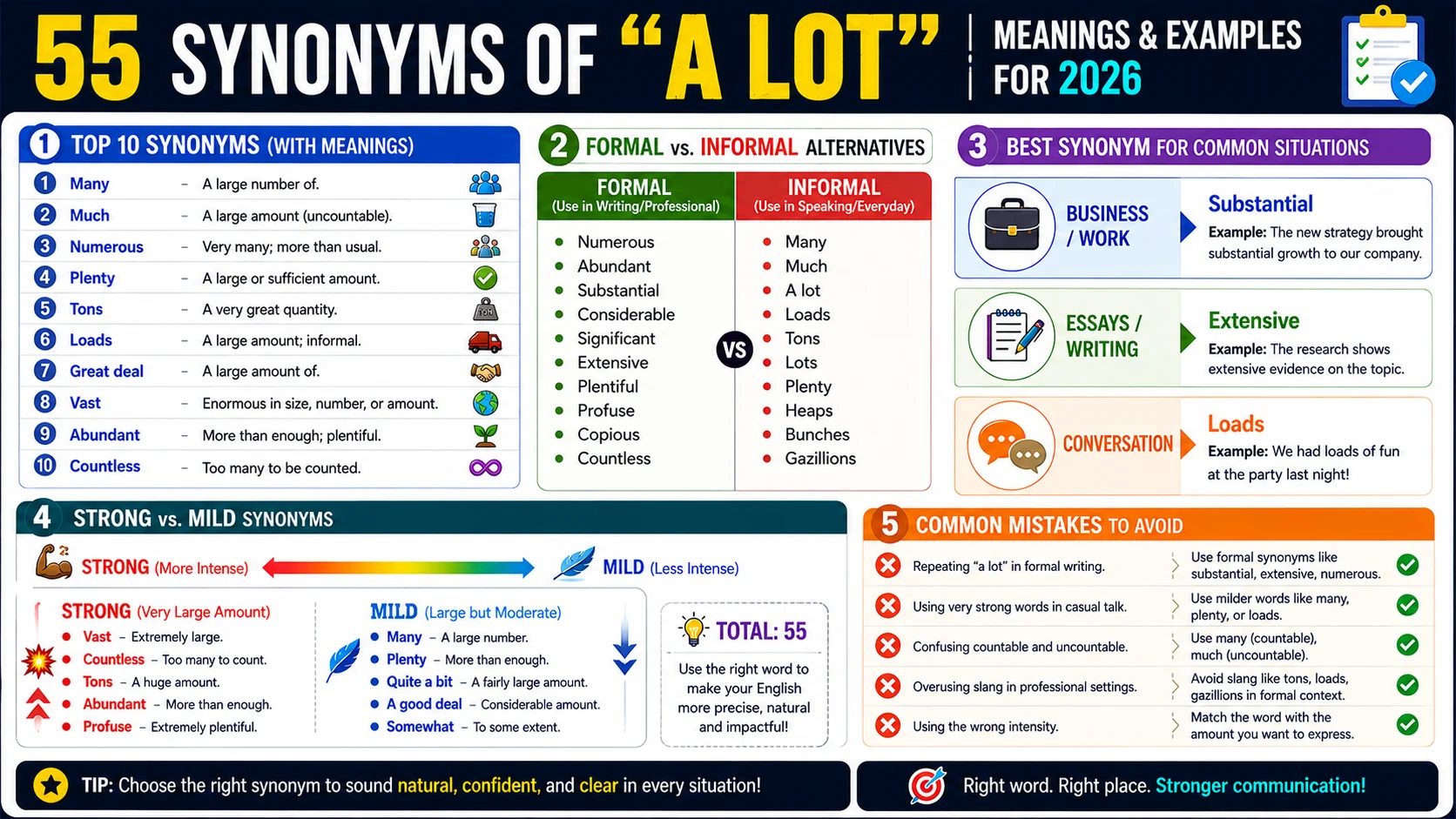
“A lot” means a large amount or degree of something. The best synonyms are many, much, plenty, numerous, and ample. “Many” is the most common natural alternative. Each synonym has a slightly different meaning and context where it fits best.
Top 10 Synonyms
- Many
- Much
- Plenty
- Numerous
- Ample
- Abundant
- Copious
- Bountiful
- Substantial
- Considerable
“A lot” is one of the most common phrases in English. We use it constantly. There’s nothing wrong with it, but using it too often can make your English feel basic and repetitive.
Think about it. You can have a lot of work, a lot of time, a lot of money, or a lot of people. Each situation might need a different word that captures the exact amount or degree.
In this guide, you’ll learn 35 powerful synonyms for “a lot.” You’ll discover exactly when to use each one, how formal they are, and what common mistakes to avoid. Let’s begin!
What Does “A Lot” Mean?
Definition
A lot” means a large amount, number, or degree of something. It’s a very common way to say “many” or “much.” You can use it with countable nouns (a lot of people) and uncountable nouns (a lot of water). It’s informal but widely accepted in everyday English.
Pronunciation
| Feature | Value |
|---|---|
| US IPA | /ə ˈlɑt/ |
| UK IPA | /ə ˈlɒt/ |
| Syllables | 2 (a lot) |
| Tip | Stress the second word: “uh LOT” |
Grammar
| Grammar Feature | Information |
|---|---|
| Part of Speech | Phrase (determiner/adverb) |
| Common Position | Before a noun or after a verb |
| Typical Pattern | A lot + of + noun / A lot + verb |
Examples:
- “There are a lot of people here.” (countable noun)
- “She has a lot of money.” (uncountable noun)
- “I like it a lot.” (adverb)
Grammar Note: “A lot” is informal. In formal writing, use “many,” “much,” or “a great deal of.” Also note the difference between “a lot” (correct) and “alot” (incorrect—a common spelling mistake).
Word Family
| Word | Part of Speech | Meaning |
|---|---|---|
| Lot | Noun | A large amount |
| A lot | Phrase | A large amount |
| Lots | Noun (plural) | Large amounts |
| A lot of | Determiner | Many or much |
15 Synonyms of “A Lot”
Many
Meaning: A large number of people or things (countable nouns).
Best Used For: Countable nouns like people, books, questions, days.
Formality: Neutral
Tone: Precise, Clear
Frequency: ⭐⭐⭐⭐⭐ (Very Common)
CEFR Level: A1
Example Sentence 1: “Many people attended the concert last night.”
Example Sentence 2: “She has many books on her shelf.”
Usage Tip: “Many” is the most common and natural synonym for countable nouns. Use it in any situation.
Common Confusion: Many vs Much. Use “many” for countable nouns (people, cars) and “much” for uncountable nouns (water, time).
Much
Meaning: A large amount of something (uncountable nouns).
Best Used For: Uncountable nouns like water, time, money, effort.
Formality: Neutral
Tone: Precise, Clear
Frequency: ⭐⭐⭐⭐⭐ (Very Common)
CEFR Level: A1
Example Sentence 1: “She doesn’t have much time to finish the project.”
Example Sentence 2: “There isn’t much water left.”
Usage Tip: Use “much” for uncountable nouns. It’s the partner to “many” for countable nouns.
Plenty
Meaning: A large enough amount; more than enough.
Best Used For: Informal situations, reassuring someone.
Formality: Informal
Tone: Reassuring, Positive
Frequency: ⭐⭐⭐⭐ (Common)
CEFR Level: B1
Example Sentence 1: “There’s plenty of food for everyone.
Example Sentence 2: “Don’t worry—we have plenty of time.”
Usage Tip: “Plenty” suggests not just a lot, but enough or more than enough. It’s informal and positive.
Numerous
Meaning: Many; a large number of.
Best Used For: Academic writing, formal contexts, countable nouns.
Formality: Formal
Tone: Academic, Precise
Frequency: ⭐⭐⭐ (Moderate)
CEFR Level: B2
Example Sentence 1: “Numerous studies have shown the benefits of exercise.
Example Sentence 2: “She has received numerous awards.”
Usage Tip: “Numerous” is a formal synonym for “many.” Use it in academic or professional writing.
Ample
Meaning: More than enough; plentiful.
Best Used For: Space, time, evidence, formal contexts.
Formality: Formal
Tone: Generous, Sufficient
Frequency: ⭐⭐⭐ (Moderate)
CEFR Level: B2
Example Sentence 1: “We have ample time to finish the project.”
Example Sentence 2: “There is ample evidence to support the theory.”
Usage Tip: “Ample” suggests not just enough but plenty. It’s formal and positive.
Abundant
Meaning: Existing in large quantities; plentiful.
Best Used For: Natural resources, formal writing, description.
Formality: Formal
Tone: Plentiful, Rich
Frequency: ⭐⭐⭐ (Moderate)
CEFR Level: B2
Example Sentence 1: “The region is abundant in natural resources.
Example Sentence 2: “There is abundant evidence for the claim.”
Usage Tip: “Abundant” is formal and often used for resources or evidence.
Copious
Meaning: Large in quantity; abundant.
Best Used For: Notes, research, formal writing.
Formality: Formal
Tone: Extensive, Thorough
Frequency: ⭐⭐ (Rare)
CEFR Level: C1
Example Sentence 1: “She took copious notes during the lecture.”
Example Sentence 2: “The research provided copious amounts of data.
Usage Tip: “Copious” is a formal word for a large amount, especially for written materials.
Bountiful
Meaning: Large in quantity; abundant (often of food or harvest).
Best Used For: Food, harvests, nature, literary writing.
Formality: Formal/Literary
Tone: Generous, Rich
Frequency: ⭐⭐ (Rare)
CEFR Level: C1
Example Sentence 1: “The garden produced a bountiful harvest.”
Example Sentence 2: “She gave a bountiful feast for her guests.”
Usage Tip: “Bountiful” is a beautiful, slightly old-fashioned word. Use it in descriptive or literary writing.
Substantial
Meaning: Large in amount, size, or importance.
Best Used For: Money, changes, business, formal contexts.
Formality: Formal
Tone: Significant, Important
Frequency: ⭐⭐⭐⭐ (Common)
CEFR Level: B2
Example Sentence 1: “The company made a substantial profit this year.”
Example Sentence 2: “There has been a substantial improvement.”
Usage Tip: “Substantial” suggests something is not just big but significant and important.
Considerable
Meaning: Large or great in amount, size, or degree.
Best Used For: Amounts, changes, effort, formal contexts.
Formality: Formal
Tone: Significant, Notable
Frequency: ⭐⭐⭐ (Moderate)
CEFR Level: B2
Example Sentence 1: “She has considerable experience in the field.”
Example Sentence 2: “The project required considerable effort.”
Usage Tip: “Considerable” is a formal word for a large and noteworthy amount.
Countless
Meaning: Too many to count; very numerous.
Best Used For: Stars, examples, reasons, dramatic emphasis.
Formality: Neutral
Tone: Dramatic, Emphatic
Frequency: ⭐⭐⭐ (Moderate)
CEFR Level: B2
Example Sentence 1: “There are countless reasons to learn English.”
Example Sentence 2: “She has received countless letters of support.”
Usage Tip: “Countless” suggests an extremely large number, often too many to count.
Innumerable
Meaning: Too many to be counted.
Best Used For: Formal writing, dramatic emphasis.
Formality: Formal
Tone: Literary, Emphatic
Frequency: ⭐⭐ (Rare)
CEFR Level: C1
Example Sentence 1: “There are innumerable stars in the sky.”
Example Sentence 2: “She faced innumerable challenges.”
Usage Tip: “Innumerable” is a formal, literary word for “countless.”
Endless
Meaning: Seeming to have no end; very long.
Best Used For: Possibilities, patience, time.
Formality: Neutral
Tone: Dramatic, Emphatic
Frequency: ⭐⭐⭐⭐ (Common)
CEFR Level: B2
Example Sentence 1: “The possibilities are endless.”
Example Sentence 2: “She has endless patience with children.”
Usage Tip: “Endless” suggests something is so long or large it seems to go on forever.
Immense
Meaning: Extremely large or great.
Best Used For: Size, value, importance, dramatic emphasis.
Formality: Formal
Tone: Dramatic, Powerful
Frequency: ⭐⭐⭐ (Moderate)
CEFR Level: B2
Example Sentence 1: “The project required immense effort.”
Example Sentence 2: “She has immense talent.”
Usage Tip: “Immense” is a strong, dramatic word for something very large.
Tremendous
Meaning: Very large, great, or powerful.
Best Used For: Effort, success, impact, enthusiasm.
Formality: Informal
Tone: Enthusiastic, Strong
Frequency: ⭐⭐⭐⭐ (Common)
CEFR Level: B2
Example Sentence 1: “She did a tremendous amount of work.”
Example Sentence 2: “The show was a tremendous success.”
Usage Tip: “Tremendous” is an enthusiastic, strong word for something very big or successful.
Synonyms Comparison Table
| Synonym | Best Context | Formality | Tone | Frequency |
|---|---|---|---|---|
| Many | Countable nouns | Neutral | Clear | ⭐⭐⭐⭐⭐ |
| Much | Uncountable nouns | Neutral | Clear | ⭐⭐⭐⭐⭐ |
| Plenty | Informal, enough | Informal | Reassuring | ⭐⭐⭐⭐ |
| Numerous | Formal, countable | Formal | Academic | ⭐⭐⭐ |
| Ample | Enough and more | Formal | Generous | ⭐⭐⭐ |
| Abundant | Resources, nature | Formal | Plentiful | ⭐⭐⭐ |
| Substantial | Business, money | Formal | Significant | ⭐⭐⭐⭐ |
| Considerable | Effort, experience | Formal | Notable | ⭐⭐⭐ |
| Countless | Dramatic emphasis | Neutral | Emphatic | ⭐⭐⭐ |
| Tremendous | Informal enthusiasm | Informal | Enthusiastic | ⭐⭐⭐⭐ |
Best Synonyms by Situation
| Situation | Best Synonym | Why It Works |
|---|---|---|
| Daily Conversation | Many / A lot | Natural and common |
| Business Email | Substantial | Professional and precise |
| Academic Writing | Numerous | Formal and accurate |
| School Assignment | Many | Clear and simple |
| Professional Meeting | Considerable | Sounds professional |
| Presentation | Tremendous | Enthusiastic and strong |
| Creative Writing | Innumerable | Adds literary depth |
| Social Media | Plenty | Casual and positive |
| Natural Description | Abundant | Precise and descriptive |
Formal vs Informal Synonyms
Formal Alternatives
| Synonym | Best Used For |
|---|---|
| Numerous | Academic writing, formal contexts |
| Substantial | Business, finance, significant amounts |
| Considerable | Effort, experience, formal contexts |
| Abundant | Resources, evidence, formal writing |
| Copious | Notes, research, written materials |
Neutral Alternatives
| Synonym | Best Used For |
|---|---|
| Many | Countable nouns |
| Much | Uncountable nouns |
| Countless | Dramatic emphasis |
Informal Alternatives
| Synonym | Best Used For |
|---|---|
| Plenty | Reassuring, positive situations |
| Tremendous | Enthusiastic, casual contexts |
| Loads | Very informal, friendly contexts |
| Tons | Very informal, emphatic contexts |
Choosing the Right Level: Use “numerous” and “substantial” for formal writing. Use “many” and “much” for most situations. Use “plenty” and “loads” with friends.
Strong vs Mild Synonyms
Mild
Suitable for everyday situations with less intensity.
- Many
- Much
- Plenty
Moderate
More formal or precise alternatives.
- Numerous
- Ample
- Substantial
- Considerable
Strong
High-intensity alternatives suggesting extreme amounts.
- Tremendous (very large)
- Immense (extremely large)
- Countless (too many to count)
- Innumerable (countless)
How Intensity Changes Meaning: “There are many options” is simple. “There are countless options” is dramatic. Choose stronger words when you want to emphasize a very large amount.
Real-Life Examples
School: “There are many reasons to study English.”
Office: “The project required considerable effort from the team.”
Business Email: “We have made substantial progress this quarter.”
Meetings: “There were numerous questions after the presentation.”
Presentations: “The company has seen tremendous growth this year.”
Daily Conversations: “I have plenty of work to do today.”
Social Media: “There are countless benefits to exercising.”
Academic Writing: “Numerous studies support this conclusion.”
Common Collocations
| Common Phrase | Better Alternative |
|---|---|
| A lot of people | Many people |
| A lot of work | A substantial amount of work |
| A lot of time | Ample time |
| A lot of effort | Considerable effort |
| A lot of money | A substantial amount of money |
Common Phrases
Loads of: Very informal for “a lot.” (e.g., “I have loads of homework.”)
Tons of: Very informal for “a lot.” (e.g., “There are tons of options.”)
Oodles of: Playful informal for “a lot.” (e.g., “She has oodles of talent.”)
A great deal of: Formal for “a lot.” (e.g., “It takes a great deal of effort.”)
An abundance of: Formal for “a lot.” (e.g., “There is an abundance of evidence.”)
Context Guide
| Situation | Best Synonym | Reason |
|---|---|---|
| Essay | Numerous | Academic and formal |
| Speech | Tremendous | Strong and inspiring |
| Business Email | Substantial | Professional and clear |
| Novel | Innumerable | Literary and deep |
| Presentation | Considerable | Professional and clear |
| Conversation | Plenty | Natural and relatable |
| Academic Writing | Abundant | Precise and formal |
| Marketing Copy | Countless | Engaging and persuasive |
Related Words
Near Synonyms
- Loads: Very informal for “a lot.” (e.g., “I have loads to do.”)
- Tons: Very informal for “a lot.” (e.g., “There are tons of options.”)
- Scores: A large number. (e.g., “There are scores of examples.”)
- Hosts: A large number. (e.g., “He has hosts of friends.”)
- Myriad: A countless number. (e.g., “There are myriad reasons.”)
Antonyms
- Few: A small number.
- Little: A small amount.
- Scarce: Not enough.
- Rare: Not common.
- Sparse: Thinly spread.
Related Adjectives
- Numerous: Many.
- Abundant: Plentiful.
- Plentiful: More than enough.
- Meager: Not enough.
- Scarce: Not plentiful.
Related Nouns
- Abundance: A large amount.
- Plenty: Enough or more than enough.
- Wealth: A large amount (often of resources).
- Profusion: A large supply.
Related Verbs
- Abound: To exist in large quantities.
- Proliferate: To increase rapidly.
- Multiply: To increase in number.
Frequently Asked Questions
What is another word for “a lot”?
Common synonyms include many, much, plenty, numerous, ample, abundant, substantial, and considerable. “Many” is the most common for countable nouns.
Which synonym sounds the most professional?
Numerous, substantial, and considerable sound very professional. “Ample” is also excellent for formal contexts.
What is the strongest synonym for “a lot”?
Tremendous and immense are among the strongest synonyms. “Countless” and “innumerable” are also strong, suggesting too many to count.
Which synonym is best for essays?
Numerous is the best choice for academic essays. “Abundant” and “substantial” are also excellent.
What’s the difference between “a lot” and “many”?
“A lot” is informal and can be used with both countable and uncountable nouns. “Many” is more formal and used only with countable nouns.
Which synonym is most common in everyday English?
“Many” and “much” are the most common alternatives. “Plenty” is also frequently used in casual speech.
What is the opposite of “a lot”?
Common opposites are few, little, scarce, and sparse. These words describe small amounts.
Conclusion
“A lot” is a useful phrase, but now you have 35 fantastic alternatives. Each synonym adds a different shade of meaning to your language.
Remember, the key is understanding the context. Use “many” for countable nouns. Use “much” for uncountable nouns. Use “numerous” and “substantial” for formal writing. Use “plenty” for informal, reassuring situations. Use “tremendous” for enthusiastic emphasis.
The best way to improve is practice. Try using one or two new synonyms each day. Listen for these words in conversations and books. Your vocabulary will become richer and more impressive with time.
