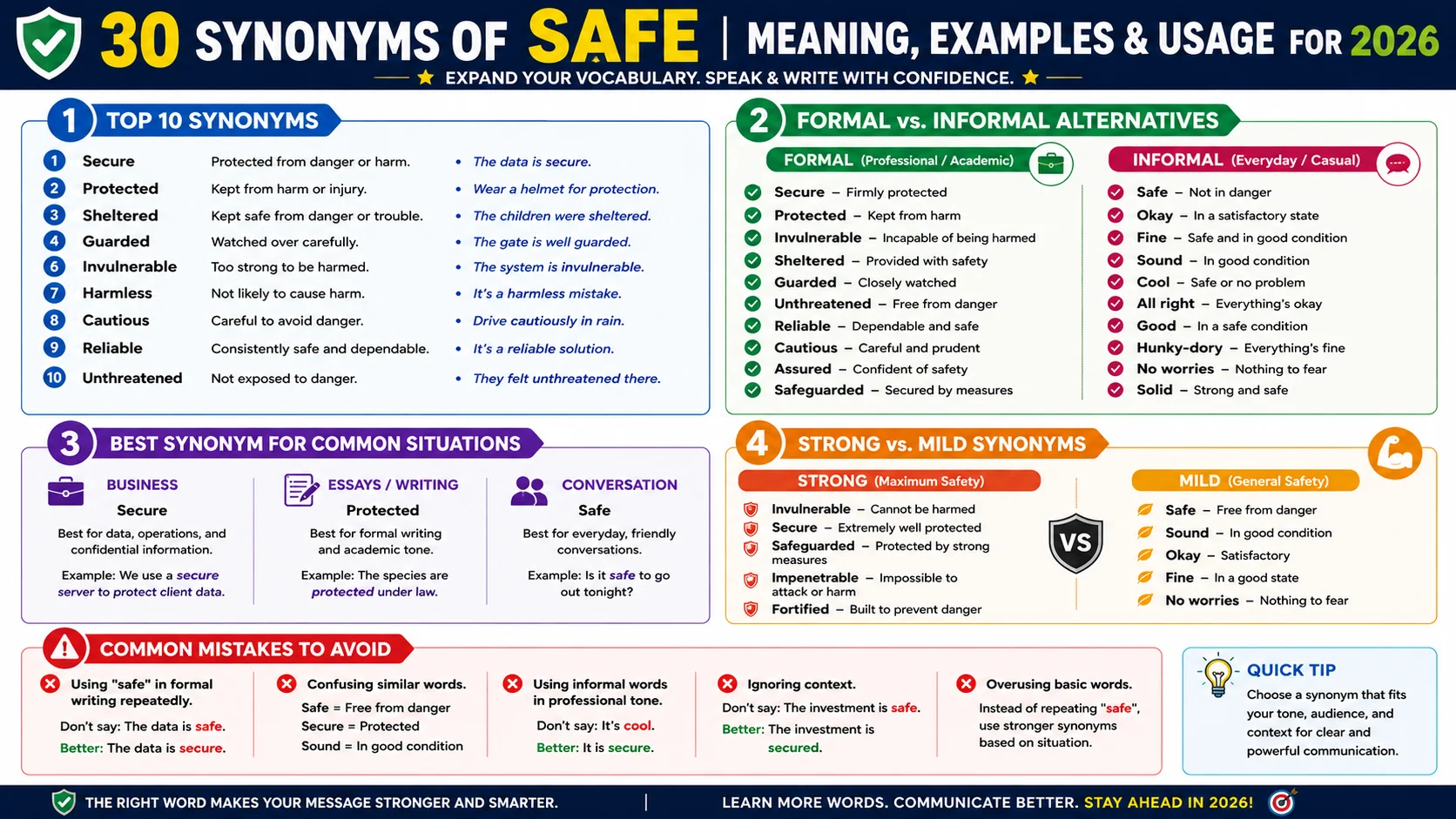
“Safe” means being protected from harm or danger. The best synonyms are secure, protected, unharmed, out of danger, and safe and sound. It can also mean cautious or risk-free. Each synonym has a slightly different meaning, tone, or context. Secure is the most common and natural alternative in everyday English.
Have you ever found yourself using the word “safe” too often? You’re not alone. Safe is a common adjective that English speakers use in many situations. But English has many other words that mean “safe” or something similar.
Learning synonyms of “safe” helps you write better and speak more naturally. You can describe situations more precisely and sound more professional. This guide will teach you the best synonyms of safe for different situations. You’ll learn which words to use in daily conversation, business writing, or academic work.
What Does “Safe” Mean?
Definition
When you say something is safe, you mean it is protected from harm, danger, or risk. Safe can describe a person who is not injured. It can also describe a place that is secure or an action that does not cause harm. For example, you might keep your money in a safe place or feel safe in your home. The word can even describe a boring or unexciting choice that involves no risk.
Pronunciation
| Feature | Value |
|---|---|
| US IPA | /seɪf/ |
| UK IPA | /seɪf/ |
| Syllables | 1 |
| Tip | The sound rhymes with “cafe” or “waif”. Make sure to pronounce the long “a” sound. |
Grammar
| Grammar Feature | Information |
|---|---|
| Part of Speech | Adjective (also a noun and verb) |
| Common Position | Before a noun (a safe place) or after a linking verb (I feel safe) |
| Typical Pattern | safe from + noun (safe from harm); safe to + verb (safe to eat); it is safe + that clause (it is safe to say) |
Example Sentences:
- Keep your passport in a safe place while traveling.
- The children are safe from the storm.
- Is it safe to swim in this river?
Grammar Note: Safe can also be a noun meaning a strong metal box for storing valuable items (like a money safe). As a verb, “to safe” is rare and usually means to secure something.
Word Family
| Word | Part of Speech | Meaning |
|---|---|---|
| Safe | Adjective | Protected from harm or danger |
| Safely | Adverb | In a safe manner |
| Safety | Noun | The condition of being protected |
| Safer | Adjective | Comparative form (more safe) |
| Safest | Adjective | Superlative form (most safe) |
| Unsafe | Adjective | Not safe, dangerous |
25 Synonyms of “Safe”
Secure
Meaning
Firmly fixed or protected so that nothing bad can happen.
Best Used For
Describing places, buildings, or digital information that is well-protected.
Formality: Neutral
Tone: Professional, Neutral
Frequency: ⭐⭐⭐⭐⭐ Very Common
CEFR Level: B1
Example Sentence 1:
You should make your passwords secure to protect your online accounts.
Example Sentence 2:
The building has a secure entrance with a guard at the front desk.
Usage Tip
Use “secure” to describe something that has strong protection. It is a good choice for business and technology topics. Avoid using “secure” to describe people who are not injured. Use “unharmed” or “safe” instead for personal safety.
Protected
Meaning
Kept safe from harm, damage, or danger by someone or something.
Best Used For
Talking about people, animals, or places that receive care and defense.
Formality: Neutral
Tone: Positive, Protective
Frequency: ⭐⭐⭐⭐⭐ Very Common
CEFR Level: B1
Example Sentence 1:
The national park is protected by strict environmental laws.
Example Sentence 2:
Our children must be protected from harmful online content.
Usage Tip
“Protected” often implies that someone or something acts as a guard or shield. It is frequently used in environmental, legal, and parenting contexts. If you want to say something is safe just because of its own strength, “secure” or “sound” might be better.
Unharmed
Meaning
Not hurt or damaged in any way.
Best Used For
Describing people, animals, or objects after a dangerous event.
Formality: Neutral
Tone: Neutral, Relieved
Frequency: ⭐⭐⭐⭐ Common
CEFR Level: B2
Example Sentence 1:
Everyone walked away from the accident unharmed.
Example Sentence 2:
The package arrived unharmed despite the rough delivery.
Usage Tip
“Unharmed” specifically means no physical damage or injury occurred. Native speakers often use it to describe positive outcomes after a negative event. It’s not usually used for abstract situations (like a secure financial plan).
Safe and Sound
Meaning
Completely safe and without any injury or damage.
Best Used For
Telling someone that a person or thing is okay after a journey or dangerous situation.
Formality: Neutral
Tone: Reassuring, Relieved
Frequency: ⭐⭐⭐⭐ Common (idiom)
CEFR Level: B1
Example Sentence 1:
The hikers returned home safe and sound after the snowstorm.
Example Sentence 2:
Don’t worry – your luggage will arrive safe and sound at your hotel.
Usage Tip
This is a common English idiom. It sounds friendly and reassuring. Use it when you want to confirm that someone made it through a potentially dangerous experience. It is more emphatic than just “safe.”
Out of Danger
Meaning
No longer in a situation where you could be hurt or harmed.
Best Used For
Medical emergencies and rescue situations.
Formality: Neutral
Tone: Relieved, Serious
Frequency: ⭐⭐⭐⭐ Common
CEFR Level: B1
Example Sentence 1:
After three days in the hospital, the patient is finally out of danger.
Example Sentence 2:
Move the children out of danger and call the fire department.
Usage Tip
This phrase is often used in health and emergency contexts. It implies that a threat has passed. It is not usually used for general safety (like securing a door).
Intact
Meaning
Complete and not broken, damaged, or harmed.
Best Used For
Objects, buildings, or historical sites that have survived without damage.
Formality: Formal
Tone: Neutral, Impressive
Frequency: ⭐⭐⭐ Moderate
CEFR Level: B2
Example Sentence 1:
The ancient temple is remarkably intact after thousands of years.
Example Sentence 2:
Her reputation remained intact despite the false accusations.
Usage Tip
“Intact” emphasizes that nothing is missing or broken. It is a good word for writing about history, art, or objects. It is more formal than “undamaged” or “unharmed.”
Unscathed
Meaning
Without any injury or damage, often from a dangerous event.
Best Used For
Describing a person who escapes an accident, attack, or disaster.
Formality: Formal
Tone: Neutral, Impressive
Frequency: ⭐⭐⭐ Moderate
CEFR Level: C1
Example Sentence 1:
The driver walked away from the crash unscathed.
Example Sentence 2:
He survived the company layoffs unscathed and kept his job.
Usage Tip
“Unscathed” is more formal than “unharmed.” It often implies the situation was dangerous, yet the person avoided all harm. Use it when you want to emphasize the contrast between the danger and the person’s safety.
Risk-Free
Meaning
Without any risk or chance of danger or loss.
Best Used For
Business, finance, and decisions about making choices.
Formality: Formal
Tone: Neutral, Professional
Frequency: ⭐⭐⭐ Moderate
CEFR Level: B2
Example Sentence 1:
This investment is not completely risk-free, but it is very safe.
Example Sentence 2:
There are no risk-free options, but we can choose the safest one.
Usage Tip
“Risk-free” is common in business and finance. Be careful: in reality, very few things are completely risk-free. Using this word suggests high confidence. It is usually used to compare options.
Cautious
Meaning
Taking care to avoid danger or problems.
Best Used For
Describing a person’s behavior or approach to a situation.
Formality: Neutral
Tone: Careful, Prudent
Frequency: ⭐⭐⭐⭐⭐ Very Common
CEFR Level: B1
Example Sentence 1:
Be cautious when you cross the busy street.
Example Sentence 2:
The company is taking a cautious approach to hiring new staff.
Usage Tip
“Cautious” describes a careful person or action. It is not the same as “safe” because it describes the attitude, not the outcome. A cautious person may still experience harm.
Sound
Meaning
Reliable, strong, and safe.
Best Used For
Money, buildings, or advice that is reliable.
Formality: Formal
Tone: Neutral, Professional
Frequency: ⭐⭐⭐ Moderate
CEFR Level: B2
Example Sentence 1:
This is a sound investment that will protect your money.
Example Sentence 2:
She gave me some sound advice about starting my business.
Usage Tip
“Sound” suggests something is trustworthy and safe based on good quality. It can describe financial plans, decisions, or physical structures (a sound building). It is more formal than “solid.”
Dependable
Meaning
Safe to use or rely on.
Best Used For
People, systems, or equipment that you can trust.
Formality: Neutral
Tone: Positive, Trustworthy
Frequency: ⭐⭐⭐⭐ Common
CEFR Level: B2
Example Sentence 1:
Our car is old but very dependable – it always starts in winter.
Example Sentence 2:
You need a dependable employee to manage the office.
Usage Tip
“Dependable” is about trust and reliability. It suggests safety because you can count on it not to fail. It is a great word for describing people at work.
Trustworthy
Meaning
Safe to trust because you are honest and reliable.
Best Used For
People and sources of information.
Formality: Neutral
Tone: Positive, Honest
Frequency: ⭐⭐⭐⭐ Common
CEFR Level: B2
Example Sentence 1:
Our babysitter is very trustworthy – we never worry about our children.
Example Sentence 2:
Only use trustworthy websites for your academic research.
Usage Tip
“Trustworthy” focuses on honesty and integrity. A trustworthy person is safe to share secrets with or rely on. It’s often used for people in positions of responsibility.
Reliable
Meaning
Safe to use because you can trust it to work well.
Best Used For
Cars, services, or people who are consistent.
Formality: Neutral
Tone: Positive, Professional
Frequency: ⭐⭐⭐⭐⭐ Very Common
CEFR Level: B1
Example Sentence 1:
The train service is fast and reliable for my daily commute.
Example Sentence 2:
I need a reliable person to deliver these packages.
Usage Tip
“Reliable” overlaps with “dependable” and “trustworthy.” “Reliable” is often for things or systems; “trustworthy” is more for people and their honesty. All three imply safety through trust.
Out of Harm’s Way
Meaning
In a safe place away from danger.
Best Used For
Physical safety and parenting.
Formality: Neutral
Tone: Protective, Caring
Frequency: ⭐⭐⭐ Moderate
CEFR Level: B2
Example Sentence 1:
The cat moved her kittens out of harm’s way under the porch.
Example Sentence 2:
Please keep the broken glass out of harm’s way so nobody steps on it.
Usage Tip
This idiom is common in daily conversation, especially when talking about children or pets. It is a friendly way to say “keep safe.”
In Safe Hands
Meaning
Being taken care of by someone you trust to keep you safe.
Best Used For
Healthcare and childcare.
Formality: Neutral
Tone: Reassuring, Caring
Frequency: ⭐⭐⭐ Moderate
CEFR Level: B2
Example Sentence 1:
You can relax – your mother is in safe hands at the hospital.
Example Sentence 2:
I know my son is in safe hands with this amazing teacher.
Usage Tip
This idiom expresses trust in a person’s ability to protect or care for someone. It gives a feeling of comfort and relief.
Vigilant
Meaning
Very careful and watchful to notice possible danger.
Best Used For
Security and safety monitoring.
Formality: Formal
Tone: Serious, Professional
Frequency: ⭐⭐⭐ Moderate
CEFR Level: C1
Example Sentence 1:
The security guard remained vigilant throughout the night.
Example Sentence 2:
Parents should stay vigilant about what their children see online.
Usage Tip
“Vigilant” is more formal and serious than “cautious.” It describes a state of constant watchfulness. Use it in security contexts.
Foolproof
Meaning
So safe and simple that it cannot fail or be used wrongly.
Best Used For
Instructions, systems, and plans.
Formality: Neutral
Tone: Confident, Reassuring
Frequency: ⭐⭐⭐ Moderate
CEFR Level: B2
Example Sentence 1:
This recipe is absolutely foolproof – you can’t mess it up.
Example Sentence 2:
The new security system is foolproof and needs no maintenance.
Usage Tip
Foolproof” means a system is so safe and well-designed that even a foolish person can’t cause a problem. It’s used for instructions, recipes, and technology that are very easy to use.
Warrantied
Meaning
Protected by a formal guarantee that your money will be refunded if something is wrong.
Best Used For
Products and purchases.
Formality: Formal
Tone: Professional, Reassuring
Frequency: ⭐⭐ Moderate
CEFR Level: B2
Example Sentence 1:
This laptop comes fully warrantied for one year against defects.
Example Sentence 2:
You feel warrantied because the store protects your purchase.
Usage Tip
This is a business and consumer term. It is not used in daily conversation. Simply saying “it has a warranty” is more natural.
Harmless
Meaning
Not causing or not able to cause harm.
Best Used For
Food, animals, and substances.
Formality: Neutral
Tone: Reassuring
Frequency: ⭐⭐⭐⭐ Common
CEFR Level: B1
Example Sentence 1:
This snake is completely harmless – don’t be scared of it.
Example Sentence 2:
It was just a harmless joke – nobody was offended.
Usage Tip
“Harmless” is often used to reassure people. It can describe something that looks dangerous but is actually safe. It can also describe a joke or comment that is not meant to hurt.
Innocuous
Meaning
Not causing harm or offense; safe.
Best Used For
Actions, comments, or substances that seem safe.
Formality: Formal
Tone: Neutral, Academic
Frequency: ⭐⭐ Rare
CEFR Level: C1
Example Sentence 1:
At first, his comments seemed innocuous and not worth worrying about.
Example Sentence 2:
The powder is innocuous and safe for household use.
Usage Tip
“Innocuous” is a formal word. It can describe harmful substances that are safe or harmless comments. It is useful in scientific or academic writing.
Impregnable
Meaning
So strong and well-protected that it cannot be broken into or conquered.
Best Used For
Buildings, forts, and strong defenses.
Formality: Formal
Tone: Dramatic, Impressive
Frequency: ⭐ Rare
CEFR Level: C1
Example Sentence 1:
The castle was impregnable, with walls twenty feet thick.
Example Sentence 2:
They built an impregnable defense around their data with high-level encryption.
Usage Tip
“Impregnable” is a strong and vivid word. It is rarely used in everyday conversation. Use it in creative writing or when you want to emphasize extreme protection.
Tried-and-True
Meaning
Proven to be safe and effective through experience.
Best Used For
Methods, strategies, or products that are tested.
Formality: Neutral
Tone: Confident, Traditional
Frequency: ⭐⭐⭐ Moderate
CEFR Level: B2
Example Sentence 1:
This tried-and-true recipe has been in my family for generations.
Example Sentence 2:
Use tried-and-true marketing techniques to sell your products.
Usage Tip
“Tried-and-true” is a common English expression. It describes something that has been used many times and has always worked well. It conveys reliability through history and testing.
Solid as a Rock
Meaning
Very safe, strong, and reliable.
Best Used For
People, structures, and relationships.
Formality: Informal
Tone: Casual, Confident
Frequency: ⭐⭐⭐ Moderate (idiom)
CEFR Level: B2
Example Sentence 1:
My husband is solid as a rock – I can always count on him.
Example Sentence 2:
The business is solid as a rock and will survive any recession.
Usage Tip
This is an English idiom that makes a comparison. It is very casual and friendly. Use it in daily conversation to express strong trust.
Sheltered
Meaning
Protected from harsh experiences or danger.
Best Used For
Childhood and living situations.
Formality: Neutral
Tone: Caring, Protective
Frequency: ⭐⭐⭐ Moderate
CEFR Level: B2
Example Sentence 1:
We lived a sheltered life in the quiet countryside.
Example Sentence 2:
She grew up sheltered from the problems of the real world.
Usage Tip
Sheltered” can have a negative tone if it means someone lacks real-world experience. Be careful of the context. It is often used to describe a protected, comfortable life.
Boring (as a synonym for “unadventurous”)
Meaning
Not exciting or taking no risks; considered safe because it is unexciting.
Best Used For
Criticizing music, movies, or careers that are not risky.
Formality: Informal
Tone: Negative, Critical
Frequency: ⭐⭐⭐⭐ Common
CEFR Level: A2
Example Sentence 1:
The movie was so boring and predictable – they didn’t take any risks.
Example Sentence 2:
He chose a boring but safe career in accounting instead of following his dreams.
Usage Tip
“Boring” is often used to describe something unadventurous. In this context, it means “safe” in a dull way. It’s not a compliment.
Unadventurous
Meaning
Not willing to take risks; always choosing safe options.
Best Used For
Describing people or choices that are not risky.
Formality: Formal
Tone: Neutral, Descriptive
Frequency: ⭐⭐ Rare
CEFR Level: B2
Example Sentence 1:
He leads a quiet, unadventurous life in his hometown.
Example Sentence 2:
The restaurant’s menu is unadventurous, offering only classic dishes.
Usage Tip
“Unadventurous” describes someone who avoids risk and change. It is more neutral than “boring” but still suggests a lack of excitement. It is often used in formal writing.
No-Risk
Meaning
Involving no risk at all.
Best Used For
Describing business offers or choices.
Formality: Neutral
Tone: Confident, Reassuring
Frequency: ⭐⭐⭐⭐ Common
CEFR Level: B2
Example Sentence 1:
The company offers a no-risk trial for the first month.
Example Sentence 2:
This is a no-risk investment guaranteed by the government.
Usage Tip
“No-risk” is a strong phrase. It is often used in marketing and advertising. Very few things in life are truly without risk, so use it carefully.
Synonyms Comparison Table
| Synonym | Best Context | Formality | Tone | Frequency |
|---|---|---|---|---|
| Secure | Protection, Technology | Neutral | Professional | Very Common |
| Protected | Environment, Parenting | Neutral | Positive | Very Common |
| Unharmed | Physical Safety | Neutral | Relieved | Common |
| Safe and Sound | After a Journey | Neutral | Reassuring | Common |
| Out of Danger | Medical Emergencies | Neutral | Serious | Common |
| Intact | Objects, Buildings | Formal | Impressive | Moderate |
| Unscathed | Escape from Danger | Formal | Impressive | Moderate |
| Risk-Free | Business, Finance | Formal | Professional | Moderate |
| Cautious | Behavior | Neutral | Careful | Very Common |
| Sound | Finance, Advice | Formal | Professional | Moderate |
| Dependable | People, Equipment | Neutral | Positive | Common |
| Trustworthy | People, Information | Neutral | Positive | Common |
| Reliable | Systems, Services | Neutral | Positive | Very Common |
| Out of Harm’s Way | Physical Safety | Neutral | Protective | Moderate |
| In Safe Hands | Caregiving | Neutral | Reassuring | Moderate |
| Vigilant | Security | Formal | Serious | Moderate |
| Foolproof | Instructions, Systems | Neutral | Confident | Moderate |
| Harmless | Animals, Food | Neutral | Reassuring | Common |
| Impregnable | Defenses, Forts | Formal | Dramatic | Rare |
| Tried-and-True | Methods, Strategies | Neutral | Confident | Moderate |
| Solid as a Rock | People, Structures | Informal | Casual | Moderate |
| Boring | Art, Careers | Informal | Negative | Very Common |
| Unadventurous | Lifestyle, Choices | Formal | Neutral | Rare |
| No-Risk | Business, Marketing | Neutral | Confident | Common |
Best Synonyms by Situation
| Situation | Best Synonym | Why It Works |
|---|---|---|
| Daily Conversation | Safe and Sound | Natural and friendly; native speakers use it often. |
| Business Email | Secure | Professional; shows careful protection. |
| Academic Writing | Unscathed | Formal and precise; good for essays. |
| School Assignment | Protected | Simple, clear, and accurate. |
| Professional Meeting | Risk-Free | Demonstrates careful planning and analysis. |
| Presentation | Cautious | Shows responsible decision-making. |
| Creative Writing | Intact | Vivid and descriptive for storytelling. |
| Social Media | Safe and Sound | Relatable and reassuring. |
| Movie Review | Boring | Criticizes lack of creativity in a casual way. |
| Book Review | Unadventurous | Formal criticism of a predictable story. |
Formal vs Informal Synonyms
Formal Alternatives
| Synonym | Best Used For |
|---|---|
| Unscathed | Academic and formal writing about disaster survivors. |
| Intact | Describing valuable objects or buildings that survived. |
| Risk-Free | Business and finance documents. |
| Sound | Financial reports and professional advice. |
| Vigilant | Security and safety contexts. |
| Innocuous | Scientific and academic writing. |
| Impregnable | Formal descriptions of strong defenses. |
Neutral Alternatives
| Synonym | Best Used For |
|---|---|
| Secure | General use in professional and everyday contexts. |
| Protected | Most situations where safety is discussed. |
| Unharmed | Reporting on accidents or rescues. |
| Cautious | Describing a careful person. |
| Reliable | Describing people, products, and services. |
| Dependable | Describing trust in people and equipment. |
| Trustworthy | Describing trustworthiness and honesty. |
Informal Alternatives
| Synonym | Best Used For |
|---|---|
| Safe and Sound | Talking to friends and family after a trip. |
| Out of Harm’s Way | Informal conversation about safety. |
| In Safe Hands | Reassuring someone about care. |
| Solid as a Rock | Expressing strong trust in a person. |
| Boring | Criticizing movies, music, or routines. |
| Harmless | Reassuring someone about animals or jokes. |
| Foolproof | Describing simple, easy instructions. |
When choosing a level of formality, match your words to your audience. Use formal synonyms for academic essays and business reports. Use neutral synonyms for emails and general writing. Use informal synonyms with friends and family for casual conversation.
Strong vs Mild Synonyms
Mild
These words are suitable for everyday situations and express low intensity.
- Harmless
- Safe and Sound
- Out of Harm’s Way
- Cautious
- Foolproof
Moderate
More expressive than the original word but still appropriate for most writing.
- Secure
- Protected
- Unharmed
- Reliable
- Dependable
- Trustworthy
- Sound
Strong
High-intensity alternatives that should be used carefully for emphasis.
- Impregnable
- Vigilant
- Unscathed
- Solid as a Rock
Strong synonyms pack more punch. Use them sparingly to avoid sounding too dramatic. Reserve strong words for truly important situations where you need to emphasize extreme safety.
Real-Life Examples
At School:
“The school building is secure with cameras at every entrance.”
In the Office:
“Always keep your passwords secure and never share them with anyone.”
In Business Emails:
“We have received your payment and your order is in safe hands.”
At a Meeting:
“This investment is risk-free because the government guarantees it.”
In Daily Conversation:
“I’m so glad you’re home safe and sound! We were so worried.”
Creative Writing (Books):
“Against all odds, she emerged unscathed from the battlefield.”
Social Media:
“Just landed in Paris! We’re safe and sound after the long flight.”
Academic Writing:
“The medieval cathedral remains remarkably intact after seven centuries of use.”
Common Collocations
| Common Phrase | Better Alternative |
|---|---|
| safe place | secure location; protected area |
| safe environment | secure surroundings; safe and sound atmosphere |
| safe journey | safe and sound travel; unharmed trip |
| safe investment | risk-free investment; sound investment |
| safe bet | foolproof choice; no-risk option |
| safe distance | cautious distance; out of harm’s way distance |
| safe house | secure location; protected property |
| safe driver | cautious driver; reliable driver |
Common Phrases
Better safe than sorry
Meaning: It is better to be careful and avoid danger. A stronger alternative is “It’s wise to be cautious.”
Safe and sound
Meaning: Completely safe. A stronger alternative is “completely unharmed.”
Play it safe
Meaning: Choose the safer option. A stronger alternative is “take a cautious approach.”
On the safe side
Meaning: To be extra careful. A stronger alternative is “to be on the cautious side.”
Keep safe
Meaning: Take care of yourself. A stronger alternative is “stay protected” or “take care.”
Context Guide
| Situation | Best Synonym | Reason |
|---|---|---|
| Essay | Secure | Formal and academic-sounding. |
| Speech | Cautious | Clear and easy to understand. |
| Business Email | Risk-Free | Professional and confident. |
| Novel | Intact | Vivid and descriptive. |
| Presentation | Reliable | Trustworthy and professional. |
| Conversation | Safe and Sound | Friendly and natural. |
| Academic Writing | Unscathed | Formal and precise. |
| Marketing Copy | No-Risk | Persuasive and confident. |
Related Words
Near Synonyms
These words are close in meaning to “safe” but have slightly different uses: secure (strong protection), reliable (trustworthy), cautious (careful behavior), harmless (not dangerous), and protected (kept safe).
Antonyms
Related Adjectives
- Vigilant (watching for danger)
- Prudent (wise and careful)
- Sound (reliable and safe)
- Solid (strong and steady)
- Guarded (protected or careful)
Related Nouns
- Safety (the condition of being safe)
- Security (protection from harm)
- Protection (keeping safe)
- Shelter (a place of safety)
- Sanctuary (a safe place)
- Vault (a safe for valuables)
Related Verbs
- Protect (to keep safe)
- Secure (to make safe)
- Guard (to watch over)
- Safeguard (to protect from harm)
- Shelter (to provide a safe place)
Frequently Asked Questions
What is another word for safe?
Another word for “safe” is secure, protected, or unharmed. The best choice depends on the context, but “secure” is the most common and natural alternative in everyday English.
Which synonym sounds the most professional?
Secure and risk-free sound the most professional. They are common in business writing and formal contexts. Use secure to describe protection, and risk-free to describe safe choices or investments.
What is the strongest synonym for safe?
Impregnable is the strongest synonym, meaning impossible to break into. Unscathed is also strong for describing escape from danger. These words are more dramatic than everyday alternatives.
Which synonym is best for essays?
Unscathed or secure are the best synonyms for essays. They are formal and precise. Intact is also good for describing objects or historical sites that survived.
What’s the difference between safe and secure?
Safe means protected from harm. Secure often means something is firmly fixed or guaranteed to be safe. For example, a building can be secure (well-locked) and you can be safe (unharmed) inside it.
Which synonym is most common in everyday English?
Secure is the most common synonym in everyday conversation and writing. Safe and sound is also very common, especially when talking about someone returning home safely.
What is the opposite of safe?
The opposite of safe is dangerous, unsafe, or insecure . Use dangerous for situations, unsafe for places or actions, and insecure for something not well-protected.
Conclusion
“Safe” is a useful word in English. It describes protection from harm, security, or caution. The best synonyms of safe help you speak and write more precisely. Secure is the most common and natural alternative. Protected works well for describing people and places. Unharmed is perfect for describing escape from danger. Risk-free is best for business and finance.
Context matters when choosing a synonym. Formal writing often calls for unscathed or intact. Daily conversation usually uses safe and sound. Business writing prefers secure or reliable.
Keep this guide handy and you’ll never struggle to find the perfect alternative for safe again. The more you use these words, the more natural they will feel. Start by choosing one or two new synonyms and practice them this week.
