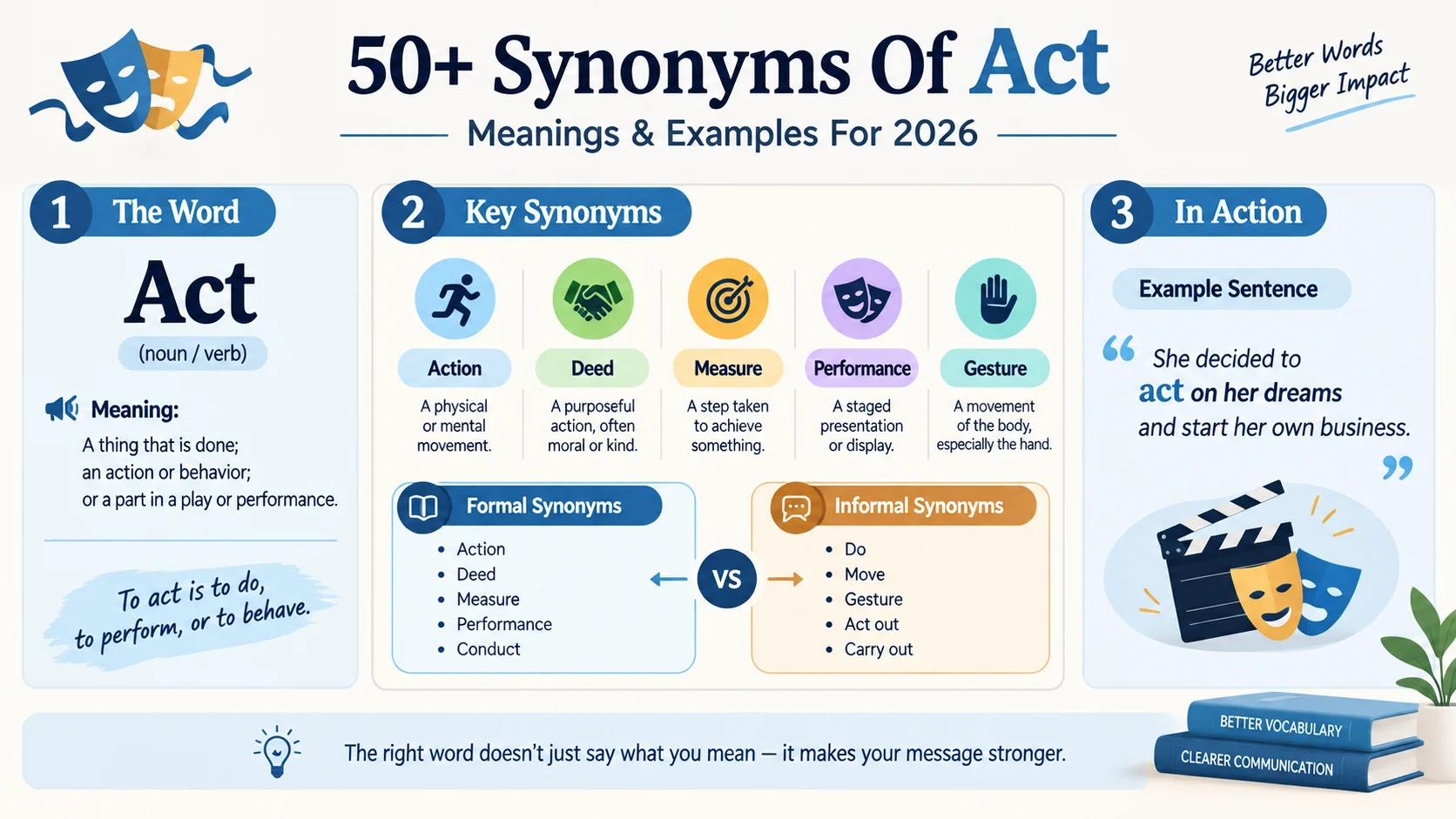
An act is a thing that someone does, or the process of doing something. It can also refer to a law, a performance, or a pretense. The best synonyms depend on your context. For general use, try action or deed. For formal writing, use conduct or measure. For performance, use performance or routine.
Meaning, Tone and Context
The word “act” is a versatile noun and verb with several related meanings. Its core function is to describe an action, a process, or a performance. The tone is generally neutral, but it can shift depending on context and the specific synonym you choose.
1. Simple Definition: An act is something that a person does, a formal decision by a group, or a performance for an audience.
2. Part of Speech: Act is used as both a noun and a verb.
- Noun: “Helping the stranger was a kind act.”
- Verb: “She acted in the school play.”
3. Tone: The tone is usually neutral. It can be positive when describing a kind act, or negative when describing a cruel act. It can also be neutral when describing a legal act.
4. Formality: “Act” is a neutral word. It is appropriate for both casual conversation and formal writing. For very formal contexts, you might choose “measure” or “conduct.”
5. Common Use Cases: You will encounter “act” in many situations.
- Everyday Actions: “Opening the door for someone is a simple act of kindness.”
- Legal Contexts: “The new act was passed by Congress.”
- Performance: “The magician’s act amazed the audience.”
- Pretense: “His bravery was just an act.”
6. Important Word Forms:
- Verb: to act. “He acted quickly to save the child.”
- Noun: action. “The action was swift and decisive.”
- Adjective: active. “She is an active member of the community.”
- Noun: actor. “The actor delivered a powerful performance.”
When and How to Use “Act”
Knowing when to use “act” is about understanding its broad scope. It is a general term for doing something or performing. Here are several scenarios where it is the perfect choice.
- Casual Conversation: To describe something someone did.
Example: “Buying her coffee was a small act of kindness.” - Professional Context: To discuss official decisions or steps taken.
Example: “The committee passed an act to protect the environment.” - Academic Context: To analyze behavior or performance in a formal way.
Example: “The study examined the act of communication in social settings.” - Creative Writing: To describe a performance or a pretense.
Example: “Her whole life was an act, a performance for an audience of one.” - Legal Context: To refer to a specific law or legislation.
Example: “The Clean Air Act was a landmark piece of legislation.” - Social Media Captions: To describe a moment or a performance.
Example: “His reaction was just an act for the cameras.” - Resume or Workplace: To describe achievements and responsibilities.
Example: “I acted as team lead on a major project.” - Storytelling: To describe a crucial moment of decision.
Example: “In the third act of the story, the hero faces his greatest fear.”
Another Word for “Act”
Choosing the best replacement for “act” depends entirely on the context. Here are the most effective single word alternatives categorized by use.
- Professional Writing: “Action” or “Measure.” “The company took swift action to resolve the issue.”
- Academic Writing: “Behavior” or “Conduct.” “The study analyzed the conduct of the participants.”
- Casual Conversation: “Move” or “Step.” “Saying hello was a good first move.”
- Emotional Writing: “Deed” or “Gesture.” “His generous deed will never be forgotten.”
- Creative Writing: “Performance” or “Routine.” “The comedian’s routine had the audience in stitches.”
- Resume or Workplace: “Initiative” or “Contribution.” “I took the initiative to redesign the onboarding process.”
- Social Media Captions: “Stunt” or “Bit.” “His latest stunt on Instagram got millions of views.”
- Stronger Meaning: “Exploit” or “Feat.” “The rescue was a daring feat.”
- Softer Meaning: “Step” or “Gesture.” “Offering a smile is a simple gesture of goodwill.”
When Not to Use “Act”
While “act” is a versatile word, it can be too vague or general in certain situations. Using a more precise synonym can improve clarity and impact.
- When You Need Specificity: If you are talking about a specific action, use a more precise word. “The act was helpful” is vague. “The rescue was heroic” is much clearer.
- When Discussing Legal Matters: “Act” is often used for laws. “The act was important” is less specific than “The legislation was groundbreaking.”
- When Criticizing Directly: Using “act” can sound neutral when you want to be critical. Instead of “The act was wrong,” try “The deed was cruel.”
Example of Precision: Compare these two sentences.
- Vague: “It was an act of kindness.”
- Precise: “It was a generous gesture.”
The second sentence is more specific and paints a clearer picture.
Words Commonly Confused With “Act”
Understanding the differences between these related words will significantly refine your English.
- Act vs. Action: “Act” often refers to a single, completed thing. “Action” refers to the process of doing something. You perform an act, but you take action.
- Act vs. Deed: “Deed” is a more formal and literary word for an act. It often implies a significant or noble action. A “good deed” sounds more impactful than a “good act.”
- Act vs. Behavior: “Behavior” refers to the way a person or animal acts in general. “Act” refers to a specific thing done. His behavior at the party was rude, but his act of leaving early was understandable.
- Act vs. Performance: “Performance” is a specific type of act done for an audience. An “act” can be a performance, but it can also be a simple action.
- Act vs. Measure: “Measure” is a formal word for an action taken by a government or organization. An “act” can be a law, but a “measure” is a step taken to achieve a goal.
- Act vs. Feat: A “feat” is an act that requires great skill, strength, or courage. Climbing the mountain was a remarkable feat.
Best Synonym by Context for “Act”
| Context | Best Synonym | Why It Works | Example |
|---|---|---|---|
| Formal Writing | Measure | It sounds official and precise. | “The government introduced a new measure to reduce pollution.” |
| Academic Writing | Behavior | It is a standard term for observed actions. | “The study focused on the social behavior of the subjects.” |
| Professional/Business | Action | It is clear, direct, and professional. | “We need to take immediate action to fix this problem.” |
| Resume | Initiative | It highlights your proactive attitude. | “I took the initiative to lead the project.” |
| Casual Conversation | Move | It is simple and relatable. | “Asking for help was a smart move.” |
| Creative Writing | Deed | It adds a literary and noble tone. | “His heroic deed saved the village.” |
| Emotional Tone | Gesture | It conveys feeling and intention. | “Her kind gesture meant the world to me.” |
| Strong Intensity | Feat | It suggests courage and skill. | “The escape was a daring feat.” |
| Soft/Moderate Tone | Step | It is gentle and non dramatic. | “Learning a new language is a step toward personal growth.” |
| Social Media Captions | Stunt | It is catchy and often implies a spectacle. | “His latest stunt got a lot of likes.” |
| US/UK Usage | Act (both) | The word is common in both dialects. | “It was an act of bravery.” |
Which Synonym Should You Choose?
Choosing the right word can seem difficult, but this simple guide will help you decide. It is all about matching the word to your goal, audience, and the message you want to send.
- Is your message formal and official? Use “measure,” “conduct,” or “initiative.” These words sound professional and authoritative.
- Is your message casual and friendly? Use “move,” “step,” or “thing.” These are simple and natural.
- Are you describing something brave or impressive? Use “feat,” “exploit,” or “deed.” These words add a sense of drama and achievement.
- Are you describing a performance? Use “performance,” “routine,” or “bit.” These words are specific to entertainment.
- Are you describing a kind or emotional action? Use “gesture” or “deed.” These words carry emotional weight.
- Do you want to be critical or negative? Use “stunt” or “ploy.” Be careful with these, as they carry a negative tone.
Real Life Examples of “Act” in Sentences
Here are examples of how “act” and its stronger synonyms can be used in different real world scenarios.
- School: “The teacher praised the student for his act of honesty.” Stronger: “The teacher praised the student for his honest deed.”
- Workplace: “The company’s act to reduce waste was praised by environmental groups.” Stronger: “The company’s initiative to reduce waste was praised by environmental groups.”
- Writing: “The first act of the play introduces the main characters.” Stronger: “The opening scene of the play introduces the main characters.”
- Conversation: “That was a strange act for him to pull.” Stronger: “That was a strange stunt for him to pull.”
- Social Media: “Her latest post was just an act for attention.” Stronger: “Her latest post was just a ploy for attention.”
- Resume: “I acted as the main point of contact for clients.” Stronger: “I served as the main point of contact for clients.”
- Email: “We need to act quickly to meet the deadline.” Stronger: “We need to take swift action to meet the deadline.”
- Storytelling: “The final act of the story was full of surprises.” Stronger: “The final chapter of the story was full of surprises.”
25 Synonyms for “Act”
The following table lists 25 accurate and practical synonyms for “act.
| Synonym | Simple Meaning | Best Used For | Example Sentence |
|---|---|---|---|
| Action | The process of doing something. | General use, professional. | “The company took decisive action to fix the problem.” |
| Deed | A thing that someone does. | Formal, literary. | “His heroic deed saved the family from the fire.” |
| Behavior | The way a person acts. | Academic, psychology. | “The teacher noted the student’s good behavior.” |
| Performance | An act done for an audience. | Entertainment, creative. | “The magician’s performance amazed the crowd.” |
| Measure | A formal action taken by a group. | Legal, government, formal. | “The new safety measure was implemented immediately.” |
| Step | A single action in a process. | General use, instructional. | “Learning to code is a great step toward a new career.” |
| Move | A planned action toward a goal. | Casual, games, strategy. | “Asking for a raise was a bold move.” |
| Gesture | An action that shows feeling. | Emotional, social. | “Offering to help was a kind gesture.” |
| Initiative | The ability to act without being told. | Professional, resume. | “She showed great initiative by starting the project herself.” |
| Feat | An act requiring great skill or courage. | Storytelling, praise. | “Climbing the mountain was an incredible feat.” |
| Exploit | A brave or daring act. | Adventure, storytelling. | “The explorer’s exploits were legendary.” |
| Stunt | A dangerous or attention seeking act. | Entertainment, social media. | “The actor performed his own stunts in the movie.” |
| Ploy | A cunning act to gain an advantage. | Strategy, criticism. | “His kindness was just a ploy to get what he wanted.” |
| Routine | A set sequence of actions. | Entertainment, daily life. | “The comedian’s routine was hilarious.” |
| Bit | A short performance or joke. | Comedy, casual. | “His comedy bit about airports was very funny.” |
| Turn | A short performance. | Entertainment, theater. | “The singer did a short turn at the charity event.” |
| Conduct | The way a person behaves. | Formal, academic. | “The code of conduct applies to all employees.” |
| Exploit | A bold or daring act. | Historical, adventure. | “The general’s military exploits are still studied today.” |
| Operation | A planned action. | Military, business. | “The rescue operation was a complete success.” |
| Procedure | An established way of doing something. | Medical, professional. | “The safety procedure must be followed at all times.” |
| Transaction | An act of buying or selling. | Business, finance. | “The transaction was completed in under a minute.” |
| Undertaking | A large or important act. | Formal, business. | “Building the bridge was a massive undertaking.” |
| Enactment | The process of making a law. | Legal, government. | “The enactment of the new law was celebrated.” |
| Portrayal | The act of playing a role. | Creative, acting. | “His portrayal of the villain was chilling.” |
| Pretense | An act that is not genuine. | Negative, social. | “Her friendliness was all pretense.” |
Synonym Groups and Usage Differences
Professional vs. Personal Synonyms
In a professional setting, like a business report or a resume, choose “action,” “measure,” or “initiative.” These words sound polished and appropriate. In a personal setting, “move,” “step,” or “gesture” are more natural and friendly. For example, you would tell a colleague “We need to take action,” but a friend “That was a smart move.”
Formal vs. Conversational Synonyms
Formal Synonyms: “Measure,” “conduct,” and “undertaking” are perfect for academic papers, legal documents, or formal speeches.
Conversational Synonyms: “Move,” “step,” and “bit” are the best choices for everyday conversations and emails to friends.
Academic Synonyms
In essays and research papers, “behavior” is a precise and standard term. “Conduct” is also useful for discussing ethical or social actions. “Transaction” is useful in economics and business studies.
Professional and Business Synonyms
“Action” is a safe and professional choice for almost any workplace communication. “Initiative” is effective when discussing proactive behavior. “Measure” is great for discussing official steps taken by a company or government.
Creative or Literary Synonyms
These words add a layer of artistry to your descriptions.
- Deed: Suggests a noble or significant action.
- Feat: Conveys a sense of courage and skill.
- Routine: Perfect for describing a comedic or performance act.
Slang or Modern Synonyms
Stunt” and “bit” are modern and casual synonyms. They are acceptable in social media captions, text messages, and very informal conversations. They should be avoided in academic or professional writing.
Strongest vs. Weaker Synonyms
Here is an intensity scale from mild to strongest:
- Step: Very mild, a small action in a process.
- Move, Gesture: Mild to moderate, planned or emotional actions.
- Act, Action: Moderate, the standard words.
- Deed, Feat: Strong, suggests courage or significance.
- Exploit: Strongest, suggests a daring and impressive act.
Emotional vs. Neutral Synonyms
Emotional Synonyms: “Gesture,” “deed,” and “ploy” all carry emotional weight. “Gesture” is positive, “deed” can be noble, and “ploy” is negative.
Neutral Synonyms: “Action,” “step,” and “procedure” are factual and free of emotional charge.
Antonyms of “Act”
Here are 15 clear antonyms for “act,” which are words that mean the opposite: not doing anything, or preventing action.
| Antonym | Meaning | Example Sentence |
|---|---|---|
| Inaction | Lack of action. | “The government’s inaction on climate change was criticized.” |
| Passivity | The state of not acting. | “His passivity in the meeting was frustrating.” |
| Idleness | The state of being inactive. | “Idleness can lead to boredom.” |
| Rest | A period of inactivity. | “After a long week, she needed a day of rest.” |
| Pause | A temporary stop. | “There was a brief pause in the conversation.” |
| Delay | A period of waiting. | “The delay in the project caused problems.” |
| Omission | The act of leaving something out. | “The omission of his name from the list was an error.” |
| Neglect | Failure to care for something. | “The neglect of the building led to its decay.” |
| Hesitation | The act of pausing before doing something. | “His hesitation cost him the opportunity.” |
| Refusal | The act of saying no. | “Her refusal to help was disappointing.” |
| Abstention | The act of choosing not to do something. | “His abstention from the vote was noted.” |
| Stagnation | The state of not moving or developing. | “The company suffered from years of stagnation.” |
| Inertia | A tendency to do nothing. | “The team’s inertia prevented any progress.” |
| Procrastination | The act of delaying tasks. | “Procrastination is the enemy of success.” |
| Suppression | The act of stopping something. | “The suppression of the protests was condemned.” |
Comparison: “Act” vs. Similar Words
Act vs. Action
Main Difference: “Act” often refers to a single, completed thing. “Action” refers to the process of doing something. You perform an act, but you take action.
Which One Is Stronger: “Action” is stronger because it implies a broader, more deliberate effort.
Which One Is More Formal: Both are neutral, but “action” is more common in professional and formal writing.
Example Sentence with Act: “It was a simple act of kindness.”
Example Sentence with Action: “The company needs to take action immediately.
Act vs. Deed
Main Difference: “Deed” is a more formal and literary word for an act. It often implies a significant or noble action.
Which One Is Stronger: “Deed” is stronger because it carries a sense of moral weight.
Which One Is More Formal: “Deed” is more formal and often used in literature or speeches.
Example Sentence with Act: “Helping the stranger was a good act.”
Example Sentence with Deed: “His good deed will not be forgotten.”
Act vs. Behavior
Main Difference: “Behavior” refers to the way a person acts in general. “Act” refers to a specific thing done.
Which One Is Stronger: “Behavior” is broader and more general.
Which One Is More Formal: “Behavior” is more formal and is standard in academic and professional contexts.
Example Sentence with Act: “His act of defiance shocked everyone.”
Example Sentence with Behavior: “His behavior at the party was unacceptable.”
Act vs. Performance
Main Difference: “Performance” is a specific type of act done for an audience. An “act” can be a performance, but it can also be a simple action.
Which One Is Stronger: “Performance” is more specific and often implies a higher level of skill or preparation.
Which One Is More Formal: Both are neutral, but “performance” is the standard term in entertainment.
Example Sentence with Act: “The magician’s act was entertaining.”
Example Sentence with Performance: “The actor gave a stunning performance.”
Act vs. Measure
Main Difference: “Measure” is a formal word for an action taken by a government or organization. An “act” can be a law, but a “measure” is a step taken to achieve a goal.
Which One Is Stronger: “Measure” is more official and formal.
Which One Is More Formal: “Measure” is more formal and is common in legal and political writing.
Example Sentence with Act: “The act was passed by a narrow margin.”
Example Sentence with Measure: “The government introduced a new measure to boost the economy.”
Act vs. Feat
Main Difference: A “feat” is an act that requires great skill, strength, or courage.
Which One Is Stronger: “Feat” is much stronger and implies extraordinary ability.
Which One Is More Formal: “Feat” is more formal and is often used in storytelling and praise.
Example Sentence with Act: “The rescue was a brave act.”
Example Sentence with Feat: “The rescue was a remarkable feat of bravery.”
Common Phrases and Expressions with “Act”
1. Act of God
Meaning: An event beyond human control, like a natural disaster.
Example Sentence: “The insurance policy did not cover damage from an act of God.”
2. Act of Kindness
Meaning: A kind thing that someone does.
Example Sentence: “Returning the lost wallet was a simple act of kindness.”
3. Act on Impulse
Meaning: To do something suddenly without thinking.
Example Sentence: “He acted on impulse and bought the car.”
4. Act Up
Meaning: To behave badly or malfunction.
Example Sentence: “The children always act up when they are tired.”
5. Act of Congress
Meaning: A difficult or lengthy process.
Example Sentence: “Getting a visa approved felt like an act of Congress.”
6. Get Your Act Together
Meaning: To organize yourself and start performing well.
Example Sentence: “You need to get your act together if you want to pass this class.”
7. Put on an Act
Meaning: To pretend or behave in a way that is not genuine.
Example Sentence: “He is not really sorry. He is just putting on an act.”
8. Balancing Act
Meaning: A situation where you must manage many things at once.
Example Sentence: “Being a working parent is a constant balancing act.”
Common Mistakes to Avoid
1. Using “Act” When a More Precise Synonym Is Better
Mistake: “The company’s act to fix the problem was successful.”
Better: “The company’s initiative to fix the problem was successful.” This is more specific and professional.
2. Confusing “Act” with “Action”
Mistake: “We need to take an act right now.”
Correction: “We need to take action right now.” “Action” is the correct word for the process of doing something.
3. Using a Casual Synonym in Formal Writing
Mistake: “The report analyzed the stunt that the company pulled.”
Better: “The report analyzed the measure that the company implemented.” “Stunt” is too casual for a formal report.
4. Using an Overly Dramatic Synonym for a Simple Situation
Mistake: “Opening the door for her was a heroic feat.”
Better: “Opening the door for her was a kind gesture.” “Feat” is too strong for a simple act of courtesy.
5. Repeating the Same Word Too Often
Mistake: “The act was brave. The act was also necessary. The act saved lives.”
Better: “The action was brave. The decision was also necessary. The deed saved lives.” This variation makes the writing more engaging.
6. Choosing a Synonym with the Wrong Emotional Tone
Mistake: “I appreciated his ploy to help me move.”
Better: “I appreciated his gesture to help me move.” “Ploy” has a negative connotation, while “gesture” is positive.
7. Using Slang in Academic or Professional Writing
Mistake: “The article is a bit about the new policy.”
Better: “The article is a critique of the new policy.” “Bit” is too casual for professional writing.
FAQs
1. What is the best synonym for act?
- The best synonym depends on your context. For general use, “action” is a safe choice. For a formal context, use “measure.” For a performance, use “performance” or “routine.”
2. What is a formal synonym for act?
A formal synonym for act is “measure” or “conduct.” Both are appropriate for formal writing and professional communication.
3. What is an informal synonym for act?
An informal synonym for act is “move” or “stunt.” These words are perfect for everyday conversation and social media captions.
4. What is another word for act in professional writing?
In professional writing, “action” is an excellent choice. “Initiative” is also effective when discussing proactive behavior. “Measure” is useful for discussing official steps.
5. What is the difference between act and action?
An “act” often refers to a single, completed thing. “Action” refers to the process of doing something. You perform an act, but you take action.
6. What is the opposite of act?
The opposite of act is “inaction,” “passivity,” or “rest.” These words describe a state of not doing anything or preventing action.
Conclusion
The word “act” is a short and useful term. It covers everything from a simple deed to a formal law to a theatrical performance. However, choosing the right synonym depends entirely on your context, audience, and the tone you wish to convey.
For a professional setting, “action” or “measure” work well. For a formal context, “conduct” or “undertaking” are excellent choices. In casual conversation, “move” or “step” are natural and friendly. For a creative or literary tone, “deed” or “feat” add depth and drama.
The best advice is to think about your purpose and your audience before you choose a word. Do you want to be formal, casual, dramatic, or precise? Matching your word to your intention will make your communication more effective and your English more precise.
A practical vocabulary tip: Try replacing “act” with a more specific synonym in your writing this week. If you are describing a kind action, use “gesture.” If you are describing a brave action, use “feat.” This small change will significantly improve the clarity and sophistication of your English.
