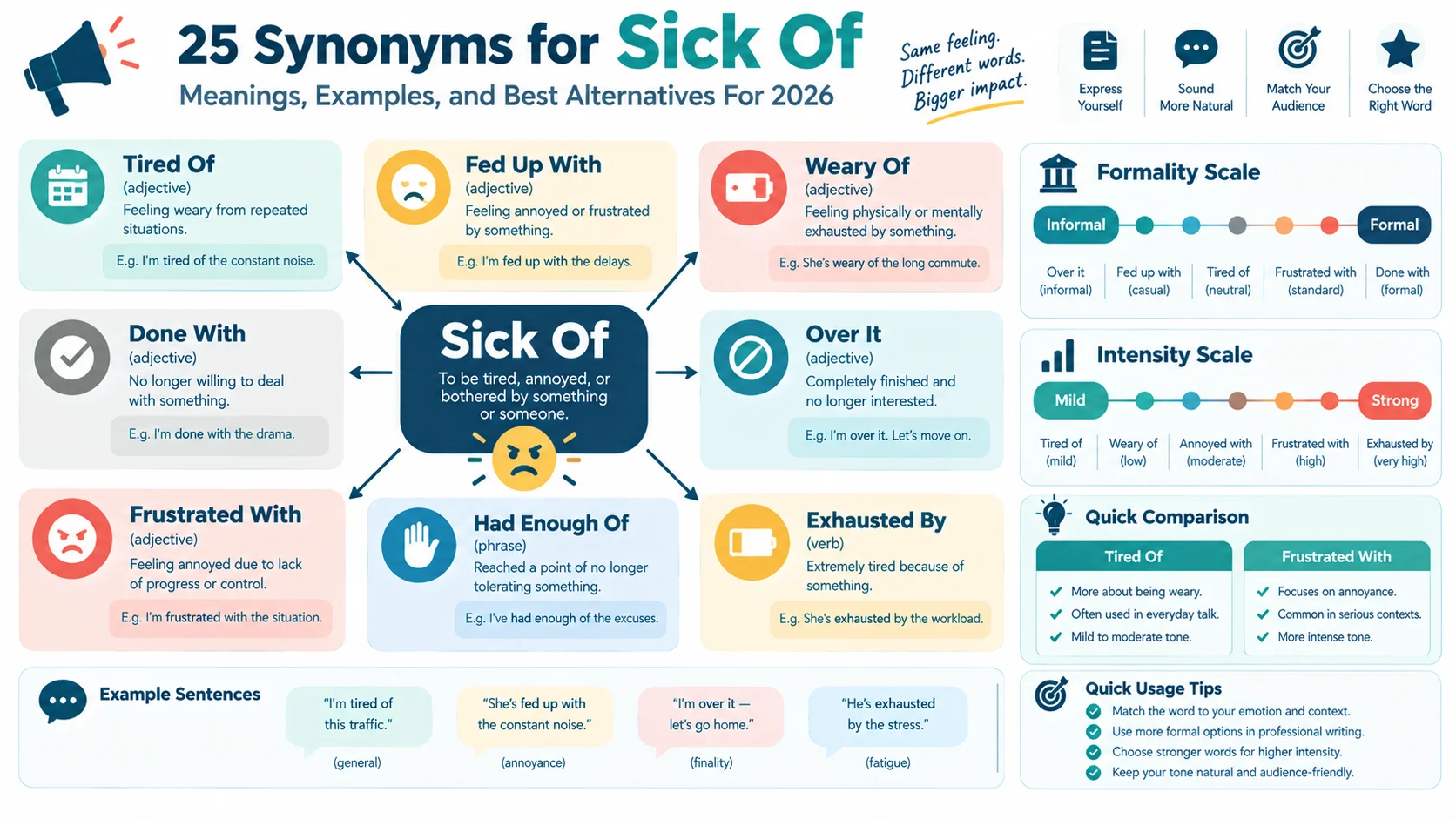
"Of Sick " means feeling tired, annoyed, or frustrated with something because you have experienced it too much. The best synonyms are tired of, fed up with, and sick and tired of. "Tired of" is the most common and neutral alternative.Top 10 Synonyms:
- Tired of
- Fed up with
- Sick and tired of
- Weary of
- Done with
- Over it
- Bored with
- Frustrated with
- Exhausted by
- Had enough of
Each synonym carries a slightly different level of emotion, formality, and intensity. Choosing the right one depends on your situation and how strongly you feel.
Have you ever said “I’m sick of this” and then wondered if there was a better, more precise, or more polite way to express the same feeling?
You are not alone. “Sick of” is a powerful phrase. It shows frustration clearly and quickly. But it is also informal, emotional, and sometimes too strong for certain situations.
Imagine you are writing a complaint email to a company. Or talking to a friend about a repetitive task at work. Or writing a character’s dialogue in a story. Each situation needs a different level of intensity and formality.
This guide will show you exactly which synonym for “sick of” fits every context. You will learn the small differences between “tired of,” “fed up with,” “weary of,” and many other useful expressions. By the end, you will express frustration with precision and control.
What Does “Of Sick ” Mean?
Definition
“Sick of” is an informal phrase that describes a strong feeling of annoyance, boredom, or frustration. You feel sick of something when you have experienced it too many times or for too long.
The feeling usually builds over time. It is not a sudden reaction. You might be sick of a repetitive job, a bad habit, a constant complaint, or a situation that never changes.
The phrase carries real emotional weight. It suggests you have reached your limit. In casual conversation, it is very common. In formal writing, it sounds too emotional and informal.
A closely related phrase is “sick and tired of,” which adds even more emphasis. Both forms mean roughly the same thing, but “sick and tired” sounds stronger.
Pronunciation
US IPA: /sɪk əv/
UK IPA: /sɪk ɒv/
Syllables: 2 (sick of)
Tip: The “s” in “sick” is soft, not sharp. In natural speech, “sick of” often blends together and sounds like “sickov.” The “o” in “of” is short and quick.
Grammar
| Grammar Feature | Information |
|---|---|
| Part of Speech | Adjective + preposition (idiomatic phrase) |
| Common Position | After linking verbs like “am,” “is,” “are,” “was,” “were” |
| Typical Pattern | Subject + be + sick of + noun / pronoun / verb + ing |
Example sentences:
- “I am sick of this rainy weather.”
- “She was sick of hearing the same excuse every day.”
- “We are sick of waiting for a decision.”
Grammar note: “Sick of” is always followed by a noun, a pronoun, or a verb ending in “ing.” You cannot say “sick of to wait.” You say “sick of waiting.” The phrase is almost always used with a form of the verb “be.”
Word Family
| Word | Part of Speech | Meaning |
|---|---|---|
| Sick | Adjective | Ill, or (in this phrase) tired and annoyed |
| Sick of | Idiomatic phrase | Feeling frustrated after too much of something |
| Sickness | Noun | The state of being ill |
| Sicken | Verb | To make someone feel disgusted or ill |
| Sickening | Adjective | Causing disgust or strong dislike |
12 Synonyms of “Sick”
Tired Of
Meaning: Feeling bored or annoyed with something because you have experienced it too often.
Best Used For: Daily conversation, emails, casual writing, professional complaints.
Formality: Neutral
Tone: Negative, Casual, Measured
Frequency: ⭐⭐⭐⭐⭐ Very Common
CEFR Level: A2
Example Sentence 1: “I’m tired of eating the same thing for lunch every day.”
Example Sentence 2: “Customers are tired of waiting on hold for hours.”
Usage Tip: “Tired of” is the safest and most versatile synonym. It works in casual talk, business emails, and even semi-formal writing. It is softer than “sick of” and much more polite. Native speakers use it constantly.
Common Confusion: Tired of vs Tired from. “Tired of” means annoyed or bored. “Tired from” means physically exhausted because of something. “I’m tired of this job” is emotional. “I’m tired from work” is physical.
Fed Up With
Meaning: Feeling completely frustrated and unable to tolerate a situation any longer.
Best Used For: Daily conversation, complaints, informal writing, social media.
Formality: Informal
Tone: Negative, Frustrated, Emotional
Frequency: ⭐⭐⭐⭐⭐ Very Common
CEFR Level: B1
Example Sentence 1: “I’m fed up with the constant delays on this train line.”
Example Sentence 2: “She was fed up with being ignored in meetings.”
Usage Tip: “Fed up with” is stronger and more emotional than “tired of.” It suggests you have reached your limit. It is perfect for expressing real frustration. Avoid it in formal reports or polite customer service messages.
Sick And Tired Of
Meaning: Extremely frustrated and completely worn out by something.
Best Used For: Emotional speech, casual conversation, strong complaints.
Formality: Informal
Tone: Negative, Strong, Emotional
Frequency: ⭐⭐⭐⭐ Common
CEFR Level: B1
Example Sentence 1: “I’m sick and tired of cleaning up after everyone else.”
Example Sentence 2: “Voters are sick and tired of empty promises.”
Usage Tip: This phrase is a stronger version of “sick of.” It doubles the emotional weight. Use it when you want to emphasize that you truly cannot take any more. It is too intense for professional writing.
Weary Of
Meaning: Feeling tired and worn out by something, often after a long time.
Best Used For: Formal writing, literary descriptions, reflective essays, news articles.
Formality: Formal
Tone: Negative, Reflective, Literary
Frequency: ⭐⭐⭐ Moderate
CEFR Level: B2
Example Sentence 1: “The community grew weary of the endless construction noise.”
Example Sentence 2: “She was weary of defending her choices to others.”
Usage Tip: “Weary of” sounds more thoughtful and mature than “sick of.” It suggests emotional exhaustion rather than quick irritation. It works beautifully in essays, editorials, and literary writing. It sounds too formal for casual chat.
Done With
Meaning: Finished with something and no longer willing to continue.
Best Used For: Casual conversation, texts, social media, personal writing.
Formality: Informal
Tone: Negative, Decisive, Casual
Frequency: ⭐⭐⭐⭐ Common
CEFR Level: B1
Example Sentence 1: “I’m done with this project. I need a break.”
Example Sentence 2: “She’s done with people who waste her time.”
Usage Tip: “Done with” is short, direct, and modern. It suggests a clear decision to stop, not just frustration. It is very common in American English. It works well in texts and casual conversation but sounds too blunt for formal writing.
Over It
Meaning: No longer interested in or bothered by something.
Best Used For: Social media, casual conversation, modern writing, texts.
Formality: Informal
Tone: Neutral to Negative, Casual, Modern
Frequency: ⭐⭐⭐⭐ Common
CEFR Level: B1
Example Sentence 1: “I’m so over this drama. Let’s talk about something else.”
Example Sentence 2: “He was over the whole argument and just wanted peace.”
Usage Tip: “Over it” is very modern and casual. It suggests emotional distance, like you have moved on. It is popular on social media and in everyday speech. Avoid it in professional or academic writing.
Bored With
Meaning: Feeling uninterested because something is no longer exciting or new.
Best Used For: Daily conversation, school contexts, casual writing.
Formality: Neutral
Tone: Neutral to Negative, Mild
Frequency: ⭐⭐⭐⭐ Common
CEFR Level: A2
Example Sentence 1: “The kids were bored with the same games every day.”
Example Sentence 2: “I’m bored with my routine and want to try something new.”
Usage Tip: “Bored with” focuses on lack of interest, not frustration. It is milder than “sick of.” Use it when something is simply not exciting anymore. Do not use it when you feel real anger or annoyance.
Frustrated With
Meaning: Feeling annoyed and upset because you cannot change or solve something.
Best Used For: Business emails, professional writing, customer service, reviews.
Formality: Neutral to Formal
Tone: Negative, Professional, Controlled
Frequency: ⭐⭐⭐⭐ Common
CEFR Level: B1
Example Sentence 1: “Many users are frustrated with the app’s slow performance.”
Example Sentence 2: “I’m frustrated with the lack of clear communication from the team.”
Usage Tip: “Frustrated with” is the best choice for professional complaints. It sounds serious but still polite. It works in emails, reviews, and reports. Use it when you want to express dissatisfaction without sounding emotional.
Exhausted By
Meaning: Feeling completely drained and worn out because of something.
Best Used For: Emotional writing, personal reflection, formal complaints, literary descriptions.
Formality: Neutral to Formal
Tone: Negative, Emotional, Deep
Frequency: ⭐⭐⭐ Moderate
CEFR Level: B2
Example Sentence 1: “She was exhausted by the constant pressure at work.”
Example Sentence 2: “The whole team felt exhausted by the endless changes in direction.”
Usage Tip: “Exhausted by” emphasizes emotional and physical tiredness. It is deeper and more serious than “sick of.” Use it when something has drained your energy over time. It works well in personal and reflective writing.
Had Enough Of
Meaning: No longer able or willing to tolerate something.
Best Used For: Daily conversation, complaints, speeches, emotional writing.
Formality: Neutral to Informal
Tone: Negative, Strong, Decisive
Frequency: ⭐⭐⭐⭐ Common
CEFR Level: B1
Example Sentence 1: “I’ve had enough of these constant excuses.”
Example Sentence 2: “The neighbors have had enough of the late-night noise.”
Usage Tip: “Had enough of” is a strong, clear expression. It suggests you are ready to take action or make a change. It works in both casual and semi-formal contexts. It is a good middle ground between “tired of” and “fed up with.”
Can’t Stand
Meaning: Strongly dislike something and find it very difficult to tolerate.
Best Used For: Casual conversation, emotional speech, personal writing.
Formality: Informal
Tone: Negative, Strong, Emotional
Frequency: ⭐⭐⭐⭐⭐ Very Common
CEFR Level: A2
Example Sentence 1: “I can’t stand the way he talks to his employees.”
Example Sentence 2: “She can’t stand waiting in long lines.”
Usage Tip: “Can’t stand” is about strong dislike, not just tiredness. It is very common in everyday English. Use it when something truly bothers you. It is too emotional for formal business writing.
Averse To
Meaning: Having a strong dislike or unwillingness toward something.
Best Used For: Formal writing, academic essays, legal documents, professional reports.
Formality: Formal
Tone: Negative, Neutral, Measured
Frequency: ⭐⭐⭐ Moderate
CEFR Level: C1
Example Sentence 1: “The committee is averse to making rapid changes without proper review.
Example Sentence 2: “She is not averse to hard work when the goal is clear.”
Usage Tip: “Averse to” is formal and less emotional than “sick of.” It suggests a steady dislike rather than frustration. It appears often in academic and legal writing. It is rarely used in casual conversation.
Disenchanted With
Meaning: Feeling disappointed because something did not live up to your hopes.
Best Used For: Formal writing, journalism, reviews, reflective essays.
Formality: Formal
Tone: Negative, Reflective, Disappointed
Frequency: ⭐⭐ Rare
CEFR Level: C1
Example Sentence 1: “Many voters have become disenchanted with the political process.”
Example Sentence 2: “He grew disenchanted with the company after years of broken promises.”
Usage Tip: “Disenchanted with” suggests lost hope or lost belief. It is more thoughtful than angry. Use it in formal writing when you want to describe disappointment with a system, person, or idea. It is not a casual phrase.
Synonyms Comparison Table
| Synonym | Best Context | Formality | Tone | Frequency |
|---|---|---|---|---|
| Tired of | General use | Neutral | Measured | ⭐⭐⭐⭐⭐ |
| Fed up with | Casual complaints | Informal | Frustrated | ⭐⭐⭐⭐⭐ |
| Sick and tired of | Strong complaints | Informal | Very Emotional | ⭐⭐⭐⭐ |
| Weary of | Essays, news writing | Formal | Reflective | ⭐⭐⭐ |
| Done with | Casual talk, texts | Informal | Decisive | ⭐⭐⭐⭐ |
| Over it | Social media, casual | Informal | Modern | ⭐⭐⭐⭐ |
| Bored with | School, daily talk | Neutral | Mild | ⭐⭐⭐⭐ |
| Frustrated with | Business, reviews | Neutral to Formal | Controlled | ⭐⭐⭐⭐ |
| Exhausted by | Personal reflection | Neutral to Formal | Deep | ⭐⭐⭐ |
| Had enough of | Complaints, speeches | Neutral to Informal | Decisive | ⭐⭐⭐⭐ |
| Can’t stand | Casual, emotional | Informal | Strong | ⭐⭐⭐⭐⭐ |
| Averse to | Academic, legal | Formal | Measured | ⭐⭐⭐ |
| Disenchanted with | Journalism, essays | Formal | Disappointed | ⭐⭐ |
Best Synonyms by Situation
| Situation | Best Synonym | Why It Works |
|---|---|---|
| Daily Conversation | Tired of or Fed up with | These sound natural and clear in casual talk. |
| Business Email | Frustrated with | It sounds professional and controlled. |
| Academic Writing | Weary of or Averse to | These are formal and measured. |
| School Assignment | Tired of or Bored with | These are simple and easy to understand. |
| Professional Meeting | Frustrated with | It communicates concern without emotion. |
| Presentation | Had enough of | It is direct and persuasive for audiences. |
| Creative Writing | Weary of or Exhausted by | These add emotional depth and weight. |
| Social Media | Over it or Done with | These are modern and relatable. |
| Movie Review | Exhausted by or Disenchanted with | These suit critical analysis. |
| Book Review | Weary of | It fits reflective literary tone. |
Formal vs Informal Synonyms
Formal Alternatives
| Synonym | Best Used For |
|---|---|
| Weary of | Essays, editorials, reflective writing |
| Averse to | Academic papers, legal documents |
| Disenchanted with | Journalism, political analysis |
| Exhausted by | Formal complaints, personal reflection |
Neutral Alternatives
| Synonym | Best Used For |
|---|---|
| Tired of | Business emails, general writing |
| Frustrated with | Professional communication, reviews |
| Bored with | School writing, general descriptions |
| Had enough of | Speeches, semi-formal complaints |
Informal Alternatives
| Synonym | Best Used For |
|---|---|
| Fed up with | Casual conversation, complaints |
| Sick and tired of | Emotional speech, strong complaints |
| Done with | Texts, casual talk |
| Over it | Social media, modern conversation |
| Can’t stand | Everyday emotional speech |
Choosing the right level of formality: Formal writing calls for “weary of,” “averse to,” or “disenchanted with.” These words sound thoughtful and mature. Neutral contexts welcome “tired of” or “frustrated with.” Casual conversations are perfect for “fed up with,” “done with,” or “over it.” Matching formality to your audience is the key to sounding natural.
Strong vs Mild Synonyms
Mild
These alternatives are gentle and calm.
- Bored with
- Tired of
- Averse to
Moderate
These are clearly negative and expressive.
- Frustrated with
- Weary of
- Had enough of
- Disenchanted with
Strong
These are intense and emotional.
- Fed up with
- Sick and tired of
- Can’t stand
- Exhausted by
How intensity changes meaning: Mild words like “bored with” describe simple lack of interest. Moderate words like “frustrated with” show real annoyance. Strong words like “fed up with” and “sick and tired of” express deep emotion and reached limits. Choose intensity based on how serious the situation truly is.
Real-Life Examples
School Context:
“The students were tired of the same homework routine every week. Some even said they were fed up with the repetitive assignments.”
Office Context:
“Our team is frustrated with the constant changes in project scope. Many of us have had enough of the unclear instructions.”
Business Email:
“Many customers have expressed that they are frustrated with the delay in delivery times. We are working to resolve this issue quickly.”
Professional Meeting:
“I think we’re all tired of revisiting the same problem without a solution. Let’s make a decision today.”
Presentation:
“Consumers today are fed up with hidden fees and confusing pricing. They want transparency and honesty.”
Daily Conversation:
“I’m so over this rainy weather. I just want one sunny day.”
Social Media:
“Officially done with Mondays that feel like they last three days. 😩 #mood #overit”
Creative Writing:
“After years of the same struggle, she had grown weary of hoping. The endless waiting had finally worn her down.”
Common Collocations
| Common Phrase | Better Alternative |
|---|---|
| Sick of waiting | Tired of waiting, Fed up with waiting |
| Sick of hearing | Tired of hearing, Weary of hearing |
| Sick of it | Over it, Done with it |
| Sick and tired | Fed up, Exhausted |
| Sick of the same thing | Bored with the routine |
| Sick of complaining | Tired of complaining |
| Sick of excuses | Fed up with excuses |
| Sick of drama | Over the drama |
Common Phrases
Sick and tired
Meaning: Extremely frustrated and worn out.
Better alternative: “Fed up” or “Exhausted.”
Example: “I’m sick and tired of being blamed for things I didn’t do.”
Sick to death of
Meaning: Completely and utterly frustrated with something.
Better alternative: “Absolutely fed up with.”
Example: “She was sick to death of hearing the same song on the radio.”
Sick of the sight of
Meaning: Unable to tolerate seeing something any longer.
Better alternative: “Can’t stand the sight of.”
Example: “After months of renovation, I’m sick of the sight of paint buckets.”
Fed up to the back teeth
Meaning: A British expression for being extremely frustrated.
Better alternative: “Completely fed up.”
Example: “He was fed up to the back teeth with the endless paperwork.”
Context Guide
| Situation | Best Synonym | Reason |
|---|---|---|
| Essay | Weary of | Formal and reflective |
| Speech | Had enough of | Direct and persuasive |
| Business Email | Frustrated with | Professional and controlled |
| Novel | Exhausted by | Adds emotional depth |
| Presentation | Fed up with | Energetic and relatable |
| Conversation | Tired of | Natural and simple |
| Academic Writing | Averse to | Precise and measured |
| Marketing Copy | Tired of | Relatable and clear |
Related Words
Near Synonyms
Annoyed, irritated, frustrated, weary, bothered
These words describe related negative feelings. “Annoyed” is milder. “Irritated” is sharper. “Frustrated” focuses on blocked goals.
Antonyms
- Content
- Satisfied
- Pleased
- Patient
- Tolerant
- Enthusiastic
Related Adjectives
- Weary
- Fed up
- Frustrated
- Annoyed
- Exhausted
Related Nouns
- Frustration
- Annoyance
- Weariness
- Exhaustion
- Impatience
Related Verbs
- Tolerate
- Endure
- Put up with
- Bear
Frequently Asked Questions
What is another word for sick of?
The most common alternatives are tired of, fed up with, and weary of. “Tired of” is the safest and most neutral choice. “Fed up with” is stronger and more emotional. “Weary of” sounds more formal and reflective.
Which synonym sounds the most professional?
“Frustrated with” sounds the most professional. It expresses dissatisfaction without sounding overly emotional. “Weary of” and “averse to” also work well in formal business and academic writing.
What is the strongest synonym for sick of?
“Sick and tired of” and “can’t stand” are the strongest. Both express intense, emotional frustration. “Fed up with” is also strong but slightly more common in everyday speech.
Which synonym is best for essays?
“Weary of” is the best choice for essays. It sounds thoughtful, formal, and mature. “Disenchanted with” also works well for analytical writing about disappointment or lost hope.
What’s the difference between tired of and sick of?
Both mean feeling frustrated after too much of something. “Sick of” is more informal and emotional. “Tired of” is softer, more neutral, and works in more situations, including polite professional writing.
Which synonym is most common in everyday English?
“Tired of” and “fed up with” are the most common in everyday English. “Tired of” works in almost any casual situation. “Fed up with” is used when the frustration is stronger.
What is the opposite of sick of?
The opposite of “sick of” is content, satisfied, or pleased. If you enjoy something and want more of it, you are not sick of it. You might even say you “can’t get enough of it.”
Conclusion
“Sick of” is a strong, informal way to express frustration after too much of something. It works perfectly in casual conversation but sounds too emotional for formal writing.
The best synonym depends on your context. Choose “tired of” for general use. Choose “fed up with” when the frustration is strong. Choose “frustrated with” in professional settings. Choose “weary of” or “averse to” in formal and academic writing. Choose “done with” or “over it” for modern, casual conversations.
Tone and formality matter just as much as meaning. A phrase that sounds natural in a text may sound unprofessional in a business email. Always think about your reader before you choose.
The next time you feel frustrated, pause and pick the word that fits your situation best. Small vocabulary choices make a big difference in how you sound. Keep practicing, and your English will grow stronger every day.
