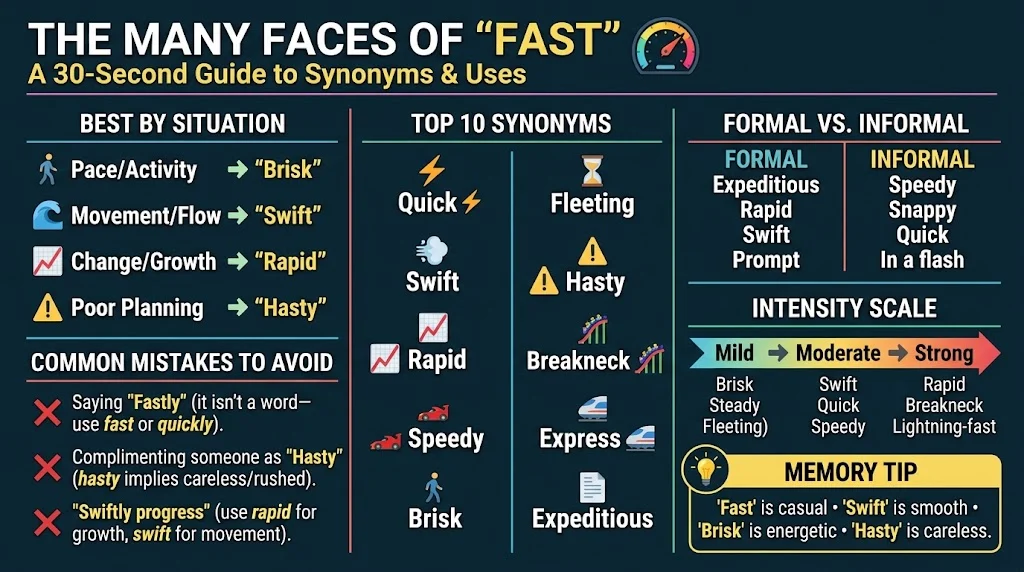
Rapid means happening very quickly or moving with great speed. The best synonyms depend on context: use fast for everyday speed, swift for smooth movement, quick for short actions, and speedy for informal situations. Swift is the most common formal alternative.Top 10 Synonyms:
- Fast
- Quick
- Swift
- Speedy
- Brisk
- Hasty
- Fleet
- Prompt
- Accelerated
- Express
Every synonym has a slightly different meaning, tone, or context. The right choice depends on how formal your writing is and what kind of speed you are describing.
Have you ever tried to describe how fast something happens and found yourself stuck on the same word?
You write “rapid growth” in one sentence, “rapid change” in the next, and “rapid pace” after that. Soon your entire paragraph sounds like a broken record.
This happens to students, professionals, and even experienced writers. “Rapid” is a useful, flexible word. But it is not the only option. English offers dozens of ways to describe speed, each with its own flavor and formality.
Imagine you are writing a business report about sales growth. Or a news article about a sudden change. Or a story about a character running through a forest. Each situation calls for a different synonym.
This guide will show you exactly which word to use in every context. You will learn the small differences between fast, swift, quick, brisk, hasty, and many other useful words. By the end, you will describe speed with precision and confidence.
What Does “Rapid” Mean?
Definition
“Rapid” describes something that happens very quickly or moves with great speed. It is a formal, neutral word that fits both physical movement and abstract change.
You can talk about rapid growth in a company, rapid movement of a river, or rapid changes in technology. The word suggests speed that is noticeable and often impressive.
- Unlike “quick,” which usually describes short actions, “rapid” often describes ongoing or repeated speed. Rapid growth continues over time. Rapid breathing repeats again and again.
- “Rapid” also sounds slightly more formal than “fast” or “quick.” This is why it appears so often in news reports, business writing, and academic texts.
Pronunciation
US IPA: /ˈræp.ɪd/
UK IPA: /ˈræp.ɪd/
Syllables: 2 (rap-id)
Tip: Stress the first syllable. The “a” sounds like the “a” in “cat,” not like the “a” in “father.”
Grammar
| Grammar Feature | Information |
|---|---|
| Part of Speech | Adjective |
| Common Position | Before a noun, or after linking verbs like “is,” “was,” “seems” |
| Typical Pattern | Rapid + noun (rapid growth) OR noun + is/was + rapid (the change was rapid) |
Example sentences:
- “The company experienced rapid growth over the past year.”
- “Her heartbeat was rapid after the long run.”
- “Technology is changing at a rapid pace.”
Grammar note: “Rapid” is almost always used before a noun. It is rarely used after a linking verb in everyday speech, though it is grammatically correct. The adverb form is “rapidly.” You say “The situation changed rapidly,” not “The situation changed rapid.”
Word Family
| Word | Part of Speech | Meaning |
|---|---|---|
| Rapid | Adjective | Happening very quickly or moving with great speed |
| Rapidly | Adverb | In a very quick way |
| Rapidity | Noun | The quality of being very fast |
| Rapidness | Noun | The state of being rapid (less common) |
| Ultra-rapid | Adjective | Extremely fast (used in technical contexts) |
12 Synonyms of “Rapid”
Fast
Meaning: Moving or happening at high speed. It is the most common and general word for speed.
Best Used For: Daily conversation, casual writing, sports, all general contexts.
Formality: Neutral to Informal
Tone: Neutral, Direct
Frequency: ⭐⭐⭐⭐⭐ Very Common
CEFR Level: A1
Example Sentence 1: “That car is really fast.”
Example Sentence 2: “She’s a fast learner and picks up new skills quickly.”
Usage Tip: “Fast” is the safest choice in everyday English. It works for people, vehicles, processes, and learning. Use “rapid” instead when you want a more formal or technical tone. Native speakers use “fast” constantly in speech.
Quick
Meaning: Done in a short amount of time. It often describes brief actions or responses.
Best Used For: Daily conversation, instructions, emails, casual writing.
Formality: Neutral to Informal
Tone: Neutral, Friendly
Frequency: ⭐⭐⭐⭐⭐ Very Common
CEFR Level: A1
Example Sentence 1: “Let’s take a quick break before we continue.”
Example Sentence 2: “She gave a quick answer without thinking too much.”
Usage Tip: “Quick” focuses on short duration. “Rapid” focuses on high speed. A quick meal takes little time. A rapid heartbeat happens at high speed. Use “quick” for short actions and “rapid” for ongoing or repeated speed.
Common Confusion: Quick vs Fast. “Quick” usually describes short actions. “Fast” describes high speed of movement. You take a quick shower, but you drive a fast car.
Swift
Meaning: Happening quickly and smoothly, often without delay.
Best Used For: Formal writing, news reports, literature, professional communication.
Formality: Formal to Neutral
Tone: Positive, Smooth, Decisive
Frequency: ⭐⭐⭐⭐ Common
CEFR Level: B2
Example Sentence 1: “The government took swift action to address the crisis.”
Example Sentence 2: “Her swift response impressed the entire team.”
Usage Tip: “Swift” sounds elegant and decisive. It works well in news writing and formal reports. It often implies that the speed was helpful or impressive. Avoid using it for clumsy or chaotic speed.
Speedy
Meaning: Very fast, often in a helpful or efficient way.
Best Used For: Casual conversation, customer service, informal writing, recovery.
Formality: Informal
Tone: Positive, Friendly, Light
Frequency: ⭐⭐⭐⭐ Common
CEFR Level: B1
Example Sentence 1: “Thanks for the speedy reply to my email.”
Example Sentence 2: “We wish you a speedy recovery after your surgery.”
Usage Tip: “Speedy” sounds friendly and positive. It is perfect for customer service and personal messages. It can sound slightly informal in academic or technical writing, where “rapid” or “swift” fits better.
Brisk
Meaning: Quick and energetic, often describing movement, pace, or weather.
Best Used For: Descriptions of walking, business activity, weather, and atmosphere.
Formality: Neutral
Tone: Positive, Energetic, Fresh
Frequency: ⭐⭐⭐ Moderate
CEFR Level: B2
Example Sentence 1: “We took a brisk walk around the park before breakfast.”
Example Sentence 2: “Business was brisk during the holiday season.”
Usage Tip: “Brisk” adds energy to your writing. It works for movement, business activity, and cold weather. It suggests speed that is healthy and refreshing, not rushed or stressful.
Hasty
Meaning: Done too quickly, often without enough thought or care.
Best Used For: Warnings, criticism, descriptions of mistakes, storytelling.
Formality: Neutral
Tone: Negative, Critical, Cautionary
Frequency: ⭐⭐⭐⭐ Common
CEFR Level: B2
Example Sentence 1: “Don’t make a hasty decision you might regret later.”
Example Sentence 2: “His hasty departure left everyone confused.”
Usage Tip: “Hasty” carries a negative tone. It means the speed caused problems. Use it when you want to criticize rushed action. Do not use it as a simple replacement for “rapid” in positive contexts.
Fleet
Meaning: Moving very quickly and lightly. It is often used in literary descriptions.
Best Used For: Poetry, storytelling, literary writing, descriptions of animals or athletes.
Formality: Formal to Literary
Tone: Poetic, Elegant, Positive
Frequency: ⭐⭐ Rare
CEFR Level: C1
Example Sentence 1: “The fleet deer disappeared into the forest within seconds.”
Example Sentence 2: “She was fleet of foot and won every race.”
Usage Tip: “Fleet” is beautiful but rare. It works best in creative writing and poetry. It often describes graceful, light movement. Avoid it in business or technical writing where it would sound out of place.
Prompt
Meaning: Done quickly and without delay, especially in response to a request.
Best Used For: Business writing, customer service, formal communication, professional emails.
Formality: Formal to Neutral
Tone: Professional, Reliable, Positive
Frequency: ⭐⭐⭐⭐ Common
CEFR Level: B2
Example Sentence 1: “Thank you for your prompt response to our inquiry.”
Example Sentence 2: “The staff provided prompt service throughout our visit.”
Usage Tip: “Prompt” emphasizes timeliness, not raw speed. It means you acted without unnecessary delay. It is very common in business writing. Use it when reliability matters more than sheer velocity.
Accelerated
Meaning: Made faster than usual, often through effort or design.
Best Used For: Business reports, academic writing, technology, strategic planning.
Formality: Formal
Tone: Professional, Technical, Neutral
Frequency: ⭐⭐⭐⭐ Common
CEFR Level: B2
Example Sentence 1: “The company announced an accelerated timeline for the product launch.”
Example Sentence 2: “Climate change has accelerated in recent decades.”
Usage Tip: “Accelerated” suggests that something was deliberately made faster. It is common in business and science. Use it when speed was increased by an external force or plan, not when speed is natural.
Express
Meaning: Designed to be faster than normal, often for a specific purpose.
Best Used For: Transportation, delivery services, business communication.
Formality: Neutral
Tone: Practical, Efficient, Neutral
Frequency: ⭐⭐⭐⭐ Common
CEFR Level: B1
Example Sentence 1: “We sent the documents by express mail to meet the deadline.”
Example Sentence 2: “The express train gets you there in half the time.”
Usage Tip: “Express” describes services or routes designed for speed. It is not a general synonym for “rapid.” Use it for trains, mail, checkout lines, and delivery services. It always implies a comparison to a slower standard option.
Snappy
Meaning: Quick and lively, sometimes with a bit of style or attitude.
Best Used For: Casual conversation, marketing, social media, creative writing.
Formality: Informal
Tone: Playful, Energetic, Modern
Frequency: ⭐⭐⭐ Moderate
CEFR Level: B2
Example Sentence 1: “Let’s keep the meeting snappy and finish in twenty minutes.”
Example Sentence 2: “The ad had a snappy slogan that everyone remembered.”
Usage Tip: “Snappy” is fun and modern. It works well in marketing and casual writing. It suggests speed with style. Avoid it in formal reports, academic essays, or serious news writing.
Meteoric
Meaning: Extremely fast, like a meteor falling from the sky. Often describes rise or success.
Best Used For: Business journalism, storytelling, dramatic descriptions of success or change.
Formality: Formal to Literary
Tone: Dramatic, Positive, Impressive
Frequency: ⭐⭐ Rare
CEFR Level: C1
Example Sentence 1: “Her meteoric rise to fame surprised everyone in the industry.”
Example Sentence 2: “The startup experienced meteoric growth in its first year.”
Usage Tip: “Meteoric” is dramatic and rare. It almost always describes a rise, growth, or success. It suggests speed that is sudden and spectacular. Do not use it for ordinary speed like walking or typing.
Synonyms Comparison Table
| Synonym | Best Context | Formality | Tone | Frequency |
|---|---|---|---|---|
| Fast | General use, all contexts | Neutral to Informal | Direct | ⭐⭐⭐⭐⭐ |
| Quick | Short actions, casual talk | Neutral to Informal | Friendly | ⭐⭐⭐⭐⭐ |
| Swift | News, formal reports, literature | Formal to Neutral | Decisive | ⭐⭐⭐⭐ |
| Speedy | Casual, customer service | Informal | Positive | ⭐⭐⭐⭐ |
| Brisk | Walking, business, weather | Neutral | Energetic | ⭐⭐⭐ |
| Hasty | Warnings, criticism | Neutral | Negative | ⭐⭐⭐⭐ |
| Fleet | Poetry, literary writing | Formal to Literary | Poetic | ⭐⭐ |
| Prompt | Business, customer service | Formal to Neutral | Reliable | ⭐⭐⭐⭐ |
| Accelerated | Business, science, strategy | Formal | Technical | ⭐⭐⭐⭐ |
| Express | Transport, delivery | Neutral | Practical | ⭐⭐⭐⭐ |
| Snappy | Marketing, casual talk | Informal | Playful | ⭐⭐⭐ |
| Meteoric | Journalism, dramatic writing | Formal to Literary | Dramatic | ⭐⭐ |
Best Synonyms by Situation
| Situation | Best Synonym | Why It Works |
|---|---|---|
| Daily Conversation | Fast or Quick | These are simple, natural, and widely understood. |
| Business Email | Prompt or Swift | These sound professional and reliable. |
| Academic Writing | Rapid or Accelerated | These are precise and appropriate for formal research. |
| School Assignment | Fast or Quick | These are clear and easy for teachers to accept. |
| Professional Meeting | Swift or Prompt | These communicate efficiency and reliability. |
| Presentation | Rapid or Accelerated | These sound data-driven and professional. |
| Creative Writing | Fleet or Meteoric | These add imagery and dramatic impact. |
| Social Media | Snappy or Speedy | These are fun, modern, and shareable. |
| Movie Review | Fast or Brisk | These describe pacing naturally. |
| Book Review | Swift or Brisk | These describe narrative flow well. |
Formal vs Informal Synonyms
Formal Alternatives
| Synonym | Best Used For |
|---|---|
| Swift | News reports, official statements, formal writing |
| Prompt | Business correspondence, customer service |
| Accelerated | Business reports, scientific writing |
| Meteoric | Business journalism, literary analysis |
Neutral Alternatives
| Synonym | Best Used For |
|---|---|
| Rapid | News, business, academic, general writing |
| Fast | General use in most contexts |
| Brisk | Descriptions of pace and activity |
| Express | Transportation and delivery contexts |
Informal Alternatives
| Synonym | Best Used For |
|---|---|
| Quick | Casual conversation, short actions |
| Speedy | Friendly messages, customer service |
| Snappy | Social media, marketing, casual talk |
Choosing the right level of formality: Always match your word to your audience. A formal business report calls for “swift,” “prompt,” or “accelerated.” A text to a friend welcomes “quick” or “speedy.” When unsure, “fast” and “rapid” are safe in almost any situation.
Strong vs Mild Synonyms
Mild
These alternatives describe normal, everyday speed.
- Fast
- Quick
- Brisk
Moderate
These are more expressive and often more formal.
- Rapid
- Swift
- Speedy
- Prompt
Strong
These describe extreme or dramatic speed.
- Accelerated
- Meteoric
- Express
How intensity changes meaning: Mild words describe ordinary speed without much emphasis. Moderate words add energy or professionalism. Strong words suggest speed that is unusual, impressive, or even spectacular. Use strong words for standout moments, not for routine descriptions.
Real-Life Examples
School Context:
“The teacher was impressed by the student’s rapid improvement in math. She had made swift progress since the start of the semester.”
Office Context:
“Our team needs to respond to client emails in a prompt manner. A speedy reply often makes the difference between winning and losing a deal.”
Business Email:
“Thank you for your prompt response. We appreciate your swift attention to this matter and look forward to an accelerated timeline.”
Professional Meeting:
“We’re seeing rapid changes in customer behavior. We need a brisk approach to keep up with the market.”
Presentation:
“The chart shows accelerated growth over the last two quarters. This meteoric rise is unlike anything we’ve seen before.”
Daily Conversation:
“Let’s take a quick coffee break before we continue. I need a fast recharge.”
Social Media:
“Snappy tips for a speedy morning routine. Save this for later! ⚡”
Creative Writing:
“The fleet fox darted through the tall grass. Its movement was so swift that the hunter never saw it disappear.”
Common Collocations
| Common Phrase | Better Alternative |
|---|---|
| Rapid growth | Accelerated growth, Explosive growth |
| Rapid change | Swift change, Dramatic change |
| Rapid pace | Brisk pace, Breakneck pace |
| Rapid response | Prompt response, Swift response |
| Rapid decline | Sharp decline, Steep decline |
| Rapid heartbeat | Racing heartbeat, Pounding heartbeat |
| Rapid development | Accelerated development, Fast-tracked development |
| Rapid increase | Sharp increase, Steep increase |
Common Phrases
In rapid succession
Meaning: Happening one after another very quickly.
Better alternative: “In quick succession” or “Back to back.”
Example: “The team won three games in rapid succession.”
At a rapid pace
Meaning: Happening very quickly over time.
Better alternative: “At breakneck speed” or “At full speed.”
Example: “Technology is evolving at a rapid pace.”
Rapid fire
Meaning: A series of things happening very quickly, one after another.
Better alternative: “Rapid succession” or “Machine-gun style.”
Example: “The reporter asked rapid fire questions during the press conference.”
Swift as an arrow
Meaning: Extremely fast and direct.
Better alternative: “Lightning fast” or “Quick as a flash.”
Example: “Her reply came swift as an arrow, without a moment’s hesitation.”
Context Guide
| Situation | Best Synonym | Reason |
|---|---|---|
| Essay | Rapid or Accelerated | Formal and precise |
| Speech | Swift or Prompt | Clear and decisive |
| Business Email | Prompt or Swift | Professional and reliable |
| Novel | Fleet or Swift | Literary and atmospheric |
| Presentation | Rapid or Accelerated | Data-friendly and credible |
| Conversation | Fast or Quick | Natural and simple |
| Academic Writing | Rapid or Accelerated | Objective and technical |
| Marketing Copy | Snappy or Speedy | Catchy and modern |
Related Words
Near Synonyms
Quick, fast, swift, speedy, brisk, hasty
These words all describe speed. “Quick” focuses on short time. “Swift” adds smoothness. “Brisk” adds energy.
Antonyms
- Slow
- Sluggish
- Gradual
- Leisurely
- Delayed
- Unhurried
- Related Adjectives
- Sudden
- Instant
- Immediate
- Abrupt
- Accelerating
- Related Nouns
- Speed
- Pace
- Velocity
- Momentum
- Acceleration
- Related Verbs
- Rush
- Hurry
- Dash
- Sprint
- Accelerate
Frequently Asked Questions
What is another word for rapid?
The most common alternatives are fast, quick, swift, and speedy. “Fast” is the safest and most natural choice in everyday English. “Swift” works best in formal and professional writing.
Which synonym sounds the most professional?
“Swift” and “prompt” sound the most professional. Both appear often in business writing and official communication. “Accelerated” is the best choice for technical and strategic reports.
What is the strongest synonym for rapid?
Meteoric” is the strongest synonym. It describes spectacular, dramatic speed. “Accelerated” and “express” are also strong. Use these words for standout moments rather than routine descriptions.
Which synonym is best for essays?
“Rapid” and “accelerated” work best in academic essays. Both sound objective and precise. “Swift” also works well in formal writing when you want to describe decisive action.
What’s the difference between rapid and quick?
“Rapid” describes ongoing or repeated high speed, like rapid growth or a rapid heartbeat. “Quick” describes short, brief actions, like a quick shower or a quick reply.
Which synonym is most common in everyday English?
“Fast” is the most common word for speed in everyday English. “Quick” is also extremely common, especially for short actions. “Rapid” sounds more formal and appears less often in casual conversation.
What is the opposite of rapid?
The opposite of rapid is slow. Other useful opposites include sluggish, gradual, and leisurely. “Gradual” is the best academic opposite because it describes slow change over time.
Conclusion
“Rapid” is a clean, formal word for speed. It works beautifully in business reports, news writing, and academic essays. But it is not the only option, and using it repeatedly weakens your writing.
- The best synonym depends on your context. Choose “fast” or “quick” for everyday situations. Choose “swift” or “prompt” for professional communication. Choose “brisk” for energetic movement and activity. Choose “hasty” when the speed caused a problem. Choose “meteoric” for dramatic, standout moments.
Tone and formality matter just as much as meaning. A word that sounds perfect in a text message may sound odd in a formal report. Always think about your reader before you choose.
- The next time you reach for “rapid,” pause and ask which synonym fits best. Small vocabulary choices make a big difference in how your writing sounds. Keep practicing, and your English will grow stronger every day.
