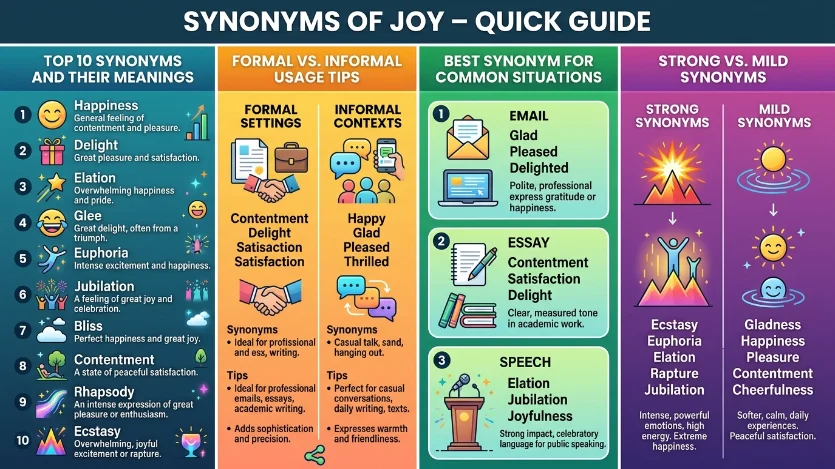
Joy is a feeling of great happiness, pleasure, or delight. The best synonyms are happiness, delight, pleasure, glee, and cheer. “Happiness” is the most common and natural in everyday English. Each synonym has a slightly different shade of meaning and fits different situations.
Top 10 Synonyms
- Happiness
- Delight
- Pleasure
- Glee
- Cheer
- Bliss
- Elation
- Euphoria
- Exhilaration
- Jubilation
Remember that every synonym has a slightly different meaning, tone, or context where it works best.
Have you ever felt like “joy” is the only word you know for that wonderful feeling of happiness? Many English learners struggle to find the perfect word to express their emotions.
Learning different ways to say “joy” helps you describe your feelings more precisely. It also makes your English sound more natural and expressive. Whether you’re writing a thank-you note, describing a special moment, or telling a friend about good news, having the right word can make your message more powerful.
In this guide, you’ll learn 30 powerful synonyms. You’ll also discover when to use each one, how formal they are, and common mistakes to avoid. Let’s jump in!
What Does “Joy” Mean?
Definition
Joy is a strong feeling of happiness, delight, or satisfaction. It’s deeper than just feeling okay or satisfied. Joy is that warm, uplifting feeling you get when something wonderful happens. It can come from big events like a wedding or small moments like watching a beautiful sunset. Joy is an emotion that makes life feel richer.
Pronunciation
| Feature | Value |
|---|---|
| US IPA | /dʒɔɪ/ |
| UK IPA | /dʒɔɪ/ |
| Syllables | 1 |
| Tip | Say it like “joy” – rhymes with “boy” and “toy” |
Grammar
| Grammar Feature | Information |
|---|---|
| Part of Speech | Noun (also used as a verb, but less common) |
| Common Position | Subject or Object |
| Typical Pattern | Joy + of + something / Joy + in + doing something |
Examples:
- “The joy of reading is something everyone should experience.”
- “She finds great joy in helping others.”
- “His children bring him so much joy.”
Note: “Joy” is usually uncountable. We say “a feeling of joy,” not “a joy” (except when meaning a specific person or thing that brings happiness, like “She is a joy to work with”).
Word Family
| Word | Part of Speech | Meaning |
|---|---|---|
| Joy | Noun/Verb | A feeling of great happiness / To feel happy |
| Joyful | Adjective | Full of joy; very happy |
| Joyfully | Adverb | In a joyful way |
| Joyous | Adjective | Full of joy (similar to joyful, more formal) |
| Enjoy | Verb | To take pleasure in something |
| Enjoyment | Noun | The feeling of taking pleasure in something |
15 Synonyms of “Joy”
Happiness
Meaning: The state of being happy. A general word for feeling good and satisfied.
Best Used For: Everyday conversation, writing, describing a general positive state.
Formality: Neutral
Tone: Positive, General
Frequency: ⭐⭐⭐⭐⭐ (Very Common)
CEFR Level: A2
Example Sentence 1: “True happiness comes from spending time with people you love.”
Example Sentence 2: “She found happiness in her new job and daily routine.”
Usage Tip: “Happiness” is the most common and general synonym. Use it when you want a simple, widely understood word. It’s always a safe choice.
Delight
Meaning: A feeling of great pleasure or satisfaction. It’s stronger than simple happiness.
Best Used For: Expressing strong satisfaction, formal and informal contexts.
Formality: Neutral to Formal
Tone: Positive, Enthusiastic
Frequency: ⭐⭐⭐⭐ (Common)
CEFR Level: B1
Example Sentence 1: “The children squealed with delight when they saw the puppy.”
Example Sentence 2: “He took great delight in surprising his wife with dinner.
Usage Tip: “Delight” is stronger than pleasure but not as intense as euphoria. It often describes immediate, obvious reactions . Use it for moments of great satisfaction.
Common Confusion: “Delight” vs “Joy”: Delight is often a reaction to something specific. Joy is a deeper, more lasting feeling. You feel delight when you taste great food, but joy when your child is born.
Pleasure
Meaning: A feeling of enjoyment, satisfaction, or happiness from doing something you like.
Best Used For: Formal situations, polite expressions, everyday conversation.
Formality: Neutral to Formal
Tone: Positive, Polite
Frequency: ⭐⭐⭐⭐⭐ (Very Common)
CEFR Level: A2
Example Sentence 1: “It gives me great pleasure to announce the winner.”
Example Sentence 2: “She takes pleasure in simple things like reading and gardening.”
Usage Tip: “Pleasure” is a versatile word. It is often used in polite phrases like “It’s a pleasure to meet you.” It can refer to both strong and mild enjoyment. It’s good, but if you need a stronger word for a very exciting event, choose something else .
Glee
Meaning: Great delight, especially when you feel happy about something that brings you satisfaction.
Best Used For: Informal contexts, describing playful or mischievous happiness.
Formality: Informal
Tone: Playful, Cheerful
Frequency: ⭐⭐⭐ (Moderate)
CEFR Level: B2
Example Sentence 1: “The children giggled with glee when they received their gifts.”
Example Sentence 2: “She couldn’t hide her glee when her team won the match.”
Usage Tip: “Glee” has a playful, sometimes mischievous quality. It’s perfect for describing delight that shows on your face or in your actions. It is not appropriate for formal writing.
Cheer
Meaning: A feeling of happiness and optimism. It also means to shout encouragement.
Best Used For: Describing a positive, upbeat atmosphere.
Formality: Neutral
Tone: Uplifting, Positive
Frequency: ⭐⭐⭐⭐ (Common)
CEFR Level: B1
Example Sentence 1: “Everyone was full of cheer at the holiday party.”
Example Sentence 2: “Words of cheer from her friends lifted her spirits.”
Usage Tip: “Cheer” often describes a shared or social happiness, like at a party or gathering. It also implies energy and brightness.
Bliss
Meaning: Perfect happiness. A state of complete and total joy.
Best Used For: Describing intense, peaceful, and perfect happiness.
Formality: Neutral to Literary
Tone: Peaceful, Perfect
Frequency: ⭐⭐⭐ (Moderate)
CEFR Level: B2
Example Sentence 1: “They spent their honeymoon in pure bliss on the beach.
Example Sentence 2: “After a long week, there’s nothing like the bliss of a quiet Sunday morning.”
Usage Tip: “Bliss” describes a state of perfect and often peaceful happiness. It’s stronger than “joy” and suggests nothing could make the moment better. Use it carefully for very special moments.
Elation
Meaning: Great happiness and excitement, often because of a success or achievement.
Best Used For: Describing excitement from winning or achieving a goal.
Formality: Formal
Tone: Excited, Triumphant
Frequency: ⭐⭐⭐ (Moderate)
CEFR Level: B2
Example Sentence 1: “Her elation was obvious after she was accepted into the university.”
Example Sentence 2: “The team’s elation at winning the championship was infectious.”
Usage Tip: “Elation” is a formal word for excitement after a success. It’s not for everyday happiness, but for moments of triumph.
Euphoria
Meaning: An intense feeling of excitement and happiness that is usually short-lived.
Best Used For: Describing very intense, overwhelming happiness.
Formality: Formal
Tone: Intense, Overpowering
Frequency: ⭐⭐⭐ (Moderate)
CEFR Level: C1
Example Sentence 1: “She felt a sense of euphoria after finishing her final exams.”
Example Sentence 2: “The crowd was in a state of euphoria after the concert.”
Usage Tip: “Euphoria” is one of the strongest words for happiness. It means a temporary state of extreme joy and excitement. Use it sparingly, only when the feeling is truly overwhelming.
Exhilaration
Meaning: A feeling of excitement, happiness, and energy from an exciting or thrilling experience.
Best Used For: Describing excitement from adventurous or thrilling activities.
Formality: Neutral
Tone: Thrilling, Energetic
Frequency: ⭐⭐⭐ (Moderate)
CEFR Level: B2
Example Sentence 1: “She felt a rush of exhilaration as she went down the roller coaster.”
Example Sentence 2: “The exhilaration of climbing to the top of the mountain made every step worth it.”
Usage Tip: “Exhilaration” combines happiness with energy and excitement. It’s perfect for experiences that make your heart race, like extreme sports, roller coasters, or big adventures.
Jubilation
Meaning: A feeling of great joy, celebration, and triumph.
Best Used For: Describing joy at a public victory or celebration.
Formality: Formal
Tone: Celebratory, Triumphant
Frequency: ⭐⭐⭐ (Moderate)
CEFR Level: B2
Example Sentence 1: “There was jubilation in the streets when the team won the championship.”
Example Sentence 2: “The announcement was met with jubilation from the crowd.”
Usage Tip: “Jubilation” is often used to describe the collective happiness of a group celebrating a victory or good news. It suggests visible celebration.
Contentment
Meaning: A state of happiness and satisfaction. It is a quieter, more peaceful feeling.
Best Used For: Describing a calm, steady feeling of satisfaction.
Formality: Neutral
Tone: Peaceful, Satisfied
Frequency: ⭐⭐⭐⭐ (Common)
CEFR Level: B1
Example Sentence 1: “She felt a deep sense of contentment as she sat by the fire.”
Example Sentence 2: “After a good meal, he leaned back with a feeling of contentment.”
Usage Tip: “Contentment” is not a strong, excited happiness. It is a calm, settled feeling of being satisfied with what you have. It is a quieter cousin to “joy.”
Joyfulness
Meaning: The state of being full of joy. It is very similar to happiness.
Best Used For: Formal or literary contexts, describing a cheerful person.
Formality: Neutral to Formal
Tone: Positive, Cheerful
Frequency: ⭐⭐ (Rare)
CEFR Level: B1
Example Sentence 1: “Her joyfulness was contagious and made everyone around her smile.”
Example Sentence 2: “The children’s joyfulness filled the room with warmth.”
Usage Tip: “Joyfulness” is used to describe the personality trait of being consistently joyful. It’s less common than “joy” or “happiness.”
Enjoyment
Meaning: The feeling of taking pleasure in something.
Best Used For: Describing pleasure from an activity or experience.
Formality: Neutral
Tone: Positive, Satisfied
Frequency: ⭐⭐⭐⭐ (Common)
CEFR Level: A2
Example Sentence 1: “She got a lot of enjoyment from her painting class.
Example Sentence 2: “The enjoyment of the movie was ruined by the noisy audience.”
Usage Tip: “Enjoyment” is specifically about the pleasure you get from an activity. It is not as strong as “joy.”
Exultation
Meaning: Great happiness and pride, especially because of a victory or success.
Best Used For: Formal or literary writing about triumph.
Formality: Formal
Tone: Triumphant, Proud
Frequency: ⭐⭐ (Rare)
CEFR Level: C1
Example Sentence 1: “His exultation was clear after he won the award.”
Example Sentence 2: “The champion raised his arms in exultation.”
Usage Tip: “Exultation” is a very formal word for the pride and joy that comes with a significant victory.
Gladsomeness
Meaning: The state of being glad. It is a very old-fashioned word for happiness.
Best Used For: Literary or poetic writing.
Formality: Formal (Old-fashioned)
Tone: Joyful, Cheerful
Frequency: ⭐ (Very Rare)
CEFR Level: C1
Example Sentence 1: “Her heart was filled with gladsomeness at the sight of spring.”
Example Sentence 2: “The community shared a feeling of gladsomeness at the news.”
Usage Tip: This word is outdated. It is more common to use “gladness” if needed, but even that is rare. It’s better to use “happiness” or “joy” in modern English.
Merriment
Meaning: Cheerful, lively enjoyment, especially at a party or celebration.
Best Used For: Describing the happiness at a fun, lively event.
Formality: Neutral to Literary
Tone: Festive, Cheerful
Frequency: ⭐⭐⭐ (Moderate)
CEFR Level: B2
Example Sentence 1: “There was great merriment and laughter at the birthday party.”
Example Sentence 2: “The old pub was filled with merriment on Friday night.”
Usage Tip: “Merriment” describes the collective, social happiness found at festive events.
Synonyms Comparison Table
| Synonym | Best Context | Formality | Tone | Frequency |
|---|---|---|---|---|
| Happiness | General Everyday | Neutral | Positive | ⭐⭐⭐⭐⭐ |
| Pleasure | Polite / General | Neutral | Positive | ⭐⭐⭐⭐⭐ |
| Delight | Strong Satisfaction | Neutral | Enthusiastic | ⭐⭐⭐⭐ |
| Cheer | Social / Uplifting | Neutral | Positive | ⭐⭐⭐⭐ |
| Contentment | Peaceful Satisfaction | Neutral | Peaceful | ⭐⭐⭐⭐ |
| Enjoyment | Activities | Neutral | Positive | ⭐⭐⭐⭐ |
| Glee | Playful Happiness | Informal | Playful | ⭐⭐⭐ |
| Bliss | Perfect Peace | Neutral | Peaceful | ⭐⭐⭐ |
| Elation | After Success | Formal | Triumphant | ⭐⭐⭐ |
| Exhilaration | Thrilling Experiences | Neutral | Energetic | ⭐⭐⭐ |
| Jubilation | Public Celebration | Formal | Celebratory | ⭐⭐⭐ |
| Merriment | Festive Events | Neutral | Festive | ⭐⭐⭐ |
| Euphoria | Extreme Intensity | Formal | Intense | ⭐⭐⭐ |
| Exultation | Triumph | Formal | Proud | ⭐⭐ |
| Joyfulness | Literary / Formal | Formal | Cheerful | ⭐⭐ |
Best Synonyms by Situation
| Situation | Best Synonym | Why It Works |
|---|---|---|
| Daily Conversation | Happiness | It’s the most natural and common word. |
| Business Email | Pleasure | Sounds professional and polite. |
| Academic Writing | Elation / Euphoria | Formal and precise. |
| School Assignment | Contentment / Happiness | Clear, appropriate, and widely understood. |
| Professional Meeting | Pleasure | Polite and professional. |
| Presentation | Elation / Jubilation | Formal terms for achievement. |
| Creative Writing | Bliss / Delight | Evocative and descriptive. |
| Social Media | Glee / Exhilaration | Captures excitement in a casual way. |
| Movie Review | Exhilaration | Perfect for describing an exciting film. |
| Book Review | Contentment / Delight | Describes enjoyment from reading. |
Formal vs Informal SynonymsH3: Formal Alternatives
| Synonym | Best Used For |
|---|---|
| Elation | Academic or professional writing about success. |
| Euphoria | Describing intense, overwhelming joy. |
| Jubilation | Describing public celebration and triumph. |
| Exultation | Formal writing about victory and pride. |
Neutral Alternatives
| Synonym | Best Used For |
|---|---|
| Happiness | Most everyday situations. |
| Pleasure | Polite conversation and writing. |
| Delight | Describing strong satisfaction. |
| Cheer | Describing an upbeat, positive mood. |
| Contentment | Describing a peaceful, settled happiness. |
Informal Alternatives
| Synonym | Best Used For |
|---|---|
| Glee | Playful or mischievous delight. |
| Joy | Very common in everyday speech. |
Choosing the Right Level: Always match your word to the situation. In a professional email, use “pleasure” or “delight.” In a text to a friend, “glee” is perfect. For everything else, “happiness” is your safe and reliable choice.
Strong vs Mild Synonyms
Mild
These are suitable for everyday situations. They describe a calm, gentle, or moderate feeling of happiness.
- Contentment
- Pleasure
- Enjoyment
- Cheer
- Happiness
Moderate
These are more expressive than the word “joy” and are good for most positive contexts.
- Delight
- Glee
- Merriment
- Joyfulness
Strong
High-intensity alternatives that should be used carefully.
- Bliss
- Elation
- Euphoria
- Exhilaration
- Jubilation
- Exultation
How Intensity Changes Meaning: Choosing a “strong” word like “euphoria” signals an overwhelming, often temporary, and intense feeling. A “mild” word like “contentment” signals a calm, steady, and lasting satisfaction. Pick the word that matches the power of the emotion.
Real-Life Examples
School: “The children were full of joy when they received their good grades.”
Office: “There was a feeling of elation around the office when the big project succeeded.”
Business Email: “It gives me great pleasure to welcome you to the team.”
Meetings: “Everyone felt delight when the manager announced the bonus.”
Presentations: “The audience’s jubilation was clear after the announcement.”
Books: “The novel ends with the characters finding a state of blissful contentment.”
Movies: “The film was full of exhilarating moments that kept me on the edge of my seat.”
Daily Conversations: “I felt nothing but pure happiness when I saw her again.”
Social Media: “Can’t contain my glee – I just won tickets to the concert!”
Academic Writing: “The subject’s elation at the success was a significant finding.”
Common Collocations
| Common Phrase | Better Alternative |
|---|---|
| Very happy | Overjoyed / Elated |
| Really happy | Thrilled / Delighted |
| Quite happy | Content / Pleased |
| So happy | Euphoric / Ecstatic |
| Happy feeling | Feeling of elation / Feeling of bliss |
Common Phrases
Jump for joy: To be very happy about something.
- Alternative: “She was overjoyed with excitement.”
Full of joy: To be very happy.
- Alternative: “He was completely blissful.”
Tears of joy: Crying because you are so happy.
- Alternative: “She was so elated she cried.”
Share the joy: To make someone else happy with your good news.
- Alternative: “We shared in her delight.”
Bring someone joy: To make someone happy.
- Alternative: “She brings delight to everyone she meets.”
Joy to the world: A common phrase meaning happiness for everyone, especially in Christmas songs.
Context Guide
| Situation | Best Synonym | Reason |
|---|---|---|
| Essay | Contentment / Elation | Formal and precise vocabulary. |
| Speech | Delight / Pleasure | Appropriate for addressing an audience. |
| Business Email | Pleasure | Professional and respectful. |
| Novel | Bliss / Exhilaration | Evocative and descriptive for storytelling. |
| Presentation | Elation / Jubilation | Formal, celebratory, and professional. |
| Conversation | Happiness | The most natural and common choice. |
| Academic Writing | Euphoria / Exultation | Formal and specific for research. |
| Marketing Copy | Joy / Delight | Positive, engaging, and customer-focused. |
Related Words
Near Synonyms
- Satisfaction: A feeling of contentment and fulfillment.
- Optimism: A hopeful and positive outlook.
- Cheerfulness: The quality of being noticeably happy and optimistic.
- Well-being: A state of being comfortable, healthy, and happy.
Antonyms
- Sorrow: A deep feeling of sadness or grief.
- Sadness: The state of being unhappy.
- Misery: Extreme unhappiness and suffering.
- Despair: A complete loss of hope.
- Grief: Deep sadness, especially from losing someone.
Related Adjectives
- Joyful: Full of joy.
- Joyous: Full of joy (more formal).
- Cheerful: Noticeably happy and positive.
- Delightful: Very pleasing and enjoyable.
- Blissful: Extremely and peacefully happy.
- Ecstatic: Feeling overwhelming happiness.
Related Nouns
- Joy: The feeling itself.
- Happiness: The state of being happy.
- Delight: Great pleasure.
- Pleasure: Enjoyment or satisfaction.
- Bliss: Perfect happiness.
Related Verbs
- Rejoice: To feel or show great joy.
- Celebrate: To show joy through a happy event.
- Enjoy: To take pleasure in something.
- Delight: To give someone great pleasure.
- Exult: To show great joy or triumph.
Frequently Asked Questions
What is another word for joy?
Common synonyms include happiness, delight, pleasure, glee, and cheer. The best choice depends on the intensity and context of the feeling .
Which synonym sounds the most professional?
Pleasure and elation sound very professional. “Pleasure” is excellent for polite business communication, while “elation” is a great formal word for describing the joy of success.
What is the strongest synonym for joy?
Euphoria and bliss are among the strongest. Euphoria describes an intense, overwhelming excitement, while bliss describes a perfect, almost spiritual state of happiness. Both are for very powerful feelings .
Which synonym is best for essays?
Elation or contentment are great choices for essays. “Elation” is perfect for describing the joy of an achievement, while “contentment” is ideal for discussing a calmer, more philosophical form of happiness.
What’s the difference between joy and happiness?
Happiness is a broader, more general term for feeling good. Joy is often seen as deeper, more intense, and longer-lasting. Joy is usually connected to meaningful experiences, while happiness can be about everyday pleasures .
Which synonym is most common in everyday English?
Happiness is the most common word. It’s simple, widely understood, and works in almost any situation. It is the default word for describing a positive emotional state.
What is the opposite of joy?
The most common opposites are sorrow, sadness, misery, despair, and grief. “Sadness” is the most direct and general opposite, while “sorrow” and “grief” imply deeper, often more lasting pain.
Conclusion
Joy is a beautiful and powerful emotion, and having many ways to express it makes your English richer and more precise. As you have seen, no two synonyms are exactly the same. Each one brings its own unique shade of meaning.
“Happiness” is your everyday workhorse. “Delight” and “pleasure” add a touch of formality and satisfaction. “Glee” brings a playful energy, while “bliss” and “euphoria” describe the most intense and perfect feelings. Choosing the right synonym is all about matching the word to the moment.
The best way to improve is to practice. Try using one new synonym each day. Pay attention to how people use these words in movies, books, and real conversations. This active practice will help your vocabulary grow naturally and make your English more expressive.
