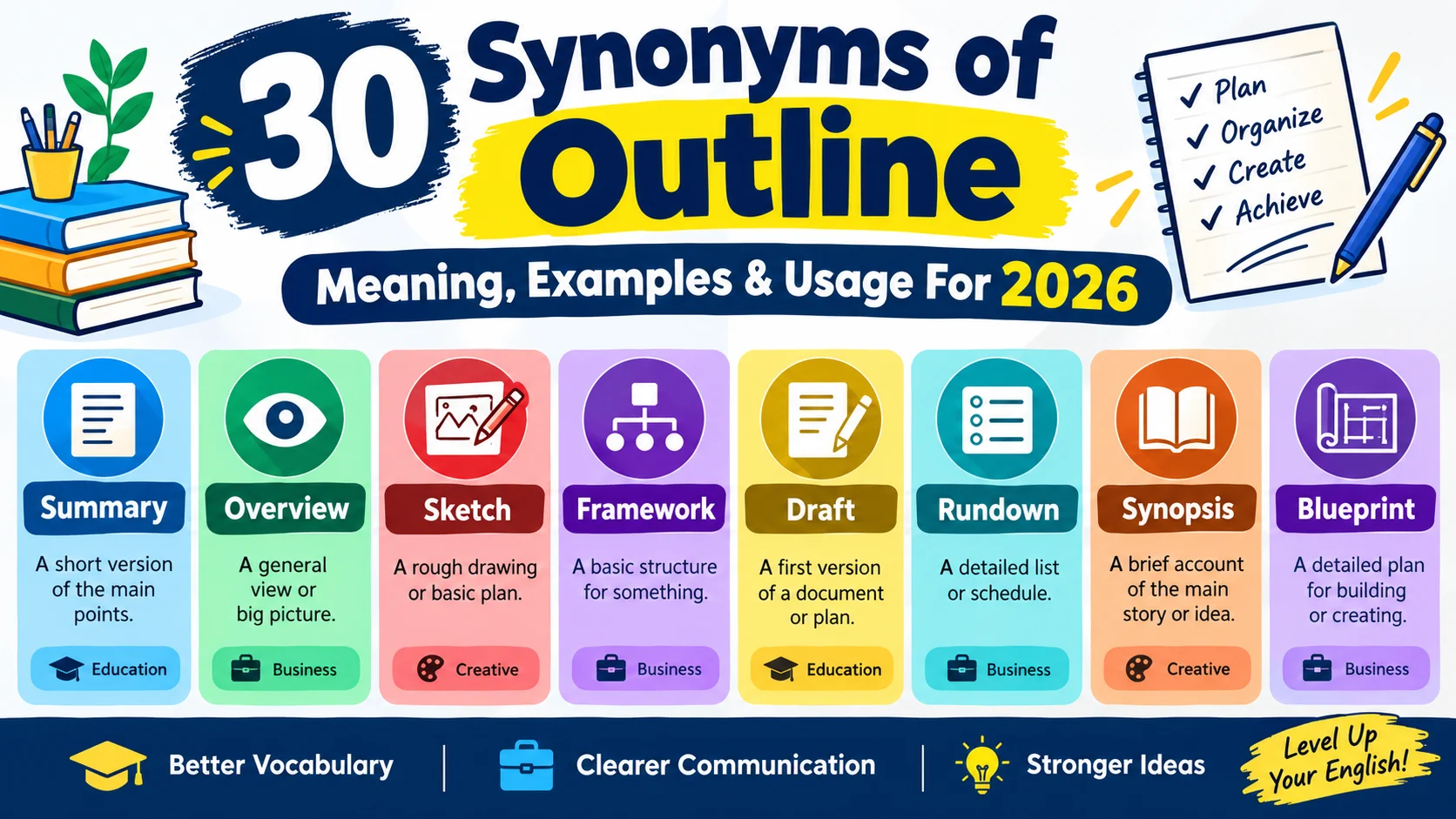
Outline means to give a short general description or the main points of something. The best synonyms include summary, overview, skeleton, framework, draft, sketch, and rundown. The most common everyday synonym is summary when giving a brief description, and draft when planning something. Each synonym has a slightly different meaning, tone, and context.
Have you ever needed to explain something quickly without going into every tiny detail? That’s what “outline” is all about. It’s one of those super useful words we use constantly whether we’re planning a presentation, writing an essay, or just giving someone the main points of a story.
The great thing about “outline” is that it’s incredibly versatile. You can outline a book, outline a business plan, or even outline your weekend plans. But sometimes, using the same word over and over gets boring. That’s why I’ve put together this guide with 30 excellent alternatives. By the time you finish reading, you’ll have a whole toolbox of words to choose from. Let’s dive in!
What Does “Outline” Mean?
Definition
Outline has two main meanings. First, as a noun, it refers to a short summary or the main points of something like the outline of a speech or an essay. Second, as a verb, it means to describe the main ideas or general shape of something without going into too much detail. Think of it as giving someone the big picture.
Pronunciation
| Feature | Information |
|---|---|
| US IPA | /ˈaʊt.laɪn/ |
| UK IPA | /ˈaʊt.laɪn/ |
| Syllables | 2 (out-line) |
| Tip | Stress the first syllable: OUT-line |
Grammar
| Feature | Information |
|---|---|
| Part of Speech | Noun and Verb |
| Common Position | Subject or object (noun); before an object (verb) |
| Typical Pattern | “outline of [something]” or “outline [something]” |
Example Sentences:
- The professor gave us an outline of the semester’s topics.
- Can you outline the main points of your argument?
- She drew a rough outline of the house on the paper.
Grammar Note: “Outline” works as both a noun and a verb. As a noun, it’s countable (you can have several outlines). As a verb, it’s regular just add -ed for past tense: “outlined.”
Word Family
| Word | Part of Speech | Meaning |
|---|---|---|
| Outline | Noun/Verb | A summary; to summarize |
| Outlined | Verb (past tense) | Summarized in the past |
| Outlining | Verb (gerund) | The act of summarizing |
| Outliner | Noun (rare) | Someone who outlines |
30 Synonyms of Outline
1. Summary
Meaning: A short statement that gives the main points of something.
Best Used For: Daily conversation, writing, school assignments, business reports.
Formality: Neutral
Tone: Neutral
Frequency: ⭐⭐⭐⭐⭐ Very Common
CEFR Level: A2
Example Sentence 1: She gave me a quick summary of the movie.
Example Sentence 2: The summary at the end of the chapter helped me study.
Usage Tip: “Summary” is the most common and natural synonym. Use it for almost any situation where you’re giving a brief overview. It’s safe for both formal and informal contexts.
Common Confusion: Summary vs Outline. A “summary” comes after reading something, while an “outline” often comes before planning something.
2. Overview
Meaning: A general view or explanation of something.
Best Used For: Business presentations, introductions, explaining complex topics.
Formality: Formal
Tone: Professional
Frequency: ⭐⭐⭐⭐ Common
CEFR Level: B1
Example Sentence 1: This overview will help you understand our company’s goals.
Example Sentence 2: The first chapter provides an overview of the subject.
Usage Tip: “Overview” sounds professional. Use it when you want to present the big picture, especially in business or education.
3. Sketch
Meaning: A rough drawing or a simple description of the main points.
Best Used For: Creative writing, brainstorming, art, early planning stages.
Formality: Neutral
Tone: Creative
Frequency: ⭐⭐⭐⭐ Common
CEFR Level: B1
Example Sentence 1: She sketched her idea for the new product.
Example Sentence 2: I’ll just sketch the main points for now.
Usage Tip: “Sketch” suggests something rough and not fully developed. Use it when you’re working on an early version or a quick draft.
4. Skeleton
Meaning: The basic structure of something.
Best Used For: Planning, organizing, academic writing.
Formality: Informal
Tone: Figurative
Frequency: ⭐⭐⭐ Moderate
CEFR Level: B2
Example Sentence 1: I’ve got the skeleton of my essay, now I just need to fill in the details.
Example Sentence 2: The skeleton of the plan is solid.
Usage Tip: “Skeleton” is a metaphor that suggests you have the basic structure without the details. It’s perfect for when you’re planning something.
5. Framework
Meaning: A structure that gives shape and support to something.
Best Used For: Business planning, government policy, academic theories.
Formality: Formal
Tone: Professional
Frequency: ⭐⭐⭐⭐ Common
CEFR Level: B2
Example Sentence 1: We need a framework for our new marketing strategy.
Example Sentence 2: The book provides a framework for understanding modern economics.
Usage Tip: “Framework” is formal and suggests a structure that supports bigger ideas. Use it in professional or academic contexts.
6. Draft
Meaning: A first version of something before it’s finished.
Best Used For: Writing, planning, creative projects.
Formality: Neutral
Tone: Neutral
Frequency: ⭐⭐⭐⭐⭐ Very Common
CEFR Level: A2
Example Sentence 1: He wrote a rough draft of his speech.
Example Sentence 2: The draft of the document needs more work.
Usage Tip: “Draft” is perfect when you’re working on something that isn’t finished yet. It suggests that you’ll probably make changes later.
Common Confusion: Draft vs Outline. A “draft” is a complete but rough version; an “outline” is just the main points without the details.
7. Rundown
Meaning: A quick explanation or summary of information.
Best Used For: Daily conversation, briefings, informal presentations.
Formality: Informal
Tone: Casual
Frequency: ⭐⭐⭐ Moderate
CEFR Level: B2
Example Sentence 1: Can you give me a quick rundown of the meeting?
Example Sentence 2: Here’s a rundown of our plans for the weekend.
Usage Tip: “Rundown” is casual and conversational. Use it with friends or in informal work settings. It’s not appropriate for formal writing.
8. Synopsis
Meaning: A brief summary of a book, movie, or larger work.
Best Used For: Book reviews, movie descriptions, academic summaries.
Formality: Formal
Tone: Neutral
Frequency: ⭐⭐⭐ Moderate
CEFR Level: B2
Example Sentence 1: The synopsis on the back of the book made me want to read it.
Example Sentence 2: She wrote a synopsis of her research paper.
Usage Tip: “Synopsis” is specific to summarizing larger works like books, movies, or research. It’s more formal than “summary.”
9. Abstract
Meaning: A short summary of a research paper or academic article.
Best Used For: Academic writing, research papers, scientific journals.
Formality: Formal
Tone: Academic
Frequency: ⭐⭐⭐ Moderate
CEFR Level: B2
Example Sentence 1: The abstract summarizes the study’s findings.
Example Sentence 2: Please write a 200-word abstract for your thesis.
Usage Tip: “Abstract” is highly specific to academic contexts. Use it for research, but not for everyday conversations.
10. Brief
Meaning: A short statement of the main points.
Best Used For: Professional documents, legal contexts, news reports.
Formality: Formal
Tone: Professional
Frequency: ⭐⭐⭐⭐ Common
CEFR Level: B1
Example Sentence 1: The lawyer prepared a brief for the case.
Example Sentence 2: Here’s a brief on the current situation.
Usage Tip: “Brief” is formal and often used in legal and professional settings. It suggests something concise and focused.
11. Recap
Meaning: A summary of what has been said or done.
Best Used For: Ending presentations, conversations, meetings.
Formality: Informal
Tone: Conversational
Frequency: ⭐⭐⭐⭐ Common
CEFR Level: B1
Example Sentence 1: Let me give you a quick recap of today’s lesson.
Example Sentence 2: The sports show did a recap of all the weekend’s games.
Usage Tip: “Recap” is short for “recapitulation.” It’s casual and natural. Use it when you’re going over something again quickly.
12. Résumé (Resume)
Meaning: A summary of someone’s work experience and skills.
Best Used For: Job applications, professional profiles.
Formality: Formal
Tone: Professional
Frequency: ⭐⭐⭐⭐⭐ Very Common
CEFR Level: A2
Example Sentence 1: Please submit your résumé with your application.
Example Sentence 2: She provided a résumé of her qualifications.
Usage Tip: “Résumé” is specifically about summarizing work experience. The meaning is different from other synonyms on this list.
13. Digest
Meaning: A shortened version of a longer work.
Best Used For: Books, articles, news summaries.
Formality: Neutral
Tone: Neutral
Frequency: ⭐⭐⭐ Moderate
CEFR Level: B2
Example Sentence 1: The digest includes the most important news of the week.
Example Sentence 2: I read the digest instead of the full report.
Usage Tip: “Digest” suggests the information has been condensed into a more manageable form. It’s common for news and publications.
14. Condensation
Meaning: A shortened version of something.
Best Used For: Academic writing, describing summaries.
Formality: Formal
Tone: Academic
Frequency: ⭐⭐ Rare
CEFR Level: C1
Example Sentence 1: The condensation of the novel was still over 200 pages.
Example Sentence 2: Her condensation of the theory was clear and helpful.
Usage Tip: “Condensation” is formal and not commonly used. Stick to “summary” or “abbreviation” in daily conversation.
15. Preamble
Meaning: An introduction or opening statement.
Best Used For: Legal documents, formal speeches.
Formality: Formal
Tone: Professional
Frequency: ⭐⭐ Rare
CEFR Level: C1
Example Sentence 1: The preamble to the constitution explains its purpose.
Example Sentence 2: His preamble to the speech outlined the main topics.
Usage Tip: “Preamble” is formal and specific to introductions. It’s not a general synonym for “outline.”
16. Schema
Meaning: A conceptual plan or diagram.
Best Used For: Psychology, education, planning.
Formality: Formal
Tone: Academic
Frequency: ⭐⭐ Rare
CEFR Level: C1
Example Sentence 1: Her schema for the project was logical and organized.
Example Sentence 2: Children develop schemas for understanding the world.
Usage Tip: “Schema” is technical and used in psychology or education. Not suitable for casual conversation.
17. Blueprint
Meaning: A detailed plan of action.
Best Used For: Business planning, construction, important projects.
Formality: Neutral
Tone: Professional
Frequency: ⭐⭐⭐⭐ Common
CEFR Level: B2
Example Sentence 1: The company has a blueprint for expansion.
Example Sentence 2: He provided a blueprint for the new building.
Usage Tip: “Blueprint” suggests a detailed, thorough plan. It’s stronger than “outline” and implies more completeness.
18. Scheme
Meaning: A systematic plan or arrangement.
Best Used For: Official planning, describing strategies.
Formality: Neutral
Tone: Neutral (can be negative)
Frequency: ⭐⭐⭐⭐ Common
CEFR Level: B2
Example Sentence 1: The government introduced a new health scheme.
Example Sentence 2: They planned a scheme to increase profits.
Usage Tip: “Scheme” can have a negative meaning (like a secret plot), so be careful with the context. In official British English, it often means a government plan.
19. Plan
Meaning: A detailed proposal for achieving something.
Best Used For: Almost everything work, personal life, school.
Formality: Neutral
Tone: Neutral
Frequency: ⭐⭐⭐⭐⭐ Very Common
CEFR Level: A2
Example Sentence 1: She outlined her plan for the project.
Example Sentence 2: The plan includes ten key points.
Usage Tip: “Plan” is incredibly common. It’s a perfect synonym when you mean something more detailed than a basic outline.
20. Program
Meaning: A planned series of events or activities.
Best Used For: Events, education, official contexts.
Formality: Neutral
Tone: Professional
Frequency: ⭐⭐⭐⭐ Common
CEFR Level: A2
Example Sentence 1: The training program included five modules.
Example Sentence 2: She programs her day carefully.
Usage Tip: “Program” is great for planned sequences of activities. It can be a noun or verb (in US English) and is widely used.
21. Curriculum
Meaning: The subjects studied in a school or course.
Best Used For: Education, teaching, training.
Formality: Formal
Tone: Professional
Frequency: ⭐⭐⭐⭐ Common
CEFR Level: B2
Example Sentence 1: The curriculum includes science and mathematics.
Example Sentence 2: Teachers follow a standard curriculum.
Usage Tip: “Curriculum” is specifically about education. Use it for school courses, not general outlines.
22. Stratagem
Meaning: A clever plan or trick.
Best Used For: Military, game strategies, formal writing.
Formality: Formal
Tone: Strategic
Frequency: ⭐⭐ Rare
CEFR Level: C1
Example Sentence 1: The general’s stratagem caught the enemy by surprise.
Example Sentence 2: She used a clever stratagem to win the game.
Usage Tip: “Stratagem” is fancy and formal. Save it for dramatic or strategic contexts.
23. Representation
Meaning: A description or explanation of something.
Best Used For: Academic writing, scientific contexts.
Formality: Formal
Tone: Professional
Frequency: ⭐⭐⭐ Moderate
CEFR Level: B2
Example Sentence 1: The graph gives a visual representation of the data.
Example Sentence 2: His representation of the problem was clear.
Usage Tip: “Representation” focuses on how something is described or shown. It’s more about the description than a simple outline.
24. Delineation
Meaning: The action of describing or showing something.
Best Used For: Formal writing, scientific descriptions.
Formality: Formal
Tone: Academic
Frequency: ⭐⭐ Rare
CEFR Level: C1
Example Sentence 1: The delineation of the chemical process was complicated.
Example Sentence 2: Her delineation of the theory took an entire chapter.
Usage Tip: “Delineation” is very formal and often used in scientific writing. Not for everyday use.
25. Portrayal
Meaning: The way something is shown or described.
Best Used For: Art, literature, character descriptions.
Formality: Neutral
Tone: Creative
Frequency: ⭐⭐⭐ Moderate
CEFR Level: B2
Example Sentence 1: The movie gave a realistic portrayal of life in the 1930s.
Example Sentence 2: Her portrayal of the character was brilliant.
Usage Tip: “Portrayal” is about how something is depicted or shown, not just summarized.
26. Explanation
Meaning: A statement that makes something clear.
Best Used For: Teaching, clarifying things.
Formality: Neutral
Tone: Helpful
Frequency: ⭐⭐⭐⭐⭐ Very Common
CEFR Level: A2
Example Sentence 1: He gave a detailed explanation of the process.
Example Sentence 2: The explanation in the manual was confusing.
Usage Tip: “Explanation” focuses on making things clear. It’s a great substitute when you’re describing why something is the way it is.
27. Description
Meaning: A spoken or written account of something.
Best Used For: Everyday conversation, writing, creative work.
Formality: Neutral
Tone: Neutral
Frequency: ⭐⭐⭐⭐⭐ Very Common
CEFR Level: A2
Example Sentence 1: The description of the house was very accurate.
Example Sentence 2: He gave a full description of what happened.
Usage Tip: “Description” is broader than “outline.” It can include details, not just main points.
28. Narrative
Meaning: A spoken or written account of connected events.
Best Used For: Storytelling, personal experiences.
Formality: Neutral
Tone: Creative
Frequency: ⭐⭐⭐⭐ Common
CEFR Level: B2
Example Sentence 1: Her narrative of the journey was fascinating.
Example Sentence 2: The book offers a powerful narrative of hope.
Usage Tip: “Narrative” suggests storytelling and a sequence of events. It’s more than just an outline.
29. Account
Meaning: A description of an event or situation.
Best Used For: News reporting, personal stories.
Formality: Neutral
Tone: Neutral
Frequency: ⭐⭐⭐⭐ Common
CEFR Level: B1
Example Sentence 1: The newspaper gave a full account of the events.
Example Sentence 2: His account of the accident differed from hers.
Usage Tip: “Account” is about reporting what happened. It can be detailed or brief.
30. Profile
Meaning: A short description of someone or something.
Best Used For: Personal descriptions, media, introductions.
Formality: Neutral
Tone: Professional
Frequency: ⭐⭐⭐⭐ Common
CEFR Level: B1
Example Sentence 1: The magazine published a profile of the famous actor.
Example Sentence 2: We need to outline the customer profile.
Usage Tip: “Profile” is specific to describing a person, group, or place. It’s not a general synonym but works well when you’re describing someone.
Synonyms Comparison Table
| Synonym | Best Context | Formality | Tone | Frequency |
|---|---|---|---|---|
| Summary | Most situations | Neutral | Neutral | ⭐⭐⭐⭐⭐ |
| Overview | Business, education | Formal | Professional | ⭐⭐⭐⭐ |
| Sketch | Creative, planning | Neutral | Creative | ⭐⭐⭐⭐ |
| Skeleton | Planning | Informal | Figurative | ⭐⭐⭐ |
| Framework | Business, academic | Formal | Professional | ⭐⭐⭐⭐ |
| Draft | Writing, planning | Neutral | Neutral | ⭐⭐⭐⭐⭐ |
| Rundown | Conversation | Informal | Casual | ⭐⭐⭐ |
| Synopsis | Books, movies | Formal | Neutral | ⭐⭐⭐ |
| Abstract | Academic | Formal | Academic | ⭐⭐⭐ |
| Brief | Legal, professional | Formal | Professional | ⭐⭐⭐⭐ |
Best Synonyms by Situation
| Situation | Best Synonym | Why It Works |
|---|---|---|
| Daily Conversation | Summary | Simple and natural |
| Business Email | Overview | Professional and clear |
| Academic Writing | Abstract | Formal and precise |
| School Assignment | Outline | Expected and appropriate |
| Professional Meeting | Brief | Focused and concise |
| Presentation | Overview | Gives the big picture |
| Creative Writing | Sketch | Creative and open-ended |
| Social Media | Recap | Casual and quick |
| Movie Review | Synopsis | Standard for entertainment |
| Book Review | Synopsis | Professional and concise |
Formal vs Informal Synonyms
Formal Alternatives
| Synonym | Best Used For |
|---|---|
| Abstract | Academic papers |
| Synopsis | Research summaries |
| Framework | Business planning |
| Delineation | Scientific descriptions |
| Preamble | Legal documents |
| Brief | Legal contexts |
Neutral Alternatives
| Synonym | Best Used For |
|---|---|
| Summary | Most situations |
| Outline | Everyday use |
| Overview | Professional contexts |
| Draft | Creative work |
| Plan | General planning |
Informal Alternatives
| Synonym | Best Used For |
|---|---|
| Recap | Ending conversations |
| Rundown | Quick explanations |
| Skeleton | Casual planning |
Strong vs Mild Synonyms
Mild
- Outline – basic structure
- Summary – short version
- Recap – quick review
- Sketch – rough idea
Moderate
- Overview – broad picture
- Framework – supporting structure
- Synopsis – complete summary
- Draft – working version
Strong
- Blueprint – detailed plan
- Brief – focused document
- Abstract – technical summary
- Curriculum – complete program
Real-Life Examples
Classroom:
“The teacher outlined the exam topics. She gave us a summary of everything we needed to study.”
Workplace:
“During the meeting, the manager outlined the new policy. He provided an overview of the changes and how they would affect us.”
Business Email:
“Please find below a brief outline of the project. A more detailed framework will follow next week.”
Everyday Conversation:
“Can you give me a quick rundown of what happened? Just outline the main points.”
Academic Paper:
“The abstract outlines the research methodology and key findings. The synopsis at the beginning of the paper provides a complete overview.”
Common Collocations
| Common Phrase | Better Alternative |
|---|---|
| Outline the plan | Sketch the plan |
| Outline the problem | Describe the problem |
| Outline a strategy | Present a strategy |
| Outline the process | Explain the process |
| Outline the steps | List the steps |
Common Phrases
| Phrase | Meaning | Better Alternative |
|---|---|---|
| In outline | Generally | In summary |
| Broad outline | General idea | General overview |
| Outlined in detail | Described fully | Detailed description |
Context Guide
| Situation | Best Synonym | Reason |
|---|---|---|
| Essay | Outline | Standard academic word |
| Speech | Overview | Easy for audience to understand |
| Business Email | Brief | Professional and concise |
| Novel | Synopsis | Standard for book descriptions |
| Presentation | Framework | Structured and clear |
| Conversation | Rundown | Casual and natural |
| Academic Writing | Abstract | Formal and expected |
| Marketing Copy | Summary | Clear and helpful |
Related Words
Near Synonyms
- Outline is similar to summary, but “summary” is usually a finished product while “outline” can be part of planning. You outline before writing; you write a summary after finishing.
Antonyms
- Detail – the specific points (opposite of general outline)
- Full version – the complete work
- Expansion – making something longer
- Related Adjectives
- Outline – general, rough, brief
- Detailed – full of specifics
- Comprehensive – complete
- Related Nouns
- Summary – a short version
- Plan – a scheme for doing something
- Draft – a first version
- Structure – the organization of something
- Related Verbs
- Summarize – to give a short version
- Plan – to organize in advance
- Sketch – to give a rough idea
- Draft – to write a first version
Frequently Asked Questions
What is another word for outline?
The most common synonyms for outline are summary, overview, sketch, framework, draft, and rundown. Each one has a slightly different meaning and context, so choose based on your situation.
Which synonym sounds the most professional?
Overview, framework, and brief sound the most professional. “Overview” is great for presentations and business, while “brief” works well for legal and professional documents.
What is the difference between an outline and a summary?
An outline is a plan or structure of main points, often created before writing. A summary comes after writing and condenses the finished work. You outline before you start; you summarize after you finish.
Which synonym is best for everyday conversation?
Summary and rundown are the most natural choices for everyday conversation. “Summary” works for almost any situation, while “rundown” is perfect for informal chats.
What is the strongest synonym for outline?
Blueprint and framework are among the strongest synonyms. They suggest detailed, organized planning that provides structure and support for bigger ideas.
What is the opposite of outline?
Detail, expansion, and full version are the main opposites. They all suggest going into depth rather than staying at the summary level.
Which synonym is most common in everyday English?
Summary, plan, and draft are the most common synonyms in everyday English. You’ll hear them frequently in work, school, and daily life.
Can “outline” be used as both a noun and a verb?
Yes! As a noun: “I wrote an outline.” As a verb: “I will outline the main points.” This flexibility makes it very useful.
What’s the difference between a synopsis and an abstract?
A synopsis summarizes books, movies, or plays. An abstract summarizes academic research and scientific papers. They’re similar but used in different contexts.
Is “recap” the same as “outline”?
A recap reviews what has already been said or done. An outline often plans what will happen. They’re similar but not exactly the same.
Conclusion
We’ve explored a rich collection of synonyms for “outline,” from the everyday “summary” to the more sophisticated “framework” and “deliberation.” The key takeaway is that context matters enormously. What works in a casual conversation with friends might sound out of place in a professional document.
For most situations, summary is your safest bet it’s clear, widely understood, and perfectly natural. Need something more formal? Overview and framework are excellent choices. Working on creative projects? Sketch and draft will serve you well. And when you’re just chatting with friends, rundown and recap sound perfectly natural.
The best way to get comfortable with these synonyms is to start using them. Try swapping “outline” for “summary” in your next email. Use “overview” in your next presentation. Practice with “rundown” when you’re telling a friend about your day. Each time you use a new word, you’ll become more confident and your vocabulary will grow. Happy learning!
