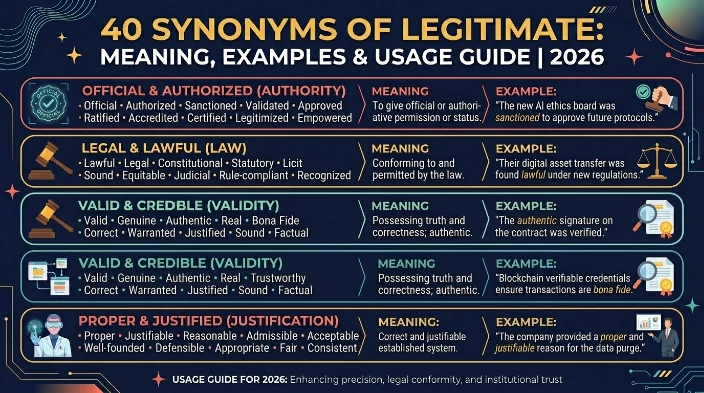
Legitimate means lawful, valid, or acceptable according to the rules. The best synonyms include lawful, valid, genuine, authentic, legal, proper, authorized, justified, reasonable, and bona fide. The most common everyday synonym is genuine, while lawful works best for legal contexts. Each synonym has a slightly different meaning, tone, or context, so choose carefully based on your situation.
Top 10 Synonyms
- Lawful
- Valid
- Genuine
- Authentic
- Legal
- Proper
- Authorized
- Justified
- Reasonable
- Bona fide
Every synonym has a slightly different meaning, tone, or context, so choose carefully based on your situation.
Do you keep using “legitimate” in emails, essays, and conversations? It’s a useful word, but overusing it makes your writing sound repetitive and less impressive.
Learning synonyms for “legitimate” helps you express yourself more precisely. Whether you’re discussing legal matters, verifying authenticity, or justifying a decision, having the right word makes all the difference.
In this guide, you’ll discover 35 powerful alternatives to “legitimate.” You’ll learn their meanings, when to use them, and which ones native speakers prefer in different situations. Let’s begin!
What Does “Legitimate” Mean?
Definition
Legitimate means lawful, valid, or acceptable according to established rules, standards, or laws. It describes something that is genuine, real, and not fake or illegal.
In everyday terms, think of a legitimate business—it follows the law, pays taxes, and is real, not a scam. A legitimate reason is a fair and valid reason, not an excuse.
Legitimate can describe:
- Legal matters (“The contract is legitimate”)
- Authenticity (“This is a legitimate signature”)
- Justification (“She had a legitimate reason for being late”)
- Acceptability (“That is a legitimate question”)
Pronunciation
| Feature | Value |
|---|---|
| US IPA | /ləˈdʒɪt̬.ə.mət/ |
| UK IPA | /ləˈdʒɪt.ə.mət/ |
| Syllables | 4 (le-gi-ti-mate) |
| Tip | Stress the second syllable: le-GI-ti-mate |
Grammar
| Grammar Feature | Information |
|---|---|
| Part of Speech | Adjective |
| Common Position | Before a noun or after a linking verb |
| Typical Pattern | legitimate + noun |
Example Sentences:
- “The company is a legitimate business with proper licenses.”
- “She had a legitimate concern about the project.”
- “Is this document legitimate?”
Grammar Notes: “Legitimate” can be used with “legitimately” (adverb) and “legitimacy” (noun). In informal English, people often shorten it to “legit.”
Word Family
| Word | Part of Speech | Meaning |
|---|---|---|
| Legitimate | Adjective | Lawful, valid, genuine |
| Legitimately | Adverb | In a lawful or valid way |
| Legitimacy | Noun | The state of being lawful or valid |
| Legitimize | Verb | To make something legitimate |
| Legit | Adjective (informal) | Short form of legitimate |
| Illegitimate | Adjective | Not legitimate; illegal or invalid |
40 Synonyms of “Legitimate”
1. Lawful
Meaning: Allowed by law; not illegal.
Best Used For: Legal contexts, official documents, formal writing.
Formality: Formal
Tone: Official, Serious
Frequency: ⭐⭐⭐⭐⭐ Very Common
CEFR Level: B2
Example Sentence 1: “The police made a lawful arrest.”
Example Sentence 2: “Their business activities are entirely lawful.”
Usage Tip: “Lawful” is the most direct synonym for the legal meaning of “legitimate.” Use it for actions that follow the law. It’s more formal than “legal.”
Common Confusion: “Lawful” vs “Legal” – They’re similar, but “lawful” suggests following moral principles, while “legal” just means following written laws.
2. Valid
Meaning: Based on truth or reason; legally acceptable.
Best Used For: Arguments, documents, tickets, contracts.
Formality: Neutral to Formal
Tone: Logical, Reasonable
Frequency: ⭐⭐⭐⭐⭐ Very Common
CEFR Level: B1
Example Sentence 1: “You need a valid passport to travel.
Example Sentence 2: “She made a valid point during the meeting.”
Usage Tip: “Valid” works for both legal documents and logical arguments. Use it when something is acceptable or reasonable.
3. Genuine
Meaning: Real, authentic, not fake.
Best Used For: Products, people, emotions, authenticity.
Formality: Neutral
Tone: Honest, Sincere
Frequency: ⭐⭐⭐⭐⭐ Very Common
CEFR Level: B1
Example Sentence 1: “This is a genuine leather bag, not fake.”
Example Sentence 2: “She showed genuine concern for her friend.”
Usage Tip: “Genuine” is the best choice for authenticity. Use it when something is real and not fake.
4. Authentic
Meaning: Known to be real and not copied; original.
Best Used For: Art, food, experiences, documents.
Formality: Neutral to Formal
Tone: Original, Trustworthy
Frequency: ⭐⭐⭐⭐⭐ Very Common
CEFR Level: B2
Example Sentence 1: “The restaurant serves authentic Italian cuisine.”
Example Sentence 2: “The painting is authentic, not a copy.”
Usage Tip: “Authentic” suggests originality and cultural or historical accuracy. Use it for things that are true to their origins.
5. Legal
Meaning: Allowed or established by law.
Best Used For: General legal contexts, everyday situations.
Formality: Neutral
Tone: Practical, Clear
Frequency: ⭐⭐⭐⭐⭐ Very Common
CEFR Level: A2
Example Sentence 1: “It’s legal to drive at 16 in some countries.”
Example Sentence 2: “The company operates in a legal manner.”
Usage Tip: “Legal” is the most common everyday word for things allowed by law. Use it when you mean “not illegal.
6. Proper
Meaning: Correct according to rules or standards; suitable.
Best Used For: Behavior, procedures, official contexts.
Formality: Neutral to Formal
Tone: Correct, Appropriate
Frequency: ⭐⭐⭐⭐⭐ Very Common
CEFR Level: A2
Example Sentence 1: “Follow the proper procedure for refunds.”
Example Sentence 2: “She wore proper business attire to the interview.”
Usage Tip: “Proper” suggests following rules and standards. Use it for correct behavior, dress, or procedures.
7. Authorized
Meaning: Officially allowed or approved.
Best Used For: Access, actions, official approval.
Formality: Formal
Tone: Official, Professional
Frequency: ⭐⭐⭐⭐ Common
CEFR Level: B2
Example Sentence 1: “Only authorized personnel may enter this area.”
Example Sentence 2: “She is authorized to approve expenses.”
Usage Tip: “Authorized” suggests official permission. Use it for access, approvals, and special permissions.
8. Justified
Meaning: Having a good reason or explanation.
Best Used For: Actions, decisions, reactions.
Formality: Neutral to Formal
Tone: Reasonable, Fair
Frequency: ⭐⭐⭐⭐ Common
CEFR Level: B2
Example Sentence 1: “His anger was justified after the unfair treatment.
Example Sentence 2: “The decision was fully justified by the evidence.”
Usage Tip: “Justified” is about having a good reason. Use it when an action or decision is fair and reasonable.
9. Reasonable
Meaning: Fair, sensible, and not too extreme.
Best Used For: Requests, prices, expectations.
Formality: Neutral
Tone: Fair, Sensible
Frequency: ⭐⭐⭐⭐⭐ Very Common
CEFR Level: A2
Example Sentence 1: “The price is reasonable for the quality.”
Example Sentence 2: “She made a reasonable request for more time.”
Usage Tip: “Reasonable” suggests fairness and good sense. Use it when something is not extreme or unfair.
10. Bona fide
Meaning: Genuine, real, made in good faith.
Best Used For: Official contexts, legal matters, authenticity.
Formality: Formal
Tone: Official, Authentic
Frequency: ⭐⭐⭐ Moderate
CEFR Level: C1
Example Sentence 1: “This is a bona fide contract, signed by both parties.”
Example Sentence 2: “She is a bona fide expert in her field.”
Usage Tip: This Latin phrase means “in good faith.” Use it for official documents or to emphasize genuine expertise.
11. Legit
Meaning: Short, informal form of legitimate.
Best Used For: Casual conversation, social media, text messages.
Formality: Informal
Tone: Casual, Modern
Frequency: ⭐⭐⭐⭐⭐ Very Common
CEFR Level: B1
Example Sentence 1: “This website is legit, I’ve used it before.”
Example Sentence 2: “He’s a legit professional, trust him.”
Usage Tip: This is very informal. Use it with friends or in casual contexts, never in formal writing.
12. Official
Meaning: Formally approved or authorized.
Best Used For: Documents, announcements, procedures.
Formality: Formal
Tone: Official, Serious
Frequency: ⭐⭐⭐⭐⭐ Very Common
CEFR Level: B1
Example Sentence 1: “We received the official approval yesterday.”
Example Sentence 2: “The official policy states otherwise.”
Usage Tip: “Official” suggests formal authority. Use it for approved documents and announcements.
13. Permissible
Meaning: Allowed; not forbidden.
Best Used For: Rules, regulations, permission.
Formality: Formal
Tone: Official, Restrictive
Frequency: ⭐⭐⭐ Moderate
CEFR Level: B2
Example Sentence 1: “Is it permissible to leave early?”
Example Sentence 2: “Only permissible activities are allowed in the park.
Usage Tip: “Permissible” is formal for “allowed.” Use it when discussing what is and isn’t permitted.
14. Acceptable
Meaning: Good enough; allowed.
Best Used For: Behavior, quality, standards.
Formality: Neutral
Tone: Satisfactory, Okay
Frequency: ⭐⭐⭐⭐⭐ Very Common
CEFR Level: B1
Example Sentence 1: “Is this acceptable behavior in your country?”
Example Sentence 2: “The quality is acceptable for the price.”
Usage Tip: “Acceptable” suggests something is satisfactory but not perfect. Use it when meeting minimum standards.
15. Credible
Meaning: Believable; trustworthy.
Best Used For: Sources, witnesses, information.
Formality: Neutral to Formal
Tone: Trustworthy, Reliable
Frequency: ⭐⭐⭐⭐ Common
CEFR Level: B2
Example Sentence 1: “She is a credible witness in the case.
Example Sentence 2: “We need credible sources for the research.”
Usage Tip: “Credible” is about trustworthiness. Use it for sources, evidence, and information you can believe.
16. Plausible
Meaning: Possibly true; reasonable.
Best Used For: Explanations, theories, stories.
Formality: Neutral to Formal
Tone: Logical, Believable
Frequency: ⭐⭐⭐⭐ Common
CEFR Level: B2
Example Sentence 1: “His explanation sounds plausible.”
Example Sentence 2: “The theory is plausible but needs more evidence.”
Usage Tip: “Plausible” suggests something could be true. It doesn’t mean it is true, just that it’s reasonable.
17. Sound
Meaning: Based on good judgment; logical.
Best Used For: Arguments, decisions, advice.
Formality: Neutral
Tone: Logical, Trustworthy
Frequency: ⭐⭐⭐⭐ Common
CEFR Level: B2
Example Sentence 1: “She gave me sound advice.”
Example Sentence 2: “His argument is logically sound.”
Usage Tip: “Sound” suggests good judgment. Use it for advice, decisions, and arguments that make sense.
18. Founded
Meaning: Based on evidence or good reason.
Best Used For: Beliefs, claims, arguments.
Formality: Formal
Tone: Evidence-based, Reasonable
Frequency: ⭐⭐⭐ Moderate
CEFR Level: B2
Example Sentence 1: “His claim is well-founded in evidence.”
Example Sentence 2: “These fears are not founded in reality.”
Usage Tip: “Founded” suggests being based on evidence. Use it when something has a good basis.
19. Tenable
Meaning: Able to be defended or maintained.
Best Used For: Arguments, positions, beliefs.
Formality: Formal
Tone: Defensible, Logical
Frequency: ⭐⭐ Rare
CEFR Level: C1
Example Sentence 1: “His position is no longer tenable.”
Example Sentence 2: “The theory remains tenable after the new evidence.”
Usage Tip: “Tenable” is formal for “defensible.” Use it for arguments or positions that can be supported.
20. Warrantable
Meaning: Deserving; justified by evidence.
Best Used For: Actions, decisions, beliefs.
Formality: Formal
Tone: Justified, Reasonable
Frequency: ⭐⭐ Rare
CEFR Level: C1
Example Sentence 1: “Was his action warrantable in that situation?”
Example Sentence 2: “The decision was fully warrantable.”
Usage Tip: “Warrantable” suggests being justified. It’s rare but useful in formal contexts.
21. Rightful
Meaning: According to what is right or fair.
Best Used For: Claims, inheritance, fair treatment.
Formality: Neutral to Formal
Tone: Fair, Just
Frequency: ⭐⭐⭐⭐ Common
CEFR Level: B2
Example Sentence 1: “She is the rightful owner of the house.”
Example Sentence 2: “They received their rightful share of the inheritance.”
Usage Tip: “Rightful” suggests moral fairness. Use it for fair claims and what someone deserves.
22. True
Meaning: Real; correct.
Best Used For: Facts, statements, emotions.
Formality: Neutral
Tone: Honest, Direct
Frequency: ⭐⭐⭐⭐⭐ Very Common
CEFR Level: A1
Example Sentence 1: “Is this story true?”
Example Sentence 2: “She showed her true feelings.”
Usage Tip: “True” is the most basic word for something real. Use it to confirm facts and honesty.
23. Real
Meaning: Actually existing; not imaginary.
Best Used For: Objects, feelings, situations.
Formality: Neutral
Tone: Direct, Honest
Frequency: ⭐⭐⭐⭐⭐ Very Common
CEFR Level: A1
Example Sentence 1: “This is a real diamond, not plastic.”
Example Sentence 2: “Her feelings were real, not pretend.”
Usage Tip: “Real” is simple and direct. Use it when something is not fake.
24. Actual
Meaning: Real; existing in fact.
Best Used For: Facts, reality, truth.
Formality: Neutral
Tone: Factual, Direct
Frequency: ⭐⭐⭐⭐⭐ Very Common
CEFR Level: A2
Example Sentence 1: “The actual cost was higher than expected.
Example Sentence 2: “Her actual intention was to help.”
Usage Tip: “Actual” emphasizes what really happened or exists. Use it to separate reality from expectations.
25. Competent
Meaning: Having ability; legally qualified.
Best Used For: People, professionals, legal ability.
Formality: Formal
Tone: Professional, Capable
Frequency: ⭐⭐⭐⭐ Common
CEFR Level: B2
Example Sentence 1: “She is a competent lawyer.”
Example Sentence 2: “The court found him competent to stand trial.”
Usage Tip: “Competent” suggests legal qualification or ability. Use it for professional capacity.
26. Qualified
Meaning: Having the right skills or credentials.
Best Used For: Jobs, professional roles, education.
Formality: Neutral to Formal
Tone: Professional, Skilled
Frequency: ⭐⭐⭐⭐⭐ Very Common
CEFR Level: B1
Example Sentence 1: “She is qualified for the position.”
Example Sentence 2: “He is a qualified engineer.”
Usage Tip: “Qualified” is about having the right skills or education. Use it for professional competence.
27. Proper (UK)
Meaning: Real; genuine (British English).
Best Used For: Emphasis, British English.
Formality: Informal (British)
Tone: Emphatic, Convincing
Frequency: ⭐⭐⭐ Moderate
CEFR Level: B1
Example Sentence 1: “This is a proper meal, not just a snack.”
Example Sentence 2: “He’s a proper gentleman.”
Usage Tip: In British English, “proper” can mean “real.” Use it for emphasis in casual conversation.
28. Validated
Meaning: Confirmed; proven valid.
Best Used For: Research, claims, processes.
Formality: Formal
Tone: Scientific, Verified
Frequency: ⭐⭐⭐ Moderate
CEFR Level: B2
Example Sentence 1: “The results were validated by independent research.”
Example Sentence 2: “Her concerns were validated by the findings.”
Usage Tip: “Validated” suggests confirmation. Use it for things that have been proven true.
29. Certifiable
Meaning: Able to be officially recognized.
Best Used For: Documents, qualifications, official recognition.
Formality: Formal
Tone: Official, Professional
Frequency: ⭐⭐⭐ Moderate
CEFR Level: C1
Example Sentence 1: “The documents are certifiable by the government.”
Example Sentence 2: “She earned a certifiable qualification.”
Usage Tip: “Certifiable” suggests official recognition. Use it for credentials and official documents.
30. Licenced/Licensed
Meaning: Having official permission or a license.
Best Used For: Businesses, drivers, professionals.
Formality: Neutral to Formal
Tone: Official, Professional
Frequency: ⭐⭐⭐⭐ Common
CEFR Level: B2
Example Sentence 1: “He is a licensed surgeon.”
Example Sentence 2: “The restaurant is fully licensed to serve alcohol.”
Usage Tip: “Licensed” means having official permission. Use it for regulated professions and activities.
31. Recognized
Meaning: Officially accepted or acknowledged.
Best Used For: Qualifications, organizations, achievements.
Formality: Formal
Tone: Official, Respected
Frequency: ⭐⭐⭐⭐ Common
CEFR Level: B2
Example Sentence 1: “Her qualifications are internationally recognized.”
Example Sentence 2: “The organization is recognized by the government.
Usage Tip: “Recognized” suggests official acceptance. Use it for credentials and achievements.
32. Established
Meaning: Firmly set up and recognized.
Best Used For: Organizations, rules, traditions.
Formality: Neutral to Formal
Tone: Stable, Trusted
Frequency: ⭐⭐⭐⭐⭐ Very Common
CEFR Level: B1
Example Sentence 1: “The company is well-established in the market.”
Example Sentence 2: “We need to follow established procedures.”
Usage Tip: “Established” suggests stability and recognition. Use it for organizations and rules.
33. Verifiable
Meaning: Able to be confirmed as true.
Best Used For: Facts, evidence, claims.
Formality: Formal
Tone: Evidence-based, Trustworthy
Frequency: ⭐⭐⭐ Moderate
CEFR Level: B2
Example Sentence 1: “The data is verifiable by independent sources.”
Example Sentence 2: “Her claims are not verifiable.”
Usage Tip: “Verifiable” suggests evidence exists. Use it for facts and information that can be checked.
34. Fair
Meaning: Reasonable and just.
Best Used For: Decisions, treatment, rules.
Formality: Neutral
Tone: Just, Reasonable
Frequency: ⭐⭐⭐⭐⭐ Very Common
CEFR Level: A2
Example Sentence 1: “That’s a fair decision for everyone.”
Example Sentence 2: “She received fair treatment from the judge.”
Usage Tip: “Fair” is about justice and balance. Use it when something is reasonable for all.
35. Orthodox
Meaning: Following accepted rules or beliefs.
Best Used For: Religion, traditions, accepted views.
Formality: Formal
Tone: Traditional, Accepted
Frequency: ⭐⭐⭐ Moderate
CEFR Level: C1
Example Sentence 1: “She follows orthodox practices in her religion.”
Example Sentence 2: “His views are not orthodox.”
Usage Tip: “Orthodox” suggests following established rules. Use it for traditional or accepted practices.
Synonyms Comparison Table
| Synonym | Best Context | Formality | Tone | Frequency |
|---|---|---|---|---|
| Lawful | Legal contexts | Formal | Official | ⭐⭐⭐⭐⭐ |
| Valid | Documents/arguments | Neutral | Logical | ⭐⭐⭐⭐⭐ |
| Genuine | Authenticity | Neutral | Honest | ⭐⭐⭐⭐⭐ |
| Authentic | Originality | Neutral | Trustworthy | ⭐⭐⭐⭐⭐ |
| Legal | Everyday law | Neutral | Clear | ⭐⭐⭐⭐⭐ |
| Proper | Correct procedure | Neutral | Appropriate | ⭐⭐⭐⭐⭐ |
| Authorized | Official approval | Formal | Professional | ⭐⭐⭐⭐ |
| Justified | Fair actions | Neutral | Reasonable | ⭐⭐⭐⭐ |
| Reasonable | Fair expectations | Neutral | Sensible | ⭐⭐⭐⭐⭐ |
| Bona fide | Official authenticity | Formal | Official | ⭐⭐⭐ |
Best Synonyms by Situation
| Situation | Best Synonym | Why It Works |
|---|---|---|
| Business Email | Valid, Proper | Professional and clear |
| Legal Document | Lawful, Bona fide | Official and accurate |
| Daily Conversation | Genuine, Legit | Natural and easy |
| Academic Essay | Credible, Sound | Scholarly and formal |
| Consumer Protection | Authentic, Real | Proves product authenticity |
| Government | Legal, Authorized | Official and correct |
| Personal Relationships | Genuine, True | Expresses sincerity |
| Professional Meeting | Valid, Justified | Shows sound reasoning |
| Social Media | Legit, Real | Modern and relatable |
| Job Application | Qualified, Competent | Shows credentials |
Formal vs Informal Synonyms
Formal Alternatives
| Synonym | Best Used For |
|---|---|
| Lawful | Legal matters |
| Bona fide | Official authenticity |
| Permissible | Rules and permissions |
| Tenable | Defensible arguments |
| Verifiable | Evidence and claims |
Neutral Alternatives
| Synonym | Best Used For |
|---|---|
| Genuine | Real, not fake |
| Valid | Acceptable, logical |
| Legal | Allowed by law |
| Reasonable | Fair, sensible |
| Credible | Trustworthy |
Informal Alternatives
| Synonym | Best Used For |
|---|---|
| Legit | Casual conversation |
| Real | Everyday talk |
| Proper (UK) | British emphasis |
| Fair | Justice, balance |
When to choose each level: Use formal synonyms for legal documents, academic writing, and official contexts. Use neutral synonyms for everyday writing and most professional situations. Use informal synonyms with friends and in casual contexts.
Strong vs Mild Synonyms
Mild (Everyday Situations)
- Genuine
- Real
- Acceptable
- Reasonable
- Fair
Moderate (More Expressive)
- Valid
- Proper
- Legal
- Credible
- Justified
Strong (High-Intensity)
- Lawful
- Bona fide
- Authorized
- Tenable
- Orthodoxy (as a concept)
Remember: Stronger doesn’t always mean better. “Bona fide” sounds official but might be too formal for casual conversation. Choose the intensity that matches your situation.
Real-Life Examples
In the Office
“The manager made a valid point about our budget constraints.”
In a Legal Context
“The contract is lawful and binding for both parties.”
In Daily Conversation
“This website looks legit—I’ve ordered from them before.”
In Business Email
“Please ensure you have proper authorization before proceeding.”
Academic Writing
“The research findings are credible and well-supported by evidence.”
Consumer Context
“This is a genuine designer bag, not a replica.”
In Government
“Only authorized personnel may access the files.”
In Personal Relationships
“She showed genuine concern for my health.”
Common Collocations
| Common Phrase | Better Alternative |
|---|---|
| Legitimate business | Lawful business, Bona fide business |
| Legitimate reason | Valid reason, Justified reason |
| Legitimate concern | Valid concern, Reasonable concern |
| Legitimate document | Authentic document, Official document |
| Legitimate claim | Rightful claim, Valid claim |
| Legitimate owner | Rightful owner, Lawful owner |
| Legitimate question | Valid question, Reasonable question |
Common Phrases
- “Legit” – Meaning: Real, genuine, acceptable. Used casually to confirm something is real.
- “Bona fide” – Meaning: In good faith; genuine. Use for official contexts.
- “Above board” – Meaning: Honest and lawful. Use for transparent business practices.
- “On the level” – Meaning: Honest; genuine. Use in casual conversation.
Context Guide
| Situation | Best Synonym | Reason |
|---|---|---|
| Essay | Credible, Sound | Academic and formal |
| Speech | Genuine, True | Simple and powerful |
| Business Email | Valid, Proper | Professional and clear |
| Novel | Real, Authentic | Descriptive and natural |
| Presentation | Justified, Reasonable | Logical and persuasive |
| Conversation | Genuine, Legit | Natural and easy |
| Academic Writing | Verifiable, Founded | Scholarly and precise |
| Marketing Copy | Authentic, Genuine | Builds trust |
Related Words
Near Synonyms
- Lawful: Allowed by law
- Valid: Logically sound
- Genuine: Real, not fake
- Authentic: Original, real
Antonyms
- Illegal: Against the law
- Fake: Not real
- Invalid: Not valid
- Unjustified: Without good reason
- Illegitimate: Not legitimate
Related Adjectives
- Legal: Allowed by law
- Authentic: Real, original
- Credible: Trustworthy
- Reasonable: Fair, sensible
Related Nouns
- Legitimacy: The quality of being legitimate
- Validity: The quality of being valid
- Authenticity: The quality of being real
- Authority: Official power or approval
Related Verbs
- Legitimize: To make something legitimate
- Validate: To confirm as valid
- Authenticate: To prove as genuine
- Authorize: To give official approval
Frequently Asked Questions
What is another word for legitimate?
The best alternatives are lawful, valid, genuine, authentic, legal, proper, authorized, justified, and bona fide. The most common everyday synonym is genuine, while lawful works best for legal contexts.
Which synonym sounds the most professional?
Lawful, bona fide, and authorized sound the most professional. These words appear in legal documents, official reports, and formal communications. Valid is also professional but more versatile.
What is the strongest synonym for legitimate?
Lawful and bona fide are among the strongest alternatives. Lawful emphasizes legality, while bona fide emphasizes authenticity and good faith. Use them carefully as they carry strong connotations.
Which synonym is best for essays?
Credible, valid, founded, and sound work best in academic essays. They’re formal enough while remaining clear. Avoid casual alternatives like legit in academic writing.
What’s the difference between lawful and legal?
They’re similar, but lawful suggests following moral principles and natural law, while legal just means following written laws. For example, something can be legal but not lawful (like unfair but legal practices).
Which synonym is most common in everyday English?
Genuine and real are the most common everyday synonyms. Native speakers use them constantly in conversation. Legit is also very common in casual speech.
What is the opposite of legitimate?
The most common opposites are illegal, fake, invalid, unjustified, and illegitimate. These words describe things that are not legal, real, or reasonable.
Is “legit” acceptable in formal writing?
No, “legit” is informal slang. Use it in casual conversation, text messages, and social media. In formal writing, use legitimate, valid, or lawful instead.
Conclusion
Learning alternatives to “legitimate” helps you express yourself more precisely and naturally. The right word depends on your context, audience, and what you want to emphasize.
For everyday situations, genuine and real are your safest choices. They’re natural, clear, and work in almost any context. For legal and official contexts, lawful, valid, and bona fide will help you sound professional. For academic writing, credible, sound, and founded are excellent choices.
Remember these key principles:
- Legal contexts need words like lawful, legal, or authorized
- Authenticity contexts work well with genuine, authentic, or real
- Justification contexts suit valid, justified, or reasonable
