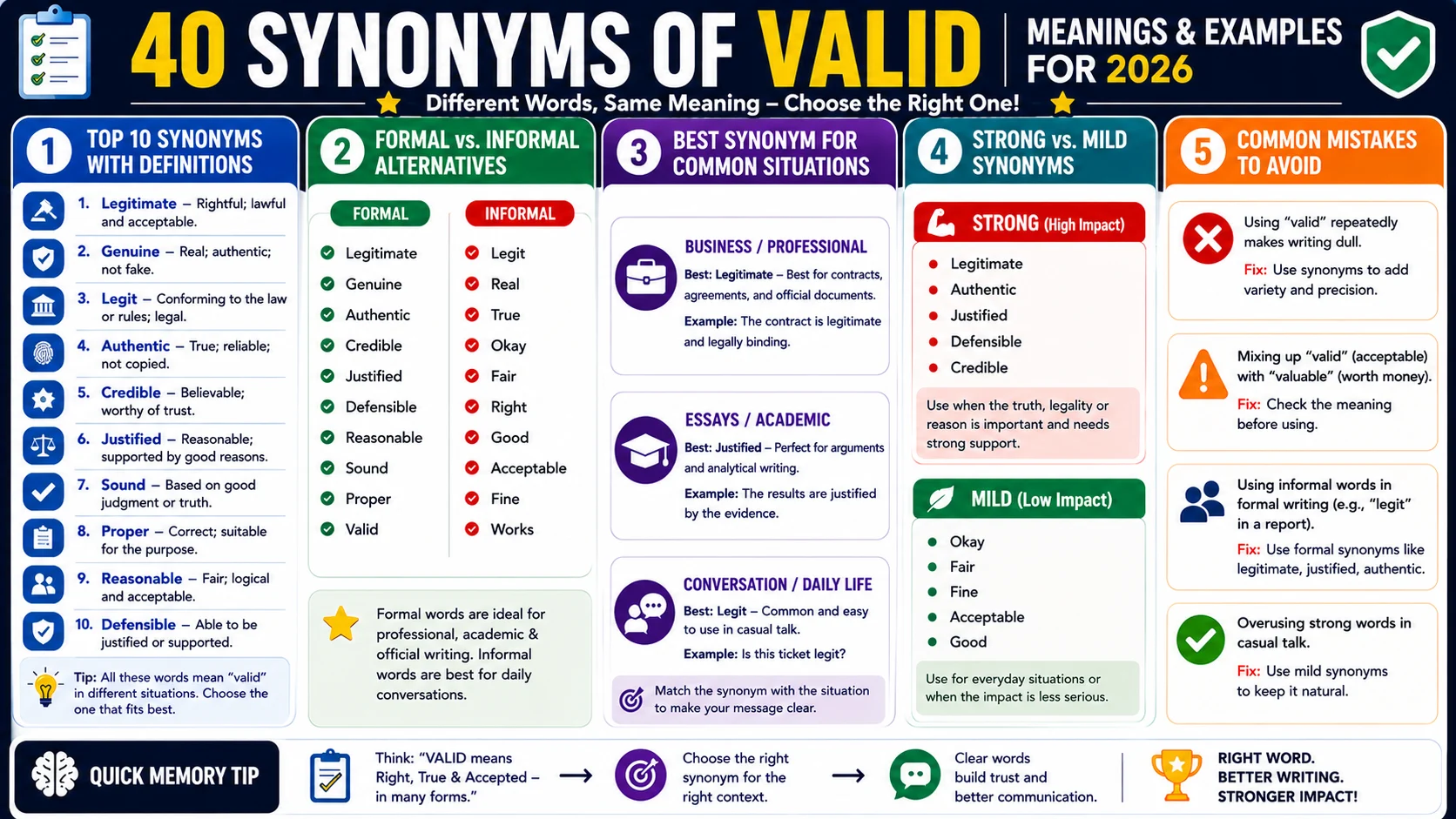
Valid” means something is true, reasonable, or legally acceptable. The best synonyms are legitimate, authentic, reasonable, sound, and logical. “Legitimate” is the most common natural alternative. Each synonym has a slightly different meaning and context where it fits best.
Top 10 Synonyms
- Legitimate
- Authentic
- Reasonable
- Sound
- Logical
- Justifiable
- Binding
- Legal
- Acceptable
- Valid
“Valid” is a word we use in many contexts. We talk about valid arguments, valid tickets, valid passports, and valid opinions. It’s useful, but using it too often can make your English feel repetitive.
Think about it. You can say an argument is valid, a ticket is valid, a passport is valid, or a point is valid. Each situation might need a different word that captures the specific type of validity.
In this guide, you’ll learn 35 powerful synonyms for “valid.” You’ll discover exactly when to use each one, how formal they are, and what common mistakes to avoid. Let’s begin!
What Does “Valid” Mean?
Definition
Valid” means something is true, reasonable, or legally acceptable. It can describe arguments that make sense, documents that are officially accepted, or reasons that are logical and fair. When something is valid, it’s right or acceptable in the situation.
Pronunciation
| Feature | Value |
|---|---|
| US IPA | /ˈvælɪd/ |
| UK IPA | /ˈvælɪd/ |
| Syllables | 2 (val-id) |
| Tip | Stress the first syllable: “VAL-id” |
Grammar
| Grammar Feature | Information |
|---|---|
| Part of Speech | Adjective |
| Common Position | Before a noun or after a linking verb |
| Typical Pattern | Valid + noun / Subject + be + valid |
Examples:
- “He made a valid point.” (before noun)
- “Your passport is still valid.” (after verb)
- “The argument is valid.” (after verb)
Grammar Note: “Valid” can be used with “still” to show something remains acceptable, like a ticket or passport.
Word Family
| Word | Part of Speech | Meaning |
|---|---|---|
| Valid | Adjective | True, reasonable, or legally acceptable |
| Validity | Noun | The quality of being valid |
| Validate | Verb | To confirm as valid |
| Invalid | Adjective | Not valid |
| Validation | Noun | The act of confirming validity |
15 Synonyms of “Valid”
Legitimate
Meaning: Legal, acceptable, or valid according to the rules.
Best Used For: Legal contexts, authority, businesses.
Formality: Formal
Tone: Official, Acceptable
Frequency: ⭐⭐⭐⭐⭐ (Very Common)
CEFR Level: B2
Example Sentence 1: “She has a legitimate reason for being late.
Example Sentence 2: “The business is completely legitimate.
Usage Tip: “Legitimate” emphasizes being legal and acceptable by rules or laws. Use it for official contexts.
Common Confusion: Legitimate vs Valid. “Legitimate” often suggests legal or rightful. “Valid” is broader and includes logical arguments.
Authentic
Meaning: Real, genuine, and not a copy.
Best Used For: Products, art, experiences, documents.
Formality: Neutral
Tone: Genuine, Real
Frequency: ⭐⭐⭐⭐ (Common)
CEFR Level: B2
Example Sentence 1: “The painting was confirmed as authentic.”
Example Sentence 2: “She gave an authentic account of the events.”
Usage Tip: “Authentic” is about being real and not fake. Use it for genuine items or experiences.
Reasonable
Meaning: Fair, sensible, and acceptable.
Best Used For: Requests, expectations, prices.
Formality: Neutral
Tone: Fair, Sensible
Frequency: ⭐⭐⭐⭐⭐ (Very Common)
CEFR Level: B1
Example Sentence 1: “His request seems reasonable.”
Example Sentence 2: “The price is reasonable for the quality.”
Usage Tip: “Reasonable” suggests something makes sense and is fair. It’s very common in everyday speech.
Sound
Meaning: Based on good sense, logic, or evidence.
Best Used For: Arguments, decisions, advice.
Formality: Neutral
Tone: Sensible, Well-founded
Frequency: ⭐⭐⭐⭐ (Common)
CEFR Level: B2
Example Sentence 1: “She gave some sound advice.”
Example Sentence 2: “The decision was based on sound reasoning.”
Usage Tip: “Sound” suggests something is well-grounded and makes sense. Use it for arguments and advice.
Logical
Meaning: Based on reason and clear thinking.
Best Used For: Arguments, conclusions, thinking.
Formality: Formal
Tone: Rational, Analytical
Frequency: ⭐⭐⭐⭐ (Common)
CEFR Level: B2
Example Sentence 1: “That seems like a logical conclusion.”
Example Sentence 2: “He made a logical argument.”
Usage Tip: “Logical” emphasizes reason and clear thinking. Use it for intellectual contexts.
Justifiable
Meaning: Reasonable and deserving of approval.
Best Used For: Actions, decisions, reasons.
Formality: Formal
Tone: Defensible, Acceptable
Frequency: ⭐⭐⭐ (Moderate)
CEFR Level: B2
Example Sentence 1: “His anger was justifiable.”
Example Sentence 2: “The decision was justifiable under the circumstances.”
Usage Tip: “Justifiable” means something can be defended or explained. It’s formal and often used for actions.
Binding
Meaning: Legally valid and impossible to break.
Best Used For: Contracts, agreements, laws.
Formality: Formal
Tone: Legal, Official
Frequency: ⭐⭐⭐ (Moderate)
CEFR Level: C1
Example Sentence 1: “The contract is legally binding.”
Example Sentence 2: “They signed a binding agreement.”
Usage Tip: “Binding” is a legal term for agreements that cannot be broken. Use it in legal contexts.
Legal
Meaning: Allowed by law.
Best Used For: Documents, actions, situations.
Formality: Formal
Tone: Legal, Official
Frequency: ⭐⭐⭐⭐⭐ (Very Common)
CEFR Level: B1
Example Sentence 1: “Is it legal to park here?”
Example Sentence 2: “He has a legal right to be there.”
Usage Tip: “Legal” is about what the law allows. Use it for official and legal contexts.
Acceptable
Meaning: Satisfactory and allowed.
Best Used For: Behavior, performance, standards.
Formality: Neutral
Tone: Satisfactory, Allowed
Frequency: ⭐⭐⭐⭐⭐ (Very Common)
CEFR Level: B1
Example Sentence 1: “That behavior is not acceptable.”
Example Sentence 2: “The results were acceptable.”
Usage Tip: “Acceptable” suggests something meets the minimum standards.
Established
Meaning: Proved valid or confirmed over time.
Best Used For: Facts, practices, businesses.
Formality: Formal
Tone: Confirmed, Trusted
Frequency: ⭐⭐⭐ (Moderate)
CEFR Level: B2
Example Sentence 1: “This is an established fact.”
Example Sentence 2: “She works for an established company.”
Usage Tip: “Established” suggests long-term validity or acceptance.
Solid
Meaning: Strong, reliable, and valid.
Best Used For: Arguments, evidence, relationships.
Formality: Informal
Tone: Strong, Reliable
Frequency: ⭐⭐⭐⭐ (Common)
CEFR Level: B2
Example Sentence 1: “We need solid evidence.”
Example Sentence 2: “Her argument was solid.”
Usage Tip: “Solid” is informal but suggests strength and reliability.
Feasible
Meaning: Possible and valid enough to do.
Best Used For: Plans, ideas, solutions.
Formality: Formal
Tone: Possible, Practical
Frequency: ⭐⭐⭐ (Moderate)
CEFR Level: B2
Example Sentence 1: “The plan is feasible.”
Example Sentence 2: “Is that a feasible solution?”
Usage Tip: “Feasible” suggests something is possible and makes sense.
Credible
Meaning: Believable and trustworthy.
Best Used For: Sources, arguments, people.
Formality: Formal
Tone: Trustworthy, Believable
Frequency: ⭐⭐⭐ (Moderate)
CEFR Level: B2
Example Sentence 1: “Is this a credible source?
Example Sentence 2: “The witness gave a credible account.”
Usage Tip: “Credible” is about being believable. Use it for sources and people you can trust.
Tenable
Meaning: Valid and able to be defended.
Best Used For: Arguments, positions, theories.
Formality: Formal
Tone: Defensible, Logical
Frequency: ⭐⭐ (Rare)
CEFR Level: C1
Example Sentence 1: “His theory is no longer tenable.”
Example Sentence 2: “That position is not tenable.”
Usage Tip: “Tenable” is a formal word for a position that can be defended logically.
Official
Meaning: Formal and approved by authority.
Best Used For: Documents, announcements, rules.
Formality: Formal
Tone: Official, Authorized
Frequency: ⭐⭐⭐⭐ (Common)
CEFR Level: B2
Example Sentence 1: “The document is official.”
Example Sentence 2: “We received official approval.”
Usage Tip: “Official” suggests formal approval from authority.
Synonyms Comparison Table
| Synonym | Best Context | Formality | Tone | Frequency |
|---|---|---|---|---|
| Legitimate | Legal contexts | Formal | Official | ⭐⭐⭐⭐⭐ |
| Reasonable | Fairness, sense | Neutral | Fair | ⭐⭐⭐⭐⭐ |
| Sound | Arguments, advice | Neutral | Sensible | ⭐⭐⭐⭐ |
| Logical | Thinking, arguments | Formal | Rational | ⭐⭐⭐⭐ |
| Authentic | Real, genuine | Neutral | Genuine | ⭐⭐⭐⭐ |
| Acceptable | Standards | Neutral | Satisfactory | ⭐⭐⭐⭐⭐ |
| Legal | Law-related | Formal | Legal | ⭐⭐⭐⭐⭐ |
| Justifiable | Actions, reasons | Formal | Defensible | ⭐⭐⭐ |
| Credible | Sources, people | Formal | Trustworthy | ⭐⭐⭐ |
Best Synonyms by Situation
| Situation | Best Synonym | Why It Works |
|---|---|---|
| Daily Conversation | Reasonable | Natural and common |
| Business Email | Legitimate | Professional and clear |
| Academic Writing | Logical | Formal and precise |
| School Assignment | Reasonable | Clear and simple |
| Professional Meeting | Justifiable | Sounds thoughtful |
| Presentation | Sound | Clear and credible |
| Creative Writing | Authentic | Adds depth |
| Social Media | Valid | Casual and relatable |
| Legal Context | Legitimate | Formal and correct |
Formal vs Informal Synonyms
Formal Alternatives
| Synonym | Best Used For |
|---|---|
| Legitimate | Legal contexts |
| Justifiable | Actions, decisions |
| Logical | Arguments, thinking |
| Credible | Sources, people |
| Tenable | Theories, positions |
Neutral Alternatives
| Synonym | Best Used For |
|---|---|
| Reasonable | Most situations |
| Sound | Arguments, advice |
| Acceptable | Standards |
| Authentic | Real, genuine |
Informal Alternatives
| Synonym | Best Used For |
|---|---|
| Solid | Strong arguments |
| Legal | Simple legal contexts |
| Valid | General use |
Choosing the Right Level: Use “legitimate” and “justifiable” for formal writing. Use “reasonable” and “sound” for most situations.
Strong vs Mild Synonyms
Mild
Suitable for everyday situations with less intensity.
- Acceptable
- Reasonable
- Valid (itself)
Moderate
More specific or noticeable alternatives.
- Sound
- Logical
- Authentic
- Legitimate
Strong
High-intensity alternatives suggesting strong validity.
- Binding (legally unbreakable)
- Justifiable (fully defensible)
- Tenable (logically defensible)
- Established (proven over time)
How Intensity Changes Meaning: “It’s acceptable” is mild. “It’s a binding agreement” is strong. Choose stronger words when you want to emphasize unbreakable validity.
Real-Life Examples
School: “That’s a valid point about the homework.”
Office: “We need to make sure the contract is legally valid.”
Business Email: “Your concerns are legitimate and will be addressed.”
Meetings: “We need a sound strategy for the project.”
Presentations: “His argument is logical and well-supported.”
Daily Conversations: “That seems like a reasonable request.”
Social Media: “Is this website a credible source?”
Academic Writing: “The study provides valid evidence.”
Common Collocations
| Common Phrase | Better Alternative |
|---|---|
| Valid point | Reasonable point |
| Valid argument | Sound argument |
| Valid reason | Legitimate reason |
| Valid passport | Valid passport (unchanged) |
| Valid evidence | Credible evidence |
Common Phrases
Stand to reason: To be logical or valid. (e.g., “It stands to reason that we should check.”)
Hold water: To be valid or sound. (e.g., “His excuse doesn’t hold water.”)
Make sense: To be logical or valid. (e.g., “That makes sense to me.”)
Ring true: To seem valid or credible. (e.g., “His story rings true.”)
Fair enough: Acceptable or valid. (e.g., “Fair enough, I understand.”)
Context Guide
| Situation | Best Synonym | Reason |
|---|---|---|
| Essay | Logical | Academic and formal |
| Speech | Sound | Clear and credible |
| Business Email | Legitimate | Professional and clear |
| Novel | Authentic | Adds literary depth |
| Presentation | Sound | Clear and professional |
| Conversation | Reasonable | Natural and relatable |
| Academic Writing | Logical | Precise and formal |
| Marketing Copy | Legitimate | Trustworthy and credible |
Related Words
Near Synonyms
- Genuine: Real and authentic.
- True: Correct and factual.
- Right: Correct or acceptable.
- Proper: Appropriate and correct.
- Authorized: Officially approved.
Antonyms
- Invalid: Not valid.
- Fake: Not real.
- False: Not true.
- Illegitimate: Not legal.
- Unreasonable: Not fair or sensible.
Related Adjectives
- Valid: Acceptable.
- Genuine: Real.
- Authentic: Real and original.
- Legitimate: Legal.
- Credible: Believable.
Related Nouns
- Validity: The quality of being valid.
- Legitimacy: The quality of being legal.
- Logic: Reason and sense.
- Soundness: The quality of being sound.
- Authenticity: The quality of being real.
Related Verbs
- Validate: To confirm as valid.
- Verify: To check if true.
- Confirm: To state as true.
- Justify: To show as reasonable.
Frequently Asked Questions
What is another word for valid?
Common synonyms include legitimate, authentic, reasonable, sound, and logical. “Legitimate” is the most common and direct alternative.
Which synonym sounds the most professional?
Legitimate and logical sound very professional. “Justifiable” is also excellent for formal contexts.
What is the strongest synonym for valid?
Binding and tenable are among the strongest synonyms. “Binding” suggests legal unbreakability. “Tenable” suggests logical defensibility.
Which synonym is best for essays?
Logical is the best choice for academic essays. It’s formal and precise.
What’s the difference between valid and legitimate?
“Valid” is broader and includes logical arguments. “Legitimate” is more specific to legal or rightful contexts.
Which synonym is most common in everyday English?
“Reasonable” and “acceptable” are very common in everyday speech. “Legitimate” is also frequently used.
What is the opposite of valid?
Common opposites are invalid, fake, false, and unreasonable. These words describe things that are not valid.
Conclusion
“Valid” is a useful word, but now you have 35 fantastic alternatives. Each synonym adds a different shade of meaning to your language.
Remember, the key is understanding the context. Use C ” legitimate” for legal and official contexts. Use “reasonable” for everyday situations. Use “logical” for academic writing. Use “sound” for well-grounded arguments.
The best way to improve is practice. Try using one or two new synonyms each day. Listen for these words in conversations and books. Your vocabulary will become richer and more impressive with time.
