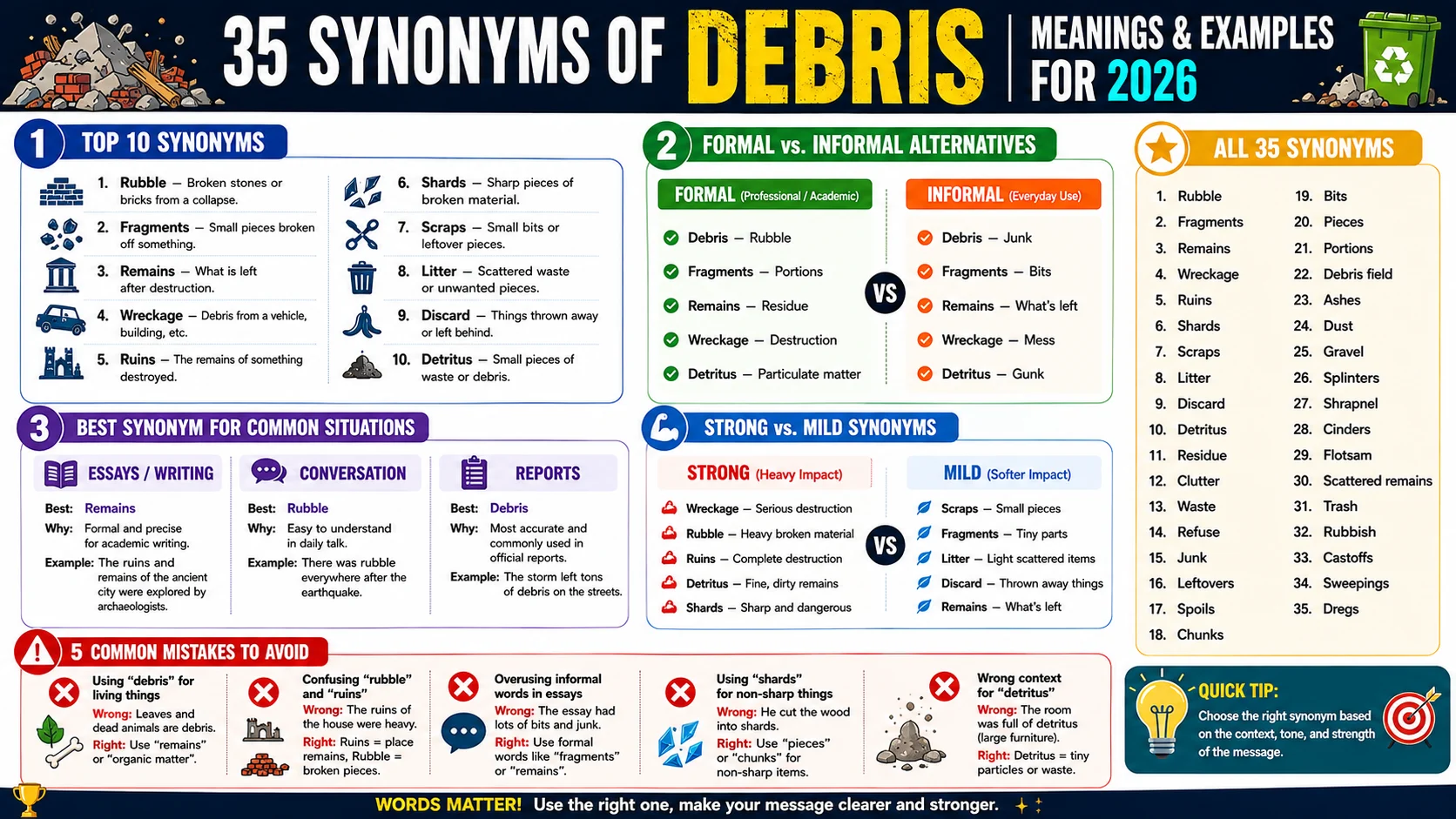
“Debris” means scattered pieces of waste, rubbish, or broken material. The best synonyms are rubble, wreckage, remains, fragments, and scraps. “Rubble” is the most common natural alternative for building debris. Each synonym has a slightly different meaning and context where it fits best.
Top 10 Synonyms
- Rubble
- Wreckage
- Remains
- Fragments
- Scraps
- Ruins
- Detritus
- Litter
- Refuse
- Waste
“Debris” is a useful word. It describes broken pieces of things, often after destruction or damage. But using it too often can make your English feel repetitive and basic.
Think about it. There’s debris after a storm, debris at a construction site, debris in space, or debris on the ground after a party. Each situation might need a different word that captures the exact type of scattered material.
In this guide, you’ll learn 35 powerful synonyms for “debris.” You’ll discover exactly when to use each one, how formal they are, and what common mistakes to avoid. Let’s begin!
What Does “Debris” Mean?
Definition
Debris” means scattered pieces of broken, destroyed, or waste material. It can be from buildings after a disaster, rocks after a landslide, or even small pieces of trash on the ground. Debris is usually the remains of something that was once whole.
Pronunciation
| Feature | Value |
|---|---|
| US IPA | /dəˈbriː/ |
| UK IPA | /ˈdebriː/ |
| Syllables | 2 (de-bris) |
| Tip | Stress the second syllable in US: “duh-BREE” |
Grammar
| Grammar Feature | Information |
|---|---|
| Part of Speech | Noun (uncountable) |
| Common Position | Subject or object |
| Typical Pattern | Debris + from + source / Debris + of + something |
Examples:
- “The street was covered in debris after the storm.”
- “Workers cleared the debris from the construction site.”
- “Space debris is becoming a serious problem.”
Grammar Note: “Debris” is an uncountable noun. We don’t say “debrises.” It’s always singular, even when referring to many pieces.
Word Family
| Word | Part of Speech | Meaning |
|---|---|---|
| Debris | Noun | Scattered broken material |
| Debris-filled | Adjective | Containing debris |
15 Synonyms of “Debris”
Rubble
Meaning: Broken pieces of stone, brick, or concrete from destroyed buildings.
Best Used For: Construction, building damage, earthquakes, demolitions.
Formality: Neutral
Tone: Practical, Physical
Frequency: ⭐⭐⭐⭐⭐ (Very Common)
CEFR Level: B1
Example Sentence 1: “Rescue workers searched through the rubble for survivors.”
Example Sentence 2: “The old building was reduced to rubble.”
Usage Tip: “Rubble” is the best word for broken building materials. Use it for construction sites and destroyed structures.
Wreckage
Meaning: The remains of something that has been destroyed, especially vehicles or buildings.
Best Used For: Car accidents, plane crashes, shipwrecks, disasters.
Formality: Neutral
Tone: Dramatic, Serious
Frequency: ⭐⭐⭐⭐ (Common)
CEFR Level: B2
Example Sentence 1: “The wreckage of the plane was found in the mountains.”
Example Sentence 2: “Firefighters pulled survivors from the wreckage.”
Usage Tip: “Wreckage” is often used for vehicles and transportation accidents. It suggests serious destruction.
Remains
Meaning: The parts of something that are left after destruction or decay.
Best Used For: Archaeological sites, fires, historical ruins.
Formality: Formal
Tone: Serious, Historical
Frequency: ⭐⭐⭐⭐ (Common)
CEFR Level: B2
Example Sentence 1: “The remains of the ancient temple were discovered.”
Example Sentence 2: “All that remained was the burnt remains of the house.”
Usage Tip: “Remains” is formal and often used for historical or scientific contexts. It can also refer to human remains.
Fragments
Meaning: Small pieces or parts that have broken off from something.
Best Used For: Glass, pottery, bones, documents.
Formality: Neutral
Tone: Precise, Practical
Frequency: ⭐⭐⭐⭐ (Common)
CEFR Level: B2
Example Sentence 1: “Archaeologists found fragments of ancient pottery.”
Example Sentence 2: “Fragments of glass covered the floor.”
Usage Tip: “Fragments” suggests small, often sharp pieces. It’s great for broken materials like glass or pottery.
Scraps
Meaning: Small pieces of something, often leftover or unwanted.
Best Used For: Food, paper, cloth, building materials.
Formality: Informal
Tone: Casual, Practical
Frequency: ⭐⭐⭐⭐ (Common)
CEFR Level: B1
Example Sentence 1: “She collected scraps of paper for recycling.”
Example Sentence 2: “The dog ate the scraps from the dinner table.”
Usage Tip: “Scraps” is informal and often used for leftover food, paper, or fabric. It suggests something small and leftover.
Ruins
Meaning: The remains of buildings or structures that are badly damaged or destroyed.
Best Used For: Historical sites, abandoned buildings, ancient cities.
Formality: Formal
Tone: Historical, Poetic
Frequency: ⭐⭐⭐⭐ (Common)
CEFR Level: B2
Example Sentence 1: “We visited the ruins of the ancient city.”
Example Sentence 2: “The castle now lies in ruins.”
Usage Tip: “Ruins” is used for old, historical structures that are still standing but damaged.
Detritus
Meaning: Waste, debris, or loose material that is left over.
Best Used For: Scientific writing, geological contexts, environmental descriptions.
Formality: Formal
Tone: Scientific, Analytical
Frequency: ⭐⭐⭐ (Moderate)
CEFR Level: C1
Example Sentence 1: “The stream was full of detritus from the forest.”
Example Sentence 2: “Detritus from the factory polluted the river.”
Usage Tip: “Detritus” is a formal, scientific word for waste or leftover material, often in nature.
Litter
Meaning: Waste or trash that has been left out in a public place.
Best Used For: Parks, streets, environmental contexts.
Formality: Neutral
Tone: Practical, Environmental
Frequency: ⭐⭐⭐⭐ (Common)
CEFR Level: B1
Example Sentence 1: “Please don’t leave litter in the park.”
Example Sentence 2: “Volunteers cleaned up the litter on the beach.
Usage Tip: “Litter” specifically refers to trash left in public spaces. It’s a common word in environmental contexts.
Refuse
Meaning: Waste or unwanted materials.
Best Used For: Formal writing, waste management, official contexts.
Formality: Formal
Tone: Official, Formal
Frequency: ⭐⭐⭐ (Moderate)
CEFR Level: B2
Example Sentence 1: “The truck collects refuse every Tuesday.”
Example Sentence 2: “The refuse was taken to the landfill.”
Usage Tip: “Refuse” is a formal word for garbage or waste. Use it in official or formal contexts.
Waste
Meaning: Materials that are not wanted and have been thrown away.
Best Used For: General contexts, environmental discussions.
Formality: Neutral
Tone: Practical, Environmental
Frequency: ⭐⭐⭐⭐⭐ (Very Common)
CEFR Level: A2
Example Sentence 1: “The factory produces a lot of waste.”
Example Sentence 2: “We need to reduce food waste.
Usage Tip: “Waste” is a very general word for unwanted materials. It’s common in everyday speech.
Garbage
Meaning: Waste or unwanted materials.
Best Used For: Informal contexts, everyday speech.
Formality: Informal
Tone: Casual, Direct
Frequency: ⭐⭐⭐⭐⭐ (Very Common)
CEFR Level: A2
Example Sentence 1: “Please take out the garbage.”
Example Sentence 2: “The garbage truck comes on Mondays.”
Usage Tip: “Garbage” is informal and used in everyday conversation. It’s the American word for household waste.
Trash
Meaning: Waste or unwanted materials.
Best Used For: Informal contexts, everyday speech.
Formality: Informal
Tone: Casual, Direct
Frequency: ⭐⭐⭐⭐⭐ (Very Common)
CEFR Level: A2
Example Sentence 1: “Throw the empty can in the trash.”
Example Sentence 2: “The park was full of trash.”
Usage Tip: “Trash” is informal American English. It’s very common in everyday speech.
Debris (general)
Meaning: Broken or scattered pieces.
Best Used For: General contexts.
Formality: Neutral
Tone: Practical
Frequency: ⭐⭐⭐⭐⭐ (Very Common)
CEFR Level: B1
Example Sentence 1: “The road was blocked by debris.”
Example Sentence 2: “Helicopters flew over the debris field.”
Usage Tip: The word “debris” itself works in many contexts. Use it when you want a general word.
Leavings
Meaning: What is left behind or remains.
Best Used For: Formal, literary contexts.
Formality: Formal
Tone: Literary, Reflective
Frequency: ⭐⭐ (Rare)
CEFR Level: C1
Example Sentence 1: “The leavings of the feast were given to the people with low-income.”
Example Sentence 2: “The archaeologists studied the leavings of the ancient village.”
Usage Tip: “Leavings” is a formal, somewhat old-fashioned word. Use it in literary or historical writing.
Shards
Meaning: Broken pieces of glass, ceramic, or pottery.
Best Used For: Broken glass, pottery, sharp fragments.
Formality: Neutral
Tone: Sharp, Precise
Frequency: ⭐⭐⭐ (Moderate)
CEFR Level: B2
Example Sentence 1: “Shards of glass were everywhere.”
Example Sentence 2: “Archaeologists found shards of ancient bowls.”
Usage Tip: “Shards” is the specific word for sharp, broken pieces of glass or pottery. Use it for archaeological or injury contexts.
Synonyms Comparison Table
| Synonym | Best Context | Formality | Tone | Frequency |
|---|---|---|---|---|
| Rubble | Building debris | Neutral | Practical | ⭐⭐⭐⭐⭐ |
| Waste | General unwanted | Neutral | Practical | ⭐⭐⭐⭐⭐ |
| Garbage | Household waste | Informal | Casual | ⭐⭐⭐⭐⭐ |
| Trash | Household waste | Informal | Casual | ⭐⭐⭐⭐⭐ |
| Wreckage | Accidents, vehicles | Neutral | Dramatic | ⭐⭐⭐⭐ |
| Remains | Historical, scientific | Formal | Serious | ⭐⭐⭐⭐ |
| Litter | Public trash | Neutral | Environmental | ⭐⭐⭐⭐ |
| Fragments | Small broken pieces | Neutral | Precise | ⭐⭐⭐⭐ |
| Ruins | Historical sites | Formal | Historical | ⭐⭐⭐⭐ |
| Refuse | Official waste | Formal | Official | ⭐⭐⭐ |
Best Synonyms by Situation
| Situation | Best Synonym | Why It Works |
|---|---|---|
| Daily Conversation | Garbage / Trash | Natural and casual |
| Business Email | Waste | Professional and clear |
| Academic Writing | Detritus | Formal and precise |
| School Assignment | Rubble | Clear and descriptive |
| Professional Meeting | Remains | Serious and formal |
| Presentation | Debris | Clear and direct |
| Creative Writing | Ruins | Adds literary depth |
| Social Media | Litter | Environmental and relatable |
| Accident Report | Wreckage | Serious and accurate |
Formal vs Informal Synonyms
Formal Alternatives
| Synonym | Best Used For |
|---|---|
| Refuse | Official waste management |
| Detritus | Scientific, environmental |
| Remains | Historical, archaeological |
| Ruins | Historical sites |
| Leavings | Literary, historical |
Neutral Alternatives
| Synonym | Best Used For |
|---|---|
| Debris | Most general situations |
| Rubble | Building materials |
| Fragments | Small broken pieces |
| Wreckage | Accidents, vehicles |
| Litter | Public waste |
Informal Alternatives
| Synonym | Best Used For |
|---|---|
| Garbage | Household waste (American) |
| Trash | Household waste (American) |
| Scraps | Leftover pieces |
| Junk | Old unwanted items |
Choosing the Right Level: Use “refuse” and “detritus” for formal writing. Use “garbage” and “trash” for casual contexts. Use “debris” and “rubble” for most neutral situations.
Strong vs Mild Synonyms
Mild
Suitable for everyday situations with less intensity.
- Waste
- Litter
- Scraps
Moderate
More specific or noticeable alternatives.
- Rubble
- Fragments
- Remains
- Debris
Strong
High-intensity alternatives suggesting significant damage.
- Wreckage (severe destruction)
- Ruins (historical destruction)
- Detritus (scientific, leftover)
- Shards (sharp, dangerous pieces)
How Intensity Changes Meaning: “There’s waste on the ground” is mild. “There’s wreckage everywhere” is dramatic. Choose stronger words when you want to emphasize destruction or danger.
Real-Life Examples
School: “After the fire, the classroom was filled with debris.”
Office: “Workers cleared the rubble from the construction site.”
Business Email: “Please dispose of the refuse according to regulations.”
Meetings: “The wreckage from the accident has been cleared.”
Presentations: “Space debris is a growing concern.”
Daily Conversations: “Please take out the garbage before you leave.”
Social Media: “Let’s clean up the litter in our neighborhood!”
Academic Writing: “The site contained detritus from multiple historical periods.”
Common Collocations
| Common Phrase | Better Alternative |
|---|---|
| Debris field | Rubble field / Wreckage site |
| Building debris | Rubble |
| Space debris | Space junk |
| Storm debris | Storm damage debris |
| Debris removal | Rubble removal |
Common Phrases
Rubble and debris: Broken materials. (e.g., “The street was full of rubble and debris.”)
In ruins: Completely destroyed. (e.g., “The building is now in ruins.”)
Waste away: To gradually become weak. (e.g., “The old house is wasting away.”)
Shards of glass: Broken glass pieces. (e.g., “Shards of glass were everywhere.”)
Pick through the rubble: To search through debris. (e.g., “They picked through the rubble for survivors.”)
Clear the debris: To remove rubble. (e.g., “Crews worked to clear the debris.”)
Context Guide
| Situation | Best Synonym | Reason |
|---|---|---|
| Essay | Detritus | Academic and precise |
| Speech | Rubble | Clear and visual |
| Business Email | Refuse | Professional |
| Novel | Ruins | Literary and evocative |
| Presentation | Debris | Clear and direct |
| Conversation | Garbage / Trash | Natural and casual |
| Academic Writing | Detritus | Precise and formal |
| Marketing Copy | Avoid negative words | Not appropriate |
Related Words
Near Synonyms
- Junk: Old, unwanted things. (e.g., “The garage is full of junk.”)
- Jumble: A messy collection. (e.g., “A jumble of broken items.”)
- Mullock: Waste rock from mining (Australian).
- Spoil: Waste from excavation or digging.
- Discards: Things thrown away.
Antonyms
- Treasure: Valuable things.
- Artifacts: Valuable historical items.
- Keepsakes: Valuable sentimental items.
- Mementos: Items kept for memories.
- Prizes: Valuable awards.
Related Adjectives
- Broken: In pieces.
- Scattered: Spread around.
- Ruined: Destroyed.
- Abandoned: Left behind.
- Derelict: In bad condition.
Related Nouns
- Rubble: Broken building materials.
- Wreckage: Remains of destruction.
- Refuse: Waste materials.
- Litter: Public waste.
- Fragments: Small broken pieces.
Related Verbs
- Clear: To remove debris.
- Clean up: To remove waste.
- Demolish: To destroy buildings.
- Scatter: To spread around.
- Sweep: To clean debris.
Frequently Asked Questions
What is another word for debris?
Common synonyms include rubble, wreckage, remains, fragments, scraps, and waste. “Rubble” is the most common for building debris.
Which synonym sounds the most professional?
Refuse and detritus sound the most professional. “Refuse” is used in official contexts, and “detritus” is used in scientific writing.
What is the strongest synonym for debris?
Wreckage is one of the strongest synonyms, suggesting severe destruction. “Ruins” is also strong for historical destruction.
Which synonym is best for essays?
Detritus is excellent for academic essays, especially in scientific contexts. “Remains” is also good for historical topics.
What’s the difference between debris and rubble?
“Rubble” specifically refers to broken building materials like stone and brick. “Debris” is broader and includes any scattered broken material.
Which synonym is most common in everyday English?
“Garbage” and “trash” are very common in everyday speech. “Waste” is also frequently used.
What is the opposite of debris?
Common opposites are treasure, artifacts, and keepsakes. These words describe valuable items that are not waste.
Conclusion
“Debris” is a useful word, but now you have 35 fantastic alternatives. Each synonym adds a different shade of meaning to your language.
Remember, the key is understanding the context. Use “rubble” for building materials. Use “wreckage” for accidents and disasters. Use “remains” for historical contexts. Use “garbage” and “trash” for everyday conversation.
The best way to improve is practice. Try using one or two new synonyms each day. Listen for these words in conversations and books. Your vocabulary will become richer and more expressive with time.
