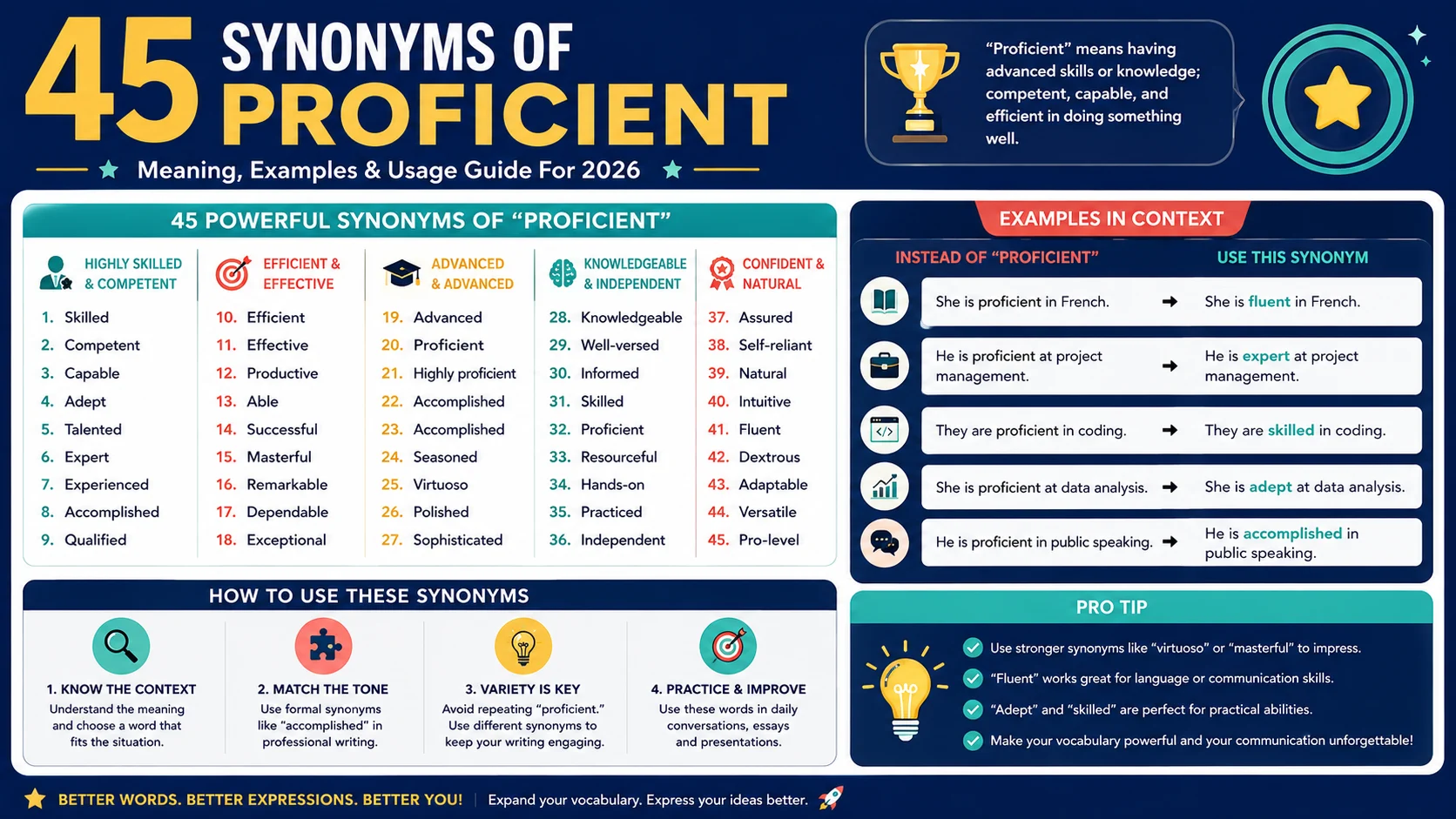
Proficient means skilled and competent at something. The best synonyms include skilled, competent, adept, expert, capable, accomplished, masterful, talented, qualified, and professional. The most common everyday synonym is skilled, while adept works well for natural ability. Each synonym has a slightly different meaning, tone, or context, so choose carefully based on your situation.
Top 10 Synonyms
- Skilled
- Competent
- Adept
- Expert
- Capable
- Accomplished
- Masterful
- Talented
- Qualified
- Professional
Every synonym has a slightly different meaning, tone, or context, so choose carefully based on your situation.
Have you ever described someone as “proficient” but felt the word didn’t quite capture their true ability? You’re not alone. It’s a useful word, but overusing it makes your writing sound repetitive and dull.
Learning synonyms for “proficient” helps you express skill levels more precisely. Whether you’re writing a resume, describing a colleague, or talking about your own abilities, having the right word makes your English sound more natural and impressive.
In this guide, you’ll discover 35 powerful alternatives to “proficient.” You’ll learn their meanings, when to use them, and which ones native speakers prefer in different situations. Let’s begin!
What Does “Proficient” Mean?
Definition
Proficient means having a high level of skill or competence in a particular area. It describes someone who can perform tasks well because they have learned and practiced extensively.
In everyday terms, think of it like this: a proficient driver handles the car smoothly in all conditions. A proficient speaker expresses ideas clearly and confidently. It’s not just knowing something it’s being able to use that knowledge effectively.
Proficient can describe:
- Skills (“She is proficient in Spanish”)
- Abilities (“He is proficient at coding”)
- Performance (“The team showed proficient handling of the crisis”)
Pronunciation
| Feature | Value |
|---|---|
| US IPA | /prəˈfɪʃ.ənt/ |
| UK IPA | /prəˈfɪʃ.ənt/ |
| Syllables | 3 (pro-fi-cient) |
| Tip | Stress the second syllable: pro-FI-cient |
Grammar
| Grammar Feature | Information |
|---|---|
| Part of Speech | Adjective |
| Common Position | Before a noun or after a linking verb |
| Typical Pattern | proficient + in/at + noun/gerund |
Example Sentences:
- “She is proficient in three languages.”
- “He is proficient at solving complex problems.”
- “The team showed proficient project management skills.”
Grammar Note: Use “in” for general areas (“proficient in English”) and “at” for specific actions (“proficient at writing reports”).
Word Family
| Word | Part of Speech | Meaning |
|---|---|---|
| Proficient | Adjective | Skilled and competent |
| Proficiency | Noun | The state of being skilled |
| Proficiently | Adverb | In a skilled manner |
| Proficience | Noun (rare) | Skill, competence |
45 Synonyms of “Proficient”
1. Skilled
Meaning: Having natural ability or training to do something well.
Best Used For: Daily conversation, resumes, general descriptions.
Formality: Neutral
Tone: Positive, Capable
Frequency: ⭐⭐⭐⭐⭐ Very Common
CEFR Level: B1
Example Sentence 1: “She is a skilled negotiator who always gets the best deals.
Example Sentence 2: “The skilled craftsman created beautiful furniture.”
Usage Tip: “Skilled” is the most common everyday alternative. Use it when you want to be clear and natural. It works in almost any context.
2. Competent
Meaning: Having enough skill to do something successfully.
Best Used For: Professional contexts, job descriptions, formal writing.
Formality: Formal
Tone: Professional, Reliable
Frequency: ⭐⭐⭐⭐⭐ Very Common
CEFR Level: B1
Example Sentence 1: “She is a competent manager who handles challenges well.”
Example Sentence 2: “The team delivered competent work on the project.”
Usage Tip: “Competent” suggests meeting a minimum standard of skill. It’s professional but doesn’t mean exceptional. Use it for reliable performance.
3. Adept
Meaning: Very skilled at something; naturally talented.
Best Used For: Describing natural ability, creative skills.
Formality: Formal
Tone: Impressive, Natural
Frequency: ⭐⭐⭐⭐ Common
CEFR Level: B2
Example Sentence 1: “He is adept at reading people’s emotions.”
Example Sentence 2: “She is adept at finding creative solutions.”
Usage Tip: “Adept” suggests natural skill rather than learned ability. Use it when someone seems to have a gift for something.
4. Expert
Meaning: Having special knowledge or skill in a particular field.
Best Used For: Professional contexts, specialized fields.
Formality: Neutral to Formal
Tone: Authoritative, Knowledgeable
Frequency: ⭐⭐⭐⭐⭐ Very Common
CEFR Level: B1
Example Sentence 1: “She is an expert in digital marketing.”
Example Sentence 2: “The expert witness provided crucial testimony.”
Usage Tip: “Expert” suggests a very high level of skill. Use it for professionals with deep knowledge. It’s stronger than “proficient.”
5. Capable
Meaning: Having the ability to do something effectively.
Best Used For: Everyday situations, job descriptions.
Formality: Neutral
Tone: Dependable, Practical
Frequency: ⭐⭐⭐⭐⭐ Very Common
CEFR Level: B1
Example Sentence 1: “She is a capable leader who guides the team well.
Example Sentence 2: “He is capable of handling difficult customers.”
Usage Tip: “Capable” suggests having what it takes to get the job done. It’s practical and reliable. Use it when someone can be counted on.
6. Accomplished
Meaning: Highly skilled and successful in a particular field.
Best Used For: Resumes, professional profiles, formal contexts.
Formality: Formal
Tone: Impressive, Achieved
Frequency: ⭐⭐⭐⭐ Common
CEFR Level: B2
Example Sentence 1: “She is an accomplished pianist who has performed worldwide.”
Example Sentence 2: “The accomplished author published her fifth book.”
Usage Tip: “Accomplished” suggests proven success and recognition. Use it for people who have achieved notable things in their field.
7. Masterful
Meaning: Showing great skill and control.
Best Used For: Creative writing, performance, professional contexts.
Formality: Formal
Tone: Impressive, Controlled
Frequency: ⭐⭐⭐ Moderate
CEFR Level: B2
Example Sentence 1: “Her masterful performance captivated the audience.”
Example Sentence 2: “He handled the negotiation with masterful skill.”
Usage Tip: “Masterful” suggests exceptional control and expertise. Use it for impressive demonstrations of skill.
8. Talented
Meaning: Having natural ability or skill.
Best Used For: Creative fields, personal descriptions.
Formality: Neutral
Tone: Positive, Natural
Frequency: ⭐⭐⭐⭐⭐ Very Common
CEFR Level: B1
Example Sentence 1: “She is a talented artist who creates beautiful paintings.”
Example Sentence 2: “The talented musician played the violin beautifully.
Usage Tip: “Talented” suggests natural gift rather than learned skill. Use it for artistic abilities or natural aptitudes.
9. Qualified
Meaning: Having the necessary skills, knowledge, or credentials.
Best Used For: Job applications, professional contexts.
Formality: Formal
Tone: Professional, Certified
Frequency: ⭐⭐⭐⭐ Common
CEFR Level: B1
Example Sentence 1: “She is highly qualified for the position.”
Example Sentence 2: “The qualified engineer passed all the examinations.”
Usage Tip: “Qualified” suggests official certification or proven credentials. Use it for formal qualifications and job requirements.
10. Professional
Meaning: Having the skill and experience of a trained person.
Best Used For: Work contexts, formal descriptions.
Formality: Neutral to Formal
Tone: Professional, Reliable
Frequency: ⭐⭐⭐⭐⭐ Very Common
CEFR Level: B1
Example Sentence 1: “She is a professional photographer who does amazing work.”
Example Sentence 2: “He handled the situation in a professional manner.”
Usage Tip: “Professional” suggests meeting workplace standards. Use it for someone who acts and performs like a trained expert.
11. Apt
Meaning: Quick to learn or understand; naturally skilled.
Best Used For: Learning contexts, natural ability.
Formality: Formal
Tone: Intelligent, Quick
Frequency: ⭐⭐⭐ Moderate
CEFR Level: B2
Example Sentence 1: “She is apt at learning new languages quickly.”
Example Sentence 2: “He is apt at solving mathematical problems.”
Usage Tip: “Apt” suggests natural ability to learn or understand. Use it when someone picks things up quickly.
12. Gifted
Meaning: Having exceptional natural ability.
Best Used For: Describing exceptional talent.
Formality: Neutral
Tone: Special, Exceptional
Frequency: ⭐⭐⭐⭐ Common
CEFR Level: B1
Example Sentence 1: “She is a gifted musician who started playing at age three.”
Example Sentence 2: “The gifted student excelled in all subjects.
Usage Tip: “Gifted” suggests a special natural talent. Use it for people with exceptional abilities that seem innate.
13. Able
Meaning: Having the power, skill, or means to do something.
Best Used For: General use, everyday conversation.
Formality: Neutral
Tone: Capable, Practical
Frequency: ⭐⭐⭐⭐⭐ Very Common
CEFR Level: A2
Example Sentence 1: “She is able to speak four languages fluently.”
Example Sentence 2: “He is able to fix almost any mechanical problem.”
Usage Tip: “Able” is simple and versatile. Use it when you want to say someone can do something without emphasizing how well.
14. Seasoned
Meaning: Experienced and skilled through long practice.
Best Used For: Professional contexts, experienced professionals.
Formality: Neutral to Formal
Tone: Experienced, Wise
Frequency: ⭐⭐⭐⭐ Common
CEFR Level: B2
Example Sentence 1: “The seasoned journalist has worked for 30 years.”
Example Sentence 2: “She is a seasoned professional who knows the industry well.”
Usage Tip: “Seasoned” emphasizes experience and time in the field. Use it for people who have been doing something for a long time.
15. Versatile
Meaning: Able to do many different things well.
Best Used For: Describing broad skills, adaptable people.
Formality: Neutral
Tone: Adaptable, Flexible
Frequency: ⭐⭐⭐⭐ Common
CEFR Level: B2
Example Sentence 1: “She is a versatile performer who acts, sings, and dances.”
Example Sentence 2: “He is a versatile employee who can work in any department.”
Usage Tip: “Versatile” suggests skill in many areas. Use it when someone can adapt and succeed at different tasks.
16. Practiced
Meaning: Having skill gained through experience and practice.
Best Used For: Describing learned skills.
Formality: Neutral
Tone: Experienced, Polished
Frequency: ⭐⭐⭐ Moderate
CEFR Level: B2
Example Sentence 1: “She is a practiced public speaker who never gets nervous.”
Example Sentence 2: “His practiced hands made the task look easy.”
Usage Tip: “Practiced” emphasizes skill gained through repetition. Use it for skills that come from lots of practice.
17. Adroit
Meaning: Clever and skillfully quick in movement or thought.
Best Used For: Creative writing, describing cleverness.
Formality: Formal
Tone: Clever, Quick
Frequency: ⭐⭐ Rare
CEFR Level: C1
Example Sentence 1: “Her adroit handling of the situation impressed everyone.
Example Sentence 2: “He is adroit at finding diplomatic solutions.”
Usage Tip: “Adroit” is a sophisticated word for quick skillfulness. Use it for clever, nimble skill.
18. Dexterous
Meaning: Skillful with hands or mentally agile.
Best Used For: Physical skills, craftsmanship.
Formality: Formal
Tone: Nimble, Skillful
Frequency: ⭐⭐ Rare
CEFR Level: C1
Example Sentence 1: “The dexterous surgeon performed the delicate procedure.”
Example Sentence 2: “Her dexterous fingers moved quickly across the keyboard.”
Usage Tip: “Dexterous” is specific to manual or mental nimbleness. Use it for physical skill or quick thinking.
19. Savvy
Meaning: Having practical knowledge and good judgment.
Best Used For: Business, technology, practical situations.
Formality: Informal
Tone: Smart, Practical
Frequency: ⭐⭐⭐⭐ Common
CEFR Level: B2
Example Sentence 1: “She is tech-savvy and can fix any computer problem.”
Example Sentence 2: “The savvy businessman made smart investments.”
Usage Tip: “Savvy” suggests practical, street-smart intelligence. Use it for someone who understands things well.
20. Competent
Meaning: Having enough skill to do something successfully.
Best Used For: Professional contexts.
Formality: Formal
Tone: Professional, Reliable
Frequency: ⭐⭐⭐⭐⭐ Very Common
CEFR Level: B1
Example Sentence 1: “She is a competent nurse who handles emergencies well.”
Example Sentence 2: “The team delivered competent work on the project.”
Usage Tip: “Competent” suggests meeting professional standards. It’s reliable but doesn’t mean exceptional.
21. Polished
Meaning: Refined and skilled through practice.
Best Used For: Performance, professional presentation.
Formality: Neutral to Formal
Tone: Refined, Professional
Frequency: ⭐⭐⭐ Moderate
CEFR Level: B2
Example Sentence 1: “She gave a polished presentation that impressed the audience.”
Example Sentence 2: “His polished writing style shows years of practice.”
Usage Tip: “Polished” suggests refinement and professional finish. Use it for someone who is smooth and professional.
22. Experienced
Meaning: Having knowledge or skill from doing something over time.
Best Used For: General use, job contexts.
Formality: Neutral
Tone: Knowledgeable, Trustworthy
Frequency: ⭐⭐⭐⭐⭐ Very Common
CEFR Level: B1
Example Sentence 1: “She is an experienced teacher who has taught for 20 years.”
Example Sentence 2: “We need an experienced driver for the long trip.”
Usage Tip: “Experienced” emphasizes time and practice. Use it when someone has been doing something for a long time.
23. Efficient
Meaning: Working quickly and effectively without waste.
Best Used For: Work contexts, productivity.
Formality: Neutral to Formal
Tone: Productive, Organized
Frequency: ⭐⭐⭐⭐ Common
CEFR Level: B2
Example Sentence 1: “She is an efficient worker who always meets deadlines.”
Example Sentence 2: “The efficient team completed the project in half the time.
Usage Tip: “Efficient” emphasizes working well without wasting time or resources. Use it for productivity and speed.
24. Effective
Meaning: Producing the intended result; successful.
Best Used For: Describing results and success.
Formality: Neutral
Tone: Successful, Impactful
Frequency: ⭐⭐⭐⭐⭐ Very Common
CEFR Level: B1
Example Sentence 1: “She is an effective leader who achieves company goals.”
Example Sentence 2: “The effective treatment helped the patient recover quickly.”
Usage Tip: “Effective” emphasizes results. Use it when someone gets things done successfully.
25. Resourceful
Meaning: Good at finding solutions when problems arise.
Best Used For: Problem-solving situations.
Formality: Neutral
Tone: Creative, Practical
Frequency: ⭐⭐⭐⭐ Common
CEFR Level: B2
Example Sentence 1: “She is resourceful and always finds a way to solve problems.”
Example Sentence 2: “The resourceful traveler navigated the foreign city easily.”
Usage Tip: “Resourceful” emphasizes creative problem-solving. Use it for people who handle challenges well.
26. Handy
Meaning: Skillful at doing practical things.
Best Used For: Home repair, practical skills.
Formality: Informal
Tone: Practical, Useful
Frequency: ⭐⭐⭐⭐ Common
CEFR Level: B1
Example Sentence 1: “He is handy around the house and can fix anything.”
Example Sentence 2: “She is handy with a sewing machine.”
Usage Tip: “Handy” is informal and practical. Use it for DIY skills and practical abilities.
27. Accomplished
Meaning: Highly skilled and successful.
Best Used For: Resumes, formal contexts.
Formality: Formal
Tone: Impressive, Achieved
Frequency: ⭐⭐⭐⭐ Common
CEFR Level: B2
Example Sentence 1: “She is an accomplished researcher with many publications.”
Example Sentence 2: “The accomplished lawyer won every case.”
Usage Tip: “Accomplished” suggests proven success. Use it for people with notable achievements.
28. Knowledgeable
Meaning: Having a lot of information about something.
Best Used For: Describing understanding and expertise.
Formality: Neutral
Tone: Informed, Intelligent
Frequency: ⭐⭐⭐⭐⭐ Very Common
CEFR Level: B1
Example Sentence 1: “She is knowledgeable about European history.”
Example Sentence 2: “The knowledgeable guide answered all our questions.
Usage Tip: “Knowledgeable” emphasizes knowing things. Use it for someone who understands their subject well.
29. Proficient
Meaning: Skilled and competent.
Best Used For: General professional contexts.
Formality: Neutral to Formal
Tone: Professional, Capable
Frequency: ⭐⭐⭐⭐⭐ Very Common
CEFR Level: B1
Example Sentence 1: “She is proficient in Microsoft Office applications.”
Example Sentence 2: “He is proficient at using various software tools.
Usage Tip: This is the original word. It’s still useful, but vary your vocabulary with the alternatives in this guide.
30. Trained
Meaning: Having learned skills through instruction and practice.
Best Used For: Professional contexts, specific skills.
Formality: Neutral
Tone: Prepared, Professional
Frequency: ⭐⭐⭐⭐ Common
CEFR Level: B1
Example Sentence 1: “She is a trained nurse with a nursing degree.”
Example Sentence 2: “The trained technician fixed the machine quickly.”
Usage Tip: “Trained” emphasizes formal learning. Use it for skills gained through instruction.
31. Specialist
Meaning: Having deep knowledge in a particular area.
Best Used For: Professional expertise.
Formality: Neutral to Formal
Tone: Expert, Focused
Frequency: ⭐⭐⭐⭐ Common
CEFR Level: B2
Example Sentence 1: “She is a specialist in pediatric medicine.”
Example Sentence 2: “The specialist provided expert advice on the matter.”
Usage Tip: “Specialist” emphasizes focus on one area. Use it for people with deep knowledge in a specific field.
32. Master
Meaning: Having the highest level of skill.
Best Used For: Very high skill levels.
Formality: Neutral to Formal
Tone: Exceptional, Elite
Frequency: ⭐⭐⭐⭐ Common
CEFR Level: B2
Example Sentence 1: “He is a master craftsman who creates beautiful furniture.”
Example Sentence 2: “She is a master at negotiation and always gets the best deal.”
Usage Tip: “Master” suggests the highest level of skill. Use it only for exceptional expertise.
33. Brilliant
Meaning: Exceptionally skilled and intelligent.
Best Used For: Very high skill levels.
Formality: Neutral
Tone: Exceptional, Impressive
Frequency: ⭐⭐⭐⭐ Common
CEFR Level: B2
Example Sentence 1: “She is a brilliant scientist making groundbreaking discoveries.”
Example Sentence 2: “The brilliant musician composed a beautiful symphony.”
Usage Tip: “Brilliant” suggests exceptional intelligence and skill. Use it for outstanding abilities.
34. Fine
Meaning: Skilled and of good quality.
Best Used For: Creative arts, quality work.
Formality: Neutral
Tone: Refined, Quality
Frequency: ⭐⭐⭐⭐ Common
CEFR Level: B1
Example Sentence 1: “She is a fine artist who creates beautiful paintings.”
Example Sentence 2: “The fine craftsman paid attention to every detail.”
Usage Tip: “Fine” suggests quality and refinement. Use it for artistic or high-quality work.
35. Sharp
Meaning: Quick and clever; mentally acute.
Best Used For: Quick thinking, intelligence.
Formality: Informal
Tone: Clever, Quick
Frequency: ⭐⭐⭐⭐ Common
CEFR Level: B1
Example Sentence 1: “She has a sharp mind and solves problems quickly.”
Example Sentence 2: “The sharp lawyer found the flaw in the argument.”
Usage Tip: “Sharp” emphasizes mental quickness. Use it for someone who thinks fast and is clever.
Synonyms Comparison Table
| Synonym | Best Context | Formality | Tone | Frequency |
|---|---|---|---|---|
| Skilled | Everyday use | Neutral | Capable | ⭐⭐⭐⭐⭐ |
| Competent | Professional | Formal | Reliable | ⭐⭐⭐⭐⭐ |
| Adept | Natural ability | Formal | Impressive | ⭐⭐⭐⭐ |
| Expert | Professional | Neutral | Authoritative | ⭐⭐⭐⭐⭐ |
| Capable | General use | Neutral | Dependable | ⭐⭐⭐⭐⭐ |
| Accomplished | Resumes | Formal | Impressive | ⭐⭐⭐⭐ |
| Masterful | Performance | Formal | Controlled | ⭐⭐⭐ |
| Talented | Creative fields | Neutral | Natural | ⭐⭐⭐⭐⭐ |
| Qualified | Job contexts | Formal | Professional | ⭐⭐⭐⭐ |
| Professional | Work contexts | Neutral | Reliable | ⭐⭐⭐⭐⭐ |
Best Synonyms by Situation
| Situation | Best Synonym | Why It Works |
|---|---|---|
| Resume | Accomplished, Skilled | Shows proven success |
| Job Interview | Qualified, Competent | Shows credentials |
| Daily Conversation | Skilled, Talented | Natural and clear |
| Business Report | Expert, Professional | Sounds authoritative |
| Academic Writing | Adept, Proficient | Professional and precise |
| Performance Review | Accomplished, Capable | Shows achievement |
| Creative Writing | Masterful, Gifted | Adds descriptive depth |
| Social Media | Skilled, Talented | Engaging and positive |
| Teaching Context | Competent, Trained | Shows qualification |
| Technical Fields | Expert, Specialist | Shows specific knowledge |
Formal vs Informal Synonyms
Formal Alternatives
| Synonym | Best Used For |
|---|---|
| Adept | Natural ability, formal contexts |
| Competent | Professional standards |
| Accomplished | Achievements, resumes |
| Masterful | Exceptional skill |
| Adroit | Clever skillfulness |
Neutral Alternatives
| Synonym | Best Used For |
|---|---|
| Skilled | Most situations |
| Capable | Getting things done |
| Talented | Natural gifts |
| Expert | Professional knowledge |
| Professional | Work contexts |
Informal Alternatives
| Synonym | Best Used For |
|---|---|
| Savvy | Practical knowledge |
| Handy | DIY, practical skills |
| Sharp | Quick thinking |
| Good at | Casual description |
When to choose each level: Use formal synonyms for academic papers, professional reports, and official documents. Use neutral synonyms for everyday writing and business communication. Use informal synonyms with friends and in casual conversation.
Strong vs Mild Synonyms
Mild (Everyday Situations)
- Capable
- Skilled
- Trained
- Competent
- Qualified
Moderate (More Expressive)
- Accomplished
- Talented
- Expert
- Proficient
- Experienced
Strong (High-Intensity)
- Masterful
- Adept
- Gifted
- Brilliant
- Exceptional
Remember: Stronger doesn’t always mean better. Choose the intensity that fits your situation. “Competent” is perfect for professional reliability, while “brilliant” suggests exceptional achievement.
Real-Life Examples
In the Office
“She is a skilled project manager who expertly handles complex deadlines.”
In a Resume
“Accomplished marketing professional with 10+ years of experience driving revenue growth.”
In a Job Interview
“I am proficient in data analysis and adept at finding insights from complex datasets.”
In Daily Conversation
“He’s really good at fixing things around the house. He’s so handy!”
Academic Context
“The researcher is knowledgeable about quantum physics and competent in experimental design.”
On Social Media
“Feeling talented after finishing this painting! 🎨✨”
Common Collocations
| Common Phrase | Better Alternative |
|---|---|
| Very skilled | Highly skilled |
| Really good at | Adept at |
| Professional level | Expert-level |
| Lots of experience | Seasoned |
| Naturally good | Gifted |
| Quick to learn | Apt |
Common Phrases
- “Know your stuff” – Meaning: Knows something very well. Instead of “proficient,” say “knowledgeable” or “expert.”
- “Have a knack for” – Meaning: Natural ability to do something. Instead of “proficient,” say “gifted” or “adept.”
- “Be in one’s element” – Meaning: Doing something one is very good at. Instead of “proficient,” say “accomplished” or “masterful.”
- “Be a natural” – Meaning: Someone with natural talent. Instead of “proficient,” say “talented” or “gifted.”
Context Guide
| Situation | Best Synonym | Reason |
|---|---|---|
| Essay | Adept, Competent | Formal and precise |
| Speech | Accomplished, Masterful | Inspiring and strong |
| Business Email | Professional, Skilled | Professional and clear |
| Novel | Gifted, Brilliant | Descriptive and vivid |
| Presentation | Expert, Knowledgeable | Confident and authoritative |
| Conversation | Skilled, Talented | Natural and easy |
| Academic Writing | Proficient, Qualified | Scholarly and precise |
| Marketing Copy | Expert, Accomplished | Persuasive and impressive |
Related Words
Near Synonyms
- Skilled: Having ability or training.
- Competent: Having enough skill.
- Adept: Naturally skilled.
- Expert: Having high-level knowledge.
Antonyms
- Incompetent: Lacking necessary skill.
- Inept: Unskilled and clumsy.
- Unskilled: Not having training.
- Amateur: Not professional.
- Related Adjectives
- Experienced: Having practice over time.
- Knowledgeable: Having information.
- Qualified: Having credentials.
- Talented: Having natural gifts.
- Related Nouns
- Proficiency: Skill level.
- Competence: Ability to do something.
- Expertise: High-level knowledge.
- Skill: Learned ability.
- Related Verbs
- Excel: To be very good at something.
- Master: To become highly skilled.
- Specialize: To focus on one area.
- Qualify: To gain credentials.
Frequently Asked Questions
What is another word for proficient?
The best alternatives are skilled, competent, adept, expert, capable, accomplished, masterful, and talented. The most common everyday synonym is skilled, while adept works well for natural ability.
Which synonym sounds the most professional?
Competent, accomplished, and adept sound the most professional. These words appear in resumes, performance reviews, and formal documents. Competent suggests reliability, while accomplished suggests proven success.
What is the strongest synonym for proficient?
Masterful, gifted, brilliant, and exceptional are among the strongest alternatives. These words suggest the highest levels of skill. Use them carefully as they carry strong connotations of excellence.
Which synonym is best for resumes?
Accomplished, skilled, and competent work best on resumes. Accomplished shows proven success, while skilled is clear and effective. Choose based on your specific experience level.
What’s the difference between proficient and competent?
Proficient suggests a high level of skill, while competent suggests having enough skill to meet minimum standards. Proficient is stronger than competent. Use proficient for advanced abilities and competent for reliable performance.
Which synonym is most common in everyday English?
Skilled and talented are the most common everyday alternatives. Native speakers use these words frequently in conversation. They’re natural, clear, and easy to understand.
What is the opposite of proficient?
The most common opposites are incompetent, inept, unskilled, and amateur. These words describe people who lack the necessary skill or training.
Is “adept” the same as “expert”?
No. Adept suggests natural ability and skillfulness, while expert suggests deep knowledge and training. Adept is about natural skill, while expert is about professional knowledge. Choose adept for natural gifts and expert for professional credentials.
Conclusion
Learning alternatives to “proficient” helps you express skill levels more precisely and naturally. The right word depends on your context, audience, and how much skill you want to describe.
- For everyday situations, skilled and capable are your safest choices. For professional writing and resumes, accomplished, competent, and expert will help you stand out. For describing natural ability, adept and talented work beautifully.
Remember these key principles:
- Formal situations need formal words like competent, adept, or accomplished
- Neutral situations work well with skilled, capable, or talented
- Informal situations let you use savvy, handy, or sharp
Choose the word that fits your situation, and your writing will sound more natural and professional. The more you practice using these alternatives, the more natural they’ll become.
