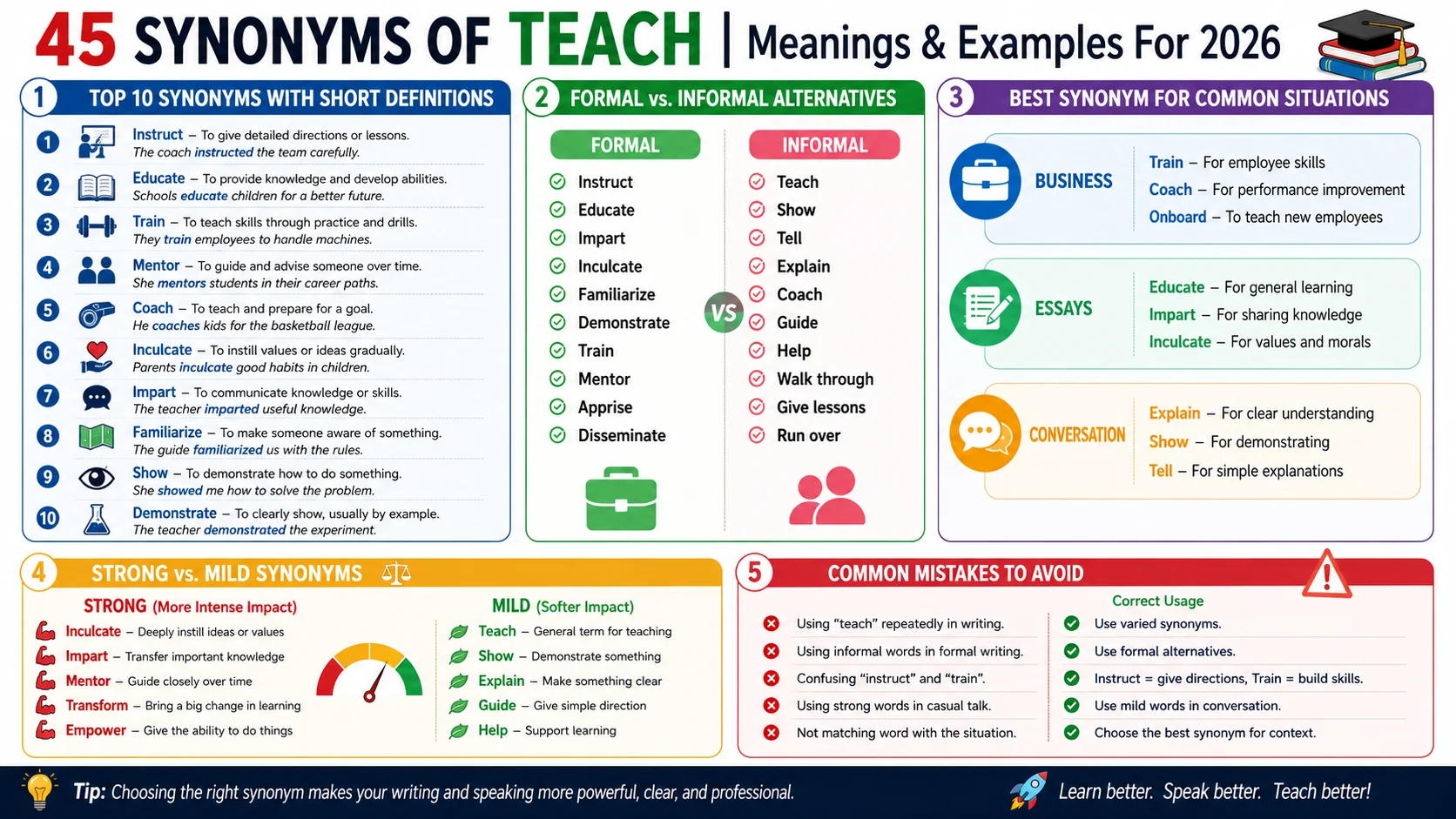
“Teach” means to help someone learn something new. The best synonyms are educate, instruct, train, coach, and guide. “Educate” is the most common formal alternative. Each synonym has a slightly different meaning and context where it fits best.
Top 10 Synonyms
- Educate
- Instruct
- Train
- Coach
- Guide
- Tutor
- Mentor
- Show
- Drill
- Enlighten
“Teach” is one of the most important words in English. It’s what teachers do, what parents do, and what we all do when we share knowledge. But using it too often can make your English feel repetitive and basic.
Think about it. You can teach a class, teach a skill, teach a child, or teach someone a lesson. Each situation might need a different word that captures the specific type of teaching.
In this guide, you’ll learn 35 powerful synonyms for “teach.” You’ll discover exactly when to use each one, how formal they are, and what common mistakes to avoid. Let’s begin!
What Does “Teach” Mean?
Definition
Teach” means to give knowledge, instruction, or skills to someone. When you teach, you help someone learn something they didn’t know before. It can be formal, like in a classroom, or informal, like showing a friend how to cook.
Pronunciation
| Feature | Value |
|---|---|
| US IPA | /tiːtʃ/ |
| UK IPA | /tiːtʃ/ |
| Syllables | 1 |
| Tip | Rhymes with “each” and “beach” |
Grammar
| Grammar Feature | Information |
|---|---|
| Part of Speech | Verb |
| Common Position | After the subject |
| Typical Pattern | Subject + teach + someone + something |
Examples:
- “She teaches English at the university.”
- “He taught me how to cook.”
- “They teach children to read.”
Grammar Note: “Teach” can take two objects: the person being taught and the subject being taught. You teach someone something.
Word Family
| Word | Part of Speech | Meaning |
|---|---|---|
| Teach | Verb | To give knowledge or skills |
| Teacher | Noun | A person who teaches |
| Teaching | Noun/Gerund | The act of teaching |
| Teachings | Noun (plural) | Moral lessons or principles |
| Teachable | Adjective | Able to be taught |
15 Synonyms of “Teach”
Educate
Meaning: To give someone knowledge or training, often in a formal setting.
Best Used For: Formal education, schools, universities.
Formality: Formal
Tone: Academic, Professional
Frequency: ⭐⭐⭐⭐⭐ (Very Common)
CEFR Level: B1
Example Sentence 1: “The school educates students from all over the city.”
Example Sentence 2: “We need to educate people about healthy eating.
Usage Tip: “Educate” is more formal than “teach.” Use it for formal schooling or important public awareness.
Common Confusion: Educate vs Teach. “Educate” suggests a broader, more formal learning experience. “Teach” can be informal.
Instruct
Meaning: To give clear directions or information about how to do something.
Best Used For: Formal teaching, giving directions, workplace training.
Formality: Formal
Tone: Professional, Direct
Frequency: ⭐⭐⭐⭐ (Common)
CEFR Level: B2
Example Sentence 1: “The manual instructs you on how to assemble the furniture.
Example Sentence 2: “He instructed the team on the new procedures.”
Usage Tip: “Instruct” emphasizes giving clear, specific directions. Use it for formal or technical training.
Train
Meaning: To teach someone the skills needed for a particular job or activity.
Best Used For: Jobs, sports, practical skills.
Formality: Neutral
Tone: Practical, Skill-focused
Frequency: ⭐⭐⭐⭐⭐ (Very Common)
CEFR Level: B1
Example Sentence 1: “The company trains new employees for two weeks.”
Example Sentence 2: “He trains athletes for the Olympics.”
Usage Tip: “Train” focuses on developing specific skills through practice. Use it for jobs, sports, and practical activities.
Coach
Meaning: To teach and guide someone in a sport, skill, or personal development.
Best Used For: Sports, personal development, business.
Formality: Neutral
Tone: Supportive, Developmental
Frequency: ⭐⭐⭐⭐ (Common)
CEFR Level: B2
Example Sentence 1: “He coaches the local football team.”
Example Sentence 2: “She coaches executives on leadership skills.”
Usage Tip: “Coach” suggests personalized guidance and encouragement. It’s often one-on-one or in small groups.
Guide
Meaning: To help someone learn by showing them the way.
Best Used For: Mentoring, travel, personal development.
Formality: Neutral
Tone: Supportive, Helpful
Frequency: ⭐⭐⭐⭐⭐ (Very Common)
CEFR Level: B1
Example Sentence 1: “The teacher guided the students through the experiment.
Example Sentence 2: “She guides young entrepreneurs through the startup process.
Usage Tip: “Guide” emphasizes leading and showing the way. It’s supportive and often one-on-one.
Tutor
Meaning: To teach a student individually or in a small group.
Best Used For: Private lessons, extra help, test preparation.
Formality: Neutral
Tone: Personal, Academic
Frequency: ⭐⭐⭐ (Moderate)
CEFR Level: B2
Example Sentence 1: “She tutors students in mathematics after school.”
Example Sentence 2: “I tutored my neighbor’s daughter in English.”
Usage Tip: “Tutor” is specific to private or small-group teaching. Use it for extra help or individualized instruction.
Mentor
Meaning: To guide and support someone’s personal or professional development.
Best Used For: Career development, personal growth, professional relationships.
Formality: Formal
Tone: Supportive, Developmental
Frequency: ⭐⭐⭐ (Moderate)
CEFR Level: B2
Example Sentence 1: “She mentors young professionals in her field.”
Example Sentence 2: “He mentored me through my first years in the company.”
Usage Tip: “Mentor” suggests long-term, supportive guidance in career or personal development.
Show
Meaning: To teach by demonstrating or explaining.
Best Used For: Informal teaching, simple skills, demonstrations.
Formality: Informal
Tone: Friendly, Practical
Frequency: ⭐⭐⭐⭐⭐ (Very Common)
CEFR Level: A2
Example Sentence 1: “Can you show me how to use this app?”
Example Sentence 2: “She showed him how to change a tire.”
Usage Tip: “Show” is the most informal synonym. Use it for quick demonstrations or simple instructions.
Drill
Meaning: To teach by repeating exercises until the skill is mastered.
Best Used For: Military, language learning, music practice.
Formality: Neutral
Tone: Repetitive, Disciplined
Frequency: ⭐⭐ (Rare)
CEFR Level: B2
Example Sentence 1: “The sergeant drilled the soldiers on basic commands.”
Example Sentence 2: “He drilled his students on vocabulary every day.”
Usage Tip: “Drill” suggests repetitive practice. Use it for memorization and skill mastery through repetition.
Enlighten
Meaning: To give someone greater knowledge or understanding.
Best Used For: Formal writing, philosophical contexts.
Formality: Formal
Tone: Intellectual, Revealing
Frequency: ⭐⭐ (Rare)
CEFR Level: C1
Example Sentence 1: “The lecture enlightened the students about climate change.”
Example Sentence 2: “He enlightened me on the history of the region.”
Usage Tip: “Enlighten” suggests bringing someone out of ignorance. It’s formal and a bit literary.
Edify
Meaning: To instruct or improve someone morally or intellectually.
Best Used For: Religious, moral, or intellectual contexts.
Formality: Formal
Tone: Moral, Intellectual
Frequency: ⭐ (Very Rare)
CEFR Level: C1
Example Sentence 1: “The teacher edified her students through thoughtful discussion.
Example Sentence 2: “His writing edifies and inspires readers.”
Usage Tip: “Edify” is a rare, formal word for improving someone intellectually or morally.
Indoctrinate
Meaning: To teach someone to accept a set of beliefs without question.
Best Used For: Negative contexts, political or religious indoctrination.
Formality: Formal
Tone: Negative, Controlling
Frequency: ⭐⭐ (Rare)
CEFR Level: C1
Example Sentence 1: “The regime indoctrinated children from a young age.”
Example Sentence 2: “He was indoctrinated with extreme political views.
Usage Tip: “Indoctrinate” has a negative meaning. Use it only for teaching beliefs in a controlling way.
School
Meaning: To teach or train someone in a particular subject.
Best Used For: Formal training, experience-based learning.
Formality: Formal
Tone: Educative, Experiential
Frequency: ⭐⭐ (Rare)
CEFR Level: B2
Example Sentence 1: “He was schooled in the classics from a young age.”
Example Sentence 2: “Her experience schooled her in the realities of business.”
Usage Tip: “School” (as a verb) is formal and suggests being trained in a particular tradition.
Brief
Meaning: To give someone essential information or instructions.
Best Used For: Quick instructions, business contexts.
Formality: Formal
Tone: Concise, Professional
Frequency: ⭐⭐⭐ (Moderate)
CEFR Level: B2
Example Sentence 1: “The manager briefed the team before the meeting.
Example Sentence 2: “She briefed him on the new policies.”
Usage Tip: “Brief” is for giving essential information quickly, often before an event or task.
Prepare
Meaning: To make someone ready for a specific task or situation.
Best Used For: Training, building skills, education.
Formality: Neutral
Tone: Practical, Preparatory
Frequency: ⭐⭐⭐⭐⭐ (Very Common)
CEFR Level: B1
Example Sentence 1: “The course prepares students for university life.
Example Sentence 2: “Her experience prepared her for the challenges ahead.”
Usage Tip: “Prepare” emphasizes getting someone ready for a specific situation.
Synonyms Comparison Table
| Synonym | Best Context | Formality | Tone | Frequency |
|---|---|---|---|---|
| Educate | Formal education | Formal | Academic | ⭐⭐⭐⭐⭐ |
| Train | Skills, jobs | Neutral | Practical | ⭐⭐⭐⭐⭐ |
| Instruct | Directions | Formal | Professional | ⭐⭐⭐⭐ |
| Coach | Sports, personal | Neutral | Supportive | ⭐⭐⭐⭐ |
| Guide | Showing the way | Neutral | Helpful | ⭐⭐⭐⭐⭐ |
| Tutor | Private teaching | Neutral | Personal | ⭐⭐⭐ |
| Mentor | Career guidance | Formal | Supportive | ⭐⭐⭐ |
| Show | Demonstrations | Informal | Friendly | ⭐⭐⭐⭐⭐ |
| Prepare | Getting ready | Neutral | Preparatory | ⭐⭐⭐⭐⭐ |
| Drill | Repetitive practice | Neutral | Disciplined | ⭐⭐ |
Best Synonyms by Situation
| Situation | Best Synonym | Why It Works |
|---|---|---|
| Daily Conversation | Show | Natural and casual |
| Business Email | Instruct | Professional and clear |
| Academic Writing | Educate | Formal and precise |
| School Assignment | Teach | Simple and appropriate |
| Professional Meeting | Brief | Efficient and direct |
| Presentation | Educate | Formal and effective |
| Creative Writing | Enlighten | Adds literary depth |
| Social Media | Show | Casual and relatable |
| Coaching | Coach | Perfect for sports |
Formal vs Informal Synonyms
Formal Alternatives
| Synonym | Best Used For |
|---|---|
| Educate | Formal schooling, awareness |
| Instruct | Official teaching, directions |
| Enlighten | Intellectual understanding |
| Mentor | Career guidance |
| Edify | Moral or intellectual improvement |
Neutral Alternatives
| Synonym | Best Used For |
|---|---|
| Teach | Most general situations |
| Train | Skills, jobs |
| Guide | Showing and leading |
| Tutor | Private lessons |
| Prepare | Getting ready |
Informal Alternatives
| Synonym | Best Used For |
|---|---|
| Show | Demonstrations |
| Walk through | Guiding step-by-step |
| Fill in | Giving basic information |
Choosing the Right Level: Use “educate” and “instruct” for formal contexts. Use “train” and “guide” for professional contexts. Use “show” for casual situations.
Strong vs Mild Synonyms
Mild
Suitable for everyday situations with less intensity.
- Show
- Guide
- Prepare
Moderate
More formal or structured alternatives.
- Teach
- Instruct
- Train
- Tutor
Strong
High-intensity alternatives suggesting deep or formal teaching.
- Educate (broad, formal learning)
- Enlighten (deep understanding)
- Mentor (long-term guidance)
- Drill (intensive practice)
How Intensity Changes Meaning: “I showed him how to do it” is simple. “I educated him on the topic” is more formal and intense. Choose stronger words when you want to emphasize the depth or importance of the teaching.
Real-Life Examples
School: “The teacher teaches mathematics to high school students.”
Office: “The manager briefed the team on the new strategy.”
Business Email: “Please instruct the team on the new procedures.”
Meetings: “The consultant mentored the junior staff.”
Presentations: “We need to educate consumers about our product.”
Daily Conversations: “Can you show me how to use this?”
Social Media: “Here’s a video to show you how to cook pasta.”
Academic Writing: “The study educates readers about the importance of recycling.”
Common Collocations
| Common Phrase | Better Alternative |
|---|---|
| Teach a class | Instruct a class |
| Teach a skill | Train a skill |
| Teach someone | Educate someone |
| Teach children | School children |
| Teach students | Tutor students |
Common Phrases
Learn the ropes: To learn how to do something. (e.g., “The new employee is learning the ropes.”)
Show someone the ropes: To teach someone how to do something. (e.g., “She showed me the ropes on my first day.”)
School of hard knocks: Learning from life experience. (e.g., “He was educated in the school of hard knocks.”)
Under someone’s wing: Being taught or guided by someone experienced. (e.g., “She took me under her wing.”)
Pass on knowledge: To teach others. (e.g., “He passed on his knowledge to the next generation.”)
Context Guide
| Situation | Best Synonym | Reason |
|---|---|---|
| Essay | Educate | Academic and formal |
| Speech | Educate | Inspiring and clear |
| Business Email | Instruct | Professional and direct |
| Novel | Enlighten | Adds literary depth |
| Presentation | Educate | Formal and effective |
| Conversation | Show | Natural and relatable |
| Academic Writing | Educate | Precise and formal |
| Marketing Copy | Show | Engaging and practical |
Related Words
Near Synonyms
- Demonstrate: To show how something works.
- Explain: To make something clear.
- Impart: To give knowledge or information.
- Bestow: To give as a gift (often knowledge).
- Convey: To communicate ideas.
Antonyms
- Learn: To receive knowledge (opposite perspective).
- Mislead: To teach falsely.
- Confuse: To make unclear.
- Misinform: To teach incorrectly.
Related Adjectives
- Educational: Related to teaching.
- Informative: Giving useful information.
- Instructional: Related to giving instructions.
- Didactic: Intended to teach (often a negative word).
- Pedagogical: Related to teaching methods.
Related Nouns
- Education: The process of teaching.
- Instruction: The act of teaching.
- Training: The process of learning skills.
- Mentorship: The act of mentoring.
- Coaching: The act of coaching.
Related Verbs
- Explain: To make something clear.
- Demonstrate: To show how to do something.
- Instruct: To give directions.
- Train: To teach skills.
- Guide: To show the way.
Frequently Asked Questions
What is another word for teach?
Common synonyms include educate, instruct, train, coach, guide, and tutor. “Educate” is the most common formal alternative.
Which synonym sounds the most professional?
Educate and instruct sound very professional. “Brief” is also excellent for business contexts.
What is the strongest synonym for teach?
Enlighten is one of the strongest synonyms. It suggests deep understanding and awareness. “Mentor” is also strong for long-term guidance.
Which synonym is best for essays?
Educate is the best choice for academic essays. It’s formal, clear, and widely used.
What’s the difference between teach and educate?
“Teach” is more general and can be informal. “Educate” suggests a broader, more formal learning experience, often in schools.
Which synonym is most common in everyday English?
“Teach” itself is the most common, but “show” is also very common in informal speech. “Train” is common for job skills.
What is the opposite of teach?
Common opposites are learn (from the student’s perspective), mislead, confuse, and misinform.
Conclusion
“Teach” is a wonderful word, but now you have 35 fantastic alternatives. Each synonym adds a different shade of meaning to your language.
Remember, the key is understanding the context. Use “educate” for formal learning. Use “train” for developing skills. Use “coach” for sports and personal development. Use “guide” for showing the way. Use “show” for simple demonstrations.
The best way to improve is practice. Try using one or two new synonyms each day. Listen for these words in conversations and books. Your vocabulary will become richer and more expressive with time.
