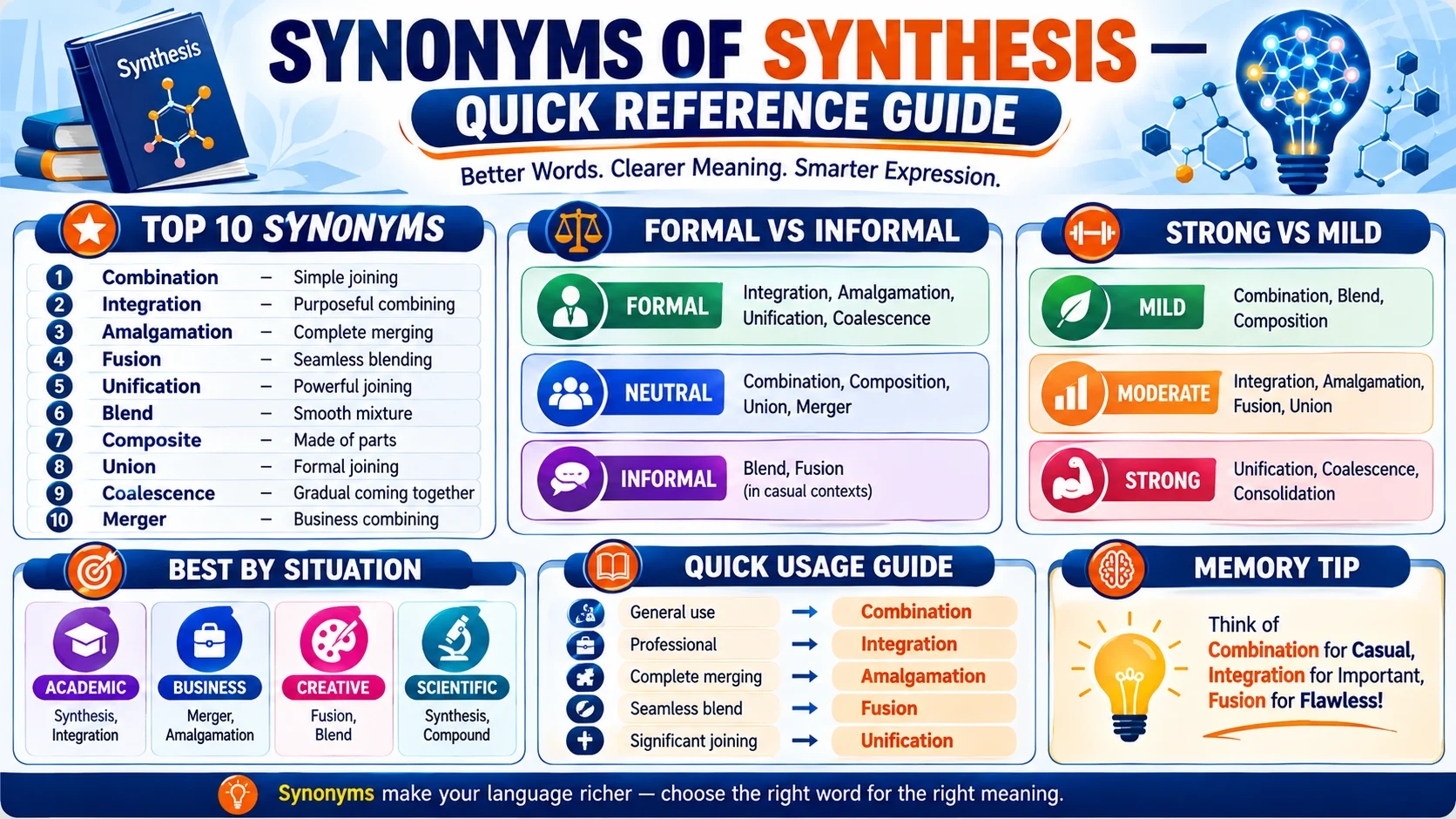
Synthesis means combining separate elements to create something new. The best synonyms include combination, integration, amalgamation, fusion, unification, blend, composite, union, coalescence, and merger. But each synonym has a slightly different meaning and context, so choosing the right one depends on your situation.
Looking for the best synonyms of synthesis? The right alternative depends on what you are trying to describe. Synthesis can mean combining different ideas, materials, facts, or elements to create something new. In academic writing, it may refer to bringing information together. In science, it can describe the formation of a compound. In everyday or professional writing, words like combination, integration, amalgamation, composition, or fusion may fit better.
This guide is designed to help you choose the most accurate synonym for synthesis based on meaning and context. Each alternative includes clear explanations and practical examples, making it easier to understand when a word sounds natural. Whether you are writing an essay, research paper, business document, or creative piece, you can quickly find a suitable replacement for synthesis without changing your intended meaning.
What Does “Synthesis” Mean?
Definition
In simple terms, synthesis is the act of combining different elements to form something new and unified. It can describe combining ideas, like bringing together different theories into one framework. It can also describe physical combination, like chemicals joining to form a new compound. Essentially, whenever separate things come together to create a whole, that’s synthesis. The word comes from Greek roots meaning “to put together”.
Pronunciation
| Feature | Value |
|---|---|
| US IPA | /ˈsɪnθəsəs/ |
| UK IPA | /ˈsɪnθɪsɪs/ |
| Syllables | 3 |
| Tip | Stress the first syllable: SIN-thuh-sis |
Grammar
| Grammar Feature | Information |
|---|---|
| Part of Speech | Noun (countable and uncountable) |
| Common Position | Subject or object of a sentence |
| Typical Pattern | synthesis of X and Y or synthesis of X with Y |
Example Sentences:
- The band’s sound is a synthesis of jazz and rock music.
- His theory is actually a synthesis of several other theories.
- The synthesis of water from hydrogen and oxygen is a classic chemistry experiment.
Grammar Note: Synthesis is both countable and uncountable. The plural form is syntheses (pronounced /ˈsɪnθəsiːz/). It’s often used with the preposition of to show what elements are being combined.
Word Family
| Word | Part of Speech | Meaning |
|---|---|---|
| Synthesize | Verb | To combine elements into a new whole |
| Synthesis | Noun | The act or result of combining elements |
| Synthetic | Adjective | Made by synthesis; not natural |
| Synthetical | Adjective | Relating to synthesis |
| Synthetically | Adverb | In a synthetic manner |
| Synthesist | Noun | A person who synthesizes |
| Synthesizer | Noun | A device or person that synthesizes |
20 Synonyms of “Synthesis”
1. Combination
Meaning: The act of joining or mixing things together.
Best Used For: Daily conversation, general writing, and describing simple mixtures.
Formality: Neutral
Tone: Neutral, straightforward
Frequency: ⭐⭐⭐⭐⭐ Very Common
CEFR Level: A2
Example Sentence 1: A combination of hard work and luck led to her success.
Example Sentence 2: The recipe is a combination of traditional and modern techniques.
Usage Tip: Combination is the most common and versatile synonym. Use it when you want a simple, clear word that everyone understands. It works in almost any context. For more formal writing, consider integration or amalgamation instead.
2. Integration
Meaning: The process of combining parts into a unified whole.
Best Used For: Academic writing, business, technology, and social contexts.
Formality: Formal
Tone: Professional, analytical
Frequency: ⭐⭐⭐⭐ Common
CEFR Level: B2
Example Sentence 1: There is little integration of our work and no single focus.
Example Sentence 2: The integration of new software into the existing system took months.
Usage Tip: Integration emphasizes that different parts are brought together to function as one. It’s very common in technology, business, and social policy. Use it when you want to sound professional and precise.
3. Amalgamation
Meaning: The result of combining two or more things into one.
Best Used For: Business, organizational contexts, and formal writing.
Formality: Formal
Tone: Professional, structural
Frequency: ⭐⭐⭐ Moderate
CEFR Level: B2
Example Sentence 1: The organization was formed by an amalgamation of two groups.
Example Sentence 2: The company is an amalgamation of several smaller firms.
Usage Tip: Amalgamation suggests that separate entities have merged into one new entity. It’s commonly used in business and organizational contexts. It sounds more formal than combination and implies a more complete merging.
4. Fusion
Meaning: The process of joining different things together to form one thing.
Best Used For: Describing cultural blends, music styles, and scientific processes.
Formality: Neutral to formal
Tone: Creative, dynamic
Frequency: ⭐⭐⭐⭐ Common
CEFR Level: B2
Example Sentence 1: The restaurant serves a fusion of Asian and European cuisines.
Example Sentence 2: Nuclear fusion powers the sun.
Usage Tip: Fusion suggests a seamless blending where the original elements become indistinguishable. It’s often used for cultural and culinary blends. In science, it refers to atoms joining together. Use it when you want to emphasize a smooth, natural combination.
5. Unification
Meaning: The process of bringing things together into one unit.
Best Used For: Political, social, and organizational contexts.
Formality: Formal
Tone: Serious, unifying
Frequency: ⭐⭐⭐ Moderate
CEFR Level: B2
Example Sentence 1: The unification of Italy in 1870 was a historic event.
Example Sentence 2: The unification of the two departments improved efficiency.
Usage Tip: Unification implies that separate groups or entities come together to form a single unit. It’s often used in political and social contexts. It’s more formal than combination and suggests a purposeful, often significant, joining.
6. Blend
Meaning: A mixture of different things that go well together.
Best Used For: Daily conversation, creative writing, and describing mixtures.
Formality: Neutral to informal
Tone: Casual, creative
Frequency: ⭐⭐⭐⭐ Common
CEFR Level: B1
Example Sentence 1: The music is a blend of jazz and classical.
Example Sentence 2: This coffee is a perfect blend of Arabica and Robusta beans.
Usage Tip: Blend is a great everyday word. It suggests that things mix together smoothly and naturally. It’s less formal than synthesis and works well in casual conversation and creative writing. Use it when you want a friendly, approachable word.
7. Composite
Meaning: Something made up of various parts or elements.
Best Used For: Technical writing, descriptions of materials, and formal contexts.
Formality: Formal
Tone: Technical, descriptive
Frequency: ⭐⭐⭐ Moderate
CEFR Level: B2
Example Sentence 1: The sculpture is a composite of different materials.
Example Sentence 2: Her identity is a composite of many cultural influences.
Usage Tip: Composite emphasizes that something is made of distinct parts that remain recognizable. It’s often used in technical and scientific contexts. Use it when you want to highlight that the whole is made up of identifiable components.
8. Union
Meaning: The state of being joined together as one.
Best Used For: Political, social, and organizational contexts.
Formality: Formal
Tone: Serious, unifying
Frequency: ⭐⭐⭐⭐ Common
CEFR Level: B1
Example Sentence 1: The union of the two companies created a global leader.
Example Sentence 2: The European Union is a political and economic union of member states.
Usage Tip: Union suggests a strong, formal joining. It’s often used for political entities, organizations, and marriages. It’s more formal than combination and implies a lasting, significant connection.
9. Coalescence
Meaning: The process of coming together to form one mass or whole.
Best Used For: Scientific writing, formal descriptions, and academic contexts.
Formality: Formal
Tone: Scientific, analytical
Frequency: ⭐ Rare
CEFR Level: C1
Example Sentence 1: The coalescence of the droplets formed a larger pool of water.
Example Sentence 2: The coalescence of different artistic movements created a new style.
Usage Tip: Coalescence is a sophisticated word that suggests separate things gradually come together. It’s often used in science and formal writing. Use it when you want to sound very precise and educated. It’s too formal for everyday conversation.
10. Merger
Meaning: The combining of two or more companies or organizations into one.
Best Used For: Business, finance, and organizational contexts.
Formality: Formal
Tone: Professional, strategic
Frequency: ⭐⭐⭐⭐ Common
CEFR Level: B2
Example Sentence 1: The merger of the two banks created the largest financial institution in the country.
Example Sentence 2: The merger was approved by shareholders.
Usage Tip: Merger is the standard term for companies joining together. It’s also used metaphorically for other kinds of combining. Use it specifically for business and organizational contexts. Don’t use it for abstract ideas or personal relationships.
11. Synthesis (the original)
Sometimes, the best word is the original one. Synthesis is a powerful, precise word that works well in academic and professional contexts. Don’t feel you always need a synonym — use synthesis when you want to sound sophisticated and accurate.
12. Consolidation
Meaning: The process of making something stronger or more solid by combining parts.
Best Used For: Business, finance, and organizational contexts.
Formality: Formal
Tone: Professional, strategic
Frequency: ⭐⭐⭐ Moderate
CEFR Level: B2
Example Sentence 1: The consolidation of several small departments improved efficiency.
Example Sentence 2: Debt consolidation can help manage multiple loans.
Usage Tip: Consolidation emphasizes strengthening through combination. It’s common in business and finance. Use it when you want to highlight that combining things makes them stronger or more effective.
13. Synthesis (as deductive reasoning)
Meaning: Reasoning from general principles to specific conclusions.
Best Used For: Philosophy, logic, and academic writing.
Formality: Formal
Tone: Logical, analytical
Frequency: ⭐⭐ Rare
CEFR Level: C1
Example Sentence 1: His argument is a synthesis of general principles applied to this specific case.
Example Sentence 2: Synthesis in logic moves from cause to effect.
Usage Tip: This is a specialized meaning of synthesis used in philosophy and logic. It’s the opposite of analysis, which breaks things down. Use it only in academic or philosophical contexts.
14. Composition
Meaning: The way parts are arranged to form a whole.
Best Used For: Art, music, writing, and describing structures.
Formality: Neutral to formal
Tone: Creative, structural
Frequency: ⭐⭐⭐⭐ Common
CEFR Level: B1
Example Sentence 1: The composition of the painting is balanced and harmonious.
Example Sentence 2: The chemical composition of the substance is complex.
Usage Tip: Composition focuses on how parts are arranged within a whole. It’s very common in art, music, and chemistry. Use it when you want to describe the structure or arrangement of elements, not just their combination.
15. Organization
Meaning: The arrangement of parts into a structured whole.
Best Used For: Describing systems, structures, and arrangements.
Formality: Neutral to formal
Tone: Structural, functional
Frequency: ⭐⭐⭐⭐ Common
CEFR Level: B1
Example Sentence 1: The organization of the report made it easy to follow.
Example Sentence 2: The organization of cells in the body is highly complex.
Usage Tip: Organization emphasizes structure and arrangement. It’s about how things are put together in an orderly way. Use it when you want to highlight structure rather than the act of combining.
16. Assemblage
Meaning: A collection or gathering of things put together.
Best Used For: Art, creative writing, and describing collections.
Formality: Neutral to formal
Tone: Creative, descriptive
Frequency: ⭐⭐ Rare
CEFR Level: B2
Example Sentence 1: The exhibition featured an assemblage of contemporary sculptures.
Example Sentence 2: The assemblage of artifacts provided insight into ancient life.
Usage Tip: Assemblage suggests a collection of distinct items brought together. It’s often used in art and archaeology. Use it when you want to emphasize that the parts remain somewhat separate within the whole.
17. Intermixture
Meaning: The process or result of mixing things together.
Best Used For: Describing mixtures, especially in formal or scientific contexts.
Formality: Formal
Tone: Scientific, analytical
Frequency: ⭐ Rare
CEFR Level: C1
Example Sentence 1: The intermixture of cultures created a vibrant community.
Example Sentence 2: The intermixture of different chemicals produced an unexpected reaction.
Usage Tip: Intermixture emphasizes that things are thoroughly mixed together. It’s a formal word that sounds sophisticated. Use it in academic or scientific writing when you want to be precise about mixing.
18. Alliance
Meaning: A union or connection formed for mutual benefit.
Best Used For: Political, business, and strategic contexts.
Formality: Formal
Tone: Strategic, cooperative
Frequency: ⭐⭐⭐⭐ Common
CEFR Level: B2
Example Sentence 1: The two countries formed a military alliance.
Example Sentence 2: The company entered into an alliance with a technology partner.
Usage Tip: Alliance is about formal partnerships, not just any combination. Use it when groups or individuals agree to work together for shared goals. It’s too specific for general combinations.
19. Compound
Meaning: Something formed by combining two or more parts or elements.
Best Used For: Chemistry, linguistics, and technical writing.
Formality: Formal
Tone: Technical, precise
Frequency: ⭐⭐⭐ Moderate
CEFR Level: B2
Example Sentence 1: Water is a compound of hydrogen and oxygen.
Example Sentence 2: The word “sunflower” is a compound of “sun” and “flower.”
Usage Tip: Compound is a technical term in chemistry and linguistics. In chemistry, it refers to a substance made of two or more elements. In linguistics, it refers to words made of two or more parts. Use it in these specific contexts.
20. Construct
Meaning: Something built or put together from parts.
Best Used For: Describing buildings, theories, and systems.
Formality: Neutral to formal
Tone: Structural, creative
Frequency: ⭐⭐⭐ Moderate
CEFR Level: B1
Example Sentence 1: The theory is a construct of several earlier ideas.
Example Sentence 2: The bridge is a remarkable construct of steel and concrete.
Usage Tip: Construct emphasizes that something has been built or created. It’s used for both physical structures and abstract ideas. Use it when you want to highlight the act of building or creating.
Synonyms Comparison Table
| Synonym | Best Context | Formality | Tone | Frequency |
|---|---|---|---|---|
| Combination | General, everyday | Neutral | Neutral | ⭐⭐⭐⭐⭐ |
| Integration | Business, technology | Formal | Professional | ⭐⭐⭐⭐ |
| Amalgamation | Business, organizations | Formal | Professional | ⭐⭐⭐ |
| Fusion | Culture, music, science | Neutral | Creative | ⭐⭐⭐⭐ |
| Unification | Politics, social | Formal | Serious | ⭐⭐⭐ |
| Blend | Daily, creative | Informal | Casual | ⭐⭐⭐⭐ |
| Composite | Technical, materials | Formal | Technical | ⭐⭐⭐ |
| Union | Politics, organizations | Formal | Serious | ⭐⭐⭐⭐ |
| Coalescence | Scientific, academic | Formal | Scientific | ⭐ |
| Merger | Business, finance | Formal | Professional | ⭐⭐⭐⭐ |
| Composition | Art, music, chemistry | Neutral | Creative | ⭐⭐⭐⭐ |
| Organization | Systems, structures | Neutral | Structural | ⭐⭐⭐⭐ |
| Alliance | Politics, business | Formal | Strategic | ⭐⭐⭐⭐ |
Best Synonyms by Situation
| Situation | Best Synonym | Why It Works |
|---|---|---|
| Daily Conversation | Combination or Blend | Simple, natural, and easy to understand |
| Business Email | Integration or Merger | Professional and precise |
| Academic Writing | Synthesis or Integration | Formal and accurate |
| School Assignment | Combination or Composition | Clear and appropriate |
| Professional Meeting | Amalgamation or Unification | Strategic and business-like |
| Presentation | Fusion or Integration | Engaging and clear |
| Creative Writing | Blend or Composite | Imaginative and descriptive |
| Social Media | Blend or Fusion | Modern and relatable |
| Science Report | Synthesis or Compound | Technical and precise |
| Art Review | Composition or Assemblage | Creative and descriptive |
Formal vs Informal Synonyms
Formal Alternatives
| Synonym | Best Used For |
|---|---|
| Integration | Business, technology, social policy |
| Amalgamation | Business mergers, organizational combining |
| Unification | Political, social, and national contexts |
| Coalescence | Scientific and academic writing |
| Consolidation | Business and financial contexts |
Neutral Alternatives
| Synonym | Best Used For |
|---|---|
| Combination | Almost any context |
| Composition | Art, music, chemistry |
| Union | Political, organizational |
| Merger | Business contexts |
| Construct | Physical and abstract building |
Informal Alternatives
| Synonym | Best Used For |
|---|---|
| Blend | Casual conversation, creative writing |
| Mix | Everyday situations (not listed above but common) |
| Fusion | Creative, cultural contexts |
When to Choose Each Level of Formality: Use formal synonyms in academic papers, business reports, and professional presentations. Use neutral synonyms in everyday writing, emails, and most conversations. Use informal synonyms with friends, in creative writing, and on social media. Match your word to your audience.
Strong vs Mild Synonyms
Mild
- Combination — A simple joining
- Blend — A smooth mixture
- Composition — An arrangement of parts
- Construct — Something built from parts
These words are suitable for everyday situations. They don’t carry strong connotations.
Moderate
- Integration — A purposeful combining
- Amalgamation — A complete merging
- Fusion — A seamless blend
- Union — A formal joining
- Merger — A business combining
These words suggest a more significant, intentional combination than mild synonyms.
Strong
- Unification — A powerful, often historic joining
- Coalescence — A gradual, natural coming together
- Consolidation — Combining to strengthen
Use these words when you want to emphasize the importance or significance of the combination. They carry more weight and should be used in appropriate contexts.
Real-Life Examples
In the Workplace:
- “The integration of our new software system will improve efficiency across all departments.”
- “The merger of our two companies will create new opportunities for growth.”
In Academic Writing:
- “This paper offers a synthesis of existing research on climate change.”
- “The study presents a comprehensive amalgamation of data from multiple sources.”
In Everyday Conversation:
- “This recipe is a delicious combination of sweet and savory flavors.”
- “Their music is a blend of rock and classical.”
In Creative Writing:
- “Her novel is a fusion of mystery and romance.”
- “The painting is a composite of different artistic styles.”
In Business Emails:
- “We need to focus on the integration of our marketing and sales strategies.”
- “The union of our two teams will strengthen our project delivery.”
In Social Media:
- “This smoothie is the perfect blend of fruits and superfoods!”
- “The new collection is a fusion of vintage and modern styles.”
Common Collocations
| Common Phrase | Better Alternative |
|---|---|
| chemical synthesis | chemical combination, chemical integration |
| protein synthesis | protein production, protein formation |
| sound synthesis | sound generation, audio production |
| synthesis of ideas | combination of ideas, integration of ideas |
| organic synthesis | organic combination, organic formation |
| speech synthesis | speech generation, voice production |
| DNA synthesis | DNA production, DNA replication |
Common Phrases
| Phrase | Meaning | Stronger Alternative |
|---|---|---|
| A synthesis of styles | A combination of different styles | A fusion of styles |
| The synthesis of ideas | Combining different ideas | The integration of ideas |
| A work of synthesis | A work that combines sources | A work of integration |
| Chemical synthesis | Producing chemicals by combining | Chemical combination |
| Synthesis of evidence | Combining evidence from sources | Integration of evidence |
Context Guide
| Situation | Best Synonym | Reason |
|---|---|---|
| Essay | Synthesis or Integration | Academic and precise |
| Speech | Fusion or Union | Engaging and clear |
| Business Email | Integration or Merger | Professional and strategic |
| Novel | Blend or Composite | Creative and descriptive |
| Presentation | Combination or Integration | Audience-friendly |
| Conversation | Combination or Blend | Natural and easy |
| Academic Writing | Synthesis or Amalgamation | Formal and precise |
| Marketing Copy | Fusion or Blend | Modern and appealing |
Related Words
Near Synonyms
- Combination — A general joining of things
- Integration — A purposeful combining into a whole
- Amalgamation — A complete merging of separate entities
- Fusion — A seamless blending
Antonyms
- Analysis — Breaking down a whole into parts
- Division — Separating into parts
- Separation — Keeping things apart
- Breakdown — Breaking into smaller pieces
- Disintegration — Falling apart into pieces
Related Adjectives
- Synthetic — Made by synthesis; artificial
- Integrated — Combined into a whole
- Unified — Brought together as one
- Composite — Made of distinct parts
- Fused — Blended together seamlessly
Related Nouns
- Synthesizer — A device that synthesizes
- Synthesis — The act or result of combining
- Integration — The process of combining
- Combination — The result of joining
Related Verbs
- Synthesize — To combine elements into a new whole
- Integrate — To bring parts together into a whole
- Amalgamate — To merge into one
- Fuse — To blend together seamlessly
- Unify — To bring together as one
Frequently Asked Questions
What is another word for synthesis?
The most common synonyms for synthesis are combination, integration, amalgamation, fusion, and unification. The best choice depends on your context. For general use, combination works well. For professional contexts, integration or amalgamation are better.
Which synonym sounds the most professional?
Integration and amalgamation sound the most professional. Integration is common in business and technology. Amalgamation is often used in business and organizational contexts. Both are formal and respected in professional writing.
What is the strongest synonym for synthesis?
Unification and coalescence are the strongest synonyms. Unification suggests a powerful, significant joining. Coalescence suggests a natural, gradual coming together. Choose based on whether you want to emphasize power or naturalness.
Which synonym is best for essays?
Synthesis itself is the best word for essays, followed by integration and amalgamation. These words are formal, precise, and commonly used in academic writing. They show that you understand complex concepts and can express them clearly.
What’s the difference between synthesis and analysis?
Synthesis combines parts to form a whole, while analysis breaks a whole into parts to study them. They are opposites. Synthesis creates, analysis examines. In academic writing, you often need both: analysis to understand, synthesis to create new insights.
Which synonym is most common in everyday English?
Combination is the most common synonym in everyday English. It’s simple, versatile, and everyone understands it. Blend is also common, especially in casual conversation. Use combination when you want a clear, straightforward word.
What is the opposite of synthesis?
The main opposites are analysis, division, separation, and breakdown. Analysis is the most direct opposite — it breaks things down instead of putting them together. Separation and division emphasize keeping things apart.
Is synthesis countable or uncountable?
Synthesis is both countable and uncountable. As a countable noun, you can say a synthesis or syntheses. For example: “His theory is a synthesis of several ideas.” As an uncountable noun, it refers to the process itself: “Synthesis is essential in chemistry.”
Conclusion
Synthesis is a powerful word that describes the act of combining elements to create something new. Whether you’re writing an academic paper, a business report, or just trying to express yourself more clearly, having a range of synonyms at your disposal will make your communication stronger.
Now you have 20 powerful synonyms to choose from. Remember:
- Use combination or blend for everyday situations
- Use integration or amalgamation for professional contexts
- Use synthesis itself for academic and formal writing
- Use fusion or unification when you want to emphasize seamless blending or significant joining
The key to choosing the right synonym is understanding your context, tone, and audience. A word that works perfectly in a business email might sound odd in a casual conversation. Practice using these synonyms in your daily writing and speaking, and soon they’ll feel completely natural.
Start small try replacing synthesis with combination or integration in your next piece of writing. Then experiment with more advanced words like amalgamation or coalescence when the situation is right. Your vocabulary will grow, and your English will sound more fluent and sophisticated.
Discover More Articles:
- 21 Synonyms of Thesis| Meaning, Examples & Usage For 2026
- 30 Synonyms of Communication | Meanings & Examples For 2026
