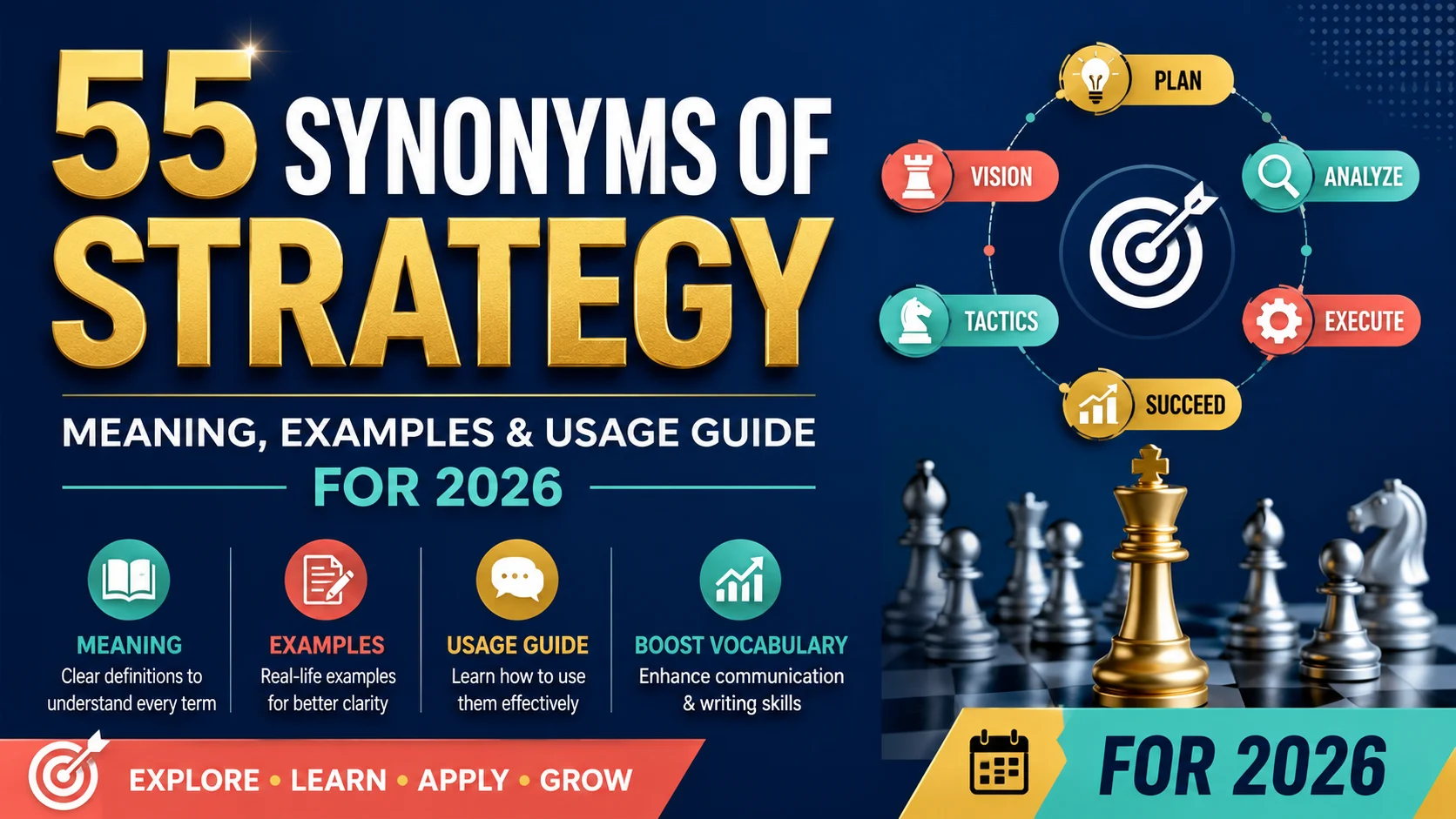
Strategy means a careful plan or method for achieving a goal. The best synonyms include plan, approach, tactic, scheme, blueprint, game plan, master plan, and roadmap. The most common everyday synonym is plan, while approach works best for describing methods. Each synonym has a slightly different meaning, tone, or context, so choose carefully based on your situation.
Top 10 Synonyms
- Plan
- Approach
- Tactic
- Scheme
- Blueprint
- Game plan
- Master plan
- Roadmap
- Policy
- Program
Every synonym has a slightly different meaning, tone, or context, so choose carefully based on your situation.
Do you find yourself using “strategy” too often in meetings, reports, and conversations? You’re not alone. It’s a useful word, but overusing it makes your writing sound repetitive and less impressive.
Learning synonyms for “strategy” helps you express your ideas more precisely. Whether you’re writing a business plan, describing a sports approach, or explaining how to achieve a goal, having the right word makes all the difference.
In this guide, you’ll discover 35 powerful alternatives to “strategy.” You’ll learn their meanings, when to use them, and which ones native speakers prefer in different situations. Let’s begin!
What Does “Strategy” Mean?
Definition
Strategy means a detailed plan or method designed to achieve a long-term goal. It’s the “big picture” thinking that guides your actions and decisions.
In everyday terms, think of strategy like a chess game. Each move isn’t random—it’s part of a bigger plan to win. Strategy is the overall direction, while tactics are the specific steps you take to get there.
Strategy can describe:
- Business plans (“Our marketing strategy focuses on social media”)
- Military operations (“The general developed a winning strategy”)
- Personal goals (“My strategy for saving money is to budget carefully”)
Pronunciation
| Feature | Value |
|---|---|
| US IPA | /ˈstræt̬.ə.dʒi/ |
| UK IPA | /ˈstræt.ə.dʒi/ |
| Syllables | 3 (strat-e-gy) |
| Tip | Stress the first syllable: STRAT-e-gy |
Grammar
| Grammar Feature | Information |
|---|---|
| Part of Speech | Noun (countable and uncountable) |
| Common Position | After the subject or as the subject |
| Typical Pattern | strategy + for + noun/gerund |
Example Sentences:
- “The company developed a new marketing strategy.”
- “We need a clear strategy for growth.”
- “Her strategy worked perfectly.”
Grammar Notes: “Strategy” can be countable (“three strategies”) or uncountable (“strategy is important”). The plural is “strategies.” The adjective form is “strategic.”
Word Family
| Word | Part of Speech | Meaning |
|---|---|---|
| Strategy | Noun | A plan for achieving a goal |
| Strategic | Adjective | Related to or part of a strategy |
| Strategically | Adverb | In a way that relates to strategy |
| Strategist | Noun | A person skilled in planning strategy |
| Strategize | Verb | To create or develop a strategy |
55 Synonyms of “Strategy”
1. Plan
Meaning: A detailed proposal for doing or achieving something.
Best Used For: Everyday conversation, general use, all contexts.
Formality: Neutral
Tone: Practical, Straightforward
Frequency: ⭐⭐⭐⭐⭐ Very Common
CEFR Level: A2
Example Sentence 1: “We made a plan to increase sales this quarter.”
Example Sentence 2: “Her plan for the project impressed everyone.
Usage Tip: “Plan” is the most common and versatile synonym. Use it when “strategy” sounds too formal. It works in almost every situation.
2. Approach
Meaning: A way of dealing with something.
Best Used For: Describing methods, techniques, and handling situations.
Formality: Neutral
Tone: Professional, Methodical
Frequency: ⭐⭐⭐⭐⭐ Very Common
CEFR Level: B1
Example Sentence 1: “Her approach to problem-solving is very creative.”
Example Sentence 2: “We need a new approach to customer service.
Usage Tip: “Approach” emphasizes the method or style. Use it when describing how you tackle a problem. It’s more about the “how” than the “what.”
3. Tactic
Meaning: A specific action or method used to achieve a goal.
Best Used For: Short-term actions, specific steps, sports.
Formality: Neutral
Tone: Action-oriented, Specific
Frequency: ⭐⭐⭐⭐⭐ Very Common
CEFR Level: B1
Example Sentence 1: “The team used a new tactic in the final game.”
Example Sentence 2: “The manager’s tactic was to reduce prices temporarily.”
Usage Tip: “Tactic” is more specific than “strategy.” A strategy is the big picture; a tactic is one step. Use it for short-term actions.
Common Confusion: “Strategy” vs “Tactic” – Strategy is the overall plan (the “what”). Tactic is a specific action (the “how”). Strategy is long-term; tactics are short-term.
4. Scheme
Meaning: A carefully arranged plan or system.
Best Used For: Formal contexts, organized plans, sometimes negative.
Formality: Neutral to Formal
Tone: Organized, Careful
Frequency: ⭐⭐⭐⭐ Common
CEFR Level: B1
Example Sentence 1: “The government introduced a new savings scheme.”
Example Sentence 2: “The scheme helped thousands of people find jobs.”
Usage Tip: “Scheme” is common in British English. It’s neutral but can have negative connotations (like “evil scheme”). Use it carefully in American English.
5. Blueprint
Meaning: A detailed plan or outline.
Best Used For: Big projects, construction, detailed planning.
Formality: Formal
Tone: Detailed, Comprehensive
Frequency: ⭐⭐⭐⭐ Common
CEFR Level: B2
Example Sentence 1: “The manager presented a blueprint for the new project.”
Example Sentence 2: “We need a blueprint for the company’s future.”
Usage Tip: “Blueprint” suggests a detailed, step-by-step plan. Use it for major projects or long-term goals.
6. Game plan
Meaning: A strategy or plan for achieving a goal.
Best Used For: Sports, business, projects, informal contexts.
Formality: Informal
Tone: Practical, Action-oriented
Frequency: ⭐⭐⭐⭐ Common
CEFR Level: B2
Example Sentence 1: “Our game plan is to enter the market slowly.”
Example Sentence 2: “The coach explained the game plan to the team.”
Usage Tip: “Game plan” is casual and energetic. Use it in business or sports contexts. It’s more engaging than “strategy.”
7. Master plan
Meaning: A complete and detailed plan that guides everything.
Best Used For: Big projects, city planning, career goals.
Formality: Neutral
Tone: Comprehensive, Ambitious
Frequency: ⭐⭐⭐⭐ Common
CEFR Level: B2
Example Sentence 1: “The city has a master plan for development.”
Example Sentence 2: “His master plan is to become CEO in five years.”
Usage Tip: “Master plan” suggests a big, complete plan. Use it for major goals and long-term projects.
8. Roadmap
Meaning: A plan that shows how to achieve something step by step.
Best Used For: Business planning, career development, technology.
Formality: Neutral to Formal
Tone: Clear, Practical
Frequency: ⭐⭐⭐⭐ Common
CEFR Level: B2
Example Sentence 1: “The company created a roadmap for digital transformation.”
Example Sentence 2: “We need a roadmap for our career growth.
Usage Tip: “Roadmap” is modern and visual. It suggests a clear path with milestones. Use it in business and career contexts.
9. Policy
Meaning: A set of principles or rules that guide decisions.
Best Used For: Government, organizations, formal rules.
Formality: Formal
Tone: Official, Structured
Frequency: ⭐⭐⭐⭐⭐ Very Common
CEFR Level: B1
Example Sentence 1: “The company has a policy against discrimination.”
Example Sentence 2: “The government changed its immigration policy.”
Usage Tip: “Policy” is more official than “strategy.” Use it for rules and principles, not just plans.
10. Program
Meaning: A planned series of activities or actions.
Best Used For: Education, community projects, official initiatives.
Formality: Neutral to Formal
Tone: Organized, Structured
Frequency: ⭐⭐⭐⭐⭐ Very Common
CEFR Level: A2
Example Sentence 1: “The school has a new reading program.”
Example Sentence 2: “We launched a program to help small businesses.”
Usage Tip: “Program” suggests organized activities. Use it for initiatives and projects.
11. System
Meaning: A set of methods or rules for doing something.
Best Used For: Processes, work methods, operations.
Formality: Neutral
Tone: Organized, Practical
Frequency: ⭐⭐⭐⭐⭐ Very Common
CEFR Level: B1
Example Sentence 1: “We need a better system for tracking orders.”
Example Sentence 2: “Her system for organizing files is very efficient.
Usage Tip: “System” emphasizes process and structure. Use it for methods and procedures.
12. Method
Meaning: A particular way of doing something.
Best Used For: Teaching, science, specific processes.
Formality: Neutral
Tone: Practical, Clear
Frequency: ⭐⭐⭐⭐⭐ Very Common
CEFR Level: B1
Example Sentence 1: “Her teaching method is very effective.”
Example Sentence 2: “We tried a new method for solving the problem.”
Usage Tip: “Method” is about the specific way you do something. Use it for techniques and procedures.
13. Course of action
Meaning: A plan or way of doing something.
Best Used For: Formal writing, decision-making, business.
Formality: Formal
Tone: Serious, Professional
Frequency: ⭐⭐⭐⭐ Common
CEFR Level: B2
Example Sentence 1: “We need to decide on a course of action.”
Example Sentence 2: “The best course of action is to wait and see.”
Usage Tip: This phrase is formal and professional. Use it in business reports and serious discussions.
14. Line of attack
Meaning: A particular way of dealing with a problem.
Best Used For: Problem-solving, business, politics.
Formality: Neutral to Formal
Tone: Strategic, Active
Frequency: ⭐⭐⭐ Moderate
CEFR Level: B2
Example Sentence 1: “Her line of attack was to focus on customer satisfaction.”
Example Sentence 2: “We need to change our line of attack.”
Usage Tip: This phrase suggests a strategic approach, especially when facing competition or challenges.
15. Grand design
Meaning: An overall plan that guides everything.
Best Used For: Creative writing, ambitious projects, vision.
Formality: Formal to Literary
Tone: Ambitious, Inspiring
Frequency: ⭐⭐ Rare
CEFR Level: C1
Example Sentence 1: “The grand design of the project took years to complete.”
Example Sentence 2: “The architect presented his grand design for the city.”
Usage Tip: “Grand design” suggests something impressive and complete. Use it for ambitious projects.
16. Action plan
Meaning: A detailed plan showing what steps to take.
Best Used For: Projects, goals, immediate tasks.
Formality: Neutral
Tone: Practical, Action-oriented
Frequency: ⭐⭐⭐⭐⭐ Very Common
CEFR Level: B1
Example Sentence 1: “We created an action plan for the new product launch.”
Example Sentence 2: “His action plan helped us meet the deadline.”
Usage Tip: “Action plan” emphasizes doing things. Use it for concrete steps, not abstract ideas.
17. Battle plan
Meaning: A plan for achieving something difficult.
Best Used For: Competition, difficult projects, sports.
Formality: Informal
Tone: Competitive, Energetic
Frequency: ⭐⭐⭐ Moderate
CEFR Level: B2
Example Sentence 1: “The marketing team prepared their battle plan.”
Example Sentence 2: “We need a battle plan for the upcoming quarter.”
Usage Tip: This phrase is metaphorical and energetic. Use it for competitive situations.
18. Procedure
Meaning: An established way of doing something.
Best Used For: Official processes, rules, regulations.
Formality: Formal
Tone: Official, Correct
Frequency: ⭐⭐⭐⭐ Common
CEFR Level: B2
Example Sentence 1: “The company has a procedure for handling complaints.”
Example Sentence 2: “We followed standard procedure.”
Usage Tip: “Procedure” is more official than “method.” Use it for established processes and official steps.
19. Scheme (British)
Meaning: A plan or system.
Best Used For: UK English, formal plans.
Formality: Neutral to Formal
Tone: Organized, Official
Frequency: ⭐⭐⭐⭐ Common
CEFR Level: B1
Example Sentence 1: “The government introduced a new housing scheme.”
Example Sentence 2: “The pension scheme helps people save for retirement.”
Usage Tip: In British English, “scheme” is neutral and common. In American English, it can sound negative. Know your audience.
20. Formula
Meaning: A method or plan that works well.
Best Used For: Success formulas, business, proven methods.
Formality: Neutral
Tone: Logical, Successful
Frequency: ⭐⭐⭐⭐ Common
CEFR Level: B2
Example Sentence 1: “The company found a winning formula.”
Example Sentence 2: “His formula for success is hard work and planning.”
Usage Tip: “Formula” suggests a proven method. Use it when something works repeatedly.
21. Scheme of work
Meaning: A plan for teaching or learning.
Best Used For: Education, training, courses.
Formality: Formal
Tone: Academic, Organized
Frequency: ⭐⭐⭐ Moderate
CEFR Level: B2
Example Sentence 1: “The teacher prepared a scheme of work for the term.”
Example Sentence 2: “We followed the scheme of work carefully.”
Usage Tip: Use this in educational contexts. It’s specific to teaching and learning plans.
22. Directive
Meaning: An official instruction or plan.
Best Used For: Government, management, authority.
Formality: Formal
Tone: Official, Authoritative
Frequency: ⭐⭐⭐ Moderate
CEFR Level: B2
Example Sentence 1: “The CEO issued a directive to all departments.”
Example Sentence 2: “We followed the directive from headquarters.”
Usage Tip: “Directive” suggests commands from authority. Use it when someone in power gives instructions.
23. Proposal
Meaning: A suggested plan.
Best Used For: Business, projects, official suggestions.
Formality: Formal
Tone: Professional, Considered
Frequency: ⭐⭐⭐⭐ Common
CEFR Level: B2
Example Sentence 1: “She submitted a proposal for the new project.”
Example Sentence 2: “The proposal was accepted by the committee.”
Usage Tip: “Proposal” is a suggestion, not a final plan. Use it when you’re offering ideas for consideration.
24. Recommendation
Meaning: A suggested plan of action.
Best Used For: Advice, suggestions, official guidance.
Formality: Formal
Tone: Helpful, Professional
Frequency: ⭐⭐⭐⭐ Common
CEFR Level: B2
Example Sentence 1: “The report made several recommendations.”
Example Sentence 2: “We followed the consultant’s recommendations.”
Usage Tip: “Recommendation” is less forceful than “directive.” Use it for suggestions based on expertise.
25. Manifesto
Meaning: A public declaration of plans and principles.
Best Used For: Politics, organizations, public statements.
Formality: Formal
Tone: Political, Declarative
Frequency: ⭐⭐⭐ Moderate
CEFR Level: C1
Example Sentence 1: “The party published its election manifesto.”
Example Sentence 2: “The company released a manifesto for sustainable business.”
Usage Tip: “Manifesto” is public and political. Use it for public declarations of plans.
26. Game strategy
Meaning: A plan for winning a game or competition.
Best Used For: Sports, business, games.
Formality: Neutral
Tone: Competitive, Strategic
Frequency: ⭐⭐⭐⭐ Common
CEFR Level: B2
Example Sentence 1: “The team developed a winning game strategy.”
Example Sentence 2: “We need to refine our game strategy.”
Usage Tip: Use this for any competitive context, not just sports.
27. Long-term plan
Meaning: A plan for the distant future.
Best Used For: Career, business, personal goals.
Formality: Neutral
Tone: Forward-looking, Ambitious
Frequency: ⭐⭐⭐⭐ Common
CEFR Level: B1
Example Sentence 1: “We need a long-term plan for sustainable growth.”
Example Sentence 2: “Her long-term plan is to start her own business.”
Usage Tip: This is clear and specific about time frame. Use it when emphasizing the future.
28. Short-term plan
Meaning: A plan for the near future.
Best Used For: Immediate goals, quick actions.
Formality: Neutral
Tone: Immediate, Practical
Frequency: ⭐⭐⭐⭐ Common
CEFR Level: B1
Example Sentence 1: “Our short-term plan is to increase sales this month.”
Example Sentence 2: “The short-term plan focused on urgent priorities.”
Usage Tip: Use this when the time frame is limited. It’s the opposite of “long-term plan.”
29. Modus operandi
Meaning: A particular way of doing things.
Best Used For: Formal writing, law enforcement, habit patterns.
Formality: Formal
Tone: Scientific, Observational
Frequency: ⭐⭐⭐ Moderate
CEFR Level: C1
Example Sentence 1: “The detective understood the criminal’s modus operandi.”
Example Sentence 2: “His modus operandi is to work late at night.”
Usage Tip: This Latin phrase is formal. Use it for describing habitual patterns.
30. Plan of action
Meaning: A detailed plan for achieving a goal.
Best Used For: Professional contexts, decision-making.
Formality: Formal
Tone: Practical, Professional
Frequency: ⭐⭐⭐⭐ Common
CEFR Level: B2
Example Sentence 1: “We presented a plan of action to the board.”
Example Sentence 2: “The plan of action outlined clear steps.”
Usage Tip: This is a professional phrase. Use it in business meetings and formal contexts.
31. Path forward
Meaning: A plan for how to move ahead.
Best Used For: Problem-solving, future planning.
Formality: Neutral
Tone: Forward-looking, Hopeful
Frequency: ⭐⭐⭐⭐ Common
CEFR Level: B2
Example Sentence 1: “The team discussed the path forward.”
Example Sentence 2: “We need to find a path forward after the setback.”
Usage Tip: This phrase is modern and positive. Use it when talking about moving ahead after challenges.
32. Framework
Meaning: A basic structure or plan.
Best Used For: Systems, organizations, complex plans.
Formality: Formal
Tone: Structural, Organized
Frequency: ⭐⭐⭐⭐ Common
CEFR Level: B2
Example Sentence 1: “We established a framework for decision-making.”
Example Sentence 2: “The framework guides all our projects.
Usage Tip: “Framework” suggests a structure. Use it for complex systems and organizations.
33. Design
Meaning: A plan or intention.
Best Used For: Creative work, projects, intentional actions.
Formality: Neutral
Tone: Creative, Intentional
Frequency: ⭐⭐⭐⭐⭐ Very Common
CEFR Level: A2
Example Sentence 1: “The design of the project was very ambitious.”
Example Sentence 2: “Everything happened by design, not by accident.”
Usage Tip: “Design” suggests intention and careful planning. Use it for creative and intentional work.
34. Plot
Meaning: A secret plan.
Best Used For: Stories, negative plans, conspiracies.
Formality: Neutral
Tone: Negative, Secretive
Frequency: ⭐⭐⭐ Moderate
CEFR Level: B2
Example Sentence 1: “The characters discovered a plot against the king.”
Example Sentence 2: “The plot to steal the money was uncovered.”
Usage Tip: “Plot” often has negative meanings. Use it carefully for secret or bad plans.
35. Agenda
Meaning: A list of things to be done; a plan.
Best Used For: Meetings, political plans, hidden intentions.
Formality: Neutral
Tone: Organized, Sometimes Negative
Frequency: ⭐⭐⭐⭐ Common
CEFR Level: B2
Example Sentence 1: “The meeting agenda included five items.”
Example Sentence 2: “She had a hidden agenda for the project.”
Usage Tip: “Agenda” can be neutral or negative. Use it for meeting plans or when people have hidden goals.
Synonyms Comparison Table
| Synonym | Best Context | Formality | Tone | Frequency |
|---|---|---|---|---|
| Plan | General use | Neutral | Practical | ⭐⭐⭐⭐⭐ |
| Approach | Methods | Neutral | Professional | ⭐⭐⭐⭐⭐ |
| Tactic | Specific actions | Neutral | Action-oriented | ⭐⭐⭐⭐⭐ |
| Blueprint | Detailed plans | Formal | Comprehensive | ⭐⭐⭐⭐ |
| Game plan | Sports/business | Informal | Energetic | ⭐⭐⭐⭐ |
| Master plan | Big projects | Neutral | Ambitious | ⭐⭐⭐⭐ |
| Roadmap | Career/business | Neutral | Clear | ⭐⭐⭐⭐ |
| Policy | Rules/principles | Formal | Official | ⭐⭐⭐⭐⭐ |
| Program | Initiatives | Neutral | Organized | ⭐⭐⭐⭐⭐ |
| System | Processes | Neutral | Practical | ⭐⭐⭐⭐⭐ |
Best Synonyms by Situation
| Situation | Best Synonym | Why It Works |
|---|---|---|
| Business Meeting | Strategy, Approach | Professional and clear |
| Resume | Strategic planning | Shows ability to think big |
| Daily Conversation | Plan, Game plan | Natural and easy to understand |
| Academic Essay | Framework, Blueprint | Formal and precise |
| Sports | Tactic, Game plan | Specific to competition |
| Project Management | Action plan, Roadmap | Shows practical steps |
| Government | Policy, Scheme | Official and appropriate |
| Career Planning | Master plan, Long-term plan | Shows ambition |
| Problem-solving | Approach, Method | Emphasizes how to solve |
| Creative Work | Design, Grand design | Sounds artistic and intentional |
Formal vs Informal Synonyms
Formal Alternatives
| Synonym | Best Used For |
|---|---|
| Blueprint | Detailed plans, big projects |
| Policy | Rules, official guidance |
| Framework | Organizational structure |
| Scheme | Official plans (British) |
| Proposal | Suggested plans |
| Directive | Official instructions |
Neutral Alternatives
| Synonym | Best Used For |
|---|---|
| Plan | Most situations |
| Approach | Methods and styles |
| Tactic | Specific actions |
| System | Processes |
| Method | Ways of doing things |
Informal Alternatives
| Synonym | Best Used For |
|---|---|
| Game plan | Sports, business |
| Battle plan | Competition |
| Grand design | Creative projects |
| Modus operandi | Habit patterns |
When to choose each level: Use formal synonyms for academic papers, government documents, and official reports. Use neutral synonyms for everyday writing and most professional contexts. Use informal synonyms in casual conversations and creative writing.
Strong vs Mild Synonyms
Mild (Everyday Situations)
- Plan
- Method
- System
- Program
- Approach
Moderate (More Expressive)
- Strategy
- Tactic
- Blueprint
- Policy
- Framework
Strong (High-Intensity)
- Grand design
- Master plan
- Battle plan
- Directive
- Agenda (negative connotation)
Remember: Stronger doesn’t always mean better. “Master plan” sounds ambitious but might be too dramatic for a small project. Choose the intensity that matches your situation.
Real-Life Examples
In the Office
“Our strategy for increasing market share focuses on customer retention.”
In a Business Report
“The blueprint outlines our five-year growth plan with specific milestones.”
In Sports
“The coach changed the tactic in the final quarter.”
Daily Conversation
“What’s your plan for the weekend?”
In Government
“The government introduced a new policy on renewable energy.”
In Education
“The teacher presented the scheme of work for the semester.”
In Project Management
“We developed an action plan to meet the deadline.”
In Career Planning
“Her roadmap to becoming a manager includes gaining new skills.”
Common Collocations
| Common Phrase | Better Alternative |
|---|---|
| Good strategy | Effective strategy |
| Business strategy | Business plan, Corporate strategy |
| Marketing strategy | Marketing plan, Campaign strategy |
| Political strategy | Political plan, Campaign strategy |
| Military strategy | Battle plan, War plan |
| Long-term strategy | Long-term plan, Master plan |
| Short-term strategy | Short-term plan, Immediate plan |
Common Phrases
- “Game plan” – Meaning: A strategy for achieving something. Instead of “strategy,” say “game plan” in casual contexts.
- “Plan of action” – Meaning: A detailed plan for what to do. Instead of “strategy,” say “plan of action” in professional contexts.
- “Master plan” – Meaning: A complete long-term plan. Instead of “strategy,” say “master plan” for big goals.
- “The big picture” – Meaning: The overall plan or view. Instead of “strategy,” say “big picture” for overall perspective.
Context Guide
| Situation | Best Synonym | Reason |
|---|---|---|
| Essay | Framework, Blueprint | Formal and academic |
| Speech | Vision, Grand design | Inspiring and ambitious |
| Business Email | Approach, Plan | Professional and clear |
| Novel | Scheme, Plot | Creates intrigue |
| Presentation | Roadmap, Game plan | Engaging and visual |
| Conversation | Plan, Method | Natural and easy |
| Academic Writing | Framework, System | Precise and scholarly |
| Marketing Copy | Strategy, Blueprint | Professional and confident |
Related Words
Near Synonyms
- Plan: A detailed proposal
- Approach: A way of dealing with something
- Tactic: A specific action
- Method: A particular way of doing something
Antonyms
- Chaos: Complete disorder
- Randomness: Lack of plan
- Improvisation: Acting without planning
- Spontaneity: Acting on impulse
Related Adjectives
- Strategic: Relating to strategy
- Tactical: Relating to tactics
- Methodical: Done in a careful way
- Systematic: Done according to a system
Related Nouns
- Planning: The process of making plans
- Execution: Carrying out plans
- Implementation: Putting plans into action
- Coordination: Organizing activities
Related Verbs
- Plan: To make a plan
- Strategize: To develop a strategy
- Organize: To arrange systematically
- Coordinate: To bring together
Frequently Asked Questions
What is another word for strategy?
The best alternatives are plan, approach, tactic, scheme, blueprint, game plan, master plan, and roadmap. The most common everyday synonym is plan, while approach is excellent for describing methods. Your choice depends on the context.
Which synonym sounds the most professional?
Strategy itself is professional. Alternatives like blueprint, framework, policy, and roadmap also sound professional. Game plan is professional but more casual. Choose based on your audience and formality level.
What is the strongest synonym for strategy?
Master plan, grand design, and battle plan are among the strongest alternatives. They suggest large-scale, ambitious planning. Use them carefully as they can sound dramatic.
Which synonym is best for essays?
Framework, blueprint, approach, and system work best in academic essays. They’re formal enough for academic writing while remaining clear and accessible. Avoid casual alternatives like game plan in formal writing.
What’s the difference between strategy and tactic?
Strategy is the big picture—your overall plan. Tactic is a specific action you take to implement your strategy. For example, your strategy might be to “increase market share,” while your tactic is “launch a social media campaign.”
Which synonym is most common in everyday English?
Plan is the most common everyday synonym. Native speakers use it constantly in conversation. Approach and method are also very common.
What is the opposite of strategy?
The most common opposites are chaos, randomness, improvisation, and spontaneity. These words describe situations where there is no plan or order.
Is “game plan” acceptable in business?
Yes, “game plan” is widely accepted in business, especially in informal contexts. It sounds energetic and practical. However, in formal reports, use more formal alternatives like strategy, blueprint, or framework.
Conclusion
Learning alternatives to “strategy” helps you express your ideas more precisely and naturally. The right word depends on your context, audience, and what you want to emphasize.
Remember these key principles:
For everyday situations, plan and approach are your safest choices. They’re natural, clear, and work in almost any context. For professional writing, blueprint, framework, and roadmap will help you sound more impressive. For creative work, design and grand design add style.
- Formal situations need formal words like policy, framework, or blueprint
- Neutral situations work well with plan, approach, or method
- Informal situations let you use game plan or battle plan
The more you practice using these alternatives, the more natural they’ll become. Start by replacing one or two uses of “strategy” in your next meeting or document. You’ll sound more impressive in no time!
