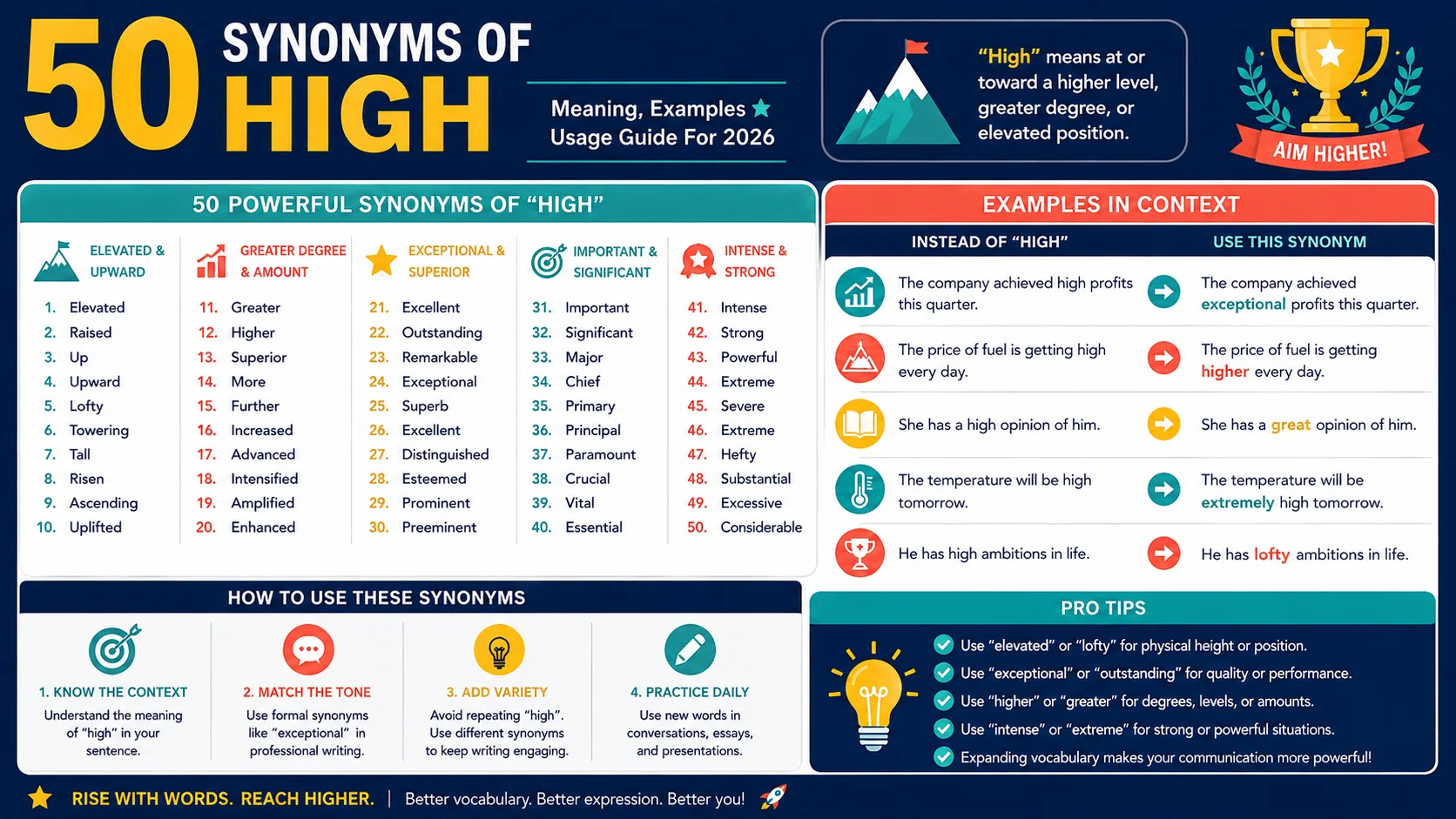
High means above average in position, level, amount, or quality. The best synonyms include tall, elevated, lofty, soaring, steep, great, extreme, and sky-high. The most common everyday synonym is tall for physical height, while elevated works best for formal contexts. Each synonym has a slightly different meaning, tone, or context, so choose carefully based on your situation.
Top 10 Synonyms
- Tall
- Elevated
- Lofty
- Soaring
- Steep
- Great
- Extreme
- Sky-high
- Towering
- Raised
Every synonym has a slightly different meaning, tone, or context, so choose carefully based on your situation.
Do you find yourself using “high” too often? It’s a word we use every day, but English has so many better alternatives. Whether you’re describing a building, a price, a temperature, or a feeling, having the right word makes your English sound more natural.
Learning synonyms for “high” helps you express yourself more precisely. You can describe a tall mountain, an elevated platform, a soaring bird, or a steep hill with just the right word.
In this guide, you’ll discover 35 powerful alternatives to “high.” You’ll learn their meanings, when to use them, and which ones native speakers prefer in different situations. Let’s begin!
What Does “High” Mean?
Definition
High means being above average in position, level, amount, intensity, or quality. It can describe physical height (a high mountain), degree (high temperature), rank (high position), or even feelings (high spirits).
In everyday terms, “high” describes anything that reaches upward or exceeds normal levels. It’s a versatile word that applies to many situations.
High can describe:
- Physical height (“a high building”)
- Amount or degree (“high prices”)
- Quality or rank (“high quality”)
- Sound (“a high note”)
- Feeling or mood (“high spirits”)
Pronunciation
| Feature | Value |
|---|---|
| US IPA | /haɪ/ |
| UK IPA | /haɪ/ |
| Syllables | 1 |
| Tip | Pronounce it like “eye” with an ‘h’ in front |
Grammar
| Grammar Feature | Information |
|---|---|
| Part of Speech | Adjective (also adverb and noun) |
| Common Position | Before a noun or after a linking verb |
| Typical Pattern | high + noun (high building) / be + high (the price is high) |
Example Sentences:
- “The mountains are very high in this region.”
- “She has a high position in the company.”
- “The temperature reached a high of 35 degrees.”
Word Family
| Word | Part of Speech | Meaning |
|---|---|---|
| High | Adjective | Above average in position or amount |
| Higher | Adjective | Comparative form of high |
| Highest | Adjective | Superlative form of high |
| Highly | Adverb | Very; to a great degree |
| Height | Noun | Measurement from bottom to top |
| Heighten | Verb | To make higher or more intense |
| Highness | Noun | Quality of being high; title of royalty |
35 Synonyms of “High”
1. Tall
Meaning: Having greater height than average for a person or object.
Best Used For: People, buildings, trees, physical objects.
Formality: Neutral
Tone: Descriptive, Practical
Frequency: ⭐⭐⭐⭐⭐ Very Common
CEFR Level: A2
Example Sentence 1: “My brother is six feet tall, so he’s the tallest in our family.”
Example Sentence 2: “The tall skyscraper dominates the city skyline.”
Usage Tip: “Tall” is the most common synonym for describing physical height of people and things. Use it for humans, buildings, trees, and plants. Don’t use it for mountains or hills—use “high” instead.
Common Confusion: “Tall” vs “High” – Tall describes something that stands upright (people, buildings, trees). High describes things that are above the ground (mountains, shelves, prices).
2. Elevated
Meaning: Raised to a higher position or level.
Best Used For: Formal contexts, describing positions, moods, or status.
Formality: Formal
Tone: Professional, Serious
Frequency: ⭐⭐⭐⭐ Common
CEFR Level: B2
Example Sentence 1: “The doctor is held in elevated esteem by her colleagues.”
Example Sentence 2: “We walked along an elevated platform above the city.”
Usage Tip: “Elevated” sounds formal and sophisticated. Use it for status, moods (“elevated spirits”), or physical positions. It’s perfect for professional writing.
3. Lofty
Meaning: Very high, towering; also means noble or grand.
Best Used For: Mountains, ideals, goals, aspirations.
Formality: Formal to Literary
Tone: Grand, Impressive
Frequency: ⭐⭐⭐ Moderate
CEFR Level: B2
Example Sentence 1: “The mountain had a lofty peak covered in snow.”
Example Sentence 2: “She has lofty goals for her career.”
Usage Tip: “Lofty” is literary and impressive. It works for physical height AND grand ideas. Use it for mountains, aspirations, and noble ideals. It sounds elegant.
4. Soaring
Meaning: Rising very high into the air.
Best Used For: Birds, buildings, prices, spirits.
Formality: Neutral to Literary
Tone: Impressive, Active
Frequency: ⭐⭐⭐⭐ Common
CEFR Level: B2
Example Sentence 1: “The soaring eagle circled above the valley.
Example Sentence 2: “The soaring cost of living is worrying everyone.
Usage Tip: “Soaring” suggests movement upward. Use it for things that rise dramatically. It’s more vivid and active than “high.” Perfect for describing birds, prices, or emotions.
5. Steep
Meaning: Rising or falling sharply; almost vertical.
Best Used For: Hills, slopes, increases, prices.
Formality: Neutral
Tone: Sharp, Intense
Frequency: ⭐⭐⭐⭐⭐ Very Common
CEFR Level: B1
Example Sentence 1: “The steep hill was hard to climb.”
Example Sentence 2: “There was a steep increase in rental prices.”
Usage Tip: “Steep” describes a sharp incline. Use it for hills, stairs, and prices. It suggests difficulty and a sudden rise. Perfect for describing dramatic increases.
6. Great
Meaning: Above average in size, degree, or importance.
Best Used For: Amounts, degree, importance, intensity.
Formality: Neutral
Tone: Strong, Positive
Frequency: ⭐⭐⭐⭐⭐ Very Common
CEFR Level: A2
Example Sentence 1: “There is a great difference between the two prices.”
Example Sentence 2: “The storm caused great damage to the coast.”
Usage Tip: “Great” works for high degree or importance. It’s a versatile alternative when something is significant. Use it for amounts, intensity, and importance.
7. Extreme
Meaning: Reaching the highest possible degree.
Best Used For: Weather, situations, emotions, measures.
Formality: Neutral to Formal
Tone: Intense, Serious
Frequency: ⭐⭐⭐⭐⭐ Very Common
CEFR Level: B1
Example Sentence 1: “The extreme heat forced everyone indoors.”
Example Sentence 2: “She showed extreme patience with difficult customers.”
Usage Tip: “Extreme” suggests the highest possible level. Use it when something is at the maximum. Perfect for weather, emotions, and situations.
8. Sky-high
Meaning: Extremely high, often referring to prices or costs.
Best Used For: Prices, costs, expectations.
Formality: Informal to Neutral
Tone: Dramatic, Modern
Frequency: ⭐⭐⭐⭐ Common
CEFR Level: B2
Example Sentence 1: “Rental prices in the city are sky-high.”
Example Sentence 2: “The candidate has sky-high ambitions.”
Usage Tip: “Sky-high” is vivid and informal. Use it for prices, expectations, and anything that seems to reach the sky. It’s more dramatic than “high.”
9. Towering
Meaning: Extremely tall or high; rising high above.
Best Used For: Buildings, mountains, trees, people.
Formality: Neutral to Literary
Tone: Impressive, Large
Frequency: ⭐⭐⭐⭐ Common
CEFR Level: B2
Example Sentence 1: “The towering skyscrapers of New York are impressive.”
Example Sentence 2: “A towering oak tree stood in the middle of the field.”
Usage Tip: “Towering” suggests great height and impressiveness. Use it for very tall things. It sounds dramatic and visual.
10. Raised
Meaning: Placed at a higher level; lifted up.
Best Used For: Platforms, hands, voices, standards.
Formality: Neutral
Tone: Active, Practical
Frequency: ⭐⭐⭐⭐⭐ Very Common
CEFR Level: A2
Example Sentence 1: “She stood on a raised platform to speak to the crowd.”
Example Sentence 2: “The company raised its standards for quality.”
Usage Tip: “Raised” describes something that has been lifted or made higher. Use it for physical positions or increased levels. It’s practical and clear.
11. Uplifted
Meaning: Raised up physically or spiritually.
Best Used For: Mood, spirits, hopes.
Formality: Neutral to Literary
Tone: Positive, Emotional
Frequency: ⭐⭐⭐ Moderate
CEFR Level: B2
Example Sentence 1: “The kind words uplifted her spirits.”
Example Sentence 2: “His heart was uplifted by the beautiful music.”
Usage Tip: “Uplifted” is often emotional or spiritual. Use it for feelings, moods, and hopes. It’s positive and inspiring.
12. Above
Meaning: Higher in position than something else.
Best Used For: Position, rank, level.
Formality: Neutral
Tone: Formal, Precise
Frequency: ⭐⭐⭐⭐⭐ Very Common
CEFR Level: A2
Example Sentence 1: “The temperature was above normal for this time of year.”
Example Sentence 2: “Her salary is above the industry average.”
Usage Tip: “Above” compares something to another level. Use it for comparisons. It’s precise and clear.
13. Superior
Meaning: Higher in rank, quality, or importance.
Best Used For: Quality, rank, performance.
Formality: Formal
Tone: Strong, Confident
Frequency: ⭐⭐⭐⭐ Common
CEFR Level: B2
Example Sentence 1: “The product is superior to its competitors.”
Example Sentence 2: “He was promoted to a superior position in the company.”
Usage Tip: “Superior” suggests something is better or higher. Use it for quality, rank, and performance. It sounds confident and professional.
14. Towering
Meaning: Extremely tall; rising to a great height.
Best Used For: Buildings, mountains, people.
Formality: Neutral to Literary
Tone: Impressive, Dominant
Frequency: ⭐⭐⭐⭐ Common
CEFR Level: B2
Example Sentence 1: “The towering cliffs rose above the ocean.”
Example Sentence 2: “A towering figure in the industry, she commands respect.”
Usage Tip: “Towering” suggests dominance and greatness. Use it for physical height and important people.
15. Skyrocketing
Meaning: Rising extremely fast, especially prices.
Best Used For: Prices, costs, demand.
Formality: Informal to Neutral
Tone: Dramatic, Modern
Frequency: ⭐⭐⭐⭐ Common
CEFR Level: B2
Example Sentence 1: “Gas prices are skyrocketing this year.”
Example Sentence 2: “Demand for online courses is skyrocketing.”
Usage Tip: “Skyrocketing” suggests rapid, extreme increase. Use it for prices, demand, or any fast-rising trend. It’s modern and vivid.
16. Maximum
Meaning: The highest possible or allowed level.
Best Used For: Limits, capacity, amounts.
Formality: Formal
Tone: Precise, Limit
Frequency: ⭐⭐⭐⭐⭐ Very Common
CEFR Level: B1
Example Sentence 1: “The car can travel at a maximum speed of 120 mph.”
Example Sentence 2: “We reached maximum capacity in the conference room.”
Usage Tip: “Maximum” is precise and official. Use it for limits, capacities, and amounts. It means the absolute highest.
17. Summit
Meaning: The highest point, especially of a mountain.
Best Used For: Mountains, conferences, achievements.
Formality: Formal to Literary
Tone: Achievement, Peak
Frequency: ⭐⭐⭐ Moderate
CEFR Level: B2
Example Sentence 1: “The summit of Mount Everest is 8,848 meters high.”
Example Sentence 2: “The summit of her career came when she won the award.”
Usage Tip: “Summit” means the very top. Use it for mountains and metaphorical peaks (career, achievements). It suggests reaching the highest point.
18. Elevated
Meaning: At a higher level or position.
Best Used For: Formal contexts, mood, status.
Formality: Formal
Tone: Professional, Sophisticated
Frequency: ⭐⭐⭐⭐ Common
CEFR Level: B2
Example Sentence 1: “The hotel is situated at an elevated location with a view.”
Example Sentence 2: “He has an elevated position in the government.”
Usage Tip: This is a refined alternative to “high.” Use it in formal writing to sound more sophisticated.
19. Lofty
Meaning: Very high or noble.
Best Used For: Ideas, goals, mountains.
Formality: Formal to Literary
Tone: Noble, Grand
Frequency: ⭐⭐⭐ Moderate
CEFR Level: B2
Example Sentence 1: “She has lofty ambitions for the new project.”
Example Sentence 2: “The palace was built on a lofty hill.”
Usage Tip: “Lofty” works for both physical height and noble ideals. It sounds elevated and grand.
20. Upper
Meaning: Higher in position, level, or rank.
Best Used For: Position, rank, limits.
Formality: Neutral
Tone: Clear, Precise
Frequency: ⭐⭐⭐⭐⭐ Very Common
CEFR Level: A2
Example Sentence 1: “She sits at the upper end of the table.”
Example Sentence 2: “We need to set an upper limit on spending.”
Usage Tip: “Upper” is simple and clear. Use it for position and limits. It works well in comparisons.
21. Imposing
Meaning: Impressively high and large.
Best Used For: Buildings, mountains, people.
Formality: Formal
Tone: Impressive, Powerful
Frequency: ⭐⭐⭐ Moderate
CEFR Level: B2
Example Sentence 1: “The imposing castle overlooked the valley.”
Example Sentence 2: “She has an imposing presence in any room.”
Usage Tip: “Imposing” suggests high AND impressive. Use it for things that command attention due to their height or presence.
22. Alpine
Meaning: Related to high mountains.
Best Used For: Mountains, landscapes, scenery.
Formality: Neutral to Formal
Tone: Natural, Scenic
Frequency: ⭐⭐ Rare
CEFR Level: B2
Example Sentence 1: “They went on an alpine hike through the mountains.”
Example Sentence 2: “The alpine scenery was breathtaking.”
Usage Tip: “Alpine” specifically relates to high mountains. Use it in travel, geography, or nature writing. It’s not for everyday use.
23. Towering
Meaning: Very high and rising above.
Best Used For: Physical height, importance.
Formality: Neutral to Literary
Tone: Grand, Dominant
Frequency: ⭐⭐⭐⭐ Common
CEFR Level: B2
Example Sentence 1: “The towering waves crashed against the shore.”
Example Sentence 2: “He was a towering figure in the world of science.”
Usage Tip: “Towering” describes something that stands out due to height or importance. Use it for physical and metaphorical height.
24. Soaring
Meaning: Rising high and gracefully.
Best Used For: Birds, prices, emotions.
Formality: Neutral to Literary
Tone: Beautiful, Rising
Frequency: ⭐⭐⭐⭐ Common
CEFR Level: B2
Example Sentence 1: “The soaring melody filled the concert hall.”
Example Sentence 2: “Soaring temperatures are expected this weekend.”
Usage Tip: “Soaring” suggests beauty and upward movement. Use it for birds, music, and rising quantities.
25. Great
Meaning: Very high in degree or intensity.
Best Used For: Degree, intensity, amount.
Formality: Neutral
Tone: Strong, Serious
Frequency: ⭐⭐⭐⭐⭐ Very Common
CEFR Level: A2
Example Sentence 1: “There was a great need for water in the region.”
Example Sentence 2: “She showed great courage in the face of danger.”
Usage Tip: “Great” is a safe alternative for high degree. Use it when something is significant.
26. Monumental
Meaning: Extremely large or important; like a monument.
Best Used For: Buildings, achievements, tasks.
Formality: Formal to Literary
Tone: Impressive, Historic
Frequency: ⭐⭐⭐ Moderate
CEFR Level: B2
Example Sentence 1: “The monumental statue was visible from miles away.”
Example Sentence 2: “This is a monumental achievement in medical research.”
Usage Tip: “Monumental” suggests high importance and size. Use it for significant things.
27. Colossal
Meaning: Extremely large or high.
Best Used For: Size, amount, cost.
Formality: Neutral to Literary
Tone: Huge, Impressive
Frequency: ⭐⭐⭐ Moderate
CEFR Level: B2
Example Sentence 1: “The colossal building took five years to build.”
Example Sentence 2: “The project required a colossal budget.”
Usage Tip: “Colossal” means very big. Use it for size, amount, or cost. It’s more dramatic than “high.”
28. Elevated
Meaning: Higher than normal or average.
Best Used For: Standards, levels, mood.
Formality: Formal
Tone: Professional, Precise
Frequency: ⭐⭐⭐⭐ Common
CEFR Level: B2
Example Sentence 1: “The patient has elevated blood pressure.”
Example Sentence 2: “The company maintains elevated standards of quality.”
Usage Tip: “Elevated” is common in medical and professional contexts. Use it for levels and standards.
29. High-rise
Meaning: A building with many stories.
Best Used For: Buildings, apartments, offices.
Formality: Neutral
Tone: Modern, Urban
Frequency: ⭐⭐⭐⭐ Common
CEFR Level: B1
Example Sentence 1: “She lives in a high-rise apartment in the city.”
Example Sentence 2: “The high-rise office building has 40 floors.”
Usage Tip: “High-rise” is specific to buildings with many floors. Use it in urban contexts.
30. Sky-scraping
Meaning: Extremely tall, like a skyscraper.
Best Used For: Buildings, towers.
Formality: Literary
Tone: Impressive, Modern
Frequency: ⭐⭐ Rare
CEFR Level: C1
Example Sentence 1: “The sky-scraping towers dominated the skyline.”
Example Sentence 2: “They build sky-scraping monuments to modern design.”
Usage Tip: This is a descriptive, literary word. Use it for very tall buildings.
31. Emergent
Meaning: Rising up; coming into view.
Best Used For: Objects, trends, phenomena.
Formality: Formal
Tone: Rising, New
Frequency: ⭐⭐⭐ Moderate
CEFR Level: B2
Example Sentence 1: “The emergent sun cast golden rays across the land.”
Example Sentence 2: “Emergent technologies are changing the world.”
Usage Tip: “Emergent” suggests rising up from something. Use it for new things appearing.
32. Precipitous
Meaning: Very steep or sudden.
Best Used For: Drops, declines, cliffs.
Formality: Formal
Tone: Sharp, Serious
Frequency: ⭐⭐⭐ Moderate
CEFR Level: B2
Example Sentence 1: “The precipitous cliff dropped into the ocean.”
Example Sentence 2: “We saw a precipitous decline in sales.”
Usage Tip: “Precipitous” describes steep drops. Use it for cliffs and sudden decreases.
33. Supremely
Meaning: To the highest degree.
Best Used For: Quality, confidence, importance.
Formality: Formal
Tone: Very strong, Confident
Frequency: ⭐⭐⭐ Moderate
CEFR Level: B2
Example Sentence 1: “She is supremely confident about the outcome.”
Example Sentence 2: “This is supremely important for our success.
Usage Tip: “Supremely” is an adverb for the highest degree. Use it to emphasize quality.
34. Mounting
Meaning: Rising or increasing gradually.
Best Used For: Pressure, costs, problems.
Formality: Neutral
Tone: Building, Serious
Frequency: ⭐⭐⭐⭐ Common
CEFR Level: B2
Example Sentence 1: “There is mounting pressure to solve the problem.”
Example Sentence 2: “Mounting costs forced them to change their plan.”
Usage Tip: “Mounting” suggests gradual increase. Use it for pressure, costs, and problems.
35. Uppermost
Meaning: Highest in position or importance.
Best Used For: Priority, position, thoughts.
Formality: Formal to Literary
Tone: Important, Top
Frequency: ⭐⭐⭐ Moderate
CEFR Level: B2
Example Sentence 1: “Safety is the uppermost priority in this project.”
Example Sentence 2: “Her concerns were uppermost in her mind.”
Usage Tip: “Uppermost” means top or most important. Use it for priorities and highest positions.
Synonyms Comparison Table
| Synonym | Best Context | Formality | Tone | Frequency |
|---|---|---|---|---|
| Tall | People, buildings | Neutral | Descriptive | ⭐⭐⭐⭐⭐ |
| Elevated | Formal contexts | Formal | Professional | ⭐⭐⭐⭐ |
| Lofty | Mountains, ideals | Formal | Grand | ⭐⭐⭐ |
| Soaring | Birds, prices | Neutral | Impressive | ⭐⭐⭐⭐ |
| Steep | Hills, prices | Neutral | Sharp | ⭐⭐⭐⭐⭐ |
| Great | Degree, amount | Neutral | Strong | ⭐⭐⭐⭐⭐ |
| Extreme | Weather, emotions | Formal | Intense | ⭐⭐⭐⭐⭐ |
| Sky-high | Prices, costs | Informal | Dramatic | ⭐⭐⭐⭐ |
| Towering | Buildings, mountains | Neutral | Impressive | ⭐⭐⭐⭐ |
| Raised | Positions, standards | Neutral | Active | ⭐⭐⭐⭐⭐ |
Best Synonyms by Situation
| Situation | Best Synonym | Why It Works |
|---|---|---|
| Describing a building | Tall, Towering | Clear and descriptive |
| Describing a mountain | Lofty, Soaring | Impressive and grand |
| Describing prices | Steep, Sky-high | Shows high cost |
| Formal writing | Elevated, Superior | Sounds professional |
| Describing a person | Tall, Towering | Common and natural |
| Describing temperature | Extreme, Great | Shows intensity |
| Describing goals | Lofty, Uppermost | Shows ambition |
| Academic writing | Elevated, Superior | Precise and formal |
| Everyday conversation | Tall, Great | Natural and easy |
| Business context | Upper, Elevated | Professional |
Formal vs Informal Synonyms
Formal Alternatives
| Synonym | Best Used For |
|---|---|
| Elevated | Professional contexts |
| Superior | Quality, rank |
| Supreme | Highest quality |
| Uppermost | Priority, position |
| Precipitous | Steep drops |
Neutral Alternatives
| Synonym | Best Used For |
|---|---|
| Tall | Physical height |
| Great | Degree, amount |
| Steep | Hills, prices |
| Raised | Higher positions |
Informal Alternatives
| Synonym | Best Used For |
|---|---|
| Sky-high | Prices, costs |
| Skyrocketing | Rising prices |
| Giant | Very big |
When to choose each level: Use formal synonyms for academic writing and business reports. Use neutral synonyms for everyday situations. Use informal synonyms in casual conversation.
Strong vs Mild Synonyms
Mild (Everyday Situations)
- Tall
- Great
- Raised
- Above
- Upper
Moderate (More Expressive)
- Elevated
- Soaring
- Towering
- Steep
- Superior
Strong (High-Intensity)
- Extreme
- Lofty
- Sky-high
- Monumental
- Colossal
Remember: Stronger doesn’t always mean better. “Extreme” is powerful but can sound dramatic. Choose the intensity that fits your situation.
Real-Life Examples
In the Office
“The elevated standards of our team have led to superior results.”
In a Business Email
“Due to the steep increase in costs, we need to adjust our budget.”
At School
“Her tall ambitions for the project impressed the entire class.”
Daily Conversation
“I can’t believe how sky-high the prices are at this store.”
In a Presentation
“The soaring demand for our product exceeded all expectations.”
Academic Writing
“The lofty ideals of the Enlightenment shaped modern democracy.”
Common Collocations
| Common Phrase | Better Alternative |
|---|---|
| High building | Tall building |
| High prices | Steep prices |
| High quality | Superior quality |
| High temperature | Extreme temperature |
| High position | Elevated position |
| High hopes | Great hopes |
| High standards | Elevated standards |
Common Phrases
- “High and low” – Meaning: Everywhere. Instead of “high,” try “far and wide.”
- “High time” – Meaning: The right time. Instead of “high,” try “perfect time.”
- “High society” – Meaning: Wealthy people. Instead of “high,” try “upper-class society.”
- “On high” – Meaning: In heaven. Instead of “high,” try “in heaven.”
Context Guide
| Situation | Best Synonym | Reason |
|---|---|---|
| Essay | Elevated, Superior | Formal and precise |
| Speech | Lofty, Towering | Impressive and grand |
| Business Email | Steep, Elevated | Professional |
| Novel | Soaring, Lofty | Literary and descriptive |
| Presentation | Sky-high, Soaring | Modern and engaging |
| Conversation | Tall, Great | Natural and easy |
| Academic Writing | Elevated, Superior | Scholarly |
| Marketing | Sky-high, Soaring | Persuasive and modern |
Related Words
Near Synonyms
- Elevated: Raised to a higher level.
- Lofty: Very high; also noble.
- Soaring: Rising high.
- Towering: Extremely tall.
Antonyms
- Low: Below average.
- Short: Not tall.
- Lowly: Low in rank.
- Minimum: The lowest level.
Related Adjectives
- Tall: Having height.
- Grand: Impressive and high.
- Supreme: Highest in authority.
Related Nouns
- Height: Measurement of how tall something is.
- Altitude: Height above sea level.
- Elevation: Height or raised position.
Related Verbs
- Raise: To make higher.
- Elevate: To lift or raise.
- Heighten: To increase intensity.
Frequently Asked Questions
What is another word for high?
The best alternatives are tall, elevated, lofty, soaring, steep, great, extreme, and sky-high. Tall is best for describing people and buildings. Elevated is excellent for formal contexts.
Which synonym sounds the most professional?
Elevated, superior, and uppermost sound the most professional. Use them in business writing, academic papers, and formal contexts. They suggest sophistication and precision.
What is the strongest synonym for high?
Extreme, lofty, and sky-high are among the strongest alternatives. Use them for maximum emphasis. Extreme suggests the highest degree, while sky-high suggests reaching the sky.
Which synonym is best for essays?
Elevated, superior, and uppermost are best for academic essays. They are formal and precise. Avoid informal words like sky-high in academic writing.
What’s the difference between high and tall?
Tall describes something standing upright (people, buildings, trees). High describes things that are above the ground (mountains, shelves, prices). You say “a tall man” but “a high price.”
Which synonym is most common in everyday English?
Tall (for physical height) and great (for degree) are most common. Native speakers use these naturally. Tall is used for people and buildings every day.
What is the opposite of high?
The most common opposites are low, short, and lowly. Low works for most contexts. Short works for physical height.
Is “sky-high” informal?
Yes, sky-high is informal. Use it in casual conversation but avoid it in formal writing. For formal contexts, use elevated or extreme instead.
Conclusion
Learning alternatives to “high” makes your English more precise and impressive. The right word depends on your context, audience, and what you want to emphasize.
For everyday situations, tall (for people and buildings) and great (for degree) are your safest choices. For professional writing, elevated and superior will help you sound sophisticated. For dramatic emphasis, sky-high and extreme pack a punch.
Remember these key principles:
- Choose tall for physical height of upright things
- Choose elevated for formal and professional contexts
- Choose steep for sharp increases and hills
- Choose soaring for rising birds and prices
The more you practice using these alternatives, the more natural they’ll become. Start by replacing one or two uses of “high” in your next email or conversation. You’ll sound more impressive in no time!
