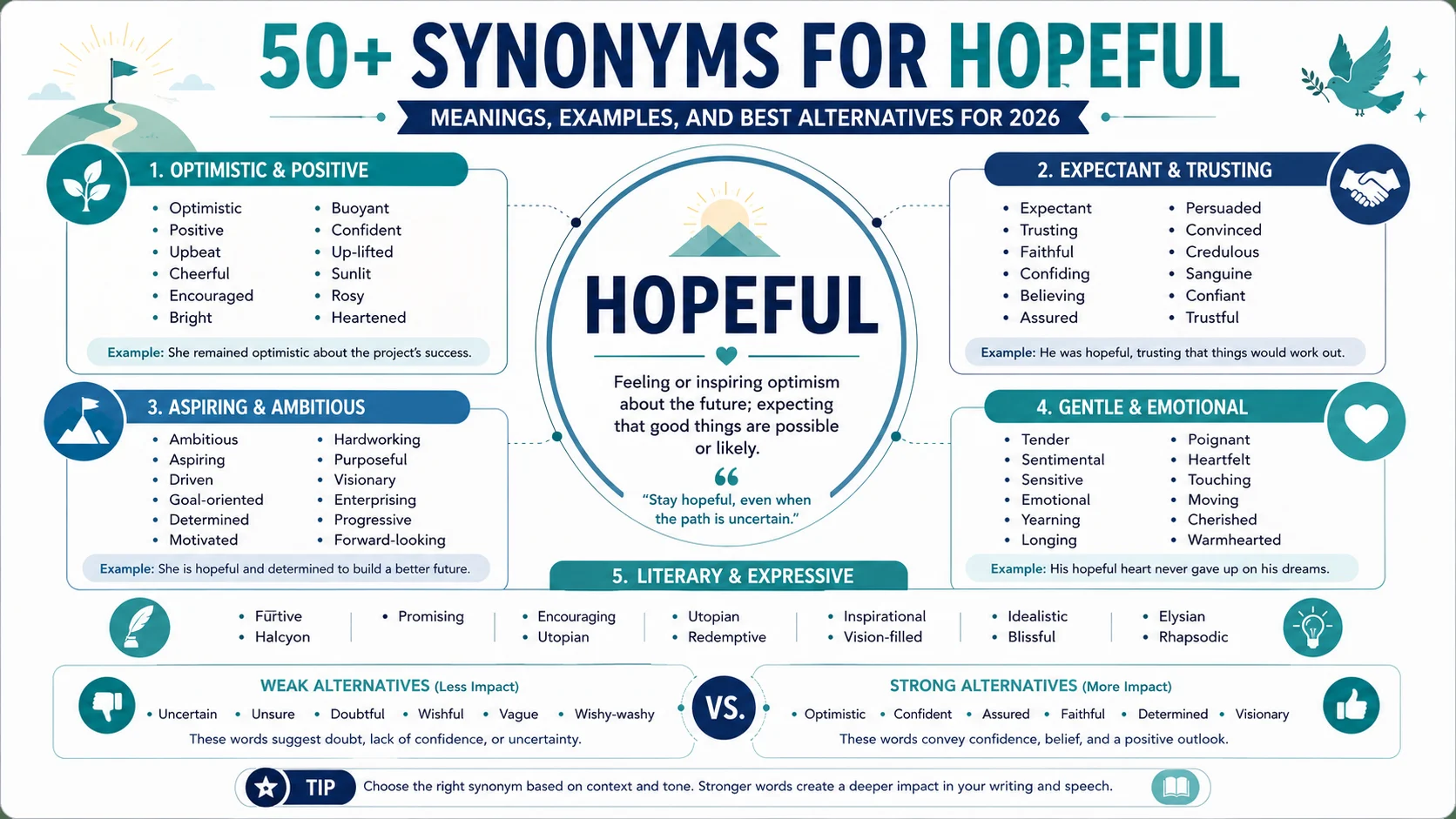
Hopeful means feeling or inspiring optimism about a future event. It describes a person’s state of mind or a situation’s promising outlook . The best synonym for hopeful in a professional setting is “optimistic,” in casual conversation it is “positive,” and for a stronger emotional tone it is “sanguine.”
Meaning, Tone and Context
- Simple definition: Feeling that something good will happen, or showing signs that it will.
- Part of speech: It is primarily an adjective. It can also be used as a noun to describe a person who aspires to succeed, such as a “young hopeful” or a “presidential hopeful” .
- Tone: The tone is positive and encouraging.
- Formality level: It is a standard word suitable for both formal and informal contexts, though more formal synonyms exist.
- Common use cases: You use it in job applications, personal letters, news reports, and daily conversation to express a positive expectation. Doctors might be hopeful about a treatment . A new singer on Broadway can be described as a hopeful prospect .
- Important word forms: The adverb is “hopefully,” and the noun form is “hopefulness.”
When and How to Use “Hopeful”
You should use “hopeful” when you want to express a simple, positive expectation without being overly dramatic. It is a safe choice for most situations. Here are some examples.
- Professional: “We are hopeful that the new strategy will increase our quarterly revenue.” This is a measured and confident statement for a business meeting.
- Personal: “I am hopeful that my family will be able to visit this summer.” This shares your personal desire for a happy outcome.
- Academic: “The initial data is hopeful, and we look forward to presenting our full findings.” This suggests promising results in a research context.
- Emotional: “A hopeful feeling washed over her as she watched the sunrise.” This describes an internal, positive emotion.
- Creative: “The first green shoots were a hopeful sign that winter was finally over.” This uses the word to create an image of renewal.
- Social Media: “Feeling hopeful for the future. Better days are coming.” This is a short, positive caption for a post.
- News/Report: “Economic indicators are hopeful, suggesting a recovery is on the way.” This presents evidence of a positive trend.
Another Word for “Hopeful”
The best single replacement for “hopeful” depends entirely on the context. There is no one-size-fits-all word.
- Professional writing: Opt for “optimistic.” It carries a formal, confident tone.
- Academic writing: Use “promising.” It suggests that evidence supports a positive outcome.
- Casual conversation: Use “positive.” It is a direct and easy word to understand.
- Emotional writing: Use “expectant.” It conveys a feeling of anticipation.
- Creative writing: Use “sanguine.” It is a literary word that adds sophistication.
- Resume or workplace use: Use “confident.” It emphasizes your belief in your own abilities.
- Social media captions: Use “upbeat.” It is modern and energetic.
- Stronger meaning: Use “confident” or “assured” for a feeling of certainty.
- Softer meaning: Use “cautiously optimistic” to show hope with some reservation.
When Not to Use “Hopeful”
The word “hopeful” can sound too vague or too weak in certain situations. Avoid it when you want to express a strong guarantee or a definite conclusion.
For example, if you are writing a professional email to confirm a deal, don’t say, “I am hopeful we will finalize this soon.” This sounds uncertain and weak. Use a more precise synonym: “I am confident we will finalize this soon.
Avoid using “hopeful” when the situation is hopeless or tragic. Using it would be insensitive. Also, avoid it when you need to sound completely objective and neutral. “Hopeful” is positive and biased.
Words Commonly Confused With “Hopeful”
Here are a few words that are often confused with “hopeful.”
- Optimistic vs. Hopeful: Optimistic is a general personality trait. It describes someone who always expects the best. Hopeful is more situational. You can be hopeful about a specific event, even if you are not generally an optimistic person .
- Promising vs. Hopeful: Promising is usually used to describe a thing, not a person’s feeling. A “promising lead” is different from a “hopeful lead.” “Hopeful” describes the person’s emotion, while “promising” describes the object’s potential.
- Confident vs. Hopeful: Confident means you are sure something will happen. Hopeful means you want it to happen and believe it is possible, but you are not entirely certain.
- Expectant vs. Hopeful: Expectant means you are waiting for something specific to happen, usually with a reason. Hopeful is a broader feeling that things will be good.
- Encouraging vs. Hopeful: Encouraging is used to describe something that gives hope to others. A “hopeful sign” and an “encouraging sign” are similar, but “encouraging” is more about the effect the sign has on people.
Best Synonym by Context for “Hopeful”
Which Synonym Should You Choose?
Choosing the right synonym is simple if you ask yourself a few questions.
First, think about the meaning. Are you talking about a person’s feeling or a situation’s potential? Use “optimistic” for a person and “promising” for a situation.
Second, consider the formality. Are you writing a text message or a formal report? Use “positive” for the text and “auspicious” for the report.
Third, think about the emotional intensity. Are you slightly hopeful or completely certain? Use “hopeful” for a modest feeling and “confident” for a strong one.
Finally, consider the professional value. If you need to sound impressive, choose a formal synonym like “sanguine” or “auspicious.
Real Life Examples of “Hopeful” in Sentences
Here are examples of how you can use “hopeful” and its synonyms in different situations.
- School: “The graduate was hopeful that his degree would lead to a good job.”
- Workplace: “The team was optimistic about hitting their sales target this quarter.”
- Writing: “The author’s note at the end of the book left the reader with a sanguine feeling.”
- Conversation: “I am positive that we can find a solution to this problem.”
- Social Media: “Spring is here. Feeling upbeat and inspired.”
- Resume: “I am a confident and decisive manager.”
- Email: “We are cautiously optimistic about the progress of the project.”
- Storytelling: “Looking at the avalanche of letters he received, a promising feeling arose that he might get the part.”
25 Synonyms for “Hopeful”
Synonym Groups and Usage Differences
Professional vs. Personal Synonyms
In professional contexts, you should sound competent and realistic. Use words like “optimistic,” “confident,” and “assured.” In personal contexts, you have more freedom. Words like “positive,” “upbeat,” and “hopeful” itself are fine.
Formal vs. Conversational Synonyms
For reports or speeches, choose “sanguine,” “auspicious,” or “propitious.” For daily conversation and texts, stick with “positive,” “optimistic,” or “upbeat.”
Academic Synonyms
In academic writing, precision is key. You want words that suggest evidence, not just feeling. Use “promising,” “encouraging,” and “favorable.”
Professional and Business Synonyms
In resumes or performance reviews, you want to show strength. Use “confident,” “bullish,” or “assured.” If you are discussing a project, you can use “optimistic” or “cautiously optimistic.”
Creative or Literary Synonyms
Add color to your writing with words like “sanguine,” “rosy,” and “expectant.” These words create a more vivid image for the reader.
Slang or Modern Synonyms
The word “upbeat” is a modern, slightly casual choice. “Bullish” is professional slang often used in business. Use these when you want to sound contemporary and energetic.
Strongest vs. Weaker Synonyms
Here is an intensity scale from mild to strong:
- Cautiously optimistic (very weak)
- Positive (weak)
- Hopeful (moderate)
- Optimistic (moderate-strong)
- Confident (strong)
- Assured (very strong)
Emotional vs. Neutral Synonyms
Words like “expectant,” “sanguine,” and “rosy” add emotional weight. They describe a feeling. Words like “promising,” “favorable,” and “auspicious” are more neutral. They describe the potential of a situation without focusing on a person’s feelings.
Antonyms of “Hopeful”
Comparison: Hopeful vs. Similar Words
Hopeful vs. Optimistic
The main difference is that “optimistic” is a general personality trait, while “hopeful” is a specific feeling about a situation . Optimistic is stronger and more formal. Example: “He is an optimistic person.” / “I am hopeful about the weather tomorrow.”
Hopeful vs. Confident
“Confident” implies a high degree of certainty, while “hopeful” implies a strong desire. Confident is much stronger. Example: “I am confident I will win.” / “I am hopeful I will win.”
Hopeful vs. Promising
“Hopeful” describes a person’s feeling. “Promising” describes a thing or situation. Example: “She feels hopeful about the new medicine.” / “The new medicine is promising.”
Hopeful vs. Expectant
“Expectant” suggests you are waiting for a specific thing. “Hopeful” is a more general feeling of positivity. Example: “The expectant crowd waited for the results.” / “The hopeful crowd believed the results would be good.”
Hopeful vs. Sanguine
“Sanguine” is the more literary and sophisticated version. It is a formal synonym for hopeful. Example: “The political leader remained sanguine about the outcome.”
Common Phrases and Expressions with “Hopeful”
1. Hopeful sign
Meaning: An event or piece of information that suggests things might go well.
Example sentence: “The declining infection rates are a hopeful sign.”
2. Remain hopeful
Meaning: To continue to feel or believe that something good will happen.
Example sentence: “We must remain hopeful during these difficult times.”
3. Cautiously optimistic
Meaning: A popular idiom that means you are hopeful but also aware of the risks.
Example sentence: “Economists are cautiously optimistic about the recovery.”
4. Young hopeful
Meaning: A young person who is ambitious and likely to succeed.
Example sentence: “The new recruit is a young hopeful.”
5. Presidential hopeful
Meaning: A person who is a candidate for president.
Example sentence: “The presidential hopefuls are campaigning across the country.”
Common Mistakes to Avoid
- Using “hopeful” when you need “confident.” If you are certain, choose the stronger word.
- Confusing “hopeful” with “hopefulness.” Remember that “hopeful” is usually an adjective, while “hopefulness” is a noun.
- Using a casual synonym in formal writing. Don’t use “upbeat” in an academic essay.
- Using an overly dramatic synonym for a simple situation. Don’t say “I am sanguine about lunch.” It sounds unnatural.
- Repeating “hopeful” too often. Vary your language to keep your reader engaged.
- Choosing a synonym with the wrong emotional tone. “Confident” is too strong if you are just “hopeful.
- Using slang in academic or professional writing. Avoid “bullish” in a research paper unless it is specifically about finance.
FAQs
What is the best synonym for hopeful?
- The best synonym depends on context. For formal writing, choose “optimistic.” For a modern, casual tone, choose “upbeat.” For an emotional, literary tone, choose “sanguine.”
What is a formal synonym for hopeful?
Formal synonyms for hopeful include “auspicious,” “sanguine,” “propitious,” and “encouraging.
What is an informal synonym for hopeful?
Informal and modern synonyms include “upbeat,” “positive,” and “bullish.
What is another word for hopeful in professional writing?
The best words are “optimistic,” “confident,” and “assured.”
What is the difference between hopeful and optimistic?
Hopeful is a specific feeling about a situation. Optimistic is a general personality trait . You can be hopeful about one thing, even if you are not generally optimistic.
What is the opposite of hopeful?
The most direct opposite is “hopeless.” Other antonyms include “pessimistic,” “despairing,” and “discouraging” .
Conclusion
- “Hopeful” is a useful and positive word. It can be a noun or an adjective. But relying on it too much will make your writing sound repetitive and vague. The best way to improve your vocabulary is to choose the right synonym for the right situation. If you are feeling positive, try “upbeat.” If you are certain, try “confident.” If you are in a formal setting, try “sanguine.” The English language is rich with alternatives. Use this guide to make your writing and speaking more precise, powerful, and engaging
