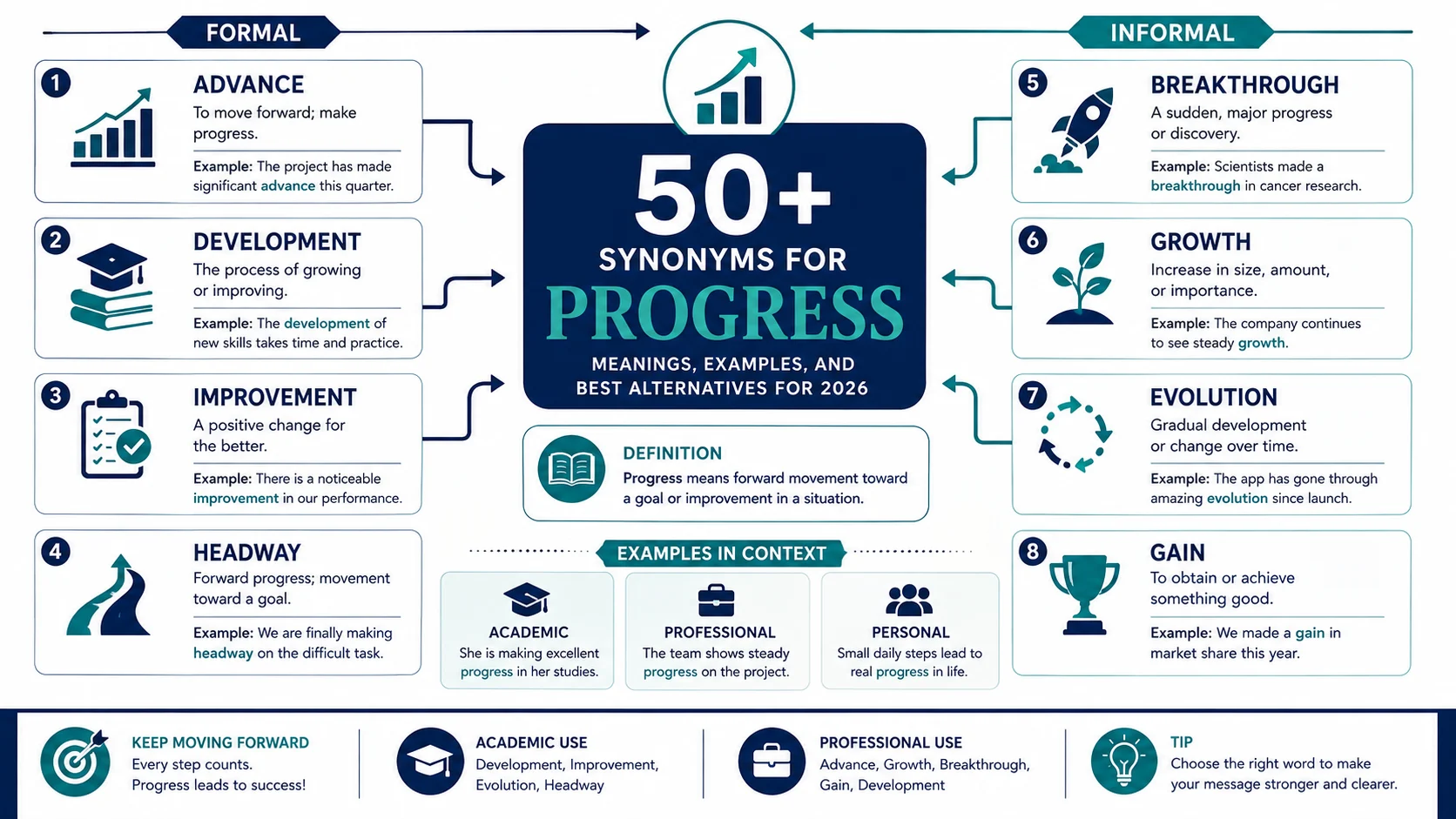
Progress means forward movement, improvement, or development toward a goal. The best synonyms include advance for movement, development for growth, improvement for getting better, headway for overcoming obstacles, and breakthrough for major leaps forward.
Top 10 Synonyms for Progress
- Advance
- Development
- Improvement
- Headway
- Breakthrough
- Growth
- Evolution
- Gain
- Progression
- Betterment
Every synonym carries a slightly different meaning and fits different situations. This guide will help you choose the right one.
Have you ever written a report and repeated “progress” three times in one paragraph? Or described a project’s status and felt stuck using the same word again and again?
You are not alone. Most writers, students, and professionals reach for “progress” by default without realizing how many precise alternatives exist.
Imagine you are writing a performance review and you keep saying “the employee shows progress.” Or you are updating stakeholders on a project and every sentence uses the same word.
This is where vocabulary matters. The right synonym makes your writing clearer, more engaging, and more professional.
This guide will help you choose the perfect synonym for progress in every situation. You will learn the subtle differences between advance, development, headway, breakthrough, and many other alternatives .
What Does “Progress” Mean?
Definition
Progress means forward movement toward a goal, improvement in a situation, or development toward a better state. It can refer to physical movement, personal growth, project advancement, or societal improvement. When you make progress, you are moving in a positive direction .
Pronunciation
| Feature | Details |
|---|---|
| US IPA | /ˈprɑːɡres/ |
| UK IPA | /ˈprəʊɡres/ |
| Syllables | 2 |
| Tip | Stress the first syllable. The verb form can be pronounced with stress on the second syllable: /prəˈɡres/ |
Grammar
| Grammar Feature | Information |
|---|---|
| Part of Speech | Noun and verb |
| Common Position | Noun: subject or object (e.g., “The progress was impressive” / “We made progress”) |
| Typical Pattern | Verb: often followed by “in,” “through,” “toward,” or “across” |
Example sentences:
- “The students showed remarkable progress in their math skills.”
- “As the project progressed, we encountered new challenges.”
- “We are making steady progress toward our goals.”
Word Family
| Word | Part of Speech | Meaning |
|---|---|---|
| Progress | Verb | To move forward or develop |
| Progression | Noun | A sequence of steps or stages |
| Progressive | Adjective | Happening gradually or favoring change |
| Progressively | Adverb | Gradually over time |
| Progressionist | Noun | Someone who supports progress |
| Progressivity | Noun | The quality of being progressive |
15 Synonyms of “Progress”
1. Advance
Meaning: Forward movement toward a goal or a positive step forward.
Best Used For: Professional communication, business writing, goal setting.
Formality: Neutral to formal.
Tone: Positive, professional.
Frequency: ⭐⭐⭐⭐⭐ Very Common.
CEFR Level: B1.
Example Sentence 1: “The company made a significant advance in renewable energy technology.”
Example Sentence 2: “His career advance came after years of dedicated work.”
Usage Tip: Advance works well for both physical movement and metaphorical progress. It is slightly more formal than “progress” and sounds confident in professional contexts.
Common Confusion: Advance vs. Advancement. Both are similar, but “advance” often refers to a specific step forward, while “advancement” refers to the broader process.
2. Development
Meaning: The process of growing, evolving, or becoming more advanced.
Best Used For: Academic writing, business reports, describing growth.
Formality: Formal.
Tone: Neutral to positive, professional.
Frequency: ⭐⭐⭐⭐⭐ Very Common.
CEFR Level: B1.
Example Sentence 1: “The development of new software has transformed the industry.”
Example Sentence 2: “We are monitoring the child’s language development closely.”
Usage Tip: Development emphasizes gradual growth over time. It works best when describing long-term change rather than quick improvements.
3. Improvement
Meaning: Becoming better or making something better.
Best Used For: Personal goals, performance reviews, learning progress.
Formality: Neutral.
Tone: Positive, straightforward.
Frequency: ⭐⭐⭐⭐⭐ Very Common.
CEFR Level: A2.
Example Sentence 1: “Her improvement in English has been remarkable.”
Example Sentence 2: “The improvement in customer satisfaction was immediate.”
Usage Tip: Improvement is the most direct synonym when you simply mean “getting better.” It is clear and easy to understand for all English learners.
4. Headway
Meaning: Progress made, especially when facing difficulties or obstacles .
Best Used For: Overcoming challenges, reporting on difficult tasks.
Formality: Neutral to informal.
Tone: Encouraging, determined.
Frequency: ⭐⭐⭐ Common.
CEFR Level: B2.
Example Sentence 1: “We are finally making headway on the budget negotiations.”
Example Sentence 2: “The rescue team made slow but steady headway through the storm.”
Usage Tip: Use headway when you want to emphasize that progress happened despite challenges. It implies effort and persistence.
5. Breakthrough
Meaning: A sudden, significant advance or discovery.
Best Used For: Scientific discoveries, major achievements, dramatic progress.
Formality: Neutral.
Tone: Exciting, dramatic.
Frequency: ⭐⭐⭐ Common.
CEFR Level: B2.
Example Sentence 1: “The medical breakthrough could save millions of lives.”
Example Sentence 2: “After months of research, we finally had a breakthrough in the experiment.”
Usage Tip: Breakthrough is for significant leaps forward, not everyday improvements. Save it for situations where the progress is truly dramatic.
6. Growth
Meaning: The process of increasing in size, amount, or development.
Best Used For: Business, economics, personal development.
Formality: Neutral.
Tone: Positive, forward-looking.
Frequency: ⭐⭐⭐⭐⭐ Very Common.
CEFR Level: A2.
Example Sentence 1: “The company experienced rapid growth in its first year.”
Example Sentence 2: “Personal growth often comes from facing challenges.”
Usage Tip: Growth emphasizes increase and expansion. It works well for numerical progress and personal development.
7. Evolution
Meaning: Gradual development over time, often involving change.
Best Used For: Academic writing, describing long-term change, philosophy.
Formality: Formal.
Tone: Neutral to positive.
Frequency: ⭐⭐⭐ Common.
CEFR Level: B2.
Example Sentence 1: “The evolution of social media has changed how we communicate.”
Example Sentence 2: “Language evolution occurs naturally through use and adaptation.”
Usage Tip: Evolution suggests slow, natural change over time. It is more formal and academic than other synonyms.
8. Gain
Meaning: An increase or advantage achieved.
Best Used For: Financial contexts, skill development, competition.
Formality: Neutral.
Tone: Positive, competitive.
Frequency: ⭐⭐⭐⭐ Common.
CEFR Level: B1.
Example Sentence 1: “We have seen significant gains in productivity this quarter.”
Example Sentence 2: “Her language gains were noticeable after just two months.”
Usage Tip: Gain suggests progress in measurable terms. It often relates to numbers, skills, or advantages.
9. Progression
Meaning: The process of moving forward from one stage to another .
Best Used For: Ordered processes, career paths, sequential development.
Formality: Formal.
Tone: Neutral.
Frequency: ⭐⭐⭐ Common.
CEFR Level: B2.
Example Sentence 1: “The natural progression of the disease was well documented.”
Example Sentence 2: “Career progression often requires additional training.”
Usage Tip: Progression emphasizes the sequence of steps in a process. It is more technical than “progress” itself.
10. Betterment
Meaning: The process of making something or someone better.
Best Used For: Social causes, personal improvement, altruistic contexts.
Formality: Formal to literary.
Tone: Noble, philosophical.
Frequency: ⭐⭐ Moderate.
CEFR Level: C1.
Example Sentence 1: “Her work is dedicated to the betterment of society.”
Example Sentence 2: “Education is essential for personal betterment.”
Usage Tip: Betterment has a somewhat formal and altruistic tone. It is excellent for discussing social progress but sounds overly formal in casual conversation.
11. Upgrading
Meaning: Replacing something with a better version.
Best Used For: Technology, equipment, systems.
Formality: Informal to neutral.
Tone: Positive, practical.
Frequency: ⭐⭐⭐⭐ Common.
CEFR Level: B1.
Example Sentence 1: “We are upgrading our software to the latest version.”
Example Sentence 2: “The hotel is upgrading its rooms with modern amenities.”
Usage Tip: Upgrading is specific to replacing with something better. It is less general than progress.
12. Amelioration
Meaning: The act of making something better or less harmful .
Best Used For: Academic writing, social policy, formal reports.
Formality: Very formal.
Tone: Intellectual.
Frequency: ⭐ Rare.
CEFR Level: C1.
Example Sentence 1: “The amelioration of working conditions was a key demand.”
Example Sentence 2: “Social programs aim for the amelioration of poverty.”
Usage Tip: This is a sophisticated word for formal writing. Avoid it in everyday conversation unless you want to sound academic.
13. Momentum
Meaning: The force gained by moving forward; progress that continues .
Best Used For: Projects, campaigns, careers.
Formality: Neutral.
Tone: Energetic, dynamic.
Frequency: ⭐⭐⭐⭐ Common.
CEFR Level: B2.
Example Sentence 1: “The campaign gained momentum after the first successful event.”
Example Sentence 2: “We need to maintain momentum until the project is complete.”
Usage Tip: Momentum emphasizes the forward drive and energy behind progress. It suggests that progress is building upon itself.
14. Stride
Meaning: A significant step forward or rapid progress.
Best Used For: Achievements, milestones, overcoming obstacles.
Formality: Neutral.
Tone: Positive, confident.
Frequency: ⭐⭐⭐ Moderate.
CEFR Level: B2.
Example Sentence 1: “The company has made great strides in reducing emissions.”
Example Sentence 2: “She has made strides in her career since joining the company.”
Usage Tip: Stride suggests confident, significant progress. It implies that progress is tangible and impressive.
15. Enhancement
Meaning: The process of improving quality or value.
Best Used For: Features, products, skills.
Formality: Formal.
Tone: Positive, professional.
Frequency: ⭐⭐⭐⭐ Common.
CEFR Level: B2.
Example Sentence 1: “The software includes several performance enhancements.”
Example Sentence 2: “Skill enhancement is a priority for professional development.”
Usage Tip: Enhancement focuses on quality improvements rather than quantity growth. It is common in business and technical writing.
Synonyms Comparison Table
| Synonym | Best Context | Formality | Tone | Frequency |
|---|---|---|---|---|
| Advance | Professional goals, business | Formal | Positive | ⭐⭐⭐⭐⭐ |
| Development | Growth, academic, business | Formal | Neutral | ⭐⭐⭐⭐⭐ |
| Improvement | Personal, learning, performance | Neutral | Positive | ⭐⭐⭐⭐⭐ |
| Headway | Overcoming obstacles | Neutral | Encouraging | ⭐⭐⭐ |
| Breakthrough | Scientific, dramatic progress | Neutral | Exciting | ⭐⭐⭐ |
| Growth | Business, personal, economics | Neutral | Positive | ⭐⭐⭐⭐⭐ |
| Evolution | Academic, long-term change | Formal | Neutral | ⭐⭐⭐ |
| Gain | Measurable progress | Neutral | Competitive | ⭐⭐⭐⭐ |
| Progression | Sequential steps | Formal | Neutral | ⭐⭐⭐ |
| Betterment | Social, altruistic | Formal | Noble | ⭐⭐ |
| Upgrading | Technology, systems | Informal | Practical | ⭐⭐⭐⭐ |
| Amelioration | Academic, policy | Very formal | Intellectual | ⭐ |
| Momentum | Projects, campaigns | Neutral | Energetic | ⭐⭐⭐⭐ |
| Stride | Achievements, milestones | Neutral | Confident | ⭐⭐⭐ |
| Enhancement | Quality improvement | Formal | Professional | ⭐⭐⭐⭐ |
Best Synonyms by Situation
| Situation | Best Synonym | Why It Works |
|---|---|---|
| Daily Conversation | Improvement, progress | Simple and natural for everyday speech |
| Business Email | Advance, development | Professional and clear for communication |
| Academic Writing | Development, evolution | Formal and precise for scholarly work |
| School Assignment | Improvement, growth | Easy to understand and appropriate for students |
| Professional Meeting | Headway, momentum | Shows progress despite challenges |
| Presentation | Breakthrough, stride | Engaging and impressive for audiences |
| Creative Writing | Evolution, progression | Adds depth and narrative sense |
| Social Media | Upgrade, growth | Modern and conversational |
| Movie Review | Development, progression | Discusses story and character growth |
| Book Review | Evolution, advancement | Analyzes narrative and themes |
Formal vs Informal Synonyms
Formal Alternatives
| Synonym | Best Used For |
|---|---|
| Advancement | Business proposals, executive summaries |
| Amelioration | Policy documents, academic papers |
| Evolution | Scientific writing, historical analysis |
| Betterment | Social causes, nonprofit communications |
| Progression | Technical writing, legal documents |
Use formal synonyms in academic essays, professional reports, legal documents, and official communications. They demonstrate professional vocabulary and serious intent.
Neutral Alternatives
| Synonym | Best Used For |
|---|---|
| Development | Most professional contexts |
| Improvement | Performance reviews, feedback |
| Growth | Business and personal contexts |
| Advance | Goal setting, career discussions |
| Enhancement | Product descriptions, feature updates |
Neutral synonyms work in almost any context. They are safe choices when you are unsure about formality requirements.
Informal Alternatives
| Synonym | Best Used For |
|---|---|
| Upgrade | Technology, lifestyle |
| Step forward | Personal achievements |
| Getting there | Everyday encouragement |
| Progress | General use (informal pronunciation) |
Informal synonyms are suitable for friends, social media, and casual conversations. They can sound unprofessional in business or academic writing.
Strong vs Mild Synonyms
Mild
Improvement, growth, development. These synonyms are suitable for everyday situations where progress is steady but not dramatic.
Moderate
Advance, headway, progression, gain. These synonyms show more substantial progress and are appropriate for most professional contexts.
Strong
Breakthrough, leap, stride, momentum. These high-intensity alternatives should be used carefully. They are perfect for major achievements but can sound exaggerated if used too often.
Choose intensity based on the significance of the progress. “We made progress” is safe. “We made a breakthrough” should be reserved for truly significant achievements.
Real-Life Examples
School Context
“After a month of tutoring, Maria showed significant improvement in her math scores. Her teacher noted that she had made exceptional progress in just a few weeks.”
Office Context
“The quarterly report highlighted our team’s steady advancement on the new platform. Despite some obstacles, we continued to make headway on the most challenging features.”
Business Email
“I am pleased to share that we have made considerable gains in user engagement this quarter. Our marketing team’s efforts have driven meaningful development in our key metrics.”
Meeting Context
“Project Blue is now gaining momentum after a slow start. The team has made great strides in the past two weeks, and we expect this upward trajectory to continue.”
Daily Conversation
“I am not fluent in Spanish yet, but I am making progress. My vocabulary has grown significantly, and I understand more of what people say.”
Social Media
“So excited about the growth we have seen this month! Our community has expanded beyond expectations, and the feedback keeps getting better.”
Common Collocations
| Common Phrase | Better Alternative | Context |
|---|---|---|
| Make progress | Make headway | Overcoming challenges |
| Progress report | Development update | Professional setting |
| Slow progress | Gradual advancement | Describing pace |
| Rapid progress | Quick advancement | Describing speed |
| Progress in | Advancement in | Career or skill context |
| Progress toward | Movement toward | Goal-oriented |
| Scientific progress | Scientific advancement | Research context |
| Economic progress | Economic growth | Financial context |
Common Phrases
In progress
Meaning: Currently happening or being done. “The construction project is currently in progress.”
Make progress
Meaning: Move forward or improve. “We need to make progress on this issue.”
Progress report
Meaning: A report showing what has been achieved. “Submit your progress report by Friday.”
Work in progress
Meaning: Something not yet finished. “My novel is still a work in progress.”
Progress to the next stage
Meaning: Move forward to the next level. “She progressed to the next round of interviews.”
Steady progress
Meaning: Consistent, reliable advancement. “The patient is showing steady progress in recovery.”
Context Guide
| Situation | Best Synonym | Reason |
|---|---|---|
| Essay | Development, evolution | Formal and analytical |
| Speech | Advancement, breakthrough | Engaging and inspiring |
| Business Email | Advance, development | Professional and clear |
| Novel | Progression, evolution | Narrative and descriptive |
| Presentation | Strides, momentum | Energetic and motivating |
| Conversation | Improvement, progress | Natural and approachable |
| Academic Writing | Amelioration, evolution | Precise and scholarly |
| Marketing Copy | Growth, enhancement | Positive and persuasive |
Related Words
Near Synonyms
- Ongoing improvement
- Forward motion
- Positive change
- Gradual development
Antonyms
| Antonym | Meaning | Example Sentence |
|---|---|---|
| Regression | Moving backward | “The patient’s condition showed regression, not progress.” |
| Decline | Deterioration | “The economy experienced a sharp decline after the crisis.” |
| Stagnation | No movement | “Stagnation set in as the team lost direction.” |
| Retreat | Going backward | “The army ordered a retreat from the front lines.” |
| Deterioration | Getting worse | “The deterioration of the building continued unchecked.” |
| Relapse | Returning to a worse state | “After a period of improvement, she had a relapse.” |
| Backslide | Falling back into old habits | “His backslide into poor habits was disappointing.” |
| Setback | Temporary reversal | “The project faced a serious setback.” |
| Retrogression | Returning to worse state | “The retrogression of living standards was concerning.” |
| Reversal | Complete change to opposite | “The reversal of fortune shocked everyone.” |
| Degeneration | Loss of quality | “The degeneration of the neighborhood continued.” |
| Decay | Gradual decline | “The decay of old buildings was evident.” |
| Decrease | Reduction | “The decrease in production caused concern.” |
| Worsening | Becoming worse | “The worsening of the situation demanded action.” |
| Downturn | Decline in performance | “The economic downturn affected all sectors.” |
Related Adjectives
- Progressive
- Gradual
- Steady
- Continuous
Related Nouns
- Process
- Journey
- Movement
Related Verbs
- Proceed
- Continue
- Develop
Frequently Asked Questions
What is another word for progress?
Another word for progress is advance. It suggests forward movement toward a goal. Other excellent alternatives include development, improvement, headway, and growth. Each carries subtle differences in meaning and context .
Which synonym sounds the most professional?
For professional writing, advance and development are the most professional synonyms. They sound confident and competent in emails, reports, and presentations. Avoid informal alternatives like “upgrade” in formal business contexts.
What is the strongest synonym for progress?
Breakthrough is the strongest synonym. It suggests a dramatic, significant advance that changes the situation entirely. Use it for major discoveries, critical project milestones, or game-changing improvements .
Which synonym is best for essays?
Development and evolution are the best choices for academic essays. They sound formal and precise. Use “amelioration” for advanced writing about social or policy issues. “Progress” itself is also appropriate for most essays.
What is the difference between progress and advancement?
Progress is general forward movement or improvement. Advancement is often more specific and formal. Advancement can refer to a significant step forward or promotion in position. Progress is broader and more commonly used .
Which synonym is most common in everyday English?
Improvement and growth are the most common in everyday English. They are simple, clear, and understandable to all English speakers. Native speakers often prefer these words in casual conversation.
What is the opposite of progress?
The opposite of progress is regression . Other opposites include decline, retreat, stagnation, and deterioration. These words mean moving backward or becoming worse instead of better.
Can “progress” be used as a verb?
Yes, progress can be a verb meaning to move forward or develop . Example: “The project progressed slowly at first.” The verb form often has stress on the second syllable.
Conclusion
Progress is a versatile word with many powerful synonyms. The right choice depends on your meaning, audience, and context.
For general use, choose advance for forward movement or improvement for getting better. In professional writing, development and growth are excellent choices. When facing challenges, headway shows persistence. For dramatic achievements, breakthrough is your best option.
Remember that tone and formality matter. Formal contexts call for words like amelioration and progression. Casual conversations welcome upgrade and gain.
The next time you write “progress,” pause and consider whether advance, development, improvement, or another alternative would serve your message better. This simple habit will elevate your vocabulary and make your communication clearer and more engaging.
