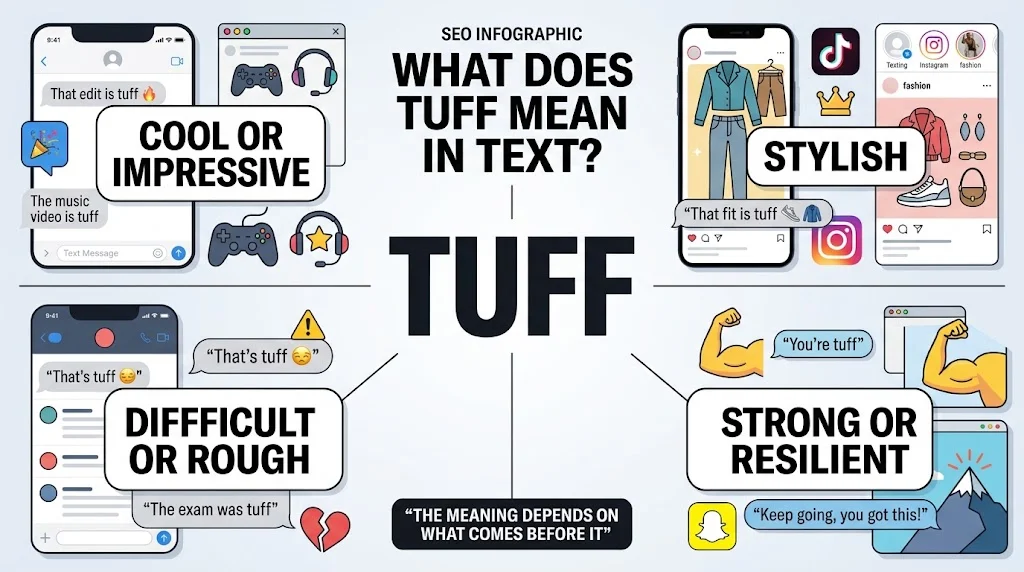
In text messages and social media, stuff is usually an informal spelling of “tough” that means cool, impressive, stylish, or admirable. However, after bad news, “tuff” can mean rough, difficult, or unfortunate. Context determines the meaning.
What does tuff mean in text is a question that often comes up when someone sees the word in a message, comment, caption, or social media reply. The spelling looks like a mistake at first. However, people often write it intentionally.
In modern online conversation, tuff commonly works as a casual compliment. Someone may call an outfit, song, car, video edit, hairstyle, sports move, or gaming clip “tuff.” In that setting, the word usually means cool, impressive, stylish, or worth respecting.
However, the word has another important use. Someone might respond with “that’s stuff” after hearing disappointing news. There, the phrase can mean “that’s rough,” “that’s unfortunate,” or “that sounds difficult.”
Therefore, you cannot interpret the word from spelling alone. You need to look at the message before it, the subject of the conversation, punctuation, emojis, and the relationship between the people talking.
The spelling also creates a relaxed internet tone. It belongs mainly in informal communication. Standard English is still used in professional, academic, and formal writing.
Quick Answer Box
| Meaning | Context | Primary Platforms | Example | Tone |
| Cool or impressive | Compliment | TikTok, Instagram, Snapchat, texting | “That fit is tuff.” | Positive |
| Stylish or attractive | Fashion or appearance | Instagram, TikTok, DMs | “Those shoes are tuff.” | Positive |
| Difficult or rough | Problems or bad news | Texting, group chats | “That’s stuff.” | Sympathetic or dry |
| Strong or resilient | Personal achievement | Texting, social media | “You stayed stuff.” | Respectful |
| Tough | Literal casual spelling | General chat | “This class is tuff.” | Neutral |
| Sarcastically impressive | Memes or jokes | TikTok, X, group chats | “Bro thinks he’s stuffy.” | Playful |
What Does Tuff Mean in Text?
The simplest answer is that tuff is an informal spelling of tough. In current internet slang, however, the spelling can carry a stronger sense of admiration or style.
For example, consider this exchange:
Alex: “I finally finished my new car build.”
Jordan: “That thing is tuff.”
Jordan is not saying the car is physically difficult. Jordan is praising it. The intended meaning is closer to “That looks really cool” or “That is impressive.”
This use has become common in casual digital communication. People use it to describe things that have visual appeal, skill, confidence, intensity, or personality.
The Core Meaning
In slang, tuff can communicate several closely related ideas:
- Cool
- Impressive
- Stylish
- Powerful
- Bold
- Admirable
- Strong
- Skillful
- Intimidating in a positive way
- Visually striking
The exact shade of meaning depends on what the speaker is describing.
“That jacket is tuff” focuses on style.
“That edit is tuff” focuses on quality.
“That move was tuff” focuses on skill.
“You’re tuff” may focus on confidence, strength, or resilience.
Tuff Versus Tough
The pronunciation is generally the same. The main difference is spelling and register.
| Word | Typical Meaning | Formality | Example |
| Tough | Difficult, strong, durable | Standard | “That exam was tough.” |
| Tuff | Cool, impressive, or casual tough | Very informal | “That jacket is tuff.” |
| Tuff | Rough or unfortunate | Informal | “That’s stuff.” |
The slang spelling is not normally an acronym. It is better understood as a stylized or phonetic spelling associated with casual online language.
Contextual Dynamics and Nuances of the Term
Context controls the meaning more than the spelling does.
That point matters because the same two words can communicate opposite emotional reactions.
Consider these examples:
“That car is tuff.”
This is probably praise.
“You missed your flight? That’s stuff.”
This probably acknowledges bad luck.
“You handled that situation well. You’re stuff.”
This praises resilience.
The surrounding words provide the strongest clue.
When Tuff Means Cool
This is one of the most recognizable modern uses.
People may write:
“Your fit is tuff.”
“That beat is tuff.”
“Those sneakers are tuff.”
“That edit is tuff.”
“The new setup is tuff.”
In each example, the speaker expresses approval.
The word can therefore replace several casual expressions, including “cool,” “fire,” “hard,” “clean,” “awesome,” or “impressive.” The exact substitute depends on the speaker and community.
When Tuff Means Difficult
The traditional sense of tough still survives in casual spelling.
Someone might say:
“This homework is tuff.”
Here, the meaning is probably “This homework is difficult.”
Likewise:
“That game was tuff.”
This could mean the game was challenging.
“That workout was tuff.”
This usually means the workout was physically demanding.
Context makes these examples different from “That outfit is tuff.”
When Tuff Means Unfortunate
The phrase “that’s stuff” deserves special attention.
A person might say:
“My laptop died right before I finished my assignment.”
Another person replies:
“That’s stuff.”
The response can mean “That’s rough” or “That’s unfortunate.”
However, it does not always express deep sympathy. Sometimes it is deliberately dry.
Online humor often depends on understated reactions. Therefore, “that’s stuff” can acknowledge someone’s problem without offering a long emotional response.
When Tuff Means Strong
The word can also describe resilience.
For example:
“She kept training after losing the match. She’s stuff.”
Here, the speaker praises determination.
This meaning connects naturally to the standard meaning of tough. The slang spelling simply makes the message sound more casual.
Tone Can Change Everything
The same sentence can feel supportive, sarcastic, dismissive, or enthusiastic.
Compare:
“That’s tuff 😭”
This can communicate sympathy.
“THAT’S TUFF 🔥”
This likely communicates excitement or admiration.
“that’s tuff lol”
This may sound playful or lightly dismissive.
“That’s tuff, bro. You’ll be good.”
This sounds more supportive.
The words stay almost identical. The surrounding signals change the interpretation.
Real Life Conversation Examples Using Tuff
The easiest way to understand internet slang is through realistic conversations.
Example 1: Complimenting an Outfit
Maya: “Rate the new jacket.”
Chris: “That jacket is tuff.”
Maya: “Actually?”
Chris: “Yeah, especially with those shoes.”
Here, the word clearly means stylish or impressive.
Example 2: Reacting to a New Car
Dylan: “Finally picked up the car today.”
Marcus: “Bro, that’s tuff 🔥”
Dylan: “Took forever to get it.”
Marcus: “Worth it though.”
In this conversation, the expression communicates admiration.
Example 3: Responding to Bad News
Sam: “My flight got cancelled again.”
Jordan: “That’s stuff.”
Sam: “I know 😭.”
Jordan: “Hopefully you get out tomorrow.”
Here, the phrase means something like “That’s rough.”
The follow up message confirms the sympathetic tone.
Example 4: Praising a Skill
Aiden: “I finally landed the trick.”
Noah: “That was tuff.”
Aiden: “I almost broke my board trying.”
Noah: “Still worth it 😂.”
Here, tuff means impressive or skillful.
Example 5: Friendly Teasing
Leo: “Nobody can beat me at this game.”
Ethan: “Bro thinks he’s tuff 😂.”
Leo: “Run the match then.”
Ethan: “Bet.”
In this case, the expression is playful. It does not literally describe physical toughness.
Platform Specific Breakdown
Different platforms encourage slightly different communication styles. However, the underlying meaning remains broadly similar.
How It Is Used on Snapchat
Snapchat encourages fast, informal conversations. Users often send short messages instead of complete sentences.
That makes stuff a natural reaction.
Someone might send a photo of new shoes and receive:
“tuff 🔥”
Someone might show a new haircut and get:
“Actually tuff.”
Someone might complain about a bad day and receive:
“Damn, that’s stuff.”
The visual context on Snapchat also matters. A photo can provide information that the text itself does not explain.
For example, “tuff” beside a picture of an outfit almost certainly functions as praise. The same word after a message about losing a wallet may express sympathy.
The Role of Tuff on TikTok
TikTok has helped spread short, expressive slang because comments often reward speed, humor, and emotional intensity.
A commenter might write:
“That fit is tuff.”
“That edit is tuff.”
“Bro is tuff.”
“Why is this actually tuff?”
The phrase can also appear in humorous or exaggerated comments.
For example, a deliberately dramatic video may receive:
“Bro thought this was tuff 💀”
Here, the commenter may be challenging the person’s attempt to look impressive.
Therefore, TikTok context requires attention to the complete comment and video. The word itself does not guarantee praise.
Instagram and Texting Dynamics
Instagram comments often use stuff as a compact compliment.
It works particularly well with visual subjects:
- Fashion
- Cars
- Sneakers
- Hairstyles
- Photography
- Artwork
- Fitness achievements
- Travel posts
- Sports clips
- Video edits
Private texting adds another layer because the relationship matters.
A close friend can use the word casually. A stranger may use it as a quick comment. A romantic interest may use it as a compliment about appearance.
For example:
“That picture is tuff 👀.”
Depending on the relationship, this could simply mean “That picture looks great.” It could also carry mild flirtation.
Gaming and Online Communities
Gaming chats provide another natural environment.
Players may call a difficult move “tuff.”
They may describe a strong opponent as “tuff.”
They may praise an impressive clip by saying:
“That play was tuff.”
The word fits gaming because players often value skill, difficulty, confidence, and style. Those ideas overlap naturally with the broader slang meaning.
Alternative Meanings and NLP Variations of the Phrase
From a language processing perspective, tuff has several possible semantic interpretations.
The safest approach is to treat it as context dependent rather than assigning one fixed definition.
Cool
Possible equivalents include:
“cool”
“awesome”
“impressive”
“fire”
“hard”
“clean”
Example:
“That design is tuff.”
Likely meaning:
“That design looks really good.”
Difficult
Possible equivalents include:
“hard”
“challenging”
“difficult”
“demanding”
Example:
“That exam was tough.”
Likely meaning:
“That exam was difficult.”
Unfortunate
Possible equivalents include:
“rough”
“unfortunate”
“tough luck”
“That sucks”
Example:
“My account got locked.”
“That’s stuff.”
Likely meaning:
“That’s rough.”
Strong
Possible equivalents include:
“resilient”
“tough”
“strong”
“durable”
Example:
“She stayed tough through the whole situation.”
Likely meaning:
“She stayed strong.”
Internet Variations
Online users may also write variations such as:
“so tuff”
“really tuff”
“actually tuff”
“that’s tuff”
“bro is tuff”
“ts is tuff”
“not tuff”
“too tuff”
The surrounding phrase determines the interpretation.
“Not tuff” usually rejects the idea that something is cool or impressive.
“Actually tuff” usually emphasizes genuine approval.
“Bro is tuff” can praise someone’s confidence, strength, appearance, or performance.
“That’s stuff” requires the most contextual interpretation because it can express either admiration or sympathy.
Misinterpretations: When Not to Use Tuff
Knowing what a slang term means also means knowing when it does not fit.
Do Not Use It in Formal Writing
Avoid slang spelling in:
- Academic essays
- Business reports
- Job applications
- Legal documents
- Formal emails
- Professional proposals
- Official statements
- School assignments
Write tough when you mean difficult, resilient, strong, or durable.
Do Not Assume It Always Means Cool
This is one of the biggest mistakes.
If someone tells you:
“My grandmother passed away.”
Replying:
“That’s tuff 🔥”
would create a serious tonal problem.
In that context, a simple sympathetic response would be much more appropriate.
Do Not Treat It as an Acronym
The word normally does not stand for a longer phrase.
It is primarily a casual spelling variation connected to tough.
Do Not Assume Every Spelling Is Intentional
Sometimes people genuinely mistype words.
Context helps distinguish intentional slang from an ordinary typo.
If someone writes:
“This math problem is tuff.”
They may intentionally use casual slang.
If the surrounding message contains many spelling errors, “tuff” could simply be a typo.
Therefore, avoid overinterpreting one word.
How to Respond in Chat Comfortably
Your response should match the meaning.
If Someone Compliments You
Someone:
“Those shoes are tuff.”
You can respond:
“Appreciate it 😂”
“Thanks bro.”
“Glad you like them.”
“Appreciate you.”
If Someone Says Your Work Is Impressive
Someone:
“That edit is tuff.”
You can say:
“Thank you.”
“I appreciate that.”
“Took me forever 😂.”
“Glad you liked it.”
If Someone Uses It After Bad News
Someone:
“My phone broke today.”
You:
“Damn, that’s rough.”
“Yeah, that sucks.”
“Hopefully you can get it fixed.”
“Sorry to hear that.”
If You Cannot Tell What They Mean
Ask for a simple clarification.
“Tuff in a good way? 😂”
Or:
“You mean cool or rough? 😂”
That approach avoids unnecessary confusion.
If Someone Sounds Dismissive
Sometimes “that’s stuff” can sound dry.
For example:
You: “I studied for ten hours and still failed.”
Them: “That’s stuff.”
If the response feels dismissive, you can answer:
“Wow, thanks for the support 😂.”
Or:
“Bro, I needed sympathy, not a status update.”
The right response depends on the relationship and existing humor.
FAQs
Is tuff a typo for tough?
Sometimes it can be a typo. However, in casual online communication, stuff is often intentional slang. It commonly works as a stylized spelling of “tough.”
What does stuff mean when someone compliments you?
It usually means the person thinks you, your appearance, your work, or something you created looks cool or impressive.
For example, “Your fit is tuff” is normally a positive comment about your outfit.
Is stuff positive or negative?
It can be either, depending on context.
As a compliment, it is positive.
After bad news, it can mean rough or unfortunate.
When used sarcastically, it can have a teasing or dismissive tone.
What does “that’s tuff” mean?
The phrase has two especially common interpretations.
After something impressive, it can mean “That is really cool.”
After bad news, it can mean “That is rough” or “That is unfortunate.”
Look at the preceding message to determine the intended meaning.
Is tuff the same as tough?
The spelling is different, but the slang form comes from the same word family.
“Tough” remains the standard spelling.
“Tuff” is primarily associated with informal, casual, or stylized communication.
What does “fit is tuff” mean?
It means the speaker likes the outfit.
In this sentence, fit means outfit, while tuff expresses approval.
The phrase is therefore similar to saying:
“Your outfit looks really good.”
What does “bro is tuff” mean?
It can mean that someone looks impressive, acts confidently, performs well, or appears strong.
The exact meaning depends on the situation.
A gaming clip may produce “bro is tuff” because of skill.
A funny video may use it ironically.
A fashion post may use it as a compliment.
Can tuff be sarcastic?
Yes.
Internet slang frequently gains meaning from irony, exaggeration, and memes.
For example:
“Bro really thought he was tuff 😂”
This may tease someone for acting overly confident.
Therefore, emojis, punctuation, and the surrounding conversation matter.
Is stuff appropriate for professional communication?
Usually, no.
Professional communication benefits from standard vocabulary.
Use tough, impressive, difficult, strong, or another precise word instead.
The slang spelling is most natural among friends, online communities, and casual conversations.
How should I reply when someone says tuff?
First, identify the context.
If they are complimenting you, say “Thanks,” “Appreciate it,” or something similarly casual.
If they are reacting to bad news, respond naturally to the sympathy.
If you cannot determine the meaning, ask what they mean.
A short clarification is better than assuming the wrong tone.
Conclusion:
Understanding what stuff means in text requires more than translating one word.
The spelling comes from tough, but online communities have given the casual form additional social meanings. Today, it can be praised as cool, stylish, impressive, or skillful. It can also describe difficulty, acknowledge bad luck, or praise someone’s resilience.
The most important clue is context.
If someone comments “That fit is tuff,” they are probably complimenting the outfit.
If someone says “That’s tuff” after hearing bad news, they may mean “That’s rough.”
If someone says “Bro is tuff” after an impressive performance, they may be praising strength, confidence, or skill.
Tone adds another layer. Emojis, capitalization, punctuation, memes, and the relationship between speakers can change how the expression feels.
The word also illustrates a broader feature of internet language. Online communication constantly reshapes familiar words. Spelling becomes part of tone. Short expressions replace longer explanations. Communities create shared meanings through repeated use.
Therefore, tuff is best understood as a flexible slang expression rather than a word with only one fixed definition.
When in doubt, read the message before it.
That single habit will usually tell you whether stuff means cool, impressive, difficult, rough, or strong.
And when the context still feels unclear, simply ask.
In internet conversation, context is often the real dictionary.
