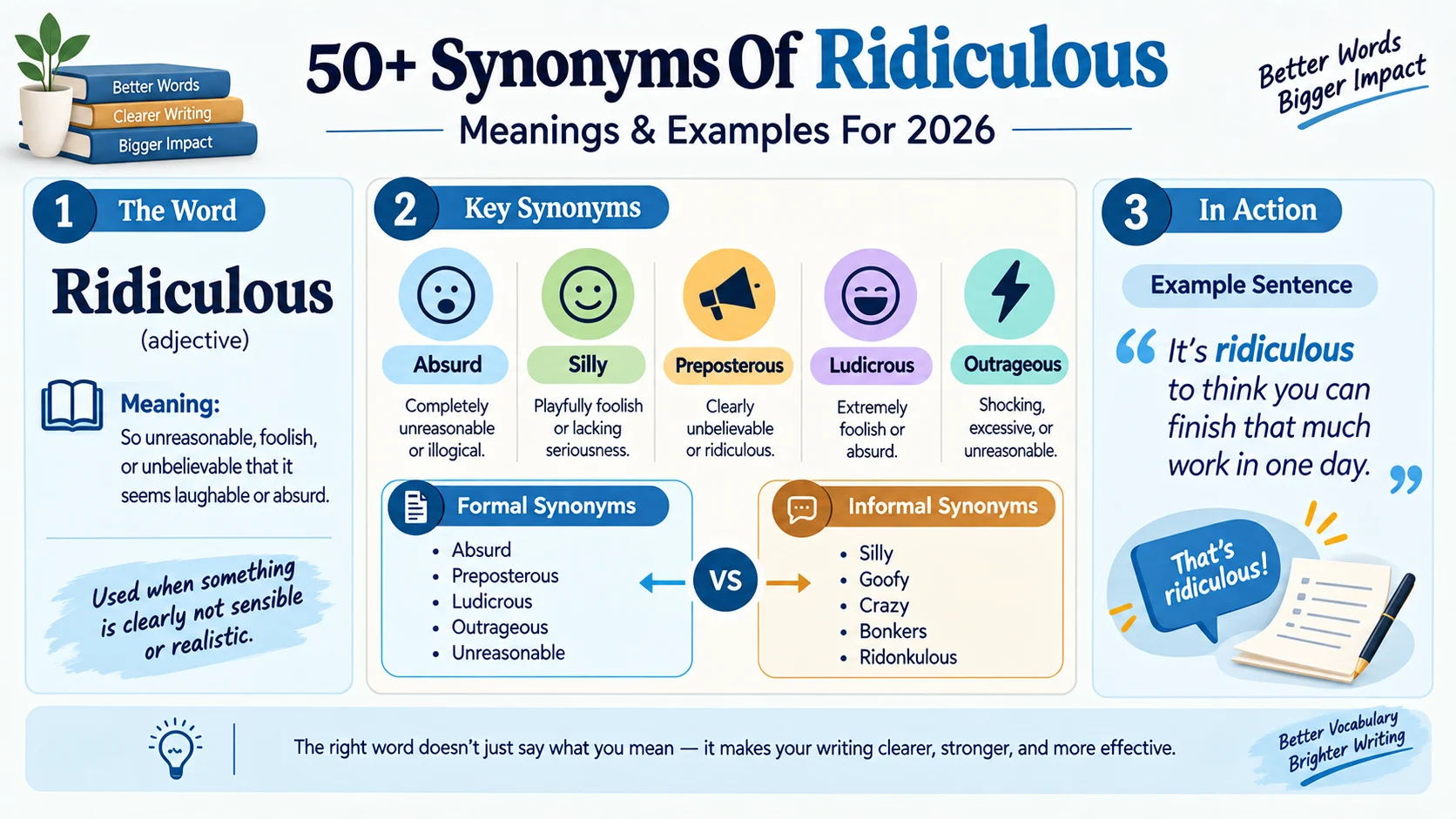
“Ridiculous” describes something that is silly, absurd, or worthy of mockery. It means something is so unreasonable or foolish that it seems laughable. The best synonyms depend on context. For formal use, try absurd or preposterous. For casual talk, use silly or wild. For strong emphasis, use ludicrous or outrageous.
Meaning, Tone and Context
The word “ridiculous” is an adjective that describes something deserving of ridicule or mockery. Its core function is to express that something is unreasonable, foolish, or absurd. The tone is generally negative, but it can range from playful teasing to harsh criticism.
1. Simple Definition: Ridiculous means something is so silly, unreasonable, or absurd that it seems laughable or deserving of mockery.
2. Part of Speech: Ridiculous is an adjective.
- Adjective: “That outfit looks ridiculous.”
- Adverb: “He was ridiculously late to the meeting.”
- Noun: “The ridiculousness of the situation made everyone laugh.”
3. Tone: The tone is usually negative, but it can be playful. When you call a friend’s joke ridiculous, it can be affectionate teasing. When you call a policy ridiculous, it is a strong criticism.
4. Formality: “Ridiculous” is a neutral word. It is appropriate for both casual conversation and professional writing. For very formal contexts, you might use “absurd” or “preposterous.”
5. Common Use Cases: You will encounter “ridiculous” in many situations.
- Casual Conversation: “The price of that handbag is ridiculous.”
- Professional Context: “The proposal was filled with ridiculous assumptions.”
- Academic Writing: “The theory was widely dismissed as ridiculous.”
- Creative Writing: “The villain’s plan was ridiculous but entertaining.”
6. Important Word Forms:
- Adjective: ridiculous. “The idea was ridiculous.”
- Adverb: ridiculously. “She was ridiculously talented.”
- Noun: ridiculousness. “The ridiculousness of the argument was clear to everyone.”
- Verb: ridicule. “They ridiculed his proposal.”
When and How to Use “Ridiculous”
Knowing when to use “ridiculous” is about understanding its power. It is a strong word that expresses disbelief, mockery, or criticism. Here are several scenarios where it is the perfect choice.
- Casual Conversation: To express disbelief at something silly or unreasonable.
Example: “The traffic today was ridiculous. It took me two hours to get home.” - Professional Context: To criticize a plan or idea that lacks logic.
Example: “The budget proposal was ridiculous and had to be rejected.” - Academic Context: To describe a theory or argument that is widely dismissed.
Example: “The hypothesis was considered ridiculous by the scientific community.” - Emotional Context: To express frustration or anger at a situation.
Example: “It is ridiculous that we have to wait three weeks for an appointment.” - Creative Writing: To describe a character or situation with humor or exaggeration.
Example: “The king’s ridiculous demands made him the laughingstock of the kingdom.” - Social Media Captions: To comment on something funny or absurd.
Example: “This outfit is ridiculous, but I love it.” - Email Context: To express frustration in a professional but informal way.
Example: “The deadline we were given is ridiculous and impossible to meet.” - Storytelling Context: To describe a plot point or character trait.
Example: “The movie’s plot was ridiculous, but it was still entertaining.”
Another Word for “Ridiculous”
Choosing the best replacement for “ridiculous” depends entirely on the context. Here are the most effective alternatives categorized by use.
- Professional Writing: “Absurd” or “Irrational.” “The proposal was based on absurd assumptions.”
- Academic Writing: “Preposterous” or “Fallacious.” “The argument was dismissed as preposterous.”
- Emotional Writing: “Outrageous” or “Unbelievable.” “The injustice was outrageous.”
- Creative Writing: “Ludicrous” or “Farcical.” “The situation was ludicrous, like something from a comedy.”
- Resume or Workplace: “Unreasonable” or “Impractical.” “The request was unreasonable given the time constraints.”
- Stronger Meaning: “Preposterous” or “Ludicrous.” “The claim was preposterous and easily disproven.”
- Softer Meaning: “Silly” or “Foolish.” “It was just a silly mistake.”
When Not to Use “Ridiculous”
While “ridiculous” is a versatile word, it can be too strong or too casual in certain situations. Using a more precise synonym can improve clarity and impact.
- When You Need Professionalism: If you are writing a formal report, “ridiculous” might sound too emotional. “The proposal was based on flawed assumptions” is more professional than “The proposal was ridiculous.”
- When Discussing Serious Matters: Using “ridiculous” to describe a tragedy or serious problem can sound insensitive. “The situation was tragic” is more appropriate than “The situation was ridiculous.”
- When Criticizing Directly: Using “ridiculous” can sound harsh and personal. Instead of “Your idea is ridiculous,” try “I have some concerns about the practicality of this idea.”
Example of Precision: Compare these two sentences.
- Vague: “The plan is ridiculous.”
- Precise: “The plan lacks a clear budget and timeline, which makes it impractical.”
The second sentence is more specific and provides a clearer, more professional criticism.
Words Commonly Confused With “Ridiculous”
Understanding the differences between these related words will significantly refine your English.
- Ridiculous vs. Absurd: “Absurd” is very similar to “ridiculous” but slightly more formal and philosophical. It suggests something that goes against logic or reason. “Ridiculous” is more about mockery.
- Ridiculous vs. Silly: “Silly” is much milder than “ridiculous.” Something silly is playful and harmless. Something ridiculous is more unreasonable and deserving of criticism.
- Ridiculous vs. Preposterous: “Preposterous” is stronger than “ridiculous.” It suggests something is completely contrary to reason and common sense. It is a more formal word.
- Ridiculous vs. Foolish: “Foolish” suggests a lack of good sense or judgment. It is more about the person who made the decision. “Ridiculous” is more about the thing itself.
- Ridiculous vs. Ludicrous: “Ludicrous” is very similar to “ridiculous” but is even stronger. It suggests something is so absurd that it is laughable. It is often used for comic effect.
- Ridiculous vs. Outrageous: “Outrageous” suggests something is shocking, bold, or offensive. It carries a stronger emotional charge than “ridiculous.” It can also be positive, meaning something is wildly entertaining.
Best Synonym by Context for “Ridiculous”
| Context | Best Synonym | Why It Works | Example |
|---|---|---|---|
| Formal Writing | Absurd | It is precise and carries intellectual weight. | “The policy was based on absurd assumptions.” |
| Academic Writing | Preposterous | It is formal and emphasizes illogical reasoning. | “The hypothesis was dismissed as preposterous.” |
| Professional/Business | Unreasonable | It is professional and focuses on practicality. | “The timeline is unreasonable and cannot be met.” |
| Resume | Impractical | It focuses on the lack of feasibility. | “The proposed solution was impractical.” |
| Casual Conversation | Silly | It is light, friendly, and playful. | “That was a silly thing to say.” |
| Creative Writing | Ludicrous | It adds humor and exaggeration. | “The situation was ludicrous, like a scene from a comedy.” |
| Emotional Tone | Outrageous | It conveys strong shock and anger. | “The price of the tickets was outrageous.” |
| Strong Intensity | Preposterous | It suggests complete lack of reason. | “His excuse was preposterous and no one believed it.” |
| Soft/Moderate Tone | Foolish | It suggests a lack of judgment but is not harsh. | “It was a foolish decision, but we can learn from it.” |
| Social Media Captions | Wild | It is modern, casual, and engaging. | “The plot twist was wild.” |
| US/UK Usage | Ridiculous | It is common in both dialects. | US and UK: “That is ridiculous.” |
Which Synonym Should You Choose?
Choosing the right word can seem difficult, but this simple guide will help you decide. It is all about matching the word to your goal, audience, and the message you want to send.
- Is your goal to be formal and intellectual? Use “absurd” or “preposterous.” These words carry weight and are perfect for academic or formal writing.
- Is your goal to be professional and objective? Use “unreasonable” or “impractical.” These words focus on the lack of logic or feasibility.
- Is your goal to be casual and playful? Use “silly” or “wild.” These words are light and friendly.
- Is your goal to express strong emotion like anger or shock? Use “outrageous” or “unbelievable.” These words convey strong feelings.
- Is your goal to be creative and humorous? Use “ludicrous” or “farcical.” These words add drama and comedy.
- Is your goal to be critical but not harsh? Use “foolish” or “unwise.” These words suggest a mistake without being overly mean.
Real Life Examples of “Ridiculous” in Sentences
Here are examples of how “ridiculous” and its stronger synonyms can be used in different real world scenarios.
- School: “The amount of homework we have is ridiculous.” Stronger: “The amount of homework we have is absurd.”
- Workplace: “The new policy is ridiculous and everyone is complaining.” Stronger: “The new policy is unreasonable and everyone is complaining.”
- Writing: “The villain’s plan was ridiculous but entertaining.” Stronger: “The villain’s plan was ludicrous but entertaining.”
- Conversation: “He paid $500 for a t shirt? That is ridiculous.” Stronger: “He paid $500 for a t shirt? That is outrageous.”
- Social Media: “The ending of that movie was ridiculous.” Stronger: “The ending of that movie was wild.”
- Resume: “The project requirements were ridiculous given the budget.” Stronger: “The project requirements were impractical given the budget.”
- Email: “The deadline is ridiculous and we need an extension.” Stronger: “The deadline is unreasonable and we need an extension.”
- Storytelling: “The king’s ridiculous demands made him a laughingstock.” Stronger: “The king’s preposterous demands made him a laughingstock.”
25 Synonyms for “Ridiculous”
The following table lists 25 accurate and practical synonyms for “ridiculous.
| Synonym | Simple Meaning | Best Used For | Example Sentence |
|---|---|---|---|
| Absurd | Completely unreasonable or illogical. | Formal, academic. | “The idea that the earth is flat is absurd.” |
| Silly | Playful and foolish. | Casual, friendly. | “It was a silly mistake, so do not worry about it.” |
| Foolish | Lacking good sense or judgment. | General, gentle criticism. | “It was foolish to spend all his savings on a car.” |
| Preposterous | Completely contrary to reason. | Formal, strong. | “The claim that he could fly was preposterous.” |
| Ludicrous | So absurd it is laughable. | Creative, humorous. | “The price they were asking was ludicrous.” |
| Outrageous | Shocking and bold. | Emotional, strong. | “The way she was treated was outrageous.” |
| Unreasonable | Not based on good sense. | Professional, business. | “The demands were unreasonable and could not be met.” |
| Impractical | Not sensible or realistic. | Professional, resume. | “The plan was impractical because of the cost.” |
| Nonsensical | Making no sense. | Academic, general. | “His argument was nonsensical and full of contradictions.” |
| Irrational | Not based on logic. | Academic, psychology. | “His fear of cats was irrational.” |
| Farcical | Absurd and ridiculous, like a comedy. | Creative, literary. | “The meeting turned into a farcical debate.” |
| Laughable | So silly it makes you laugh. | Casual, general. | “The excuse he gave was laughable.” |
| Comical | Funny and amusing. | Creative, casual. | “The way he tripped was comical.” |
| Idiotic | Extremely uninformed. | Strong, negative. | “That was an idiotic decision.” |
| wild | wild and unreasonable. | Casual, strong. | “The traffic was wild today.” |
| wild | Wild and unreasonable. | Casual, friendly. | “That is a wild idea, but I like it.” |
| Bizarre | Very strange and unusual. | General, descriptive. | “The movie had a bizarre ending.” |
| Ridiculous | Worthy of mockery. | General, neutral. | “The price of coffee here is ridiculous.” |
| Unbelievable | Hard to believe. | Emotional, strong. | “The amount of waste is unbelievable.” |
| Unthinkable | Impossible to imagine. | Formal, serious. | “It is unthinkable that anyone would do that.” |
| Foolhardy | Recklessly bold. | Literary, formal. | “It was a foolhardy decision to invest everything.” |
| Simpleminded | Lacking intelligence or sense. | Negative, harsh. | “The plan was simpleminded and doomed to fail.” |
| Harebrained | Impractical and foolish. | Casual, descriptive. | “He had a harebrained scheme to get rich quick.” |
| Asinine | Extremely foolish. | Strong, negative. | “The comment was asinine and offensive.” |
| Uninformed | Silly and foolish. | UK, casual. | “Do not be uninformed, of course you can do it.” |
Synonym Groups and Usage Differences
Professional vs. Personal Synonyms
- In a professional setting, like a business report or a resume, choose “unreasonable,” “impractical,” or “absurd.” These words sound objective and professional. In a personal setting, “silly,” “wild,” or “laughable” are more natural and friendly. For example, you would tell a colleague “The timeline is unreasonable,” but a friend “The timeline is wild.”
Formal vs. Conversational Synonyms
Formal Synonyms: “Absurd,” “preposterous,” and “irrational” are perfect for academic papers, legal documents, or formal speeches.
- Conversational Synonyms: “Silly,” “wild,” and “wild” are the best choices for everyday conversations and emails to friends.
Academic Synonyms
In essays and research papers, “absurd,” “irrational,” and “fallacious” are powerful and precise terms. “Nonsensical” is also useful for describing arguments that lack logic.
Professional and Business Synonyms
“Unreasonable” is a safe and professional choice for almost any workplace communication. “Impractical” is effective when discussing plans or budgets. “Inefficient” is useful for describing processes that waste time or resources.
Creative or Literary Synonyms
These words add a layer of artistry to your descriptions.
- Ludicrous: Suggests something is so absurd it is comical.
- Farcical: Perfect for situations that resemble a comedy of errors.
- Bizarre: Adds a sense of strangeness and mystery.
Slang or Modern Synonyms
- Wild,” “wild,” and “wild” are modern and casual synonyms. They are acceptable in social media captions, text messages, and very informal conversations. They should be avoided in academic or professional writing.
Strongest vs. Weaker Synonyms
Here is an intensity scale from mild to strongest:
- Silly: Very mild, playful and harmless.
- Foolish: Mild, suggests a lack of judgment.
- Ridiculous: Moderate, the standard word.
- Absurd, Ludicrous: Strong, suggests complete lack of reason.
- Preposterous: Strongest, completely contrary to reason.
Emotional vs. Neutral Synonyms
- Emotional Synonyms: “Outrageous,” “unbelievable,” and “wild” all carry strong emotional weight. They express shock, anger, or disbelief.
Neutral Synonyms: “Unreasonable,” “impractical,” and “nonsensical” are more factual and objective.
Antonyms of “Ridiculous”
Here are 15 clear antonyms for “ridiculous,” which are words that mean the opposite: sensible, reasonable, or logical.
| Antonym | Meaning | Example Sentence |
|---|---|---|
| Sensible | Based on good sense and logic. | “It was a sensible decision to save money.” |
| Reasonable | Fair and logical. | “The price was reasonable for the quality.” |
| Logical | Based on clear reasoning. | “Her argument was logical and convincing.” |
| Sensible | Showing good judgment. | “He made a sensible choice to study hard.” |
| Practical | Useful and realistic. | “The plan was practical and easy to follow.” |
| Rational | Based on reason. | “We need a rational discussion about the problem.” |
| Sane | Reasonable and sensible. | “It was a sane approach to a difficult situation.” |
| Wisdom | Good judgment and knowledge. | “The wisdom of the decision was clear.” |
| Prudent | Careful and sensible. | “It was prudent to save for the future.” |
| Sound | Based on good judgment. | “The advice was sound and helpful.” |
| Judicious | Showing good judgment. | “The judicious use of resources saved the project.” |
| Valid | Based on truth or reason. | “The point she made was valid.” |
| Credible | Believable and trustworthy. | “The explanation was credible and well supported.” |
| Plausible | Seeming reasonable or probable. | “The excuse was plausible, so we accepted it.” |
| Intelligent | Showing intelligence and reason. | “It was an intelligent solution to a complex problem.” |
Comparison: “Ridiculous” vs. Similar Words
Ridiculous vs. Absurd
Main Difference: “Absurd” is slightly more formal and philosophical. It suggests something goes against logic or reason. “Ridiculous” is more about mockery.
Which One Is Stronger: “Absurd” is stronger and more intellectual.
Which One Is More Formal: “Absurd” is more formal.
Example Sentence with Ridiculous: “That outfit looks ridiculous.”
Example Sentence with Absurd: “The idea that money grows on trees is absurd.”
Ridiculous vs. Silly
Main Difference: “Silly” is much milder. Something silly is playful and harmless. Something ridiculous is more unreasonable and deserving of criticism.
Which One Is Stronger: “Ridiculous” is stronger.
Which One Is More Formal: “Ridiculous” is slightly more formal.
Example Sentence with Ridiculous: “The price of that car is ridiculous.”
Example Sentence with Silly: “We played a silly game at the party.
Ridiculous vs. Preposterous
Main Difference: “Preposterous” is stronger than “ridiculous.” It suggests something is completely contrary to reason and common sense.
Which One Is Stronger: “Preposterous” is much stronger.
Which One Is More Formal: “Preposterous” is more formal.
Example Sentence with Ridiculous: “The rumor was ridiculous.”
Example Sentence with Preposterous: “The claim that he could speak ten languages fluently was preposterous.”
Ridiculous vs. Foolish
Main Difference: “Foolish” suggests a lack of good sense or judgment. It is more about the person who made the decision. “Ridiculous” is more about the thing itself.
Which One Is Stronger: “Ridiculous” is stronger.
Which One Is More Formal: Both are neutral.
Example Sentence with Ridiculous: “The plot of the movie was ridiculous.”
Example Sentence with Foolish: “It was foolish to ignore the warning signs.”
Ridiculous vs. Ludicrous
Main Difference: “Ludicrous” is very similar to “ridiculous” but is even stronger. It suggests something is so absurd that it is laughable.
Which One Is Stronger: “Ludicrous” is stronger and more dramatic.
Which One Is More Formal: “Ludicrous” is slightly more formal and literary.
Example Sentence with Ridiculous: “The situation was ridiculous.”
Example Sentence with Ludicrous: “The price of the handbag was ludicrous.”
Ridiculous vs. Outrageous
Main Difference: “Outrageous” suggests something is shocking, bold, or offensive. It carries a stronger emotional charge than “ridiculous.”
Which One Is Stronger: “Outrageous” is stronger and more emotional.
Which One Is More Formal: Both are neutral, but “outrageous” is more emotional.
Example Sentence with Ridiculous: “His behavior was ridiculous.”
Example Sentence with Outrageous: “His behavior was outrageous and unacceptable.”
Common Phrases and Expressions with “Ridiculous”
1. Ridiculously Easy
Meaning: Extremely easy.
Example Sentence: “The test was ridiculously easy. Everyone passed.”
2. Ridiculously Priced
Meaning: Extremely expensive.
Example Sentence: “The hotel was ridiculously priced for such small rooms.”
3. Beyond Ridiculous
Meaning: So ridiculous that it goes past the limit.
Example Sentence: “The amount of paperwork required is beyond ridiculous.”
4. Ridiculous to the Extreme
Meaning: Extremely ridiculous.
Example Sentence: “His outfit was ridiculous to the extreme.”
5. That is Ridiculous
Meaning: A common phrase expressing disbelief.
Example Sentence: “You have to work on your birthday? That is ridiculous.”
6. Ridiculous Amount
Meaning: An unreasonably large amount.
Example Sentence: “She spends a ridiculous amount of money on shoes.”
7. Look Ridiculous
Meaning: To appear silly or absurd.
Example Sentence: “I do not want to look ridiculous in front of everyone.”
8. Sound Ridiculous
Meaning: To seem absurd or silly.
Example Sentence: “I know it sounds ridiculous, but I think I saw a ghost.”
Common Mistakes to Avoid
1. Using “Ridiculous” When a More Precise Synonym Is Better
Mistake: “The proposal was ridiculous.”
Better: “The proposal was impractical and lacked a clear budget.” This is more specific and professional.
2. Confusing “Ridiculous” with “Absurd”
Mistake: “The idea that the earth is flat is ridiculous.” (This is fine, but “absurd” is more precise.)
Better: “The idea that the earth is flat is absurd.” “Absurd” is the better choice for philosophical or logical discussions.
3. Using a Casual Synonym in Formal Writing
- Mistake: “The new policy is wild.”
- Better: “The new policy is unreasonable.” “wild” is too casual for a formal report.
4. Using an Overly Dramatic Synonym for a Simple Situation
Mistake: “I made a preposterous mistake.”
Better: “I made a silly mistake.” “Preposterous” is too strong for a simple error.
5. Repeating the Same Word Too Often
Mistake: “The movie was ridiculous. The plot was ridiculous. The ending was ridiculous.”
Better: “The movie was ridiculous. The plot was absurd. The ending was ludicrous.” This variation makes the writing more engaging.
6. Choosing a Synonym with the Wrong Emotional Tone
Mistake: “I appreciate your asinine feedback.”
Better: “I appreciate your honest feedback, though I have some questions.” “Asinine” is offensive and too harsh for most situations.
7. Using Slang in Academic or Professional Writing
- Better: “The article is unconventional and full of unusual ideas.” “Wild” and “wild” are too casual for professional writing.
FAQs
1. What is the best synonym for ridiculous?
- The best synonym depends on your context. For formal use, “absurd” is a safe choice. For casual talk, use “silly.” For strong emphasis, use “preposterous.”
2. What is a formal synonym for ridiculous?
A formal synonym for ridiculous is “absurd” or “preposterous.” Both are appropriate for formal writing and professional communication.
3. What is an informal synonym for ridiculous?
- “Wild” is also a good casual choice. These words are perfect for everyday conversation.
4. What is another word for ridiculous in professional writing?
In professional writing, “unreasonable” is an excellent choice. “Impractical” is also effective when discussing plans. “Irrational” is useful for describing illogical decisions.
5. What is the difference between ridiculous and absurd?
“Absurd” is slightly more formal and philosophical. It suggests something goes against logic or reason. “Ridiculous” is more about mockery and is more common in everyday speech.
6. What is the opposite of ridiculous?
The opposite of ridiculous is “sensible,” “reasonable,” or “logical.” These words describe things that are based on good judgment and clear thinking.
Conclusion
The word “ridiculous” is a powerful adjective for describing things that are silly, absurd, or worthy of mockery. It is a useful word, but choosing the right synonym depends entirely on your context, audience, and the tone you wish to convey.
- For a formal setting, “absurd” or “preposterous” work well. For a professional context, “unreasonable” or “impractical” are excellent choices. In casual conversation, “silly” or “wild” are natural and friendly. For creative writing, “ludicrous” adds humor and drama.
The best advice is to think about your purpose and your audience before you choose a word. Do you want to be intellectual, professional, playful, or emotional? Matching your word to your intention will make your communication more effective and your English more precise.
A practical vocabulary tip: Try replacing “ridiculous” with a more specific synonym in your writing this week. If you are writing an academic essay, use “absurd.” If you are writing an email, use “unreasonable.” This small change will significantly improve the clarity and sophistication of your English.
