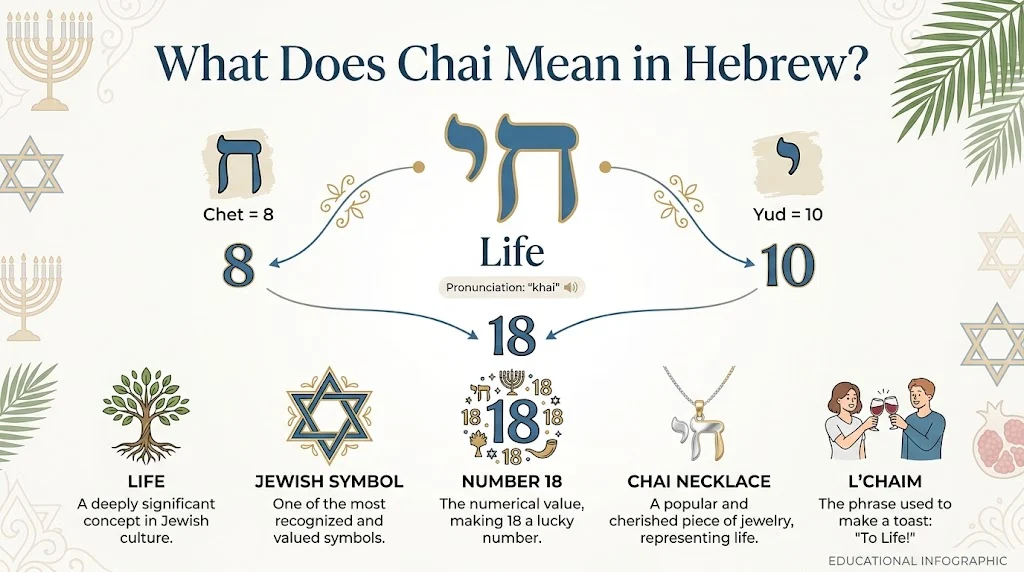
Chai (חי) means “life,” “alive,” or “living” in Hebrew. It consists of the Hebrew letters chet (ח) and yud (י), whose numerical values equal 18. In Jewish culture, chai symbolizes life, vitality, blessing, continuity, and celebration.
What does chai mean in Hebrew? It means “life” and can also describe something as alive or living. The Hebrew spelling is חי, using the letters chet (ח) and yud (י). The word has become one of the most recognizable Hebrew symbols in Jewish culture.
However, the word has more depth than a simple dictionary translation. Chai connects language, Jewish tradition, symbolism, gift giving, jewelry, celebrations, and the number 18.
You may see חי on a necklace. You may hear l’chaim at a celebration. You may also notice donations or gifts given in amounts such as $18, $36, or $180.
These uses all connect to the same linguistic idea.
It is also important to separate Hebrew chai from the English word chai used for tea. They share a Latin spelling, but they have different meanings and different pronunciation patterns. Hebrew chai uses a guttural “kh” sound. The sound resembles the “ch” in Bach or the beginning of challah, rather than the “ch” in chair.
So, if you encountered the word online, in jewelry, in a message, or during a Jewish celebration, context matters.
Quick Answer Box
| Meaning | Context | Primary Platforms | Example | Tone |
| Life, alive, living | Hebrew language | General use | חי means life or living | Positive |
| Life as a symbol | Jewish culture | Jewelry, celebrations | A chai necklace | Meaningful |
| 18 through gematria | Jewish tradition | Gifts, donations | $18 or $36 | Symbolic |
| L’chaim connection | Toasts and celebrations | In person, media | “L’chaim!” | Celebratory |
| Online reference | Social media and texting | TikTok, Instagram, Snapchat, messaging | “Chai means life” | Informational |
What Does Chai Mean in Hebrew? Full Semantic Definition and Origin
What does chai mean in Hebrew? The most direct answer is “life,” “alive,” or “living.” The Hebrew form is חי. It contains two letters: chet (ח) and yud (י).
The word can function in different grammatical and contextual ways. Therefore, translating it into English with only one fixed word can miss some of its range.
Chai as “life”
In many cultural explanations, chai is translated as life. That translation captures its symbolic use especially well.
For example, a piece of jewelry featuring חי is commonly described as a symbol of life. The same symbol can communicate vitality, continuity, and appreciation for existence.
The association is especially strong in Jewish culture.
Chai as “alive” or “living”
Chai can also relate to being alive or living. Hebrew lexical references connect חַי with meanings such as alive, living, life, and living being. The broader word family comes from the Hebrew root associated with living.
This distinction matters because English speakers sometimes assume that chai always functions exactly like the English noun “life.”
It does not.
Depending on the sentence, the underlying Hebrew idea can concern life itself, something living, or the condition of being alive.
The Hebrew spelling
The word is written:
חי
The first letter is ח, called chet or het.
The second letter is י, called yud or yod.
Together, they form the familiar word transliterated as chai, chay, or sometimes hai.
Different English spellings exist because Hebrew sounds do not always map neatly onto English letters.
Why the number 18 matters
One of the most important cultural connections involves 18.
Hebrew letters can carry numerical values in the traditional system known as gematria. Chet has a value of 8, while yud has a value of 10. Together, they total 18.
That connection gives 18 symbolic significance.
Consequently, Jewish gift giving and charitable donations sometimes use multiples of 18. Common examples include:
| Amount | Relationship to 18 |
| $18 | 1 × 18 |
| $36 | 2 × 18 |
| $54 | 3 × 18 |
| $72 | 4 × 18 |
| $90 | 5 × 18 |
| $180 | 10 × 18 |
The practice is not simply mathematical. It links the gift to the idea of life.
Chai and Jewish symbolism
The word became a recognizable Jewish cultural symbol. You can find it on pendants, necklaces, bracelets, artwork, and other objects.
A chai necklace, for example, does not merely display decorative lettering. It displays the Hebrew word חי.
Therefore, the object can communicate a connection to life and Jewish identity.
However, the exact personal meaning can vary. One person may focus on Jewish heritage. Another may focus on family continuity. Someone else may simply appreciate the traditional symbol of life.
Contextual Dynamics and Nuances of the Term
Understanding what chai means in Hebrew requires more than memorizing “life.”
Language depends on context. The same word can carry literal, cultural, symbolic, or conversational significance.
Literal linguistic meaning
At the most basic level, chai belongs to the semantic field of living and life.
English speakers may encounter translations such as:
| Hebrew concept | Common English rendering |
| חי | alive |
| חי | living |
| חי | life, depending on context |
| חיים | life or lives |
| לחיים | to life |
These translations should not be treated as perfectly interchangeable. Hebrew grammar and sentence context determine the most appropriate English rendering.
The relationship with Chaim
Another related word is Chaim, commonly written חיים.
Chaim is strongly associated with the idea of life and is also used as a Jewish masculine given name.
The relationship between chai and Chaim helps explain why the concept appears repeatedly in Jewish names, expressions, and traditions.
L’chaim
You may also recognize l’chaim, often translated as “to life.”
It is commonly used as a Jewish toast. The expression appears in celebrations and social settings, particularly when people raise a glass or mark an important occasion.
The phrase is not simply another translation of chai. Instead, it is a related expression built around the concept of life.
Chai is not inherently internet slang
This point deserves special attention.
Searchers sometimes ask what chai means in Hebrew because they encounter the word on social media. That does not automatically make it internet slang.
There is no general Hebrew definition in which chai suddenly becomes a special Snapchat or TikTok slang term.
Instead, the platform may simply be where the user encountered a genuine Hebrew word or Jewish cultural reference.
That distinction prevents a common misunderstanding.
Hebrew chai versus Indian chai
There is another major source of confusion.
In English, chai can refer to tea, particularly in the context of South Asian tea traditions.
Hebrew chai means life.
They are therefore different words despite their similar English spelling.
The pronunciation also differs. Hebrew chai uses a guttural sound that English speakers often represent with kh. Indian chai generally uses the familiar English “ch” sound.
Context usually makes the difference clear.
If someone discusses tea, spices, milk, or a café, they probably mean the beverage.
If someone discusses Hebrew, Judaism, jewelry, life, or the number 18, they may mean חי.
Real Life Conversation Examples Using Chai
Real conversations show why context matters.
The following examples use natural American English while preserving the distinction between the Hebrew word and internet slang.
Example 1: Asking about a necklace
Alex: “I saw a necklace with two Hebrew letters. Do you know what it says?”
Jordan: “It says chai, חי.”
Alex: “What does that mean?”
Jordan: “It means life. It’s also an important Jewish symbol.”
Alex: “That makes sense. I thought it looked familiar.”
Here, the word refers to the Hebrew concept of life. Nothing about the exchange requires a slang interpretation.
Example 2: Asking about $18
Maya: “Why did you give $36 instead of $40?”
Rachel: “It’s connected to chai.”
Maya: “The Hebrew word?”
Rachel: “Exactly. Chai means life, and its letters add up to 18.”
Maya: “So $36 is two times 18?”
Rachel: “Right.”
This conversation demonstrates the cultural connection between chai and gematria.
Example 3: Seeing it on TikTok
Sam: “Someone commented ‘chai’ under that video. Is that TikTok slang?”
Noah: “Not necessarily.”
Sam: “What does it mean?”
Noah: “In Hebrew, chai means life. They may just be using the Hebrew word or referring to Jewish culture.”
The key lesson is simple: platform context does not automatically create a new definition.
Example 4: Confusing tea and Hebrew
Chris: “I thought chai meant tea.”
Taylor: “It can in another context.”
Chris: “So why are people saying it means life?”
Taylor: “Because Hebrew chai means life. It’s a different word from the chai used for tea.”
Chris: “Got it. Same English spelling, different meaning.”
This is one of the most common sources of confusion for English speakers.
Example 5: A cultural explanation
Emily: “What does that symbol on your necklace mean?”
Daniel: “It’s chai, written חי.”
Emily: “What does chai mean in Hebrew?”
Daniel: “It means life. The letters also equal 18 in gematria.”
Emily: “That’s why I’ve seen Jewish gifts in multiples of 18.”
Daniel: “Exactly.”
This conversation connects the linguistic meaning with the cultural tradition.
Platform Specific Breakdown
Social media changes how quickly people encounter unfamiliar words. However, the meaning of a Hebrew word does not automatically change because it appears on a particular platform.
How It Is Used on Snapchat
Snapchat messages are usually brief. That makes unexplained cultural terms especially easy to misunderstand.
If someone sends chai in a Snapchat message, several interpretations are possible.
They might be:
- Referring to Hebrew.
- Referring to Jewish culture.
- Talking about a chai symbol.
- Discussing the number 18.
- Talking about tea.
- Simply repeating a word they saw elsewhere.
Therefore, you should use the surrounding message to interpret it.
For example:
“My grandma gave me this chai necklace.”
Here, the meaning is clearly connected to the Hebrew symbol.
By contrast:
“Want to grab chai?”
In an American conversation, that probably refers to the tea beverage.
The platform itself does not determine the definition.
The Role of Chai on TikTok
TikTok can introduce users to languages, religions, cultural traditions, jewelry, names, and memes within seconds.
Consequently, a viewer may encounter chai without knowing its Hebrew origin.
A video about Jewish jewelry could explain חי as a symbol of life.
A language-learning video could introduce chai as a Hebrew word.
A cultural video could explain the connection with 18.
Meanwhile, a food video could use “chai” for tea.
These are separate contexts.
Therefore, there is no single TikTok-specific meaning that should automatically replace the standard Hebrew definition.
Instagram and Texting Dynamics
Instagram creates similar ambiguity.
The word may appear in:
- A jewelry caption.
- A Hebrew language lesson.
- A Jewish cultural post.
- A birthday message.
- A wedding post.
- A charitable campaign.
- A discussion of the number 18.
- A tea recipe.
For example:
“Celebrating another year of chai.”
That wording could be poetic rather than slang.
Similarly, a caption mentioning 18, Jewish tradition, or חי provides strong clues that the Hebrew meaning is intended.
Text messages work the same way.
If you are unsure, a simple question works:
“Do you mean chai as in the Hebrew word for life?”
That clarification is natural and avoids guessing.
Alternative Meanings and NLP Variations of the Phrase
Natural language processing systems encounter multiple spellings and meanings for the same surface form.
This is especially important for the phrase what does chai mean in Hebrew, because search engines must distinguish Hebrew chai from other uses of “chai.”
Common spelling variations
You may see:
| Spelling | Possible interpretation |
| chai | Common English transliteration |
| chay | Alternative transliteration |
| hai | Another transliteration |
| חי | Hebrew spelling |
| חַי | Hebrew spelling with vowel marking |
The spelling חי is the clearest way to identify the Hebrew word visually.
Related terms
Semantic variations include:
- life
- alive
- living
- vitality
- existence
- Jewish symbol of life
- Hebrew word for life
- Hebrew life symbol
- chai symbol
- chai necklace
- number 18
- gematria 18
- l’chaim
- Chaim
These terms help search engines understand the topic without repeating the same exact phrase.
Why search intent matters
A person searching for the meaning may want a translation.
Another person may want pronunciation.
Someone else may have seen a necklace and want to understand the symbol.
A fourth person may be researching why Jewish gifts use $18.
These are different search intents around the same semantic entity.
A useful answer should address all of them without treating every occurrence as slang.
Chai as a name
Chai can also appear as a personal name.
That creates another layer of ambiguity.
If someone says, “Chai is my friend,” the word may function as a person’s name rather than a direct reference to the Hebrew noun.
Likewise, transliteration can produce multiple English spellings.
Context therefore remains essential.
Misinterpretations: When Not to Use Chai
Knowing what chai means in Hebrew also means knowing when not to assume the Hebrew interpretation.
Do not assume every “chai” means life
If someone says:
“I ordered a chai latte.”
They are almost certainly discussing a beverage.
Adding a Hebrew explanation would probably confuse the conversation.
Do not assume social media creates a new meaning
A word can become popular online without becoming slang.
If a TikTok creator discusses chai as a Jewish symbol, the platform has amplified an existing cultural meaning.
It has not necessarily invented a new definition.
Do not treat every use as religious
Chai has strong Jewish cultural associations. However, a person’s use of the word does not automatically tell you their religious beliefs or identity.
Someone may use the symbol because of family heritage, art, language, jewelry, cultural interest, or personal meaning.
Do not confuse chai and Chaim
Chai and Chaim are related but are not identical forms.
Chaim is commonly associated with “life” and is also a personal name.
Therefore, spelling and sentence structure matter.
Do not overstate mystical interpretations
Some sources connect chai and the number 18 with broader spiritual ideas.
However, the safest basic explanation remains straightforward:
חי is associated with life, and its letters total 18 in gematria.
Additional spiritual interpretations depend on the particular Jewish tradition or source being discussed.
How to Respond in Chat Comfortably
If someone uses chai in a message, your response should match the context.
When you understand the reference
You can respond naturally:
“Yes, chai means life in Hebrew.”
Or:
“Right, that’s the Hebrew word חי.”
When the context involves jewelry
You could say:
“That’s the chai symbol. It represents life and is connected with the number 18.”
When you are unsure
Ask:
“Do you mean chai in Hebrew, or chai tea?”
This is often the best response because the English spelling can refer to different words.
When someone asks for the meaning directly
A concise answer works:
“In Hebrew, chai means life or living. It’s written חי and has a numerical value of 18.”
That gives the essential information without overexplaining.
When the message is casual
You do not need to turn a short conversation into a language lesson.
For example:
Friend: “I finally bought a chai necklace!”
You: “Nice! The life symbol, right?”
That response acknowledges the cultural reference while keeping the conversation natural.
FAQs
What does chai mean in Hebrew?
Chai means “life,” “alive,” or “living” in Hebrew. It is written חי and consists of the letters chet and yud.
What does chai mean in Jewish culture?
Chai represents life and has become an important Jewish cultural symbol. It commonly appears in jewelry and connects with the number 18 through gematria.
Is chai a Hebrew word?
Yes. Hebrew חי is transliterated as chai or chay. It relates to being alive, living, or life.
Conclusion
What does chai mean in Hebrew? At its core, it means life, alive, or living.
The word is written חי and consists of two Hebrew letters. Chet has a numerical value of 8, while yud has a value of 10. Together, they produce 18 in gematria.
That numerical connection explains why 18 has become meaningful in Jewish gift giving and charitable donations.
The word also appears in jewelry, cultural celebrations, names, expressions, and the toast l’chaim. Its symbolism often centers on life, vitality, continuity, and celebration.
At the same time, modern social media can make the word appear in unexpected places. A user might encounter it on TikTok, Snapchat, Instagram, or in a text message. However, the platform does not automatically turn chai into slang.
Instead, context provides the answer.
If the conversation involves Hebrew, Jewish culture, a necklace, the number 18, or l’chaim, the Hebrew meaning is likely relevant. If someone discusses a latte, spices, milk, or a café, they probably mean tea.
The simplest takeaway is therefore clear:
Chai (חי) is the Hebrew word associated with life. Its letters equal 18 in gematria, which gives the word an additional layer of cultural significance.
Understanding that distinction makes it easier to interpret the word accurately, whether you encounter it in a language lesson, a Jewish celebration, a piece of jewelry, or a social media conversation.
