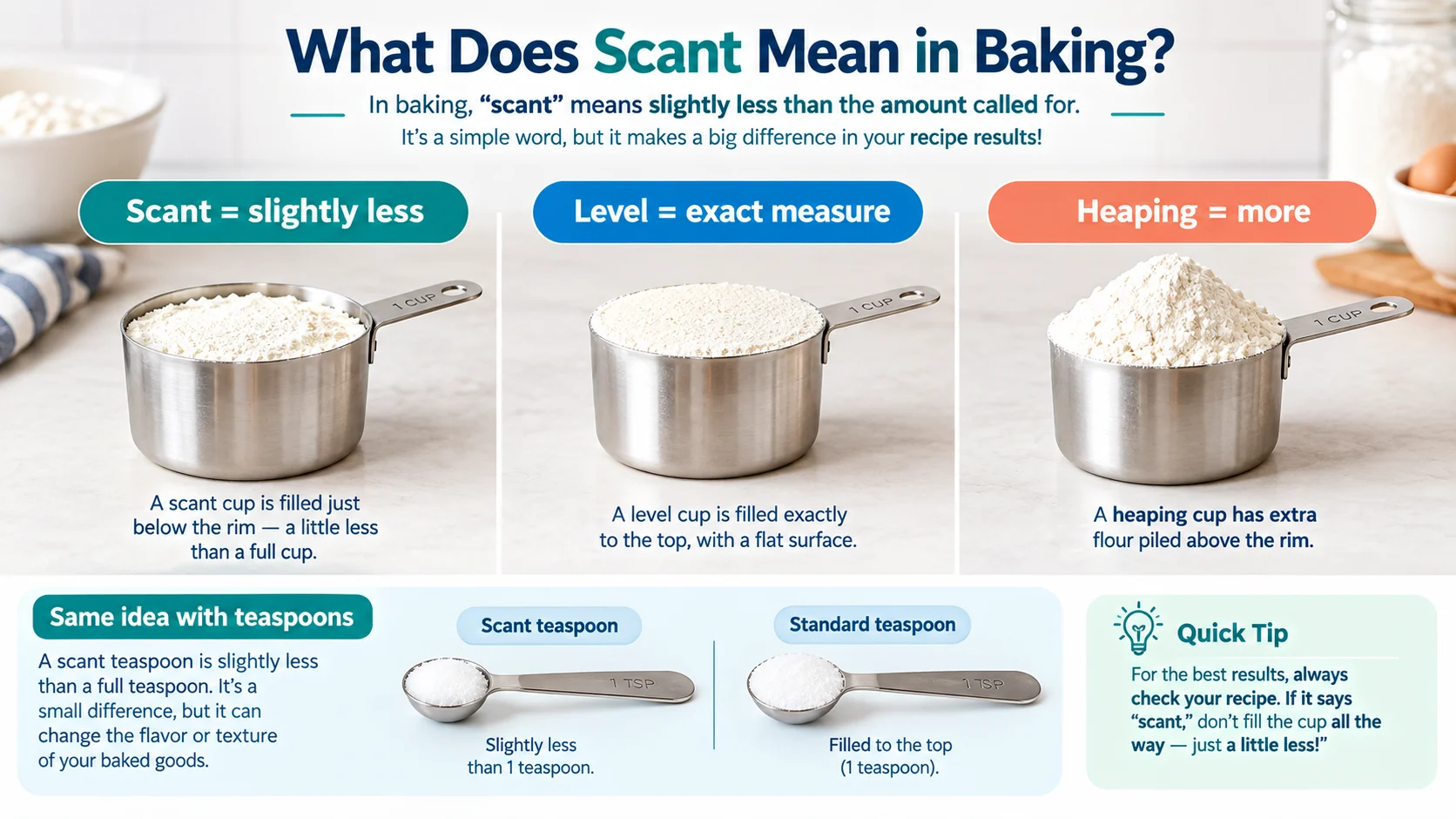
In baking, “scant” means slightly less than the stated measurement. A scant cup is not completely full. Instead, measure the ingredient normally, then leave a small amount below the rim. The difference is usually modest, not a precise universal quantity.
What does scant mean in baking? It means you should use slightly less than the stated measurement, rather than filling the measuring cup or spoon completely. The term appears often in older recipes, cookbooks, family recipes, and instructions that assume familiarity with traditional kitchen language.
However, “scant” does not usually mean dramatically less. It suggests a small reduction. For example, a recipe calling for a scant cup of flour generally asks you to fill the cup just below its normal level.
The tricky part is that recipes rarely define exactly how much “scant” means. Therefore, the intended amount depends on the ingredient, recipe style, and author.
For home bakers, the safest approach is simple. Treat “scant” as a small amount less than the listed measurement. Do not remove a large portion unless the recipe provides a specific quantity.
This guide explains the term in practical detail. It also covers measuring methods, common mistakes, recipe examples, ingredient differences, and ways to interpret the wording confidently.
Quick Answer Box
| Meaning | Context | Primary Platforms | Example | Tone |
| Slightly less than a stated measurement | Baking and cooking recipes | Cookbooks, recipe websites, food blogs, printed recipes | “Use a scant cup of sugar” means slightly less than one full cup | Instructional and precise |
| Not completely filled | Measuring dry or liquid ingredients | Home kitchens and professional kitchens | Fill the measuring cup just below the rim | Neutral |
| A small reduction | Traditional recipe language | Older and modern recipes | A scant teaspoon means a little less than a level teaspoon | Informal but practical |
What Does Scant Mean in Baking? Full Semantic Definition and Origin
When a recipe says “scant,” it modifies a measurement. The word tells you to use a little less than the stated amount.
For example, a scant cup contains slightly less than one full cup. A scant teaspoon contains slightly less than one level teaspoon.
The important word is “slightly.” Scant does not normally mean half, three quarters, or another dramatically reduced quantity.
The term comes from the broader English adjective “scant,” which describes something that is insufficient, limited, or barely enough. In recipes, however, the meaning becomes more practical.
A cook uses the word to indicate a measurement that falls just short of the stated quantity.
Scant Versus Level
A level measurement reaches the standard measuring line or sits flat across the top of a measuring spoon.
A scant measurement falls a little below that level.
For example:
| Recipe wording | Practical interpretation |
| 1 cup flour | Fill to one full cup |
| 1 scant cup flour | Use slightly less than one cup |
| 1 teaspoon salt | Use one level teaspoon |
| 1 scant teaspoon salt | Use slightly less than one teaspoon |
| ½ cup sugar | Use the full half cup |
| scant ½ cup sugar | Use slightly less than ½ cup |
The distinction matters because baking relies on proportions. A small change can affect sweetness, texture, moisture, spread, or structure.
Nevertheless, the effect depends heavily on the ingredient.
A tiny reduction in vanilla may have little practical impact. A reduction in flour or leavening can matter more.
Is “Scant” an Exact Measurement?
No. In most recipes, “scant” does not represent a universally standardized measurement.
For example, there is no single official conversion that says every scant cup equals a particular number of tablespoons less than a cup.
Instead, the word communicates an approximate instruction.
Therefore, two experienced bakers might interpret the same scant measurement slightly differently.
That does not necessarily make one interpretation wrong. The recipe language itself contains some flexibility.
How Much Less Is a Scant Measurement?
Usually, think of a scant measurement as just under the stated amount.
The exact difference depends on the recipe.
A useful practical rule is to avoid treating “scant” as a fixed percentage. Instead, aim for a visibly small reduction.
For a measuring cup, this might mean stopping slightly below the rim. For a measuring spoon, it might mean filling it without allowing the ingredient to reach a completely full level.
The goal is restraint.
If you remove a large amount, you have probably gone beyond what the recipe writer intended.
Contextual Dynamics & Nuances of the Term
The meaning becomes easier when you consider the ingredient and the recipe around it.
Scant Cups of Flour
Flour is one of the most common ingredients associated with this wording.
A recipe may call for a scant cup because the author wants slightly less flour than a conventional cup measurement provides.
That can influence texture.
Too much flour may produce a dry, dense, or firm baked good. Slightly less flour can help maintain tenderness.
However, modern recipes often specify grams instead. Weight measurements remove much of the ambiguity created by volume-based instructions.
Scant Cups of Sugar
A scant cup of sugar means slightly less than a full cup.
Here, the reduction can influence sweetness, browning, moisture, and texture.
Sugar does more than provide sweetness. It also affects how baked goods brown and how they feel when you bite them.
Consequently, changing the quantity too much can produce noticeable differences.
Scant Teaspoons of Salt
A scant teaspoon of salt means slightly less than a full teaspoon.
This instruction may appear when the recipe author wants to control saltiness carefully.
Salt can affect flavor dramatically. Therefore, a small reduction may be intentional.
Still, “scant” should not be interpreted as “barely any.”
Scant Measurements for Liquids
The term can also describe liquids.
For example, a recipe might request a scant cup of milk.
In that situation, measure slightly below the one cup mark.
Use a liquid measuring cup when possible. Place it on a level surface and read the measurement at eye level.
Why Recipes Use This Language
Recipe writers may use “scant” for several reasons.
First, traditional recipes often rely on familiar kitchen conventions. Second, the author may want to communicate a subtle adjustment without giving a more complicated measurement.
For example, saying “scant cup” can be easier than writing a fractional tablespoon conversion.
Furthermore, older recipes often assume that readers understand terms such as heaping, rounded, level, and scant.
Modern recipe writing tends to favor exact weights. Even so, these traditional terms remain common.
Real Life Conversation Examples Using what does scant mean in baking
The phrase itself is more likely to appear in a question about a recipe than in casual conversation. People often ask about it when they encounter unfamiliar recipe terminology.
Example 1: Beginner Baker
Maya: This cookie recipe says “one scant cup of flour.”
Lena: That means slightly less than one full cup.
Maya: So I should not fill it all the way?
Lena: Right. Leave a little space below the top.
Example 2: Family Recipe
Sam: Grandma’s recipe says “a scant teaspoon of salt.”
Alex: Use a little less than a level teaspoon.
Sam: Is there an exact amount?
Alex: Usually not. “Scant” is approximate.
Example 3: Online Recipe Question
Jordan: What does scant mean in baking?
Chris: It usually means slightly less than the stated measurement.
Jordan: So a scant half cup is less than half a cup?
Chris: Exactly.
Example 4: Flour Measurement
Nina: Should I scoop a scant cup of flour directly from the bag?
Owen: It is better to measure it carefully. Spoon the flour into the cup and stop slightly below the top.
Nina: Got it.
Owen: Also, weighing the flour is more consistent if the recipe gives grams.
Example 5: Clarifying a Recipe
Ella: The recipe says “scant cup of milk.”
Ben: Measure just under one cup.
Ella: Does that mean three quarters of a cup?
Ben: No. It means slightly under one cup, not a major reduction.
These examples show an important point. The word usually creates a small adjustment, not a completely different measurement.
Platform Specific Breakdown
Although recipe language now appears across social platforms, the meaning of “scant” remains rooted in cooking terminology. TikTok, Instagram, Snapchat, Pinterest, recipe blogs, and messaging apps may distribute the phrase, but they do not create a separate slang definition.
How It Is Used on Snapchat
On Snapchat, a user might share a screenshot of a recipe and ask a friend what a measurement means.
For example:
“This recipe says scant cup. What does that mean?”
A helpful reply would be:
“Just under a full cup.”
Snapchat does not give “scant” a special meaning. The context remains culinary.
Therefore, do not interpret the word as Snapchat slang simply because someone uses it in a Snap.
The Role of what does scant mean in baking on TikTok
TikTok has made recipe terminology more visible to casual cooks.
Creators may explain measurements through short videos. They may demonstrate the difference between level, heaping, and scant measurements.
For example, a creator could show a measuring cup filled almost to the top while explaining that the recipe requires slightly less.
However, TikTok comments can introduce confusion. Users may use “scant” differently based on family traditions or regional cooking habits.
Therefore, check the original recipe whenever possible.
If the recipe provides grams, use those numbers instead of relying on a visual estimate.
Instagram and Texting Dynamics
Instagram recipe posts can generate questions such as:
“What does scant mean here?”
The answer remains straightforward: slightly less than the stated measurement.
Texting works similarly.
A friend might send:
“What does scant mean in baking? The recipe says scant tablespoon.”
You can respond:
“It means a little less than a full tablespoon.”
The word does not become internet slang merely because people discuss it in comments or messages.
Alternative Meanings & NLP Variations of the Phrase
The word “scant” has several meanings outside the kitchen.
In general English, it can describe something limited or barely sufficient.
For example:
“There was scant evidence.”
Here, “scant” means very little or insufficient.
Another example is:
“He paid scant attention.”
In that sentence, the phrase means he gave very little attention.
The baking meaning follows the same broad concept. A scant measurement falls short of the full amount.
Related Baking Terms
| Term | Meaning |
| Scant | Slightly less than the stated amount |
| Level | Exactly filled to the standard measurement |
| Heaping | More than the standard level |
| Rounded | Slightly above level, depending on context |
| Generous | A little more than the stated amount |
| Packed | Pressed firmly into the measuring vessel |
| Sifted | Ingredient passed through a sieve before or during measurement |
These terms are not interchangeable.
A heaping teaspoon is larger than a level teaspoon. A scant teaspoon is smaller.
Consequently, substituting one for another can change the recipe.
Semantic Variations People Search For
People may phrase the same question in different ways.
Common variations include:
- What does scant mean in a recipe?
- What is a scant cup?
- What is a scant teaspoon?
- How much is a scant measurement?
- What does scant flour mean?
- What does scant sugar mean?
- What does slightly less than a cup mean?
- How do you measure a scant cup?
These searches point to the same underlying concept: interpreting an approximate measurement that falls just below the stated amount.
Misinterpretations: When NOT to Use what does scant mean in baking
The biggest mistake is treating “scant” as a large reduction.
For example, if a recipe asks for a scant cup, do not automatically use three quarters of a cup.
That changes the quantity too much.
Another mistake involves treating “scant” as exactly one tablespoon less.
That interpretation may work in a particular recipe, but it is not a universal rule.
Do Not Confuse Scant With Half
A scant cup is not half a cup.
A scant tablespoon is not half a tablespoon.
The word describes a small shortfall.
Do Not Confuse Scant With Heaping
These terms move in opposite directions.
A heaping measurement contains more than the standard amount.
A scant measurement contains slightly less.
Therefore, replacing one with the other can noticeably alter ingredient ratios.
Do Not Ignore Recipe Precision
Some recipes depend on precise proportions.
This is particularly true for bread, pastry, cakes, and other chemically sensitive baked goods.
If the recipe supplies weights, follow the weights.
A digital kitchen scale often provides better consistency than volume measurements.
When the Meaning Is Unclear
If the recipe comes from an old handwritten card, ask the person who wrote it if possible.
Family recipes can use personal conventions.
One person may consider a scant cup to be only slightly below the rim. Another may use a particular spoon or cup as their reference.
Context matters.
How to Respond in Chat Comfortably
If someone asks what “scant” means, you do not need a long explanation.
A simple answer works:
“It means slightly less than the stated measurement.”
You can then provide an example.
“So a scant cup means just under one cup.”
That answer is clear, natural, and useful.
Short Responses
| Situation | Natural response |
| Friend asks about a recipe | “It means slightly less than the full amount.” |
| Someone asks about a cup | “A scant cup is just under one cup.” |
| Someone asks about a teaspoon | “Use a little less than a level teaspoon.” |
| Someone thinks it means half | “No, it only means slightly less.” |
| Someone wants exact grams | “There is no universal gram value for ‘scant.’ Check the recipe or use its weight measurement.” |
A More Detailed Reply
If the person is baking something sensitive, you can say:
“Scant” means slightly under the stated measurement. It is not a fixed percentage, so if the recipe gives grams, use those instead.”
This answer handles both the definition and the practical issue.
A Helpful Clarification
If someone seems confused, ask what ingredient and measurement the recipe uses.
For example:
“What does the recipe call for: a scant cup of flour, sugar, or something else?”
The ingredient can influence how carefully the measurement should be interpreted.
FAQs
1. What does scant mean in baking?
It means slightly less than the stated measurement. A scant cup is slightly less than one full cup.
2. How much is a scant cup?
A scant cup is just under one cup. There is no universally fixed amount that defines every scant cup.
3. Is scant the same as heaping?
No. Scant means slightly less than the standard amount. Heaping means more than the standard level.
4. Does scant mean half?
No. A scant measurement represents a small reduction, not half of the stated amount.
5. What is a scant teaspoon?
It is slightly less than a level teaspoon.
6. Should I use a measuring cup for a scant measurement?
Yes. Use the appropriate measuring tool, then stop slightly below the normal measurement level.
7. Is a scant measurement exact?
Usually, no. It is an approximate instruction. If a recipe gives a weight, that weight offers greater precision.
8. Why do older recipes use the word scant?
Traditional recipes often use descriptive kitchen terms instead of exact weights. These terms were familiar to many home cooks.
9. Can I ignore the word scant?
You can, but doing so may change the ingredient ratio. The effect depends on the ingredient and recipe.
10. Is scant baking terminology used on social media?
Yes. Recipe creators and users may discuss the term on TikTok, Instagram, Pinterest, YouTube, and other platforms. However, social media does not change its culinary meaning.
Conclusion
The phrase may appear online, but its meaning comes from traditional baking language rather than modern internet slang.
In practical terms, “scant” means slightly less than the stated measurement.
Therefore, a scant cup means just under one cup. A scant teaspoon means just under one teaspoon.
The key is moderation. Do not treat the word as a precise percentage. Do not interpret it as half. Do not confuse it with a heaping measurement.
Instead, think of the word as a small instruction to stop short of the standard amount.
Modern recipes increasingly use grams because weight provides greater precision. Nevertheless, traditional terms remain common in family recipes, cookbooks, recipe websites, and social media cooking content.
When you encounter the term, look at the entire recipe first. Consider the ingredients. Check whether the author provides a weight equivalent.
Most importantly, remember the simple rule: scant means slightly less than the stated measurement.
That interpretation will help you read older recipes, understand modern recipe notes, and measure ingredients with greater confidence.
