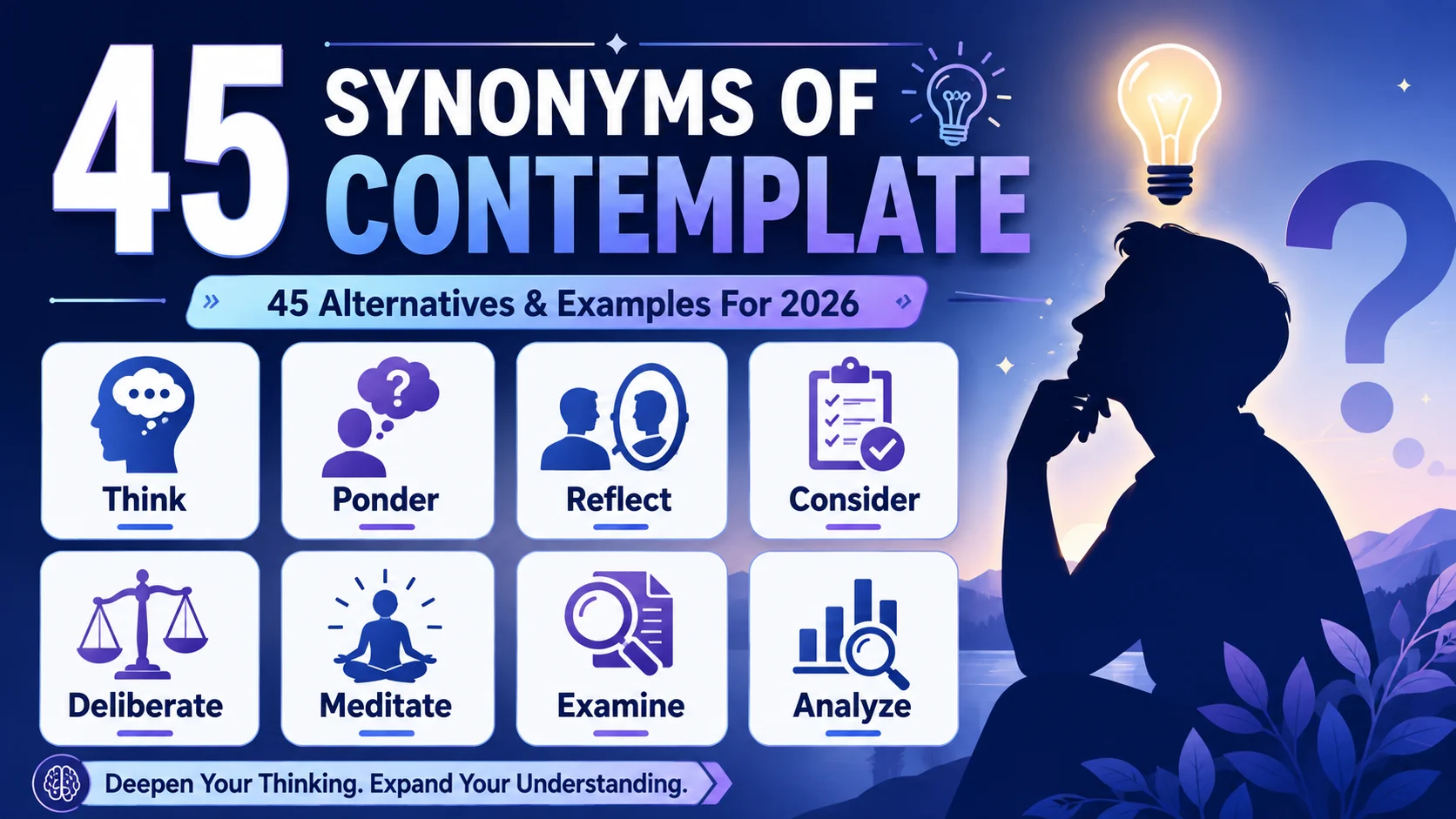
Do you ever find yourself using the word “think” too much? It’s a common problem. But English has many richer words that can make your speaking and writing more interesting. One of those words is “contemplate.” It’s a powerful verb, but sometimes you need other options.
What Does “Contemplate” Mean?
Definition
Contemplate” means to think about something carefully and for a long time. It’s not a quick thought. It’s more like sitting quietly and turning an idea over in your mind. You might contemplate a big decision, a complex problem, or even the meaning of life. It can also mean to look at something thoughtfully.
Pronunciation
US IPA: /ˈkɑːntəmpleɪt/
UK IPA: /ˈkɒntəmpleɪt/
Syllables: 3 (con-tem-plate)
Tip: Stress the first syllable: CON-tem-playt.
Grammar
| Feature | Information |
|---|---|
| Part of Speech | Verb (transitive and intransitive) |
| Common Position | After the subject |
| Typical Pattern | Contemplate + noun / Contemplate + verb-ing |
Examples:
- She sat by the window and contemplated her future.
- Have you ever contemplated moving to another country?
- He contemplated the painting for several minutes.
Word Family
| Word | Part of Speech | Meaning |
|---|---|---|
| Contemplate | Verb | To think deeply about something |
| Contemplation | Noun | The act of thinking deeply |
| Contemplative | Adjective | Tending to think deeply |
| Contemplatively | Adverb | In a thoughtful way |
45 Synonyms of “Contemplate”
1. Think
Meaning: To use your mind to consider something.
Best Used For: Daily conversation, general writing.
Formality: Neutral
Tone: Neutral, natural
Frequency: ⭐⭐⭐⭐⭐ Very Common
CEFR Level: A1
Example Sentence 1: I need to think about my options before deciding.
Example Sentence 2: She thought about the problem all day.
Usage Tip: “Think” is the most basic word for mental activity. It works in almost every context. Use it when you want a simple, natural alternative.
2. Ponder
Meaning: To think about something carefully and for a long time.
Best Used For: Academic writing, thoughtful discussions, personal reflection.
Formality: Neutral to Formal
Tone: Serious, reflective
Frequency: ⭐⭐⭐⭐ Common
CEFR Level: B1
Example Sentence 1: I need to ponder this decision before I answer.
Example Sentence 2: She sat in the garden and pondered the meaning of life.
Usage Tip: “Ponder” is a fantastic choice when you want to sound thoughtful. It’s more sophisticated than “think” but not too formal. Native speakers often use it in serious conversations.
3. Reflect
Meaning: To think deeply and carefully about something, often to learn from it.
Best Used For: Personal journals, professional development, academic writing.
Formality: Formal
Tone: Reflective, professional
Frequency: ⭐⭐⭐⭐ Common
CEFR Level: B1
Example Sentence 1: He took time to reflect on his career choices.
Example Sentence 2: I often reflect on my childhood memories.
Usage Tip: “Reflect” often includes a sense of looking back or learning from past experiences. Use it when you’re thinking about something to understand it better, especially when it relates to yourself.
4. Consider
Meaning: To think carefully about something before making a decision.
Best Used For: Business, everyday decisions, polite suggestions.
Formality: Neutral
Tone: Professional, practical
Frequency: ⭐⭐⭐⭐⭐ Very Common
CEFR Level: A2
Example Sentence 1: Please consider my proposal carefully.
Example Sentence 2: We’re considering several options for the project.
Usage Tip: “Consider” is one of the most practical alternatives. It’s formal enough for business but simple enough for everyday use. It focuses on careful thought before a decision.
5. Deliberate
Meaning: To think about something very carefully and slowly.
Best Used For: Important decisions, legal discussions, formal negotiations.
Formality: Very Formal
Tone: Serious, careful
Frequency: ⭐⭐⭐ Moderate
CEFR Level: B2
Example Sentence 1: The jury deliberated for three days before reaching a verdict.
Example Sentence 2: We need to deliberate before making this major investment.
Usage Tip: “Deliberate” suggests formal, careful thought, often in a group setting. It’s commonly used in legal and official contexts. It’s too formal for casual conversation.
6. Meditate
Meaning: To think deeply and quietly, especially for relaxation or spiritual reasons.
Best Used For: Personal well-being, spiritual discussions, self-help writing.
Formality: Neutral
Tone: Calm, peaceful
Frequency: ⭐⭐⭐ Moderate
CEFR Level: B2
Example Sentence 1: She meditates every morning to clear her mind.
Example Sentence 2: He meditated on the problem and found a solution.
Usage Tip: “Meditate” often suggests a calm, focused state of mind. Use it for intentional, quiet thinking. It’s also used in a spiritual or mental well-being context.
7. Muse
Meaning: To think about something in a quiet, careful way.
Best Used For: Creative writing, literature, thoughtful conversations.
Formality: Formal
Tone: Literary, gentle
Frequency: ⭐⭐ Rare
CEFR Level: C1
Example Sentence 1: He mused about the nature of love and friendship.
Example Sentence 2: I often muse about what life would be like in another time.
Usage Tip: “Muse” has a dreamy, creative feel. It’s perfect for literary contexts. However, it’s rarely used in everyday conversation. Use it when you want a poetic touch.
8. Ruminate
Meaning: To think deeply about something for a long time, often worrying.
Best Used For: Psychology, self-help writing, personal reflection.
Formality: Formal
Tone: Serious, sometimes negative
Frequency: ⭐⭐ Rare
CEFR Level: C1
Example Sentence 1: He tends to ruminate on his past mistakes.
Example Sentence 2: She ruminated over the conversation for days.
Usage Tip: “Ruminate” often has a negative tone. It can mean overthinking or worrying about something. Use it when you want to describe deep, sometimes stressful thinking.
9. Cogitate
Meaning: To think deeply about something in a formal, serious way.
Best Used For: Academic writing, intellectual discussions, humorous contexts.
Formality: Very Formal
Tone: Academic, sometimes playful
Frequency: ⭐ Very Rare
CEFR Level: C1
Example Sentence 1: The professor cogitated on the problem for hours.
Example Sentence 2: Let me cogitate on this and get back to you.
Usage Tip: “Cogitate” is a very formal word. It’s often used in academic or humorous contexts. Native speakers rarely use it in daily conversation.
10. Appraise
Meaning: To carefully evaluate or judge the value or nature of something.
Best Used For: Business, professional reviews, personal assessment.
Formality: Formal
Tone: Professional, analytical
Frequency: ⭐⭐⭐ Moderate
CEFR Level: B2
Example Sentence 1: We need to appraise the situation carefully.
Example Sentence 2: The manager appraised each employee’s performance.
Usage Tip: “Appraise” is about evaluating something to understand its value or quality. It’s not just thinking—it’s thinking with the goal of assessment.
11. Examine
Meaning: To look at or think about something very carefully in detail.
Best Used For: Research, medical contexts, academic writing.
Formality: Formal
Tone: Analytical, detailed
Frequency: ⭐⭐⭐⭐ Common
CEFR Level: B1
Example Sentence 1: We need to examine all the facts before deciding.
Example Sentence 2: The report examines the effects of climate change.
Usage Tip: “Examine” is more analytical and detailed than “contemplate.” Use it when you’re studying something closely, especially for a specific purpose.
12. Study
Meaning: To learn about or examine something carefully.
Best Used For: Education, academic contexts, learning.
Formality: Neutral
Tone: Serious, focused
Frequency: ⭐⭐⭐⭐⭐ Very Common
CEFR Level: A2
Example Sentence 1: He studied the map before starting the journey.
Example Sentence 2: I need to study this proposal before the meeting.
Usage Tip: “Study” is very practical. Use it when you’re thinking about something with the goal of learning or understanding it better.
13. Analyze
Meaning: To examine something methodically to understand its parts.
Best Used For: Science, data, business analysis.
Formality: Formal
Tone: Technical, precise
Frequency: ⭐⭐⭐⭐ Common
CEFR Level: B2
Example Sentence 1: The team analyzed the data to find patterns.
Example Sentence 2: We need to analyze the risks carefully.
Usage Tip: “Analyze” is a specific, technical word. It means breaking something down into parts to study them. Use it when you need detailed examination, especially of data or systems.
14. Evaluate
Meaning: To think about something carefully to decide its value or importance.
Best Used For: Business, academics, performance reviews.
Formality: Formal
Tone: Judgmental, careful
Frequency: ⭐⭐⭐⭐ Common
CEFR Level: B2
Example Sentence 1: The committee evaluated all the applications.
Example Sentence 2: We need to evaluate whether this investment is worth it.
Usage Tip: “Evaluate” is about making a judgment or assessment. It’s more final than “contemplate.” You evaluate something to make a decision or form an opinion.
15. Weigh
Meaning: To consider the positives and negatives of something.
Best Used For: Decision-making, personal advice, business discussions.
Formality: Neutral to Formal
Tone: Careful, thoughtful
Frequency: ⭐⭐⭐ Moderate
CEFR Level: B1
Example Sentence 1: I’m weighing the pros and cons of moving to a new city.
Example Sentence 2: She weighed her options before making a final decision.
Usage Tip: “Weigh” is a great synonym for comparing options. It suggests balance and careful consideration of both sides.
16. Pore Over
Meaning: To study or read something very carefully.
Best Used For: Research, reviewing documents, studying.
Formality: Neutral
Tone: Focused, concentrated
Frequency: ⭐⭐⭐ Moderate
CEFR Level: B2
Example Sentence 1: She pored over the documents to find the error.
Example Sentence 2: He spent the afternoon poring over the contract.
Usage Tip: “Pore over” is a phrasal verb that implies intense concentration. Use it when you’re looking at or reading something with great attention.
17. Mull Over
Meaning: To think about something for a long time.
Best Used For: Informal contexts, casual decision-making.
Formality: Informal
Tone: Relaxed, conversational
Frequency: ⭐⭐⭐ Moderate
CEFR Level: B2
Example Sentence 1: I’ll mull it over and tell you my decision tomorrow.
Example Sentence 2: He mulled over the job offer all weekend.
Usage Tip: “Mull over” is a friendly, informal alternative. It’s perfect for casual conversations with friends or family.
18. Chew Over
Meaning: To think about something before making a decision.
Best Used For: Very informal contexts, friendly chats.
Formality: Informal
Tone: Casual, light
Frequency: ⭐⭐ Rare
CEFR Level: B2
Example Sentence 1: Let me chew it over and get back to you.
Example Sentence 2: They chewed over the idea for a while.
Usage Tip: “Chew over” is a very casual, idiomatic expression. Use it with friends or in informal settings. Avoid it in formal writing or business contexts.
19. Entertain
Meaning: To consider or allow an idea into your mind.
Best Used For: Creative thinking, problem-solving, polite discussions.
Formality: Neutral to Formal
Tone: Open, receptive
Frequency: ⭐⭐⭐ Moderate
CEFR Level: B2
Example Sentence 1: He refused to entertain the idea of quitting.
Example Sentence 2: We should entertain all possible solutions.
Usage Tip: “Entertain” suggests being open to an idea. It’s a good choice for brainstorming or when you want to be inclusive of different viewpoints.
20. Chew On
Meaning: To think about something over time.
Best Used For: Very informal contexts, personal reflection.
Formality: Informal
Tone: Casual, thoughtful
Frequency: ⭐⭐ Rare
CEFR Level: B2
Example Sentence 1: That’s a tough question. Let me chew on it for a while.
Example Sentence 2: I’ve been chewing on your advice all day.
Usage Tip: “Chew on” is another casual expression. Use it when you need time to think. It’s similar to “mull over” but even more informal.
Synonyms Comparison Table
| Synonym | Best Context | Formality | Tone | Frequency |
|---|---|---|---|---|
| Think | All contexts | Neutral | Natural | ⭐⭐⭐⭐⭐ |
| Consider | Decisions, business | Neutral | Professional | ⭐⭐⭐⭐⭐ |
| Study | Education, learning | Neutral | Focused | ⭐⭐⭐⭐⭐ |
| Examine | Research, analysis | Formal | Analytical | ⭐⭐⭐⭐ |
| Analyze | Data, research | Formal | Technical | ⭐⭐⭐⭐ |
| Evaluate | Assessments | Formal | Judgmental | ⭐⭐⭐⭐ |
| Reflect | Personal growth | Formal | Reflective | ⭐⭐⭐⭐ |
| Ponder | Deep thought | Neutral | Serious | ⭐⭐⭐⭐ |
| Deliberate | Official decisions | Very Formal | Careful | ⭐⭐⭐ |
| Weigh | Comparing options | Neutral | Thoughtful | ⭐⭐⭐ |
| Meditate | Well-being | Neutral | Calm | ⭐⭐⭐ |
| Mull over | Casual conversation | Informal | Relaxed | ⭐⭐⭐ |
Best Synonyms by Situation
| Situation | Best Synonym | Why It Works |
|---|---|---|
| Daily Conversation | Think or Ponder | Simple and natural |
| Business Email | Consider or Evaluate | Professional and clear |
| Academic Writing | Reflect or Examine | Precise and formal |
| School Assignment | Study or Ponder | Easy to use and understand |
| Professional Meeting | Consider or Weigh | Practical and business-like |
| Presentation | Examine or Evaluate | Engaging and analytical |
| Creative Writing | Muse or Contemplate | Literary and thoughtful |
| Social Media | Think or Mull over | Relatable and casual |
| Personal Journal | Reflect or Meditate | Introspective and calm |
Formal vs Informal Synonyms
Formal Alternatives
| Synonym | Best Used For |
|---|---|
| Deliberate | Legal discussions, official decisions |
| Cogitate | Academic writing, intellectual contexts |
| Reflect | Professional development, personal growth |
| Appraise | Business, professional evaluation |
Neutral Alternatives
| Synonym | Best Used For |
|---|---|
| Think | All everyday contexts |
| Consider | Business, decisions, polite suggestions |
| Ponder | Serious reflection, thoughtful conversations |
Informal Alternatives
| Synonym | Best Used For |
|---|---|
| Mull over | Friends, family, casual decisions |
| Chew over | Very relaxed conversations |
| Chew on | Informal reflection |
When to choose which: In formal writing like academic essays or business reports, choose formal synonyms. In most professional contexts, neutral synonyms work best. For social media, text messages, or talking with friends, informal synonyms feel most natural.
Strong vs Mild Synonyms
Mild
Think, Consider, Study – These are everyday words suitable for most situations. They describe basic mental activity without implying a particular intensity or depth.
Moderate
Ponder, Reflect, Examine, Weigh – These are more specific and show deeper thought. They work well for serious, thoughtful contexts.
Strong
Deliberate, Ruminate, Cogitate – These words describe very deep or careful thought. They have strong, formal connotations and should be used sparingly.
How intensity changes meaning: Mild words are safe and natural. Moderate words show careful consideration. Strong words suggest extreme focus or formal deliberation. Choose based on how much depth you want to emphasize.
Real-Life Examples
- In a business email:
- “I need to consider your proposal carefully before responding.”
- In an academic essay:
- “The philosopher reflected on the nature of human existence.”
- In a personal journal:
- “I often ponder the direction my life is taking.”
- In a professional meeting:
- “The team evaluated several options before choosing the best one.”
- In a classroom:
- “Take a moment to study the problem before answering.”
- In a novel:
- “He contemplated the dark sea, wondering about the mysteries it hid.”
- In a casual conversation:
- “Let me mull it over and I’ll let you know what I think.”
Common Collocations
| Common Phrase | Better Alternative |
|---|---|
| Think deeply | Ponder carefully |
| Think about it | Consider it |
| Think about the future | Contemplate the future |
| Think about a problem | Examine a problem |
| Think about options | Weigh options |
| Think about your life | Reflect on your life |
Common Phrases
- “Contemplate your navel” – To think deeply about yourself in an unproductive way.
- Better alternative: Reflect on yourself (more productive)
- “Contemplate the stars” – To look at the stars and think deeply.
- Better alternative: Gaze at the stars (if not thinking deeply)
- “Contemplate a move” – To think about changing jobs or locations.
- Better alternative: Consider a move (more natural)
Context Guide
| Situation | Best Synonym | Reason |
|---|---|---|
| Essay | Reflect or Examine | Formal and academic |
| Speech | Ponder or Consider | Thoughtful and engaging |
| Business Email | Consider | Professional and polite |
| Novel | Muse or Contemplate | Literary and descriptive |
| Presentation | Examine or Analyze | Clear and structured |
| Conversation | Think or Ponder | Natural and friendly |
| Academic Writing | Reflect or Study | Precise and formal |
| Marketing Copy | Consider | Clear and persuasive |
Related Words
Near Synonyms
Ponder, Reflect, Consider – These words have the closest meanings to “contemplate” and can often be used interchangeably.
Antonyms
- Ignore – To pay no attention to
- Neglect – To fail to consider
- Disregard – To treat as unimportant
- Related Adjectives
- Contemplative – Tending to think deeply
- Thoughtful – Showing careful consideration
- Reflective – Engaged in deep thought
- Related Nouns
- Contemplation – The act of thinking deeply
- Reflection – Serious thought
- Meditation – Focused, calm thinking
- Related Verbs
- Imagine – To form a mental picture
- Daydream – To think in a pleasant, unfocused way
- Wonder – To be curious about something
Frequently Asked Questions
What is another word for contemplate?
The most common synonyms are think, ponder, reflect, and consider. Your choice depends on the context and how deep the thought is. “Think” is the simplest, while “ponder” suggests more careful reflection.
Which synonym sounds the most professional?
“Consider” and “examine” sound the most professional and are widely used in business contexts. “Deliberate” and “evaluate” are also professional but more formal.
What is the strongest synonym for contemplate?
Deliberate” is the strongest formal synonym, suggesting careful thought often involving a group. “Ruminate” is intense but often carries a negative connotation of worry.
Which synonym is best for academic writing?
“Reflect” and “examine” work well in academic contexts. “Analyze” is also excellent for research-oriented writing. These words show careful, structured thinking appropriate for scholarly work.
What is the most common synonym in everyday English?
Think” is definitely the most common and natural synonym in everyday conversation. It’s simple and understood by everyone. “Consider” is also very common and slightly more formal.
What is the opposite of contemplate?
“Ignore,” “neglect,” and “disregard” are the closest opposites. They mean to not think about or pay attention to something.
Conclusion
“Contemplate” is a wonderful word that describes deep, thoughtful thinking. But English offers many alternatives that can make your speech and writing more precise and interesting. From the simple “think” to the formal “deliberate” and the poetic “muse,” each synonym has its unique flavor.
- Remember that the best choice depends on your context, tone, and audience. In casual conversations, “think” or “mull over” feel natural. In business settings, “consider” and “evaluate” sound more professional. In creative writing, “muse” and “contemplate” add literary depth.
Don’t be afraid to experiment with these words as you practice. Listen to how native speakers use them and try using a few different ones in your own writing. The more you practice, the more natural they’ll feel. Keep learning, keep thinking, and enjoy the richness of the English language!
