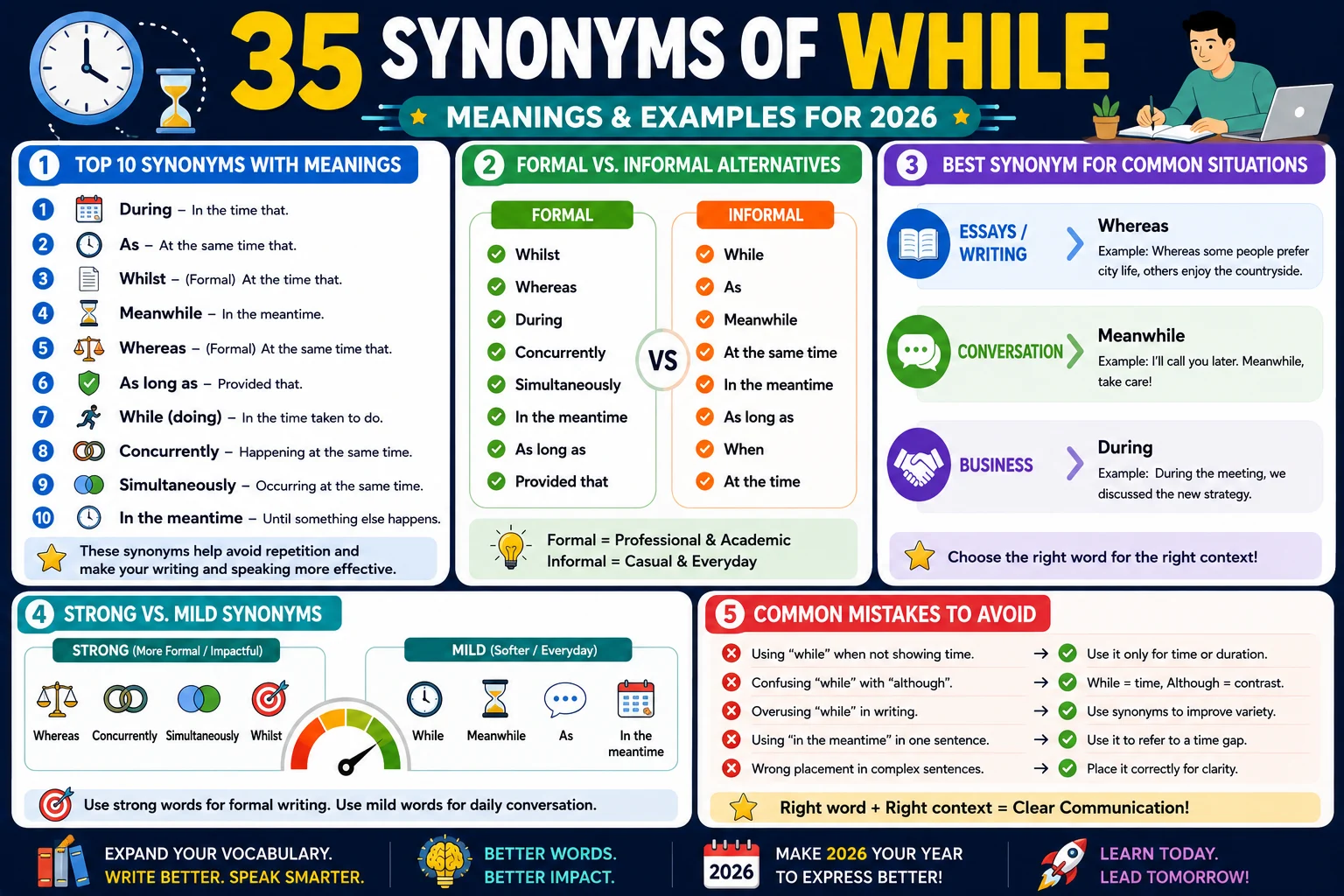
“While” means during the time that something happens. The best synonyms are during, as, whereas, whilst, and although. “During” is the most common alternative. Each synonym has a slightly different meaning and context where it fits best.
Top 10 Synonyms
- During
- As
- Whereas
- Whilst
- Although
- Though
- Whereas
- Meanwhile
- While (itself)
- When
“While” is one of the most useful words in English. We use it constantly to connect ideas and describe time. But using it too often can make your English feel repetitive and simple.
Think about it. You use “while” for time, for contrast, and for conditions. Each situation might need a different word that captures the exact meaning more clearly.
In this guide, you’ll learn 35 powerful synonyms for “while.” You’ll discover exactly when to use each one, how formal they are, and what common mistakes to avoid. Let’s begin!
What Does “While” Mean?
Definition
While” has two main meanings. First, it means during the time that something is happening. For example, “I read while I ate.” Second, it means whereas or although, showing contrast. For example, “He likes coffee, while I prefer tea.” It’s a versatile word for connecting time and contrast.
Pronunciation
| Feature | Value |
|---|---|
| US IPA | /waɪl/ |
| UK IPA | /waɪl/ |
| Syllables | 1 |
| Tip | Rhymes with “smile” and “file” |
Grammar
| Grammar Feature | Information |
|---|---|
| Part of Speech | Conjunction, Noun |
| Common Position | Beginning or middle of a sentence |
| Typical Pattern | While + clause / For a while + time |
Examples:
- “While I was sleeping, the phone rang.” (time)
- “She likes cats, while I prefer dogs.” (contrast)
- “I waited for a while.” (noun)
Grammar Note: “While” can be a conjunction (connecting two ideas) or a noun (meaning “a period of time”).
Word Family
| Word | Part of Speech | Meaning |
|---|---|---|
| While | Conjunction/Noun | During the time that; a period of time |
| Whiles | Adverb | Sometimes (old-fashioned) |
| Whilom | Adjective | Former (old-fashioned) |
| Awhile | Adverb | For a short time |
15 Synonyms of “While”
During
Meaning: Throughout the time that something is happening.
Best Used For: Talking about a period of time when something occurs.
Formality: Neutral
Tone: Direct, Informative
Frequency: ⭐⭐⭐⭐⭐ (Very Common)
CEFR Level: A2
Example Sentence 1: “She fell asleep during the movie.”
Example Sentence 2: “During the summer, we go to the beach every week.”
Usage Tip: “During” is a preposition, not a conjunction. Use it with a noun, not a full clause. “During the meeting” works, but “during I was at work” is wrong.
Common Confusion: During vs While. “During” is followed by a noun. “While” is followed by a clause with a verb. “During the meeting” vs “While I was in the meeting.”
As
Meaning: At the same time as something happens.
Best Used For: Describing simultaneous actions.
Formality: Neutral
Tone: Descriptive, Flowing
Frequency: ⭐⭐⭐⭐⭐ (Very Common)
CEFR Level: A2
Example Sentence 1: “She sang as she walked home.”
Example Sentence 2: “As I was leaving, he arrived.”
Usage Tip: “As” is very common and works well for simultaneous actions. It can also mean “because” and “like,” so be careful with context.
Whilst
Meaning: During the time that something happens (same as “while”).
Best Used For: Formal writing, British English.
Formality: Formal
Tone: Formal, Traditional
Frequency: ⭐⭐⭐ (Moderate)
CEFR Level: B2
Example Sentence 1: “He read a book whilst waiting for the train.”
Example Sentence 2: “Whilst I appreciate your offer, I must decline.”
Usage Tip: “Whilst” is more formal and common in British English. It means exactly the same as “while” and can be used interchangeably in formal writing.
Whereas
Meaning: In contrast or comparison with something.
Best Used For: Contrasting ideas, formal writing, comparisons.
Formality: Formal
Tone: Contrasting, Analytical
Frequency: ⭐⭐⭐⭐ (Common)
CEFR Level: B2
Example Sentence 1: “She enjoys cooking, whereas her husband prefers eating out.”
Example Sentence 2: “The first chapter was boring, whereas the second was fascinating.
Usage Tip: “Whereas” is used for contrast, not time. Use it to compare two different things or situations.
Although
Meaning: Despite the fact that; even though.
Best Used For: Contrast, showing something unexpected.
Formality: Neutral
Tone: Contrasting, Surprising
Frequency: ⭐⭐⭐⭐⭐ (Very Common)
CEFR Level: B1
Example Sentence 1: “Although it was raining, we went for a walk.”
Example Sentence 2: “She passed the exam, although she didn’t study much.”
Usage Tip: “Although” is for contrast, not time. Use it when something happens despite another thing.
Though
Meaning: Despite the fact that (same as “although”).
Best Used For: Casual contrast, informal writing.
Formality: Informal
Tone: Casual, Conversational
Frequency: ⭐⭐⭐⭐⭐ (Very Common)
CEFR Level: B1
Example Sentence 1: “Though she was tired, she kept working.”
Example Sentence 2: “It’s expensive, though it’s worth it.”
Usage Tip: “Though” is more casual than “although” and can come at the end of a sentence. “I enjoyed it, though.” It’s very common in speech.
Meanwhile
Meaning: During the same period of time.
Best Used For: Showing that two things happen at the same time.
Formality: Neutral
Tone: Narrative, Descriptive
Frequency: ⭐⭐⭐⭐ (Common)
CEFR Level: B1
Example Sentence 1: “The children were playing. Meanwhile, the adults were talking.”
Example Sentence 2: “She finished her homework. Meanwhile, he prepared dinner.”
Usage Tip: “Meanwhile” is an adverb. Use it to connect two events happening at the same time, often in stories.
When
Meaning: At or during the time that something happens.
Best Used For: Specific moments in time.
Formality: Neutral
Tone: Specific, Direct
Frequency: ⭐⭐⭐⭐⭐ (Very Common)
CEFR Level: A1
Example Sentence 1: “When I saw her, she was smiling.”
Example Sentence 2: “Call me when you arrive.”
Usage Tip: “When” is for specific moments, not continuous actions. “When I arrived” (specific moment) vs “While I was eating” (ongoing action).
Since
Meaning: From a particular time in the past until now.
Best Used For: Time from the past to the present, reasons.
Formality: Neutral
Tone: Temporal, Causal
Frequency: ⭐⭐⭐⭐⭐ (Very Common)
CEFR Level: A2
Example Sentence 1: “I’ve been studying English since 2015.”
Example Sentence 2: “Since we’re all here, let’s begin.”
Usage Tip: “Since” can mean time (from then until now) or reason (because). Be careful with context.
Whenever
Meaning: At any time that; every time that.
Best Used For: Repeated events or actions.
Formality: Neutral
Tone: Repeated, Conditional
Frequency: ⭐⭐⭐⭐ (Common)
CEFR Level: B1
Example Sentence 1: “Whenever I visit her, she makes cookies.”
Example Sentence 2: “He smiles whenever he sees her.”
Usage Tip: “Whenever” is for repeated or habitual events, not one-time events.
In the meantime
Meaning: During the period of time between two events.
Best Used For: What happens while waiting for something.
Formality: Neutral
Tone: Waiting, Interim
Frequency: ⭐⭐⭐⭐ (Common)
CEFR Level: B1
Example Sentence 1: “Dinner will be ready in an hour. In the meantime, we can watch TV.”
Example Sentence 2: “She went shopping. In the meantime, he cleaned the house.”
Usage Tip: “In the meantime” is great for what you do while waiting for something else to happen.
At the same time
Meaning: Simultaneously.
Best Used For: When two things happen together.
Formality: Neutral
Tone: Simultaneous
Frequency: ⭐⭐⭐⭐⭐ (Very Common)
CEFR Level: B1
Example Sentence 1: “She laughed and cried at the same time.”
Example Sentence 2: “We arrived at the same time.”
Usage Tip: This phrase is very common for emphasizing simultaneity.
Even though
Meaning: Despite the fact that.
Best Used For: Strong contrast, unexpected situations.
Formality: Neutral
Tone: Contrasting, Emphatic
Frequency: ⭐⭐⭐⭐⭐ (Very Common)
CEFR Level: B1
Example Sentence 1: “Even though it was cold, she wore a dress.”
Example Sentence 2: “He came to work even though he was sick.”
Usage Tip: “Even though” is stronger than “although” and emphasizes the surprising nature of the contrast.
During the time that
Meaning: The period in which something happens.
Best Used For: Formal writing, emphasizing time.
Formality: Formal
Tone: Precise, Formal
Frequency: ⭐⭐⭐ (Moderate)
CEFR Level: B2
Example Sentence 1: “During the time that I was in college, I worked part-time.”
Example Sentence 2: “During the time that she lived abroad, she learned Spanish.”
Usage Tip: This is a longer, more formal version of “while” that emphasizes the time period.
For a while
Meaning: For a period of time.
Best Used For: Talking about a duration of time.
Formality: Informal
Tone: Casual, Temporal
Frequency: ⭐⭐⭐⭐ (Common)
CEFR Level: A2
Example Sentence 1: “I lived in London for a while.”
Example Sentence 2: “Let’s rest for a while.”
Usage Tip: “For a while” is used as a noun phrase, not a conjunction. It means “for some time.”
Synonyms Comparison Table
| Synonym | Best Context | Formality | Tone | Frequency |
|---|---|---|---|---|
| During | Time periods | Neutral | Direct | ⭐⭐⭐⭐⭐ |
| As | Simultaneous actions | Neutral | Flowing | ⭐⭐⭐⭐⭐ |
| When | Specific moments | Neutral | Specific | ⭐⭐⭐⭐⭐ |
| Although | Contrast | Neutral | Surprising | ⭐⭐⭐⭐⭐ |
| Though | Casual contrast | Informal | Conversational | ⭐⭐⭐⭐⭐ |
| Whereas | Formal contrast | Formal | Analytical | ⭐⭐⭐⭐ |
| Meanwhile | Simultaneous | Neutral | Narrative | ⭐⭐⭐⭐ |
| Whilst | Formal time | Formal | Traditional | ⭐⭐⭐ |
| Since | Time from past | Neutral | Temporal | ⭐⭐⭐⭐⭐ |
Best Synonyms by Situation
| Situation | Best Synonym | Why It Works |
|---|---|---|
| Daily Conversation | When / Though | Natural and casual |
| Business Email | During / Whereas | Professional and precise |
| Academic Writing | Whilst / Whereas | Formal and sophisticated |
| School Assignment | Although / During | Clear and appropriate |
| Professional Meeting | Whereas / During | Professional tone |
| Presentation | While / Meanwhile | Clear and engaging |
| Creative Writing | Whilst / Meanwhile | Adds literary variety |
| Social Media | Though / When | Casual and relatable |
Formal vs Informal Synonyms
Formal Alternatives
| Synonym | Best Used For |
|---|---|
| Whilst | Formal time references |
| Whereas | Formal comparisons |
| During the time that | Precise formal time |
| Although | Formal contrast |
| Since | Formal reasons or time |
Neutral Alternatives
| Synonym | Best Used For |
|---|---|
| While | Most general situations |
| During | Time periods |
| When | Specific moments |
| As | Simultaneous actions |
| Meanwhile | Simultaneous events |
Informal Alternatives
| Synonym | Best Used For |
|---|---|
| Though | Casual contrast |
| For a while | Casual time duration |
| At the same time | Everyday simultaneity |
Choosing the Right Level: Use “whilst” and “whereas” for formal writing. Use “during” and “when” for most professional contexts. Use “though” and “for a while” in everyday conversation.
Strong vs Mild Synonyms
Mild
Suitable for everyday situations with less intensity.
- During
- When
- As
Moderate
More formal or specific alternatives.
- Although
- Though
- Whilst
- Meanwhile
Strong
High-intensity alternatives suggesting strong contrast or precise time.
- Whereas (strong contrast)
- Even though (emphatic contrast)
- During the time that (precise time)
How Intensity Changes Meaning: “I ate while she cooked” is simple. “I ate, whereas she cooked” emphasizes the contrast. Choose stronger words when you want to emphasize contrast or precision.
Real-Life Examples
School: “While I was studying, my sister was watching TV.”
Office: “During the meeting, we discussed the new project.”
Business Email: “We saw growth in sales, whereas our competitors saw a decline.”
Meetings: “We can plan the budget. Meanwhile, the team will prepare the presentation.”
Presentations: “Although sales are down, we remain optimistic.”
Daily Conversations: “I’ll call you when I arrive.”
Social Media: “She’s always posting, though she says she’s busy.”
Academic Writing: “Whilst the data supports the hypothesis, further research is needed.”
Common Collocations
| Common Phrase | Better Alternative |
|---|---|
| While I was… | During my… / As I was… |
| A while ago | Some time ago |
| Every once in a while | Occasionally |
| While on the other hand | Whereas on the other hand |
| While doing something | When doing something / During something |
Common Phrases
A while back: Some time ago. (e.g., “I saw him a while back.”)
Once in a while: Occasionally. (e.g., “We go out once in a while.”)
Make hay while the sun shines: Take advantage of opportunities.
Every now and then: Occasionally.
In a while: After some time. (e.g., “I’ll be there in a while.”)
Context Guide
| Situation | Best Synonym | Reason |
|---|---|---|
| Essay | Whereas / Whilst | Formal and precise |
| Speech | While / Although | Clear and engaging |
| Business Email | During / Whereas | Professional and clear |
| Novel | Meanwhile / Whilst | Adds literary depth |
| Presentation | While / Meanwhile | Clear and professional |
| Conversation | When / Though | Natural and relatable |
| Academic Writing | Whilst / Whereas | Precise and formal |
| Marketing Copy | As / When | Engaging and natural |
Related Words
Near Synonyms
- During: Throughout a period.
- During the course of: Throughout the progress of.
- Through: From beginning to end.
- Across: Over a period of time.
- Throughout: In every part of.
Antonyms
- After: Later than.
- Before: Earlier than.
- Until: Up to a specific time.
- Since: From a past time until now.
Related Adjectives
- Simultaneous: Happening at the same time.
- Concurrent: Existing or happening at the same time.
- Synchronous: Happening at the same time.
Related Nouns
- Interval: A period of time between events.
- Duration: The length of time something lasts.
- Interim: The time between two events.
- Period: A length of time.
Related Verbs
- Wait: To stay in one place until something happens.
- Linger: To stay for a long time.
- Delay: To make something happen later.
- Pause: To stop for a short time.
Frequently Asked Questions
What is another word for while?
Common synonyms include during, as, whereas, whilst, although, and though. “During” is the most common alternative for time contexts.
Which synonym sounds the most professional?
“Whereas” and “whilst” sound very professional. “During” is also professional and versatile.
What is the strongest synonym for while?
“Whereas” is strong for contrast. “Even though” is strong for showing unexpected situations.
Which synonym is best for essays?
“Whereas” and “whilst” are excellent for academic essays. “Although” is also strong and commonly used.
What’s the difference between while and whilst?
They mean exactly the same thing. “Whilst” is more formal and more common in British English. “While” is used in both British and American English.
Which synonym is most common in everyday English?
“During,” “when,” and “though” are very common in everyday speech. “As” is also frequently used.
What is the opposite of while?
Opposites include “after,” “before,” and “until.” These describe different relationships in time.
Conclusion
“While” is a useful and versatile word, but now you have 35 fantastic alternatives. Each synonym adds a different shade of meaning to your language.
Remember, the key is understanding the context. Use “during” for time periods. Use “whereas” for formal contrast. Use “whilst” for formal British writing. Use “although” and “though” for contrast. Use “meanwhile” for simultaneous events.
The best way to improve is practice. Try using one or two new synonyms each day. Listen for these words in conversations and books. Your vocabulary will become richer and more expressive with time.
