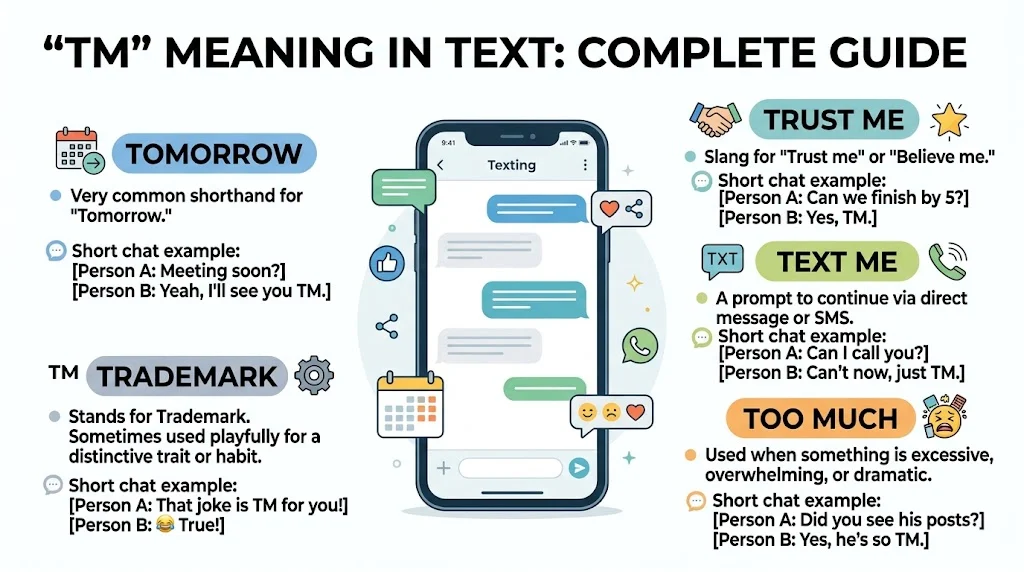
In text messages, “TM” can mean “tomorrow,” “trust me,” “text me,” or “too much.” The intended meaning comes from the surrounding words, timing, and tone. On social platforms, it can also mimic the trademark symbol in playful or humorous captions.
What do tm mean in text is a common question because the abbreviation has several possible meanings. Unlike many internet abbreviations, TM does not have one universal definition.
The surrounding sentence usually provides the strongest clue. For example, “See you tm” most naturally means “See you tomorrow.” However, “TM, you need to try this” can mean “Trust me.”
The same two letters can also mean “text me” or “too much.” In some social media posts, TM can even imitate the trademark symbol and create a humorous sense of ownership around a phrase.
Therefore, you should not interpret TM from the letters alone. Look at the sentence, conversation topic, punctuation, and timing.
Current online slang references show several recurring interpretations, including tomorrow, trust me, text me, and too much. However, usage varies between communities, so context remains more reliable than any single slang dictionary.
QUICK ANSWER BOX
| Meaning | Context | Primary Platforms | Example | Tone |
| Tomorrow | Plans or future events | Texting, Snapchat, WhatsApp | “See you tm” | Casual |
| Trust me | Reassurance or emphasis | Texting, TikTok, Instagram | “TM, it’s worth it” | Confident |
| Text me | Asking someone to message | Texting, Snapchat, Instagram | “TM later” | Friendly |
| Too much | Reaction to something excessive | TikTok, Instagram, chats | “That is tm 😂” | Playful |
| Trademark | Claiming a phrase or brand identity | Social media, business | “My catchphrase TM” | Humorous or formal |
What does tm mean in text?
The phrase what do tm mean in text points to a broader question about abbreviation and context. TM is an initialism made from the first letters of several different phrases.
The most useful interpretations are:
- Tomorrow
- Trust me
- Text me
- Too much
- Text message
- Trademark
Not every meaning appears equally often. In ordinary conversations, tomorrow, trust me, and text me are particularly easy to identify from sentence structure. Too much appears more often in reaction based conversations.
The trademark interpretation works differently. In business writing, TM can refer to the trademark symbol. The United States Patent and Trademark Office explains that TM can be used with a mark for goods even when the mark has not been federally registered. The registered symbol ® has different requirements.
TM as Tomorrow
This meaning usually appears around plans, appointments, school, work, meetings, or events.
Examples include:
“Can you call me tm?”
“See you tm.”
“I’ll finish it tomorrow.”
“Are you free tm?”
The word tomorrow fits naturally into each sentence. Therefore, this meaning is usually easy to identify.
A useful clue is the presence of a future action. If someone talks about calling, meeting, visiting, sending, arriving, or completing something, TM may refer to tomorrow.
TM as Trust Me
Trust me creates a completely different meaning.
For example:
“TM, that restaurant is amazing.”
Here, the sender is asking the reader to believe the recommendation.
Another example is:
“TM, you will love this movie.”
The abbreviation works as a confidence marker. It signals that the sender feels strongly about the statement.
This usage often appears before a claim. It can also appear after a statement for emphasis.
TM as Text Me
Text me turns TM into a request for future communication.
Examples include:
“TM when you get home.”
“TM later.”
“TM when you are free.”
“Got something to tell you. TM.”
The intended meaning becomes clearer when the message involves another communication channel or asks someone to continue a conversation.
TM as Too Much
Too much usually appears as a reaction.
For example:
“That story was tm 😂.”
“That outfit is tm.”
“You are doing it right now.”
The sender may be describing something as excessive, dramatic, overwhelming, funny, or unusually intense.
This interpretation requires more contextual awareness. Unlike tomorrow, it does not always fit a fixed grammatical pattern.
TM as Text Message
In some contexts, TM can refer to a text message itself.
For example:
“Send me a TM when you arrive.”
This use is less dependent on internet slang. It simply treats TM as an abbreviation for text message.
Context is essential because “TM” may also refer to several other phrases.
Contextual Dynamics & Nuances of the Term
Understanding what tm means in text requires more than memorizing definitions. You also need to understand how people communicate online.
Sentence Position Matters
The position of TM can provide a strong clue.
Consider these examples:
“See you tm.”
Here, tomorrow fits naturally.
“TM, you need to watch this.”
Here, trust me makes more sense.
“TM when you get home.”
Here, text me is likely.
“That was tm.”
Here, too much may fit.
The words surrounding the abbreviation often reveal its function.
Conversation Topic Matters
Suppose two friends are discussing weekend plans.
One person writes:
“Are we meeting them?”
Tomorrow makes sense.
Now imagine they are discussing a new movie.
One person writes:
“TM, this ending is Wild.”
Trust me becomes more plausible.
Therefore, the previous messages can matter more than the abbreviation itself.
Punctuation Can Change the Tone
Punctuation can provide another clue.
“TM, you need to see this.”
The comma makes trust me a natural reading.
“See you!”
The exclamation mark reinforces a casual plan for tomorrow.
“TM 😂”
This could require more context because the abbreviation alone does not provide enough information.
Capitalization Is Not a Reliable Rule
People may write TM, tm, Tm, or even tm.
Capitalization usually reflects typing habits rather than a strict difference in meaning.
Therefore, do not assume that uppercase TM automatically means trademark or that lowercase tm automatically means tomorrow.
The surrounding content matters more.
Emojis Can Help
Emojis can provide useful emotional context.
“TM 😂”
The laughing emoji could support a playful interpretation.
“See you tm ❤️”
The heart may reinforce a friendly or affectionate message about tomorrow.
“TM 😭”
The crying emoji could accompany a dramatic reaction where too much becomes possible.
However, emojis do not create a fixed definition. They simply add another contextual clue.
Real Life Conversation Examples Using what do tm mean in text
These examples show why the same abbreviation can have different meanings.
Example 1: Tomorrow
Alex: Are you coming to the game?
Jordan: Yeah, I should be there tm.
Alex: What time?
Jordan: Around 6.
Here, TM clearly means tomorrow because the conversation concerns a future event.
Example 2: Trust Me
Alex: Should I watch that show?
Jordan: TM, you will love it.
Alex: Is it really that good?
Jordan: Seriously. Give it one episode.
Here, TM means trust me. The sender is emphasizing a recommendation.
Example 3: Text Me
Alex: I have to leave now.
Jordan: No problem.
Alex: I’ll explain everything later.
Jordan: TM when you get home.
Here, TM means text me. The sender wants the conversation to continue later.
Example 4: Too Much
Alex: I sent the group chat 47 messages.
Jordan: That is tm 😂
Alex: I got excited.
Jordan: Clearly.
Here, TM means too much. The sender reacts to excessive behavior.
Example 5: Trademark Style
Alex: You really say “literally” every five seconds.
Jordan: Professional commentator TM.
Alex: 😂
Here, TM imitates the idea of a trademark. The person jokingly presents “Professional commentator” as a signature identity.
This playful use should not be confused with an actual legal trademark claim.
Platform Specific Breakdown
Different platforms encourage different communication styles. However, the platform alone cannot determine what TM means.
How It Is Used on Snapchat
Snapchat encourages quick conversations. Users often communicate through short messages, snaps, replies, and informal captions.
Therefore, context based abbreviations fit naturally.
For example:
“See you tm.”
This likely means tomorrow.
Another message could say:
“TM, you need to try this.”
That may mean trust me.
A message such as:
“TM when you get home.”
can mean text me.
The conversation topic provides the strongest clue.
Snapchat also supports playful language. Users may shorten words to keep messages fast and informal.
However, there is no universal Snapchat rule that assigns TM one specific definition. Current slang references similarly describe the meaning as context dependent across messaging and social platforms.
The Role of what do tm mean in text on TikTok
TikTok creates a different environment because comments often react to videos rather than continue private conversations.
This can make the interpretation more playful.
For example:
“TM this is actually hilarious.”
Here, trust me, it could make sense.
A comment saying:
“Part two tm.”
likely uses TM for tomorrow because it refers to timing.
TikTok also supports humorous uses that imitate trademark language.
Someone might write:
“CEO of bad decisions TM.”
The writer is not necessarily making a formal trademark claim. Instead, the phrase creates a mock title or recurring joke.
That distinction matters because internet users often borrow symbols from formal language for humor.
Instagram and Texting Dynamics
Instagram DMs work much like ordinary text conversations.
A person may write:
“TM when you are free.”
This likely means text me.
Another person may write:
“TM, order the chocolate one.”
This likely means trust me.
Instagram captions can introduce another possibility. Users may attach TM to a phrase to create a playful personal brand.
Regular texting is even more dependent on the conversation.
For example:
“See you tm” strongly suggests tomorrow.
“TM, I know what I’m talking about” suggests trust me.
“TM later” could mean text me later.
“That’s tm” could mean too much.
The grammar provides the clue.
Alternative Meanings & NLP Variations of the Phrase
The phrase what do tm mean in text has several semantic variations because users ask the same question in different ways.
Common search style variations include:
“What does TM mean in texting?”
“What does tm mean in a text?”
“What does TM stand for?”
“What does tm mean in chat?”
“What does TM mean on Snapchat?”
“What does TM mean on TikTok?”
“What does TM mean on Instagram?”
“What is the meaning of TM in messages?”
These queries share the same underlying search intent.
From an NLP perspective, the core entities include TM, texting, chat, slang, abbreviation, Snapchat, TikTok, Instagram, and social media.
Semantic variations include:
| Search Intent | Natural Variation |
| Definition | TM meaning in text |
| Expansion | What does TM stand for |
| Context | TM meaning in chat |
| Platform | TM meaning on Snapchat |
| Social media | TM meaning on TikTok |
| Usage | How to use TM in texting |
| Interpretation | What does someone mean by TM |
| Response | How should I reply to TM |
The underlying concept remains the same. The user wants to decode a short abbreviation using context.
Related Abbreviations
TM belongs to a much larger family of texting shortcuts.
Examples include:
| Abbreviation | Meaning |
| IDK | I do not know |
| TBH | To be honest |
| IMO | In my opinion |
| FYI | For your information |
| RN | Right now |
| BTW | By the way |
| TTYL | Talk to you later |
| LOL | Laughing out loud |
| SMH | Shaking my head |
| NGL | Not gonna lie |
Unlike some of these abbreviations, TM has multiple common expansions. That makes it more dependent on context.
Misinterpretations: When NOT to Use what do tm mean in text
Knowing what tm means in text also means knowing when not to assume a meaning.
Do Not Automatically Read TM as Tomorrow
If someone writes:
“TM, this is the best pizza.”
Tomorrow does not fit naturally.
Trust me is more likely.
However, you should still consider the surrounding conversation.
Do Not Automatically Read TM as Trust Me
Consider:
“I’ll call you tm.”
Trust me does not fit.
Tomorrow fits naturally because the sentence describes a future action.
Do Not Assume TM Always Means Text Me
Consider:
“See you tm.”
The likely meaning is tomorrow.
Text me would require a different grammatical structure.
Do Not Treat Every TM as a Trademark
The formal trademark meaning is appropriate in branding and business contexts.
The USPTO explains that TM can identify an asserted trademark for goods, while ® indicates a federally registered mark under the applicable conditions.
Online users may also use TM humorously. That playful use does not automatically establish a legal trademark.
Avoid Using Ambiguous Slang in Formal Writing
If you are writing an email to a client, professor, employer, customer, or official organization, spelling out the intended phrase is usually clearer.
Instead of:
“See you tm.”
write:
“See you tomorrow.”
Instead of:
“TM when you arrive.”
write:
“Text me when you arrive.”
Clarity matters more than typing speed in formal communication.
How to Respond in Chat Comfortably
If you understand the meaning, respond naturally.
If someone says:
“See you tm.”
You can say:
“Sounds good!”
If they say:
“TM, you have to try this.”
You can answer:
“I’ll give it a try.”
If they say:
“TM when you get home.”
You can respond:
“Will do.”
The situation does not require a complicated reply.
When You Are Unsure
Sometimes TM genuinely lacks enough context.
In that case, ask for a short clarification.
For example:
“Do you mean tomorrow?”
Or:
“TM as in text me?”
This approach is better than confidently choosing the wrong interpretation.
When Tone Matters
If the message seems playful, match the energy.
If someone writes:
“Professional chef TM 😂”
You might reply:
“Absolutely 😂”
If someone says:
“TM, you need to watch this.”
You can respond:
“Okay, I trust you.”
The safest approach is to mirror the conversational tone without forcing slang into your reply.
When You Should Spell It Out
Use the full phrase when ambiguity could create a problem.
For example, a workplace message should say:
“I will send it tomorrow.”
That is clearer than:
“I’ll send it to you.”
Similarly, a customer service message should avoid abbreviations that could confuse the recipient.
FAQs
1. What does tm mean in text?
What does tm mean in text depends on context. TM can mean tomorrow, trust me, text me, too much, text message, or trademark. The sentence usually reveals which interpretation fits.
2. Does TM usually mean tomorrow?
In messages about plans, schedules, appointments, or future events, TM can naturally mean tomorrow. For example, “See you tm” clearly points toward the next day.
3. Can TM mean trust me?
Yes. A message such as “TM, you need to watch this” can use TM as shorthand for trust me. This interpretation often appears before a recommendation or strong claim.
4. Can TM mean text me?
Yes. “TM when you get home” can mean “text me when you get home.” The request structure provides the clue.
5. What does TM mean on Snapchat?
On Snapchat, TM can have several meanings. The conversation determines whether it means tomorrow, trust me, text me, or another interpretation.
6. What does TM mean on TikTok?
TikTok comments can use TM in several ways. Context may point toward trust me, tomorrow, too much, or a playful trademark style.
7. Can TM mean too much?
Yes. In reaction based conversations, TM can represent too much. The sender may use it to describe something dramatic, excessive, overwhelming, or unusually intense.
8. Is TM the same as the trademark symbol?
Not always. In branding, TM refers to the trademark designation. In casual internet language, users may also type TM as ordinary slang or use it humorously. The USPTO distinguishes TM from the registered trademark symbol ®.
9. Is TM appropriate for professional messages?
It can be understood, but spelling out the intended phrase is usually clearer. Professional communication benefits from reducing ambiguity.
10. How can I tell which meaning someone intends?
Check the surrounding words first. Then consider the conversation topic, sentence structure, timing, emojis, and platform. If uncertainty remains, ask the sender directly.
Conclusion:
Understanding what tm means in text becomes much easier once you stop treating TM as a single fixed definition.
The abbreviation can mean tomorrow, trust me, text me, too much, text message, or trademark. The correct interpretation depends on the words surrounding it.
For scheduling conversations, tomorrow often fits naturally.
For recommendations, trust me it can make sense.
For requests to continue communication, text me may be the intended phrase.
For exaggerated reactions, too much may fit.
In branding, TM has a separate trademark function. The USPTO states that TM can be used to identify a trademark for goods even without federal registration, while the ® symbol applies to federally registered marks under the relevant conditions.
Social media adds another layer. TikTok, Instagram, Snapchat, and other platforms encourage short, fast communication. As a result, abbreviations can develop several meanings within different communities.
The key lesson is simple: context beats the abbreviation itself.
When you see TM, read the whole sentence. Look at what the person was discussing. Consider the timing and tone. Then choose the interpretation that fits naturally.
If the message still seems unclear, asking a quick question is perfectly normal.
That approach makes what tm mean in text less of a guessing game and more of a straightforward language puzzle.
