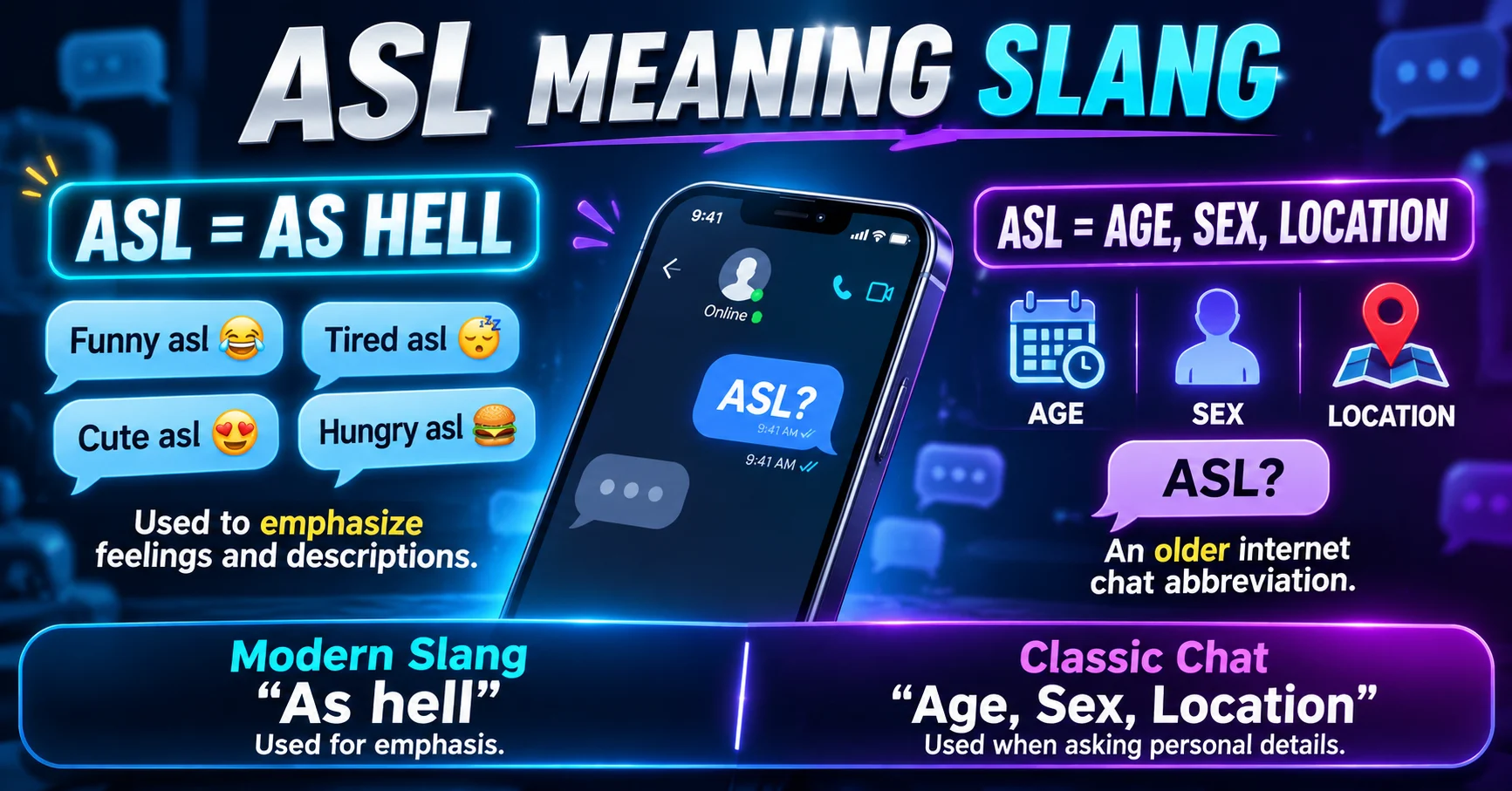
ASL is a popular internet abbreviation with several meanings. In modern casual conversations, it often means “as hell” and adds emphasis to a description. In older online chats, it means “age, sex, location.” It can also refer to American Sign Language.
Imagine opening a message from a friend and seeing, “That outfit looks good asl.” You understand the compliment, but those three letters might leave you wondering what they actually mean.
The phrase asl meaning slang has become a common search among people trying to understand modern texting language. Its most familiar meaning in casual social media conversations is “as hell.” People use it to make descriptions stronger, express emotions, and react to everyday situations.
However, there’s more to this abbreviation than one definition. Older internet users may recognize it as “age, sex, location.” Others associate it with American Sign Language, a natural language used within Deaf communities.
These different meanings explain why the abbreviation can sometimes cause confusion. A message from a friend, a question from a stranger, and a discussion about sign language can all contain the same three letters.
The trick is to understand the situation rather than memorize a single definition. This guide explores how people use the expression, what different messages communicate, and how to respond without making a conversation awkward.
Quick Answer: Understanding ASL at a Glance
| Detail | Explanation |
|---|---|
| Most common modern slang use | As hell |
| Older internet abbreviation | Age, sex, location |
| Language-related meaning | American Sign Language |
| Main purpose in slang | Adding emphasis |
| Common placement | After an adjective or description |
| Typical tone | Casual and informal |
| Example | “I’m excited asl!” |
| Plain-English translation | “I’m extremely excited!” |
Why Does ASL Appear in So Many Text Messages?
People naturally shorten words when communicating online. They want to express themselves quickly without typing long sentences.
That’s one reason abbreviations have become part of everyday digital communication.
Think about messages such as:
- “LOL” for laughing out loud.
- “BRB” for be right back.
- “NGL” for not gonna lie.
- “FR” for for real.
- “ASL” for as hell.
Each abbreviation serves a different purpose. Some communicate reactions, while others save typing time.
The modern slang version of ASL has a particularly simple function. It adds extra intensity to whatever someone wants to describe.
A Small Word That Changes the Whole Sentence
Consider these two messages:
Message A: “I’m tired.”
Message B: “I’m tired asl.”
Both describe tiredness. However, the second message expresses a much stronger feeling.
Here are more examples:
| Ordinary Message | More Expressive Version |
|---|---|
| I’m hungry. | I’m hungry asl. |
| That movie was funny. | That movie was funny asl. |
| It’s cold outside. | It’s cold asl outside. |
| Your dog is cute. | Your dog is cute asl. |
| I’m busy today. | I’m busy asl today. |
The abbreviation doesn’t introduce a new emotion. Instead, it increases the strength of the existing description.
Why Do People Prefer Short Expressions?
Online conversations often happen quickly. Someone might respond to a funny video, compliment a picture, or complain about something frustrating.
Typing a short expression feels natural in these situations.
Furthermore, internet slang helps people establish a relaxed tone. Friends often use informal language because it makes their messages feel less serious.
However, not everyone communicates this way. Some people prefer complete sentences, while others regularly use abbreviations.
Neither approach is wrong. It simply depends on personal communication habits and the audience.
The Three Different Meanings Behind ASL
Although modern social media often uses the abbreviation as an intensifier, its other meanings remain important.
Understanding all three prevents unnecessary confusion.
As Hell: The Modern Slang Interpretation
This is the meaning you’ll commonly encounter in casual social media conversations.
People use it after descriptive words to communicate that something is extremely good, bad, funny, strange, attractive, or frustrating.
For example:
Friend: How was the concert?
You: Amazing asl!
Your response means the concert was extremely amazing.
Some common expressions include:
| Expression | What the Speaker Means |
|---|---|
| Happy asl | Extremely happy |
| Angry asl | Extremely angry |
| Cute asl | Very cute |
| Fine asl | Extremely attractive |
| Weird asl | Very strange |
| Loud asl | Extremely loud |
| Expensive asl | Very expensive |
| Sleepy asl | Extremely sleepy |
| Funny asl | Incredibly funny |
| Beautiful asl | Very beautiful |
One interesting detail is that ASL doesn’t always express excitement. It can also strengthen complaints and negative reactions.
For example, “This traffic is annoying asl” communicates frustration rather than happiness.
Age, Sex, Location: The Older Chatroom Meaning
The second interpretation comes from early internet communication.
When people entered online chatrooms, they often had no idea who they were speaking with. They couldn’t see the other person’s face or easily identify their background.
A short question helped them exchange basic information.
That question was A/S/L.
It represented three things:
- Age: How old are you?
- Sex: What is your sex?
- Location: Where are you from?
A typical conversation might look like this:
User 1: Hey, anyone here?
User 2: Yeah, what’s up?
User 1: A/S/L?
User 2: 24, female, New York.
This was a quick way to start an introduction.
Today, the expression feels more associated with older internet chat culture. Nevertheless, some people still recognize and use it.
It’s also worth remembering that you don’t owe strangers your personal information.
American Sign Language: A Completely Different Meaning
ASL is also the abbreviation for American Sign Language.
Unlike internet slang, American Sign Language is a complete natural language. It has its own vocabulary, grammar, and linguistic structure.
People use it to communicate through hand movements, facial expressions, and body movements.
You might encounter this meaning in conversations about:
- Deaf education.
- Sign language learning.
- Accessibility.
- Communication support.
- Deaf culture.
- Interpreting services.
For example:
“I’m planning to learn ASL next year.”
The speaker is talking about learning a language, not using an internet expression.
This distinction matters because interpreting every occurrence of ASL as slang would produce incorrect results.
How to Identify the Intended Meaning
The easiest way to distinguish these meanings is to look at the surrounding words.
| What You See | Most Likely Meaning |
|---|---|
| “She’s beautiful asl.” | As hell |
| “I’m hungry asl.” | As hell |
| “ASL?” | Age, sex, location |
| “I’m taking an ASL course.” | American Sign Language |
| “ASL interpreter needed.” | American Sign Language |
These examples provide useful clues, although context always takes priority.
How ASL Became Part of Internet Culture
Internet slang rarely develops through one person or a single event. Most expressions spread gradually through communities and everyday communication.
The modern use of ASL follows a similar pattern.
From Everyday Speech to Online Messages
The expression “as hell” existed long before people started shortening it.
It works as an intensifier in ordinary English. People use it to emphasize feelings and descriptions.
Over time, internet users began writing the shorter form in casual messages.
This made the expression convenient for social media comments, text conversations, and online discussions.
Its Connection to Regional Online Language
Research into online language has also explored how slang develops within particular communities.
A 2016 computational linguistics study examined the use of regional language on Twitter. It identified the intensifier “asl” as one expression associated with Chicago online speech.
This provides evidence that the modern usage existed in social media language before its wider popularity. paparrizos.org+1
However, this does not establish Chicago as the sole birthplace of the expression or identify its original creator.
The Influence of Social Media
Platforms such as TikTok and Instagram give slang more opportunities to spread.
A phrase can appear in a video comment, become popular among viewers, and eventually enter everyday conversations.
ASL fits this communication style because it is short and easy to understand when the context is clear.
You might see it in a comedy reaction, a fashion compliment, or a conversation about someone’s exhausting day.
The meaning stays largely the same, even when the platform changes.
Real Conversations: How People Actually Use ASL
Dictionary definitions explain what an abbreviation means. However, real conversations show how people use it naturally.
The following examples cover different situations, from friendly compliments to casual complaints.
When Someone Talks About Their Day
Emily: How was work today?
Sophie: Exhausting asl.
Emily: What happened?
Sophie: Three meetings, two deadlines, and barely any lunch.
Emily: You definitely need a break.
Here, Sophie uses the abbreviation to emphasize how exhausting her day felt.
When Friends Talk About Food
Mike: Have you tried that new burger place?
Daniel: Yeah, their burgers are amazing asl.
Mike: Better than the place downtown?
Daniel: Honestly, not even close.
Daniel uses the expression to show how much he enjoyed the food.
When Someone Compliments a Picture
Olivia: Just posted some vacation pictures.
Ava: The beach looks beautiful asl!
Olivia: It was even better in person.
Ava: Now I want to visit.
This is a positive use. Ava expresses admiration for the scenery.
When Someone Complains About the Weather
Jake: Are you going outside today?
Noah: No way. It’s hot asl.
Jake: Same here. I can’t even sit outside.
Noah: I’ll wait until evening.
The abbreviation makes Noah’s complaint sound stronger.
When Someone Starts an Online Conversation
User 1: Hey, nice to meet you.
User 2: You too!
User 1: A/S/L?
User 2: Why do you ask?
User 1: Just trying to get to know you.
This conversation uses the older meaning. The sender wants to know some basic personal details.
These examples highlight an important point: the meaning depends on the speaker’s intention, not just the letters.
Where You’ll See ASL Across Social Media Platforms
Different platforms encourage different communication habits. Some focus on short video reactions, while others encourage private conversations.
The modern intensifier can appear in all these spaces.
Snapchat: Quick Messages Between Friends
How to See Who Someone Is Snapping on Snapchat – 5 Ways
Snapchat conversations often involve short messages, pictures, videos, and reactions.
People might use ASL when commenting on a friend’s appearance, sharing an experience, or talking about their day.
For example:
You: This filter is funny asl.
Friend: I look ridiculous 😂
You: That’s why it’s funny.
Other common Snapchat messages include:
- “I’m bored asl.”
- “You look good asl.”
- “This weather is wild asl.”
- “I’m sleepy asl.”
- “That picture is cute asl.”
The expression works well in casual conversations because friends usually understand the intended meaning.
However, someone you don’t know might still use “ASL?” as an introductory question.
If that happens, decide whether you’re comfortable sharing personal details.
TikTok: Comments, Reactions, and Trends
TikTok para tablets Android ya no es un dolor de cabeza, lo han arreglado
TikTok users frequently communicate through short comments.
Instead of writing a complete reaction, someone might use a few words to express their opinion.
Examples include:
| TikTok Comment | Intended Message |
|---|---|
| “This edit is clean asl.” | This edit looks extremely good. |
| “Bro is talented asl.” | Bro is incredibly talented. |
| “That joke was funny asl.” | That joke was extremely funny. |
| “The outfit is expensive asl.” | The outfit looks very expensive. |
| “This song hits different asl.” | This song feels particularly powerful. |
The abbreviation can also appear in video captions and replies.
For example, someone might post a video of a long-awaited vacation with the caption:
“Finally here. Excited asl!”
This communicates genuine excitement without requiring a lengthy description.
Instagram: Reels, Stories, and Direct Messages
Instagram prueba una herramienta para acceder a los últimos ‘reels’ compartidos con amigos
Instagram offers several ways to communicate.
People use comments to react publicly and direct messages to talk privately.
The abbreviation can appear in either setting.
Example:
Mason: Did you watch my new Reel?
Liam: Yeah, the editing is smooth asl.
Mason: Appreciate it!
Liam: The music fits perfectly too.
Here, the sender compliments the quality of the editing.
Instagram users might also write:
- “Your photos are beautiful asl.”
- “That restaurant looks expensive asl.”
- “This outfit is cute asl.”
- “I’m excited asl for the weekend.”
The expression works particularly well in friendly exchanges.
However, complete sentences usually work better when communicating with customers, brands, or professional contacts.
Discord: Gaming and Community Conversations
Discord conversations move quickly, especially in gaming servers.
Players use abbreviations to react to matches, discuss strategies, and communicate with teammates.
Examples include:
- “That boss fight was hard asl.”
- “Your aim is wild asl.”
- “This lobby is toxic asl.”
- “I’m lagging asl.”
- “That comeback was Wild asl.”
Imagine a group playing an online game.
Player 1: Did you see that final shot?
Player 2: Bro, that was wild asl.
Player 3: I wasn’t expecting that either.
Here, the abbreviation expresses surprise and excitement.
However, a community discussing Deaf culture or sign language might use ASL in its language-related meaning. Again, the topic determines the interpretation.
Regular Text Messages
Not every use of internet slang happens on social media.
People also use it in ordinary SMS and messaging apps.
For example:
Friend: Are you ready for tomorrow?
You: Not yet. I’m busy asl.
Friend: Need any help?
You: Actually, yes. Can you help me finish this?
This is a simple example of how online expressions enter everyday communication.
Similar Slang Expressions and Their Differences
ASL isn’t the only abbreviation people use to make their messages more expressive.
Several other expressions perform similar functions. However, they don’t all mean exactly the same thing.
ASL vs. AF
AF stands for “as f***.”
Both expressions can work as intensifiers.
For example:
- “That movie was scary asl.”
- “That movie was scary AF.”
Both communicate that the movie was extremely scary.
However, their expanded forms contain profanity. Neither is particularly suitable for formal writing.
ASL vs. FR
FR means “for real.”
People use it to express sincerity, agreement, or emphasis.
Compare these examples:
ASL: “That concert was amazing asl.”
FR: “That concert was amazing, fr.”
The first emphasizes how amazing the concert was. The second reinforces that the speaker genuinely believes it.
ASL vs. NGL
NGL means “not gonna lie.”
It introduces an honest opinion or admission.
For example:
“NGL, that restaurant was expensive.”
The speaker is introducing an honest observation.
Unlike ASL, NGL doesn’t primarily function as an intensifier.
ASL vs. TBH
TBH means “to be honest.”
People use it before sharing an opinion, feeling, or personal observation.
For example:
“TBH, I didn’t enjoy the movie.”
The speaker is presenting an honest opinion.
Comparison Table
| Abbreviation | Full Form | Main Purpose |
|---|---|---|
| ASL | As hell | Intensifies a description |
| AF | As f*** | Intensifies a description |
| FR | For real | Expresses sincerity or agreement |
| NGL | Not gonna lie | Introduces an honest opinion |
| TBH | To be honest | Introduces a personal opinion |
| IMO | In my opinion | Expresses a viewpoint |
| SMH | Shaking my head | Shows disappointment |
| RN | Right now | Refers to the present moment |
| IKR | I know, right? | Shows agreement |
| LMK | Let me know | Requests an update |
These expressions sometimes appear together in the same conversation.
For example:
“NGL, that movie was funny asl.”
Here, NGL introduces an honest opinion, while ASL strengthens the description.
Common Misunderstandings to Avoid
Even familiar internet expressions can create confusion when people interpret them without considering context.
Here are some mistakes worth avoiding.
Assuming It Always Means As Hell
This is perhaps the most common misunderstanding among people who know only the modern slang meaning.
Consider this sentence:
“I’m studying ASL at college.”
It clearly refers to American Sign Language.
Likewise, “ASL?” may refer to the older age, sex, and location question.
Don’t interpret every occurrence as an intensifier.
Thinking It Always Refers to Age, Sex, and Location
The opposite mistake is also possible.
Someone might write:
“That performance was incredible asl.”
They aren’t asking about anyone’s personal information.
They are emphasizing how impressive the performance was.
Using It in Formal Writing
Internet abbreviations don’t always translate well into professional settings.
Avoid using them in academic essays, job applications, official documents, and business correspondence.
Instead of:
“I’m tired asl after work.”
Write:
“I’m extremely tired after work.”
The second version communicates the same idea in standard English.
Assuming Someone Is Flirting
A compliment such as “You’re cute asl” can sound flirtatious.
However, it doesn’t automatically mean the sender has romantic feelings.
Friends may compliment one another without any romantic intention.
Consider the relationship, previous messages, and overall tone before drawing conclusions.
Sharing Personal Details Too Quickly
If someone asks “ASL?”, remember that the older meaning requests personal information.
You can choose what to share.
Never feel obligated to provide your exact location, home address, school, or private contact information.
How to Respond When Someone Uses ASL
A good response depends on what the other person means.
You don’t need to overthink every abbreviation. A simple, natural reply is usually enough.
If Someone Says “Cute ASL”
They are probably complimenting you or something you own.
You could respond:
- “Haha, thank you!”
- “That’s really sweet.”
- “You’re too kind.”
- “I appreciate it!”
- “You look great too.”
If the message feels flirtatious and you’re interested, you can keep the conversation going.
If Someone Says “Funny ASL”
You can respond with a playful reaction.
For example:
- “I knew you’d laugh!”
- “Right? 😂”
- “I couldn’t stop laughing.”
- “That video was hilarious.”
- “Glad you enjoyed it!”
If Someone Says “I’m Tired ASL”
Acknowledge how they’re feeling.
Try:
- “Sounds like you’ve had a long day.”
- “You should get some rest.”
- “Hope tomorrow is easier.”
- “Take it easy tonight.”
- “Same, I’m exhausted too.”
These responses sound natural without making the conversation complicated.
If Someone Asks “ASL?”
First, work out whether the sender means age, sex, and location.
If you don’t know the person, you can ask:
“What do you mean by that?”
If they request personal information, you can politely decline:
“I don’t share personal details online.”
You can also say:
“Why do you need to know?”
There’s no obligation to answer questions that make you uncomfortable.
If You Still Don’t Understand
Asking for clarification is perfectly normal.
For example:
Friend: That was wild asl.
You: What does asl mean here?
Friend: As hell. I mean it was really wild.
You: Oh, makes sense!
A quick question is better than misunderstanding the entire conversation.
Frequently Asked Questions
1. What Does ASL Mean in Text Messages?
In casual texting, ASL often means “as hell.” People use it to emphasize an emotion or description. For example, “I’m hungry asl” means “I’m extremely hungry.” However, a standalone “ASL?” may refer to age, sex, and location.
2. What Does ASL Mean on Snapchat?
On Snapchat, people commonly use ASL to mean “as hell.” You might see messages such as “I’m bored asl” or “You look cute asl.” However, someone starting a conversation with “ASL?” might be asking about your personal details.
3. What Does ASL Mean on TikTok?
On TikTok, ASL often appears in video comments, captions, and replies. It usually means “as hell” and adds emphasis to a statement. For example, “This video is funny asl” means the video is extremely funny.
4. What Does Cute ASL Mean?
“Cute asl” means “cute as hell.” It’s an informal way to compliment someone’s appearance or describe something adorable. People might use it when commenting on pictures, outfits, pets, or social media posts.
5. What Does Funny ASL Mean?
“Funny asl” means “funny as hell.” Someone uses this expression when they find a joke, video, conversation, or situation extremely amusing.
6. Is ASL a Bad Word?
ASL itself is an abbreviation, not a conventional swear word. However, its modern slang expansion, “as hell,” contains mild profanity. Therefore, consider your audience before using it in professional or formal communication.
7. What Does ASL Mean From a Girl?
The meaning doesn’t change based on the sender’s gender. If a girl writes “You’re cute asl,” she’s probably giving you a compliment. If she sends “ASL?” she may be asking about your age, sex, and location.
8. What Does ASL Mean From a Guy?
A guy can use the abbreviation in exactly the same way. For example, “That game was difficult asl” means the game was extremely difficult. The intended meaning depends on the surrounding conversation, not the sender’s gender.
9. Is ASL Still Used to Ask About Age, Sex, and Location?
Yes. Some internet users still recognize the older abbreviation from early chatroom culture. However, the modern “as hell” interpretation is common in casual social media conversations. Context helps distinguish the two.
10. Should I Reply When Someone Sends ASL?
You can reply if you understand the message and feel comfortable continuing the conversation. If someone asks for your age, sex, and location, share only what you feel safe sharing. You can always decline to provide personal information.
Conclusion
Internet language doesn’t stay the same for long. Expressions that once belonged to small online communities can eventually become familiar across social media.
ASL is a good example of this change.
In modern casual conversations, people often use it to mean “as hell.” It adds emphasis to descriptions and helps communicate strong feelings without writing a longer sentence.
However, its older meaning, “age, sex, location,” still appears in some online conversations. American Sign Language adds another important meaning, particularly in discussions about communication and Deaf culture.
The most useful thing to remember is that the surrounding conversation determines the intended meaning.
If someone writes “I’m tired asl,” they’re emphasizing how tired they feel. If someone asks “ASL?” they may want personal information. And if someone mentions taking an ASL class, they’re probably discussing American Sign Language.
Once you understand these differences, recognizing the abbreviation becomes much easier.
Editorial note: This article explains common informal usage. Internet slang can vary between communities, age groups, and regions, so no single interpretation applies to every conversation.
