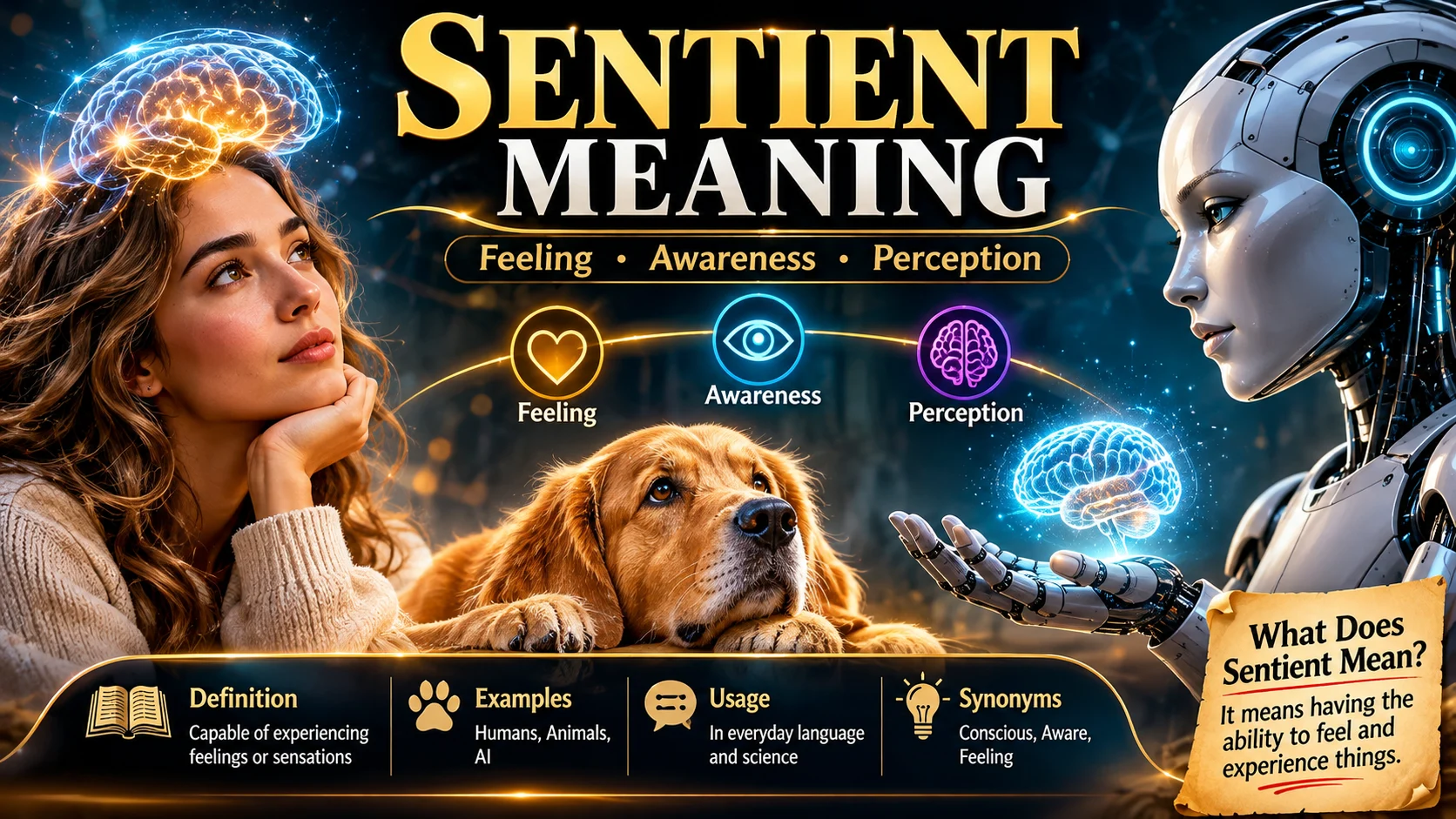
Sentient means capable of experiencing feelings, sensations, or subjective experiences. Humans and many animals are considered sentient because they can experience things such as pain, pleasure, and discomfort. The word also appears in discussions about consciousness and artificial intelligence.
Sentient meaning refers to the ability to experience feelings, sensations, and things happening around you. The word often appears in conversations about animals, humans, artificial intelligence, and consciousness.
For example, a dog can experience pain, enjoy affection, and react to its surroundings. These experiences help explain why people describe dogs as sentient beings.
However, sentience is not the same as intelligence. A person or animal does not need advanced reasoning skills to experience sensations. Likewise, an intelligent machine does not automatically have feelings simply because it can communicate with humans.
The word has also become popular in discussions about artificial intelligence, science fiction, gaming, and animal welfare. You might encounter expressions such as “sentient AI,” “sentient creature,” and “sentient being” in online conversations.
Furthermore, people sometimes use the term humorously when a computer, robot, or household appliance behaves as though it has a mind of its own.
This guide explains the word through straightforward definitions, pronunciation, everyday examples, social media contexts, synonyms, and frequently asked questions. It also explores the differences between sentience, consciousness, and intelligence.
Quick Answer: Sentient Meaning at a Glance
| Element | Explanation |
|---|---|
| Meaning | Capable of experiencing feelings and sensations |
| Part of Speech | Adjective |
| Pronunciation | SEN-shuhnt |
| Word Origin | Latin sentire, meaning to feel or perceive |
| Common Contexts | Science, philosophy, animals, AI, and everyday English |
| Example | Many animals are sentient beings. |
| Tone | Formal, scientific, thoughtful, or humorous |
| Related Noun | Sentience |
| Opposite | Insentient |
What Does Sentient Mean?
Sentient describes a person, animal, or other being that can experience sensations or subjective feelings.
In simple terms, something sentient can feel or experience things rather than merely react to its surroundings.
For example, humans experience happiness, sadness, physical pain, pleasure, and discomfort. Many animals also demonstrate the capacity for subjective experiences.
Therefore, people commonly describe humans and many animals as sentient beings.
The Oxford Advanced Learner’s Dictionary defines the adjective as the ability to perceive or feel things through the senses. It also identifies the word as formal English.
The Simple Definition
Here are a few easy ways to understand the word:
- A sentient person can experience physical and emotional sensations.
- A sentient animal can experience things such as pain and pleasure.
- A sentient creature has the capacity for sensory experiences.
- A sentient being can have subjective experiences.
Consider this example:
“My dog is a sentient creature, so I always treat him with kindness.”
The speaker recognizes that the dog can experience discomfort and other sensations.
Another example:
“Scientists are interested in understanding sentience in different animal species.”
Here, the word refers to the capacity for subjective experience.
Sentient as an Adjective
Sentient is primarily an adjective. It describes a noun rather than naming an action or object.
Writers commonly place it before nouns such as being, animal, creature, and life.
| Expression | Meaning |
|---|---|
| Sentient being | A being capable of subjective experiences |
| Sentient animal | An animal capable of experiencing sensations |
| Sentient creature | A creature with the capacity to feel |
| Sentient life | Life discussed in relation to sensory experience |
| Sentient AI | An AI system claimed or questioned to have subjective experiences |
| Sentient robot | A robot imagined or described as capable of experiencing feelings |
Notice that the adjective describes a particular ability. It does not simply mean intelligent, powerful, or alive.
Sentient Word Origin and History
The word has Latin roots.
It comes from the Latin verb sentire, which means “to feel” or “to perceive.” The English adjective dates back to the early 17th century.
According to the Oxford dictionary, its historical origin is connected to the Latin word sentientem, meaning feeling.
Over time, philosophers and writers adopted the term when discussing perception, sensory experiences, and consciousness.
Today, the word appears in several fields, including biology, neuroscience, philosophy, animal welfare, and artificial intelligence.
Sentient vs. Sentience
Sentient and sentience share the same linguistic root. However, they serve different grammatical purposes.
| Word | Part of Speech | Meaning | Example |
|---|---|---|---|
| Sentient | Adjective | Capable of experiencing sensations | A sentient animal |
| Sentience | Noun | The capacity for subjective experience | Animal sentience |
| Sentiently | Adverb | In a sentient manner | A rarely used form |
For example:
“Many researchers study animal sentience.”
In this sentence, sentience names the capacity for experience.
However:
“Many animals are sentient.”
Here, the adjective describes the animals.
Contextual Dynamics and Different Uses
The meaning of a word can become more specific depending on the subject. Sentient is a good example because people use it in science, philosophy, technology, and everyday communication.
Although its central meaning remains connected to experience and sensation, different contexts highlight different aspects.
Sentient in Everyday English
In ordinary conversations, people use the word to describe beings capable of experiencing sensations.
For example:
“Please remember that your pet is a sentient being.”
The speaker wants someone to recognize that animals can experience discomfort and other sensations.
Similarly:
“Every sentient creature deserves compassionate treatment.”
This statement emphasizes kindness toward beings capable of experiencing feelings.
However, the word sounds relatively formal. In casual conversations, people may choose simpler expressions such as “can feel pain” or “has feelings.”
Sentient in Science and Biology
Scientists and researchers use the concept when studying animal experiences and welfare.
For example, researchers investigate whether different animals experience pain, pleasure, fear, and other sensations.
These questions matter because evidence of sentience can influence animal care, veterinary practices, and welfare policies.
Scientists also examine nervous systems, behavior, learning, and responses to different situations.
However, a reaction to an external stimulus does not automatically establish subjective experience.
For instance, a plant can respond to light and environmental changes. That response alone does not demonstrate that it consciously experiences those changes.
Consequently, researchers distinguish observable biological responses from evidence of sentience.
Sentient in Philosophy
Philosophers use the term when exploring the nature of subjective experience.
They often ask questions such as:
- What does it mean to experience pain?
- Can something feel without understanding its feelings?
- Does consciousness require advanced intelligence?
- How can researchers identify subjective experiences in other species?
- Could a machine ever develop genuine experiences?
These questions connect sentience with ethics, consciousness, and moral responsibility.
For example, philosophers discuss whether the ability to experience suffering should influence how humans treat animals.
Furthermore, they examine whether intelligence and subjective experience represent separate characteristics.
Sentient in Artificial Intelligence
Artificial intelligence has made the word particularly relevant in modern technology discussions.
People sometimes describe advanced chatbots, robots, and digital assistants as sentient. However, realistic communication does not establish subjective experience.
An AI system can recognize patterns, generate natural sentences, answer questions, and simulate emotional language.
Nevertheless, these abilities do not prove that it experiences happiness, sadness, or physical sensations.
Consider this example:
“That chatbot sounds so realistic. Is it actually sentient?”
The speaker wants to know whether the system has genuine experiences or simply generates convincing responses.
At present, there is no established scientific evidence that today’s conversational AI systems experience feelings simply because they produce human-like language.
Therefore, distinguish between intelligent behavior and demonstrated subjective experience.
Real-Life Conversation Examples Using Sentient
Understanding a new word becomes easier when you see how people use it in realistic situations.
The following conversations demonstrate different contexts, including animals, technology, science fiction, and everyday humor.
Example 1: Discussing Animal Rights
Alex: Why do you care so much about animal protection?
Jordan: Because animals are sentient beings. They can experience pain and discomfort.
Alex: That makes sense. They deserve proper care.
Jordan: Exactly. We should treat them with compassion.
Explanation: Here, sentient refers to animals’ ability to experience sensations. The conversation focuses on animal welfare.
Example 2: Talking About Artificial Intelligence
Emma: This AI assistant answers questions like a real person.
Ryan: Yes, but do you think it’s sentient?
Emma: I’m not sure. It might simply generate responses based on its training.
Ryan: That’s an important distinction.
Explanation: The speakers question whether an AI system has genuine subjective experiences or simply produces realistic responses.
Example 3: Making a Joke About a Computer
Mike: My computer keeps freezing whenever I open that application.
Chris: Maybe it’s sentient and hates your work!
Mike: At this point, I wouldn’t be surprised.
Explanation: The speakers use the word humorously. They pretend that a computer has feelings and makes deliberate decisions.
Example 4: Discussing a Science Fiction Movie
Lily: The movie showed robots developing emotions.
Sophia: Right. They eventually became sentient.
Lily: That’s what made the ending so interesting.
Explanation: The conversation explores fictional robots that supposedly develop the ability to experience feelings.
Example 5: Talking About Compassion
Daniel: Why do you avoid hurting insects?
Oliver: I don’t want to cause unnecessary suffering to any sentient creature.
Daniel: I understand your point.
Explanation: The speaker uses the word to explain an ethical concern about creatures that may experience sensations.
How People Use Sentient on Social Media
Sentient is not a platform-specific abbreviation or officially defined social media slang term. It retains its standard English meaning across social networks.
However, the surrounding conversation can influence how readers interpret it.
How It Is Used on Snapchat
Snapchat users may encounter the word in private messages, stories, captions, and conversations about technology.
It generally appears in discussions about AI, pets, robots, and science fiction.
For example:
Friend 1: My new AI assistant remembers everything I tell it.
Friend 2: That’s impressive. Is it sentient now? 😂
Friend 1: No idea, but it definitely feels futuristic.
Another example:
Friend 1: My cat understands when I’m upset.
Friend 2: Cats are such interesting sentient creatures.
These examples show how the word can communicate curiosity, humor, or appreciation.
Common Snapchat contexts include:
- Conversations about artificial intelligence.
- Funny captions about pets.
- Discussions about robots and technology.
- Jokes about smart devices.
- Conversations about animal welfare.
If someone sends you the word, consider the surrounding message before interpreting its meaning.
The Role of Sentient on TikTok
TikTok features videos about artificial intelligence, robots, futuristic technology, and fictional consciousness.
Consequently, creators may use the word when discussing these subjects.
For example, someone might post a video showing an advanced robot and add the caption:
“Are we creating sentient machines?”
Other possible captions include:
- “My Roomba is becoming sentient.”
- “When your AI starts answering questions before you ask.”
- “This robot looks like it has its own personality.”
- “Imagine living in a world with sentient machines.”
These statements often use humor or exaggeration.
However, a funny caption does not establish that a device or computer actually possesses feelings.
TikTok creators may also discuss sentient characters from movies, television shows, and video games.
For example, a science fiction reviewer might describe a fictional robot as a sentient machine.
The intended meaning remains connected to perception and subjective experience.
Instagram and Texting Dynamics
Instagram users may encounter the word in educational posts, technology discussions, memes, and entertainment content.
For example, someone might share an animal welfare infographic with the caption:
“Every sentient being deserves kindness.”
Another person might post a humorous picture of a malfunctioning robot and write:
“Pretty sure this thing is becoming sentient.”
Text messages also offer several possible uses.
| Message | Intended Meaning |
|---|---|
| “Are robots becoming sentient?” | Asking about machine consciousness |
| “My dog is a sentient little creature.” | Recognizing an animal’s ability to feel |
| “This AI seems sentient.” | Suggesting that an AI appears conscious |
| “That printer is acting sentient.” | Making a humorous comparison |
| “Protect all sentient beings.” | Expressing compassion |
The word can make a conversation sound thoughtful or intellectual.
However, it is not usually necessary in casual texting. Simpler expressions such as “aware,” “can feel,” and “has feelings” may communicate the intended idea more naturally.
Alternative Meanings, Synonyms, and Related Words
Search engines and language-processing systems recognize that people often search for the same concept using different expressions.
Understanding related vocabulary helps readers identify the intended meaning and choose appropriate alternatives.
However, not every related word has exactly the same definition.
Common Synonyms
Here are several useful synonyms and related expressions.
| Word | Meaning | How It Differs |
|---|---|---|
| Conscious | Having awareness or experience | Often emphasizes awareness |
| Aware | Having knowledge or perception | Does not always imply subjective feeling |
| Feeling | Capable of experiencing sensations | Emphasizes emotional or physical experience |
| Perceptive | Able to notice or understand things | Often describes awareness |
| Sensitive | Responsive to particular sensations | Can describe physical or emotional responses |
| Responsive | Reacting to external influences | Does not necessarily establish sentience |
| Cognizant | Aware of something | Often emphasizes knowledge |
For example, someone can be aware of a sound without paying much attention to it.
Similarly, a device can respond to a stimulus without demonstrating subjective experience.
Therefore, choose an alternative according to the intended meaning.
Opposite Words
The most direct opposite is insentient.
Insentient describes something that lacks the capacity for sensory experience.
Other related expressions include:
- Non-sentient
- Unfeeling
- Without sensation
- Inanimate
However, these terms are not interchangeable in every situation.
For example, an ordinary stone is generally considered non-sentient because there is no established evidence that it experiences feelings.
An inanimate object is something that is not alive.
Although these descriptions overlap in everyday situations, they communicate different ideas.
Sentient vs. Sapient
People sometimes confuse sentience with sapience.
However, these words describe different characteristics.
| Feature | Sentient | Sapient |
|---|---|---|
| Main Idea | Ability to experience sensations | Wisdom or advanced understanding |
| Focus | Feeling and subjective experience | Intelligence and judgment |
| Example | An animal experiencing pain | A person demonstrating wisdom |
| Common Context | Animal welfare and consciousness | Reasoning and intellectual ability |
An important distinction is that sentience does not automatically require advanced reasoning.
For example, an animal may experience pain without understanding the scientific explanation behind it.
Likewise, intelligence alone does not establish sentience.
Sentient vs. Conscious
These concepts overlap, but their meanings can differ depending on the discipline.
Sentience generally focuses on subjective experiences, including sensations and feelings.
Consciousness is broader. It can refer to awareness, subjective experience, or different states of awareness.
For example:
“She is conscious of her surroundings.”
This sentence emphasizes awareness.
However:
“Many animals are sentient.”
This statement emphasizes their capacity for subjective experience.
The distinction becomes especially important in neuroscience and philosophy.
Popular Semantic Variations
Readers may encounter several related expressions when searching for this topic.
| Related Phrase | Explanation |
|---|---|
| Sentient meaning in English | Definition of the adjective |
| Sentient being meaning | A being capable of subjective experiences |
| Sentient creature meaning | A creature capable of experiencing sensations |
| Sentient AI meaning | An AI system claimed or questioned to have subjective experiences |
| Sentient robot meaning | A robot imagined as having subjective experiences |
| Sentient life meaning | Life discussed in relation to sensory experience |
| Sentience meaning | The capacity for subjective experience |
| Sentient consciousness | A phrase connecting subjective experience with awareness |
These variations help readers understand how the same central concept appears in different subjects.
Common Misunderstandings: When Not to Use Sentient
Although the definition is relatively straightforward, people sometimes use the word incorrectly.
Understanding these mistakes will help you communicate more accurately.
Do Not Confuse Sentience With Intelligence
Intelligence and sentience are separate concepts.
Intelligence generally involves learning, reasoning, problem-solving, and understanding information.
Sentience concerns the capacity to experience sensations or subjective feelings.
For example, an advanced computer may solve complicated mathematical problems.
However, this ability does not prove that the computer experiences happiness, pain, or other sensations.
Therefore, avoid describing something as sentient simply because it performs intelligent tasks.
Do Not Assume Every Living Thing Is Sentient
Being alive does not automatically establish the capacity for subjective experience.
Humans and many animals have strong scientific support for sentience.
However, discussions about insects and other organisms can involve scientific uncertainty and debate.
Plants respond to their environments, but those responses do not establish that plants consciously experience sensations.
Consequently, distinguish biological activity from evidence of subjective experience.
Do Not Use It as a Synonym for Emotional
Emotional and sentient are related but different words.
An emotional person experiences or expresses emotions.
A sentient being has the capacity for subjective experiences and sensations.
For example:
“She is an emotional person.”
This sentence describes her emotional nature.
“She is a sentient human being.”
This sentence emphasizes her capacity for experience.
Do Not Automatically Describe Every AI as Sentient
Modern AI systems can produce realistic conversations and simulate emotional language.
Nevertheless, these abilities do not demonstrate genuine subjective experiences.
For example, a chatbot might write:
“I’m happy to help you.”
That statement does not prove the system actually experiences happiness.
Instead, it uses language that communicates friendliness.
Avoid Using It in Unnecessary Situations
Sentient is a relatively formal word.
Therefore, it may sound unnatural in some everyday conversations.
For example:
“Are you a sentient person who wants coffee?”
This sentence sounds unnecessarily complicated.
A more natural version would be:
“Do you want coffee?”
Choose vocabulary according to your audience and purpose.
How to Respond When Someone Uses Sentient in Chat
When someone uses the word in a conversation, your response should match the subject.
You do not need to provide a dictionary definition every time someone mentions it.
Instead, identify whether the person is discussing animals, technology, philosophy, or making a joke.
If Someone Asks Whether AI Is Sentient
You could respond:
“That’s an interesting question. However, realistic conversations don’t prove that AI has feelings.”
This response acknowledges the discussion without making unsupported claims.
If Someone Talks About Sentient Animals
You might say:
“Absolutely. Animals deserve compassion because many can experience pain and other sensations.”
This response works well in conversations about animal welfare.
If Someone Uses It as a Joke
For example:
Friend: My laptop is becoming sentient. It keeps crashing whenever I need it.
You: 😂 Maybe it needs a vacation!
Here, a humorous response keeps the conversation natural.
If Someone Uses It in a Serious Discussion
You can respond:
“I think the distinction between intelligence and subjective experience is really important.”
This answer shows that you understand the philosophical context.
If You Do Not Understand the Context
Simply ask:
“What do you mean by sentient in this situation?”
This question works because the speaker might be discussing AI, animals, or fictional characters.
Furthermore, asking for clarification is better than assuming an incorrect interpretation.
Frequently Asked Questions
1. What Is the Sentient Meaning in Simple English?
Sentient means having the ability to experience feelings, sensations, or subjective experiences. Humans and many animals are examples of commonly recognized sentient beings.
2. Does Sentient Mean Conscious?
The words overlap, but they are not identical in every context. Sentient emphasizes the ability to experience sensations and feelings, while consciousness can also describe broader forms of awareness.
3. What Is a Sentient Being?
A sentient being is an individual or organism capable of experiencing sensations or subjective feelings. Humans and many animals fall into this category.
4. Is Sentient a Positive or Negative Word?
Sentient is generally a neutral descriptive word. However, people often use it in positive discussions about animal welfare, consciousness, and ethical responsibility.
5. What Is the Opposite of Sentient?
Insentient is the most direct opposite. It describes something that lacks the capacity for sensory experience. Non-sentient is another commonly used alternative.
6. Can Artificial Intelligence Become Sentient?
Whether an artificial system could ever develop subjective experiences remains an open scientific and philosophical question. Current conversational abilities do not establish that an AI system has feelings.
7. What Does Sentient Mean in Text Messages?
In texting, the word usually keeps its standard English meaning. People may use it when discussing AI, animals, robots, or consciousness. It can also appear in jokes about devices behaving as if they have minds.
8. How Do You Pronounce Sentient?
In American English, the common pronunciation is /ˈsenʃənt/, which sounds like “SEN-shuhnt.” Some English speakers also use alternative pronunciations.
9. Is Sentient the Same as Intelligent?
No. Intelligence involves reasoning, learning, and problem-solving. Sentience involves the ability to experience sensations or feelings. One does not automatically prove the other.
10. What Is the Difference Between Sentient and Sapient?
Sentient describes the ability to experience sensations and feelings. Sapient describes wisdom, understanding, or advanced intellectual ability. The two terms describe different characteristics.
Conclusion
Sentient describes the ability to experience sensations and subjective feelings. It is an important word in everyday English, science, philosophy, and modern technology discussions.
Humans and many animals demonstrate this capacity, which makes the term especially relevant to conversations about animal welfare and consciousness.
Furthermore, artificial intelligence has introduced new questions about whether machines could ever develop subjective experiences.
On social media, people also use the word when discussing robots, fictional characters, smart devices, and humorous everyday situations.
However, remember that intelligence, realistic communication, and responsiveness do not automatically establish sentience.
Whether you encounter the term in a TikTok video, an Instagram caption, a text message, or a scientific article, its central meaning remains connected to feeling and experience.
In simple words, sentient means capable of experiencing things. Understanding this distinction will help you use the word naturally, accurately, and confidently in modern English.
