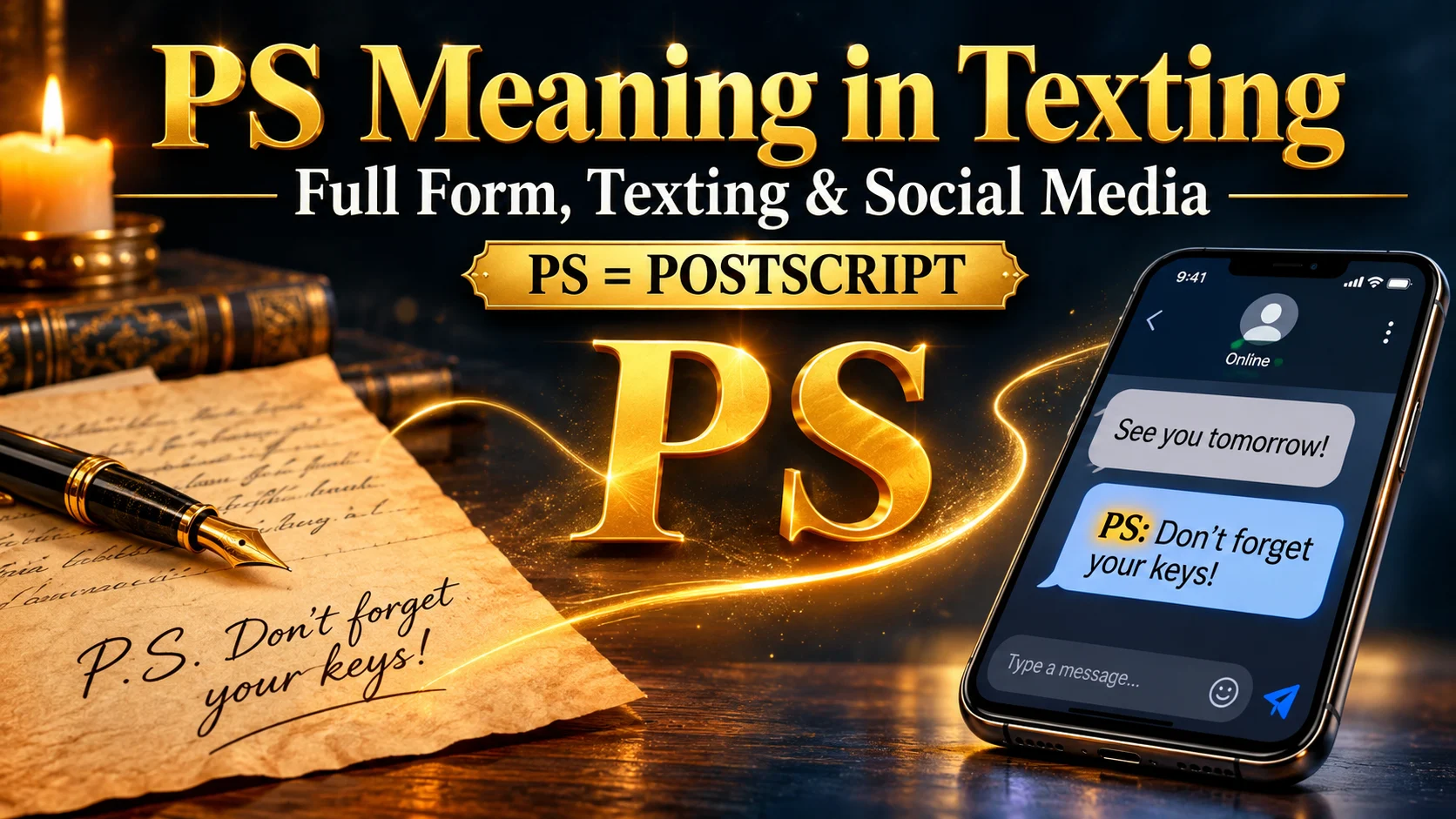
PS usually means Postscript in texting, emails, and online conversations. People use it to add an extra thought or important detail after finishing a message. However, its meaning can change depending on the conversation, platform, and context.
The PS meaning in texting is usually postscript, a short addition that someone includes after completing a message. You may notice it in text messages, emails, Instagram captions, Snapchat conversations, or online comments.
For example, someone might text, “I’ll see you tomorrow. PS, don’t forget your keys!” The extra sentence adds information without changing the original message.
However, PS does not always serve the same purpose. Some people use it to highlight a forgotten detail. Others add it to make a conversation funnier, more personal, or more memorable.
Furthermore, the abbreviation appears in different online communities with alternative meanings. Its interpretation may depend on whether someone uses it in a casual message, gaming discussion, business email, or social media post.
Understanding these differences helps you avoid confusion. This guide explains its common definition, conversational uses, platform-specific meanings, realistic examples, and appropriate responses.
PS Meaning at a Glance
| Category | Explanation |
|---|---|
| Meaning | Postscript |
| Context | Texting, emails, social media, and online conversations |
| Primary Platforms | Snapchat, TikTok, Instagram, WhatsApp, and SMS |
| Example | “PS, bring your charger!” |
| Tone | Casual, friendly, informative, or playful |
What Does PS Mean? Full Definition and Origin
The abbreviation PS stands for postscript, a term that describes an additional note written after the main message.
In traditional writing, people placed this note after their signature. Today, however, people also use it in text messages, emails, digital conversations, and social media captions.
The Full Form of PS
The full form is Postscript. It comes from the Latin expression post scriptum, which means “written after.”
The two Latin elements explain its purpose:
- Post: After or later.
- Scriptum: Something written.
Consequently, the expression describes information added after someone has completed a piece of writing.
According to the Cambridge Dictionary, people use PS to introduce extra information at the end of a letter or email. English meaning – Cambridge Dictionary+1
Why Do People Write PS Instead of Another Sentence?
People often remember something important after sending or completing a message. Instead of rewriting everything, they add a short note at the end.
For example:
“Thanks for inviting me to dinner. I had a wonderful time.
PS: Your homemade dessert was amazing!”
The final sentence adds a personal detail without changing the original message.
Furthermore, this format makes the additional information stand out. Readers can quickly identify it as a separate thought.
How Is PS Written Correctly?
You may encounter several writing styles:
| Writing Style | Example |
|---|---|
| P.S. | P.S. Don’t forget your wallet. |
| PS | PS: Call me when you arrive. |
| P.S.: | P.S.: I also bought your favorite snack. |
| p.s. | p.s. You’re still my favorite person. |
All these forms communicate the same basic idea. However, P.S. remains a familiar traditional format, particularly in formal correspondence.
For everyday texting, uppercase PS without periods also works perfectly well.
Is PS an Acronym or an Abbreviation?
Technically, PS is an abbreviation of the word postscript. It is not an acronym formed from the initial letters of several independent words.
People sometimes call it an acronym in casual discussions. Nevertheless, abbreviation is the more accurate linguistic description.
Historical Origin of the Expression
The expression has a much longer history than modern texting.
Writers used postscripts in handwritten letters to include forgotten information after signing their names. The Latin expression eventually became established in English writing.
Historical etymological records trace P.S. to the early seventeenth century. The underlying word postscript appeared even earlier. Etymology, Origin & Meaning+1
Today, digital communication has made this traditional writing convention even more convenient.
Contextual Dynamics and Nuances of the Term
Although the dictionary definition stays consistent, the meaning and emotional effect can change with the situation.
For instance, a friend might use it to share a joke. A colleague might add an important reminder. Meanwhile, a romantic partner could use it to express affection.
Understanding the surrounding conversation helps you interpret the sender’s intention.
PS as an Additional Thought
This is its most straightforward use.
Someone finishes a message and remembers another detail.
Example:
“See you at the restaurant at 7.
PS: I booked a table outside.”
The extra information adds something useful without interrupting the original message.
PS as a Friendly Reminder
People frequently use this abbreviation to emphasize something they do not want another person to forget.
For example:
“Good luck with your interview tomorrow!
PS: Take your printed resume.”
The reminder sounds natural and friendly. Furthermore, it gives the final instruction extra visibility.
PS as a Romantic Expression
In personal relationships, a short additional note can communicate affection.
For example:
“Hope you have a beautiful day. I miss you already.
PS: I love your smile.”
This format creates a warm ending. It can also make a simple message feel more personal.
PS as a Joke or Punchline
Sometimes, the final note delivers the funniest part of a conversation.
For example:
“I’m officially starting my fitness journey tomorrow.
PS: I ordered pizza for tonight.”
The contrast between the serious announcement and the final comment creates humor.
PS as an Important Clarification
People also use it to correct or clarify something they mentioned earlier.
For example:
“The meeting starts at 10 AM in Room 4.
PS: I meant Thursday, not Friday.”
This usage helps prevent misunderstandings. However, if the correction changes an important instruction, editing the original message or sending a separate clarification may work better.
Does PS Have a Hidden or Romantic Meaning?
No single hidden or romantic definition applies to everyone.
Its meaning depends on the words that follow it.
Compare these examples:
| Message | Intended Meaning |
|---|---|
| PS: I miss you. | Affection |
| PS: Bring my book. | Reminder |
| PS: You’re hilarious. | Compliment |
| PS: I forgot the tickets. | Additional information |
| PS: Pizza is on me. | Friendly gesture |
Therefore, do not automatically assume romantic interest when someone uses this abbreviation.
Real-Life Conversation Examples Using PS
The following conversations show how people naturally use the expression in everyday American English.
Each example represents a different situation, from casual friendships to professional communication.
Example 1: Casual Conversation Between Friends
Alex: Are we still meeting at the mall tomorrow?
Jordan: Yes! Around 3 PM.
Alex: Perfect. I’ll see you there.
Jordan: PS: Don’t forget the gift for Sarah!
Meaning: Jordan adds a reminder after answering the original question.
Example 2: Romantic Text Message
Emily: I had such a wonderful time with you tonight.
Ryan: Same here. I already want to see you again.
Emily: Aww, that’s sweet.
Ryan: PS: You looked absolutely beautiful tonight. ❤️
Meaning: Ryan adds a romantic compliment to make the conversation more affectionate.
Example 3: Funny Conversation
Mike: I’m going to stop wasting money this month.
Chris: That’s a good decision.
Mike: I’m serious this time.
Chris: PS: Your online shopping packages just arrived. 😂
Meaning: Chris adds a humorous comment that challenges Mike’s statement.
Example 4: School or College Conversation
Teacher: Your assignment is due next Monday. Please submit it before noon.
Student: Thank you for the reminder.
Teacher: PS: Remember to include your references.
Meaning: The teacher adds another academic instruction that students should follow.
Example 5: Professional Email or Work Conversation
Jessica: Hi Mark,
I’ve attached the updated presentation for tomorrow’s meeting. Please review the final slides when you have time.
Best,
Jessica
P.S. The meeting room has changed to Conference Room B.
Meaning: Jessica adds an important logistical update after completing her email.
What Do These Examples Teach Us?
These conversations demonstrate that the abbreviation does not have one emotional tone.
Instead, the surrounding words determine its purpose.
- Friends use it for reminders and jokes.
- Couples use it for affection and compliments.
- Students use it for additional information.
- Colleagues use it for brief professional updates.
- Social media users use it to make captions more engaging.
Consequently, reading the entire message is more useful than interpreting the two letters alone.
Platform-Specific Breakdown
People use short expressions differently across digital platforms. Nevertheless, PS does not have a universally established, separate slang definition on Snapchat, TikTok, or Instagram.
Its familiar postscript meaning generally carries over from traditional writing.
How It Is Used on Snapchat
How to See Who Someone Is Snapping on Snapchat – 5 Ways
Snapchat users can include PS in direct messages, casual conversations, and text accompanying snaps.
For example:
Person A: Just sent you the pictures.
Person B: Got them! Thanks.
Person A: PS: The third picture is my favorite. 😂
Here, the sender adds an extra comment about the pictures.
Another example:
“See you after school. PS: Bring your headphones.”
The abbreviation does not indicate a special Snapchat feature. Instead, it introduces an additional thought.
Important Snapchat distinction: Do not confuse PS with a platform-specific feature or assume it automatically means Private Story. A user might discuss a private story in a particular conversation, but that does not establish PS as its universal abbreviation.
The Role of PS Meaning on TikTok
An update on our virtual Transparency & Accountability Center experience – Newsroom | TikTok
TikTok users encounter short expressions in video captions, comments, and direct messages.
PS can introduce a funny observation, an additional explanation, or a detail that the creator forgot to mention.
For example:
Video caption:
“Finally finished my first marathon!
PS: My legs are still recovering. 😂”
Another example:
Comment: This recipe looks amazing!
Creator: Thank you!
Comment: PS: We need the full recipe.
In both cases, the abbreviation introduces an additional thought.
However, TikTok conversations frequently involve gaming and entertainment terminology. If someone writes “PS5 gameplay,” the intended meaning is PlayStation 5 rather than postscript.
Instagram and Texting Dynamics
Instagram users can add the abbreviation to captions, comments, stories, and direct messages.
It works particularly well when someone wants to add a final observation without changing the main caption.
For example:
“Weekend memories with my favorite people. ❤️
PS: We definitely need another trip!”
In direct messages, people also use it for playful reminders.
Person A: Your outfit looked amazing today!
Person B: Thank you so much!
Person A: PS: Send me the pictures when you get home.
The same principle applies to WhatsApp, Facebook Messenger, iMessage, and ordinary SMS.
Here are some platform examples:
| Platform | Typical Use | Example |
|---|---|---|
| Snapchat | Extra comments in chats | PS: Check the last snap. |
| TikTok | Additional thoughts in captions | PS: Wait for the ending. |
| Personal notes in captions | PS: More pictures coming soon. | |
| Friendly reminders | PS: Call me tonight. | |
| iMessage | Additional details | PS: I’ll bring coffee. |
| Extra information in posts | PS: Tag your friends. |
These are examples of general communication habits, not special platform definitions.
Alternative Meanings
Although postscript is the most common interpretation in ordinary messages, PS can represent different things in other contexts.
This distinction matters because abbreviations often belong to several vocabulary groups.
Common Alternative Definitions
| Alternative Meaning | Context | Example |
|---|---|---|
| PlayStation | Gaming | Do you play games on PS5? |
| Personal Statement | Education and college applications | I need to finish my PS. |
| Photoshop | Graphic design | Can you edit this in PS? |
| Postscript | Writing and messaging | PS: See you tomorrow! |
| Public School | Education, depending on regional usage | He attended a PS. |
| Psalm or Psalms | Religious references and citations | PS 23:1 |
These definitions do not carry equal relevance in everyday texting. The intended meaning depends heavily on the subject being discussed.
PS Meaning in Gaming
In gaming communities, PS commonly refers to PlayStation, Sony’s video game console family.
For example:
- “I play on PS5.”
- “Is this game available on PS?”
- “PS players can join the tournament.”
In these examples, the abbreviation has nothing to do with adding an extra sentence.
The surrounding gaming vocabulary makes the intended definition clear.
PS Meaning in Education
In college admissions and academic discussions, PS can stand for Personal Statement.
A personal statement describes someone’s background, interests, qualifications, and reasons for applying to an educational program.
Example:
Student A: Have you finished your university application?
Student B: Almost. I’m still working on my PS.
Here, the student refers to a personal statement rather than an additional note.
However, writers should check the institution’s terminology because application requirements differ.
PS Meaning in Graphic Design
In design conversations, people sometimes use PS as shorthand for Photoshop.
For example:
“Can you remove the background in PS?”
The context suggests Adobe Photoshop, the image-editing application.
This usage is informal shorthand rather than the standard product name.
PS Meaning in Religious References
In some religious and academic references, PS can refer to Psalms.
For example, someone might write “PS 23” when referring to Psalm 23.
However, biblical citation styles vary. Therefore, readers should consider the surrounding reference before interpreting the abbreviation.
Related Words and Semantic Variations
Search engines and language models understand topics through related expressions and contextual relationships.
The following terms help explain the broader concept:
| Related Term | Meaning |
|---|---|
| Postscript | Additional information after a completed message |
| Afterthought | An idea remembered later |
| Additional note | Extra written information |
| P.S. note | A short final remark |
| Final remark | A closing comment |
| Follow-up | A later message or communication |
| Addendum | Supplementary information added to a document |
| BTW | By the way |
| FYI | For your information |
| PPS | Post-postscript, an additional note after a P.S. |
These expressions have overlapping functions, but they are not interchangeable in every situation.
What Does PPS Mean?
PPS stands for post-postscript.
People use it when they want to add another thought after an existing postscript.
Consider this example:
“Thanks for coming to my birthday party.
PS: I loved your gift.
PPS: Please send me the pictures!”
The first additional note is PS. The second becomes PPS.
Although people rarely need multiple postscripts in everyday messaging, this convention remains understandable.
Misinterpretations
Abbreviations make communication faster. However, using them without considering the situation can create confusion.
Knowing when to avoid this expression is just as important as knowing its definition.
1. Do Not Assume Everyone Understands It
Some readers may understand PS immediately, while others might interpret it as a gaming or technical abbreviation.
For example:
“PS is better than Xbox.”
In this sentence, PS clearly refers to PlayStation.
However:
“PS, I enjoyed the evening.”
Here, it introduces an additional thought.
Always consider the surrounding words.
2. Avoid Using It Instead of an Important Correction
Suppose you send someone the wrong appointment time.
Adding a correction at the end might not attract enough attention.
Instead of writing:
“The appointment is at 4 PM.
PS: Actually, it’s at 2 PM.”
Send a separate correction:
“Correction: The appointment is at 2 PM, not 4 PM.”
This approach makes important changes easier to notice.
3. Avoid Excessive Postscripts in Professional Emails
One short additional note can make an email easier to read.
However, adding several unnecessary notes may make the message look disorganized.
For professional communication, organize important information into the main body whenever possible.
Use a final note only when it genuinely improves clarity.
4. Do Not Use It to Introduce an Entirely Different Conversation
A postscript should usually connect to the original message or provide a brief extra detail.
For example:
“Thanks for sharing the report.
PS: What do you think about buying a new car?”
The second sentence introduces an unrelated subject.
A separate message would make more sense.
5. Do Not Assume It Signals Romantic Interest
Someone might write:
“PS: Take care!”
This does not automatically mean they have romantic feelings.
It could simply express friendliness, kindness, or concern.
Therefore, interpret the complete conversation rather than assigning emotional meaning to two letters.
How to Respond in Chat Comfortably
Once you understand the context, responding becomes straightforward.
You usually do not need to explain the abbreviation or ask what it means.
Simply respond to the additional information.
When Someone Uses PS to Remind You
Message: “PS: Don’t forget to bring your laptop.”
Possible response:
“Sure! I’ll bring it.”
Alternatively:
“Thanks for reminding me!”
When Someone Uses It to Compliment You
Message: “PS: You looked amazing today!”
Possible response:
“That’s so sweet of you! Thank you. 😊”
You can also keep things casual:
“Aw, I appreciate that!”
When Someone Uses It Romantically
Message: “PS: I miss you already. ❤️”
Possible response:
“I miss you too! Can’t wait to see you again.”
However, your response should reflect your actual feelings.
When Someone Adds a Funny Comment
Message: “PS: I’m still waiting for you to treat me to pizza. 😂”
Possible response:
“Haha! Fine, pizza is on me next time.”
When Someone Uses It in a Professional Conversation
Message: “PS: Please bring the updated presentation.”
Possible response:
“Thanks for the reminder. I’ll bring the updated version.”
When You Cannot Understand the Meaning
Sometimes the abbreviation appears in a conversation where several interpretations seem possible.
Instead of guessing, ask a simple question:
“Just checking, do you mean postscript or PlayStation?”
This approach prevents unnecessary confusion.
Useful Responses at a Glance
| Situation | Natural Response |
|---|---|
| Friendly reminder | Thanks for the reminder! |
| Romantic message | That’s really sweet. ❤️ |
| Funny comment | Haha, good one! |
| Additional information | Got it, thanks! |
| Professional note | Understood. I’ll take care of it. |
| Unclear abbreviation | What do you mean by PS here? |
FAQs
1. What Does PS Mean in Texting?
The PS meaning in texting is usually postscript. It introduces an additional thought, reminder, or detail after the main message. For example, “PS: Don’t forget your keys!” adds information without rewriting the original text.
2. What Does PS Mean on Snapchat?
On Snapchat, PS generally means postscript when someone adds it to a chat or message. It introduces an extra comment or reminder. However, the surrounding conversation can suggest another meaning.
3. What Does PS Mean on TikTok?
On TikTok, people generally use PS to introduce an additional thought in captions, comments, or messages. It does not have one universally recognized TikTok-specific definition.
4. Does PS Mean Private Story on Snapchat?
Not necessarily. PS is not a universally established abbreviation for Private Story. Some users might use it informally in that context, but you should examine the conversation before deciding what the sender means.
5. What Does PS Stand For in a Message?
PS stands for postscript. It comes from the Latin expression post scriptum, meaning written after. People use it to include information after completing a message.
6. Is PS Flirty or Romantic?
It can appear in romantic messages, but the abbreviation itself is not inherently flirty. The words following it determine whether the sender expresses affection, humor, friendship, or something else.
7. What Is the Difference Between PS and PPS?
PS introduces the first additional note after a completed message. PPS means post-postscript and introduces another note after the original PS.
8. Can You Use PS in Professional Emails?
Yes. PS works in professional emails when you need to add a short reminder, clarification, or additional detail. However, important information should normally appear in the main body.
9. What Does PS Mean in Gaming?
In gaming conversations, PS commonly refers to PlayStation, Sony’s gaming console brand. For example, “I play on PS5” identifies the gaming platform rather than an additional written note.
10. Should PS Be Written With Periods?
Both PS and P.S. are recognizable forms. Traditional writing often uses P.S., while casual digital communication frequently uses PS. Choose one style and use it consistently.
Conclusion
Language constantly changes as people adopt new ways to communicate. Some expressions disappear, while others remain useful across generations.
PS is a good example of an abbreviation that has successfully moved from traditional letters into modern digital conversations.
Its most familiar definition remains postscript. People use it to add forgotten details, share reminders, express affection, and introduce funny observations.
Understanding the PS meaning also requires recognizing the importance of context. A gaming conversation might use PS for PlayStation, while an email or casual text usually uses it for postscript.
Furthermore, platforms such as Snapchat, TikTok, Instagram, and WhatsApp do not automatically change its traditional definition.
The easiest way to understand this abbreviation is to examine the words surrounding it.
Whether you encounter it in a romantic message, a funny caption, a professional email, or a gaming discussion, context will usually reveal what the sender intends.
Ultimately, PS remains a simple but useful part of modern digital communication.
