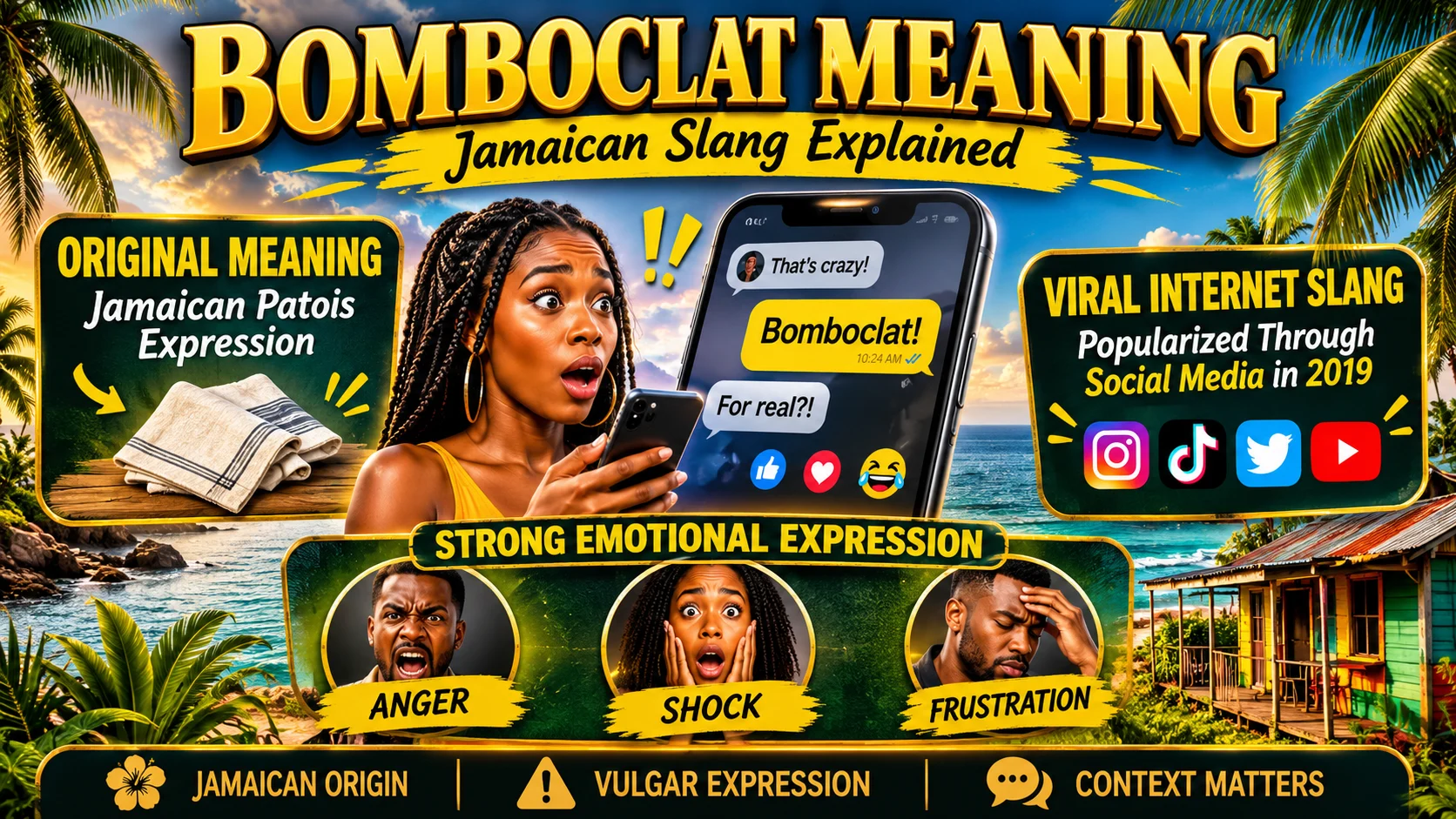
Bomboclat meaning refers to a vulgar Jamaican Patois expression used to communicate anger, frustration, shock, disbelief, or strong emotions. The word also has historical connections to cloth used for menstrual hygiene or personal cleaning. Online, it became popular as a reaction word and meme in 2019.
The bomboclat meaning comes from Jamaican Patois, where the expression functions as a strong swear word rather than an ordinary greeting or casual internet phrase. However, its popularity on social media has introduced the term to millions of people outside Jamaica.
You might encounter it in TikTok comments, Instagram captions, memes, or conversations between friends. Consequently, many American internet users wonder whether it represents excitement, anger, surprise, or something entirely different.
The answer depends on context.
In Jamaican culture, this expression carries a vulgar tone. People may use it when something shocks, frustrates, or seriously annoys them. Meanwhile, internet communities have adopted it as a humorous reaction or meme caption.
Furthermore, its spelling varies across different communities. You might see bomboclat, bomboclaat, bumboclaat, or bumbaclot. Although these variations look different, they generally refer to the same Jamaican expression.
This guide explores its original meaning, cultural background, social media popularity, conversational examples, and appropriate responses. It also explains why understanding its Jamaican roots matters before using it in everyday American conversations.
What Does Bomboclat Mean?
| Category | Explanation |
|---|---|
| Meaning | A vulgar Jamaican Patois swear word |
| Context | Anger, frustration, shock, disbelief, or strong emotion |
| Origin | Jamaica |
| Primary Platforms | TikTok, Instagram, Snapchat, X, and online forums |
| Example | “Bomboclat! I can’t believe that happened!” |
| Tone | Vulgar, emotional, expressive, and sometimes humorous |
What Does bomboclat meaning Actually Refer To?
The expression originates in Jamaican Patois, a language variety spoken in Jamaica and by Jamaican communities worldwide.
It functions as an exclamation, insult, or intensifier. Its emotional meaning changes according to the speaker’s intention and the surrounding conversation.
For example, someone might shout it after receiving shocking news. Another person might use it to express irritation during an argument.
However, it is important to understand that this is not a polite everyday expression.
The Original Jamaican Definition
In its traditional Jamaican context, the word carries a strong vulgar meaning.
English equivalents can include:
- Damn!
- What the hell!
- Holy shit!
- Fuck!
- What the fuck!
These expressions provide approximate English comparisons. However, none captures every cultural and emotional nuance.
For instance, someone might use the word to express frustration without directly insulting another person. Alternatively, they might direct it toward someone as an aggressive insult.
Therefore, the speaker’s tone matters considerably.
Understanding Its Literal Meaning
The word has historical connections to cloth used for personal hygiene.
Linguistic explanations commonly break the expression into two elements:
| Word Element | Traditional Explanation |
|---|---|
| Bumbo or Bumba | Associated with the buttocks or genital area |
| Claat or Klaat | A Jamaican Patois form related to the English word “cloth” |
Together, these elements refer to a cloth associated with intimate personal hygiene.
Historical explanations connect the expression with menstrual cloths and bathroom wiping materials. However, the exact historical interpretation can vary across linguistic sources.
Dictionary.com documents the expression’s connection to Jamaican English and records its use as a vulgarity. It also identifies the historical spelling bumbaclot. Dictionary.com+1
How to Pronounce the Expression
People generally pronounce it approximately as:
BOM-bo-clat
The first syllable receives the strongest emphasis.
However, pronunciation can vary between Jamaican speakers and international internet users.
If you hear someone saying it in a Jamaican accent, the pronunciation might sound slightly different from the version commonly repeated in American memes.
Is It a Bad Word?
Yes. The expression is generally considered vulgar and potentially offensive.
Its strength depends on the situation, speaker, and audience.
Consider these examples:
- Among close friends, it might communicate an exaggerated emotional reaction.
- During an argument, it could sound insulting or aggressive.
- In a professional conversation, it would usually appear inappropriate.
- In a meme, it might function as humorous exaggeration.
Consequently, recognizing its emotional intensity is more important than simply memorizing an English translation.
Contextual Dynamics and Nuances of the Term
Understanding an internet expression requires more than knowing its dictionary definition. People often change the way they use words depending on their audience, emotions, and communication platform.
This Jamaican expression demonstrates that difference particularly well.
Expressing Anger and Frustration
One common use involves expressing irritation.
Imagine someone discovers that their car will not start before an important meeting.
They might react with an emotional exclamation.
Example:
“Bomboclat! My car won’t start again!”
Here, the expression communicates frustration. It does not necessarily target another person.
Similarly, someone might use it after experiencing an unexpected problem.
Showing Shock and Disbelief
The expression can also communicate disbelief.
For example, imagine discovering that your favorite team lost a championship after leading throughout the game.
A person might respond:
“Bomboclat! How did they lose that match?”
The emotional meaning resembles a strong English reaction such as “What the hell?”
However, the expression remains vulgar even when someone uses it humorously.
Communicating Excitement
Some speakers also use Jamaican expletives during moments of intense excitement.
For example:
“Bomboclat! We actually won!”
Here, the speaker expresses an overwhelming emotional reaction.
Nevertheless, international audiences should understand the difference between traditional Jamaican usage and casual internet imitation.
Using It as an Insult
Another important meaning appears when someone directs the expression toward another person.
For example:
“Why you acting like that, bomboclat?”
Depending on pronunciation and context, this could sound confrontational or disrespectful.
Therefore, it should not automatically be interpreted as playful friendship slang.
Understanding the Difference Between Tone and Meaning
The same expression can communicate different emotions.
| Situation | Possible Interpretation | Emotional Tone |
|---|---|---|
| Unexpected accident | Damn! | Frustrated |
| Shocking news | What the hell! | Surprised |
| Unexpected victory | Holy shit! | Excited |
| Heated argument | Strong insult | Aggressive |
| Funny internet video | Exaggerated reaction | Humorous |
The important distinction is that humor does not automatically remove the word’s vulgar meaning.
Real-Life Conversation Examples Using bomboclat meaning
Realistic conversations make slang easier to understand. The following examples demonstrate different situations in which someone might encounter this expression.
These dialogues illustrate possible usage rather than prescribing how non-Jamaican speakers should adopt it.
Example 1: Reacting to Unexpected News
Situation: Two friends discuss an unexpected announcement.
Alex: Did you hear that Jason is moving to California?
Mike: Seriously? When?
Alex: Next week. He just told everyone yesterday.
Mike: Bomboclat! I thought he was staying here.
Meaning: Mike expresses surprise and disbelief. His reaction communicates that the announcement caught him completely off guard.
Example 2: Expressing Frustration
Situation: Someone experiences a technical problem.
Sarah: Is your laptop working now?
James: No. It crashed again.
Sarah: Didn’t you just fix it?
James: Yes! Bomboclat, I can’t deal with this computer anymore.
Meaning: James uses the expression to communicate irritation. He feels frustrated because the same problem keeps happening.
Example 3: Reacting to Something Incredible
Situation: Friends watch an unbelievable basketball performance.
Chris: Did you see that last shot?
Daniel: I did! That was unbelievable.
Chris: Bomboclat! He made it from half-court!
Meaning: Chris uses the word as an emotional exclamation. He expresses amazement at something unexpected.
Example 4: Using It During an Argument
Situation: Two people disagree about a broken agreement.
Ryan: You promised you would finish the project yesterday.
Mark: I know, but something came up.
Ryan: This is the third time!
Mark: Bomboclat, give me a chance to explain.
Meaning: Mark uses the expression during an emotionally charged disagreement. The language makes the conversation sound more aggressive.
Example 5: Reacting to a Funny Social Media Post
Situation: Friends share an embarrassing video.
Emily: Have you watched the video I sent?
Olivia: Yes! I can’t stop laughing.
Emily: Look at his face when he falls.
Olivia: Bomboclat! That reaction is hilarious.
Meaning: Olivia uses the expression as a humorous reaction. The situation makes the emotional meaning playful rather than angry.
Platform-Specific Breakdown
Social media has helped Jamaican expressions reach audiences far beyond their original communities.
However, each platform creates different opportunities for slang to spread. A word might appear in a short video, become a meme caption, or enter everyday messaging conversations.
How It Is Used on Snapchat
How to See Who Someone Is Snapping on Snapchat – 5 Ways
Snapchat encourages quick, informal communication through disappearing messages, private stories, and reactions.
Consequently, users sometimes encounter Jamaican expressions in casual conversations.
Common situations include:
- Reacting to an unexpected photograph.
- Responding to a surprising story.
- Expressing frustration about a funny situation.
- Sharing a dramatic reaction with friends.
Example Snapchat conversation:
- Friend 1: Bro, I accidentally sent that screenshot to my teacher.
- Friend 2: Bomboclat 😭
- Friend 1: I’m actually finished.
In this example, the second friend uses the expression to communicate shock and amusement.
However, the word does not become a polite greeting simply because someone uses it in a private message.
The Role of bomboclat meaning on TikTok
An update on our virtual Transparency & Accountability Center experience – Newsroom | TikTok
TikTok has helped introduce international audiences to slang from different languages and cultures.
The expression appears in reaction videos, humorous clips, comment sections, and discussions about Jamaican culture.
Some creators use it to communicate exaggerated surprise. Others include it in memes without understanding its original meaning.
Three common content styles include:
Reaction videos
Creators may use the expression when something unexpected happens in a video.
For example:
“Bomboclat! I wasn’t expecting that ending.”
Funny comment sections
Users sometimes include the word beneath videos showing unbelievable or embarrassing situations.
Jamaican culture discussions
Some creators explain its actual meaning and pronunciation. These discussions help viewers understand why the expression carries a vulgar tone.
Importantly, the internet meaning should not replace the traditional Jamaican definition.
A 2019 social media trend also contributed to the word’s popularity. Users began posting images with the expression as a prompt for humorous captions. Know Your Meme+1
Instagram and Texting Dynamics
Instagram lança respostas em vídeo para Reels, como o TikTok | Redes-sociais
Instagram offers several places where users encounter informal internet language.
These include:
- Instagram Reels comments.
- Meme pages.
- Story replies.
- Direct messages.
- Reaction captions.
For example, someone might share a video showing an unexpected celebrity appearance.
A friend could reply:
“Bomboclat! Nobody saw that coming.”
The expression communicates surprise and emphasizes the unexpected nature of the situation.
In ordinary texting, users may also combine it with emojis.
| Message | Possible Meaning |
|---|---|
| Bomboclat! 😭 | Shock or disbelief |
| Bomboclat 😂 | Humorous surprise |
| Bomboclat! What happened? | Strong reaction |
| Bomboclat, seriously? | Frustration or disbelief |
| Bomboclat 🔥 | Excitement or exaggerated approval |
These combinations illustrate informal internet usage. They do not change the expression’s original vulgar character.
What Happened to the Bomboclaat Meme on Twitter?
The expression gained significant international attention during September and October 2019.
A Jamaican Twitter user, @rudebwoy_lamz, posted a CatDog-related image with the caption “Bomboclaat” on September 3, 2019.
Other users began sharing images and inviting people to add funny captions.
The trend quickly spread beyond Jamaica.
However, many international users misunderstood the expression. They treated it as though it meant “caption this” or “What are your thoughts?”
That interpretation was not its original Jamaican meaning.
The Daily Dot documented the confusion surrounding the viral trend and explained how users mistakenly connected it with another popular internet phrase, “Sco pa tu manaa.” The Daily Dot+1
Does It Have the Same Meaning on Every Platform?
Not necessarily.
| Platform | Common Online Context |
|---|---|
| Snapchat | Private reactions and casual messages |
| TikTok | Reaction videos and viral slang |
| Reels comments and meme captions | |
| X | Viral memes and humorous image captions |
| Informal conversations and group chats | |
| Discussions about Jamaican slang and internet culture |
The platform influences how people encounter the expression. However, it does not automatically change its traditional meaning.
Alternative Meanings
Internet users frequently search for different spellings of the same expression.
This happens because Jamaican Patois has pronunciation patterns that differ from standard American English spelling conventions.
Furthermore, international audiences often reproduce words according to how they hear them.
Different Spellings You Might Encounter
| Variation | Description |
|---|---|
| Bomboclat | Common internet spelling |
| Bomboclaat | Widely recognized Jamaican spelling |
| Bumboclaat | Traditional spelling variation |
| Bumbaclot | Alternative spelling used in dictionaries |
| Bumbclaat | Informal spelling variation |
| Bombaclaat | Another phonetic variation |
These spellings generally refer to the same underlying expression.
However, individual sources may prefer one spelling over another.
For example, Dictionary.com discusses bumbaclot and bumboclaat, while other references list bomboclat as an alternative form. Dictionary.com+1
Synonyms and Similar English Expressions
There is no perfect English replacement because the expression carries cultural and emotional nuances.
Nevertheless, these alternatives can help explain its conversational meaning.
| English Expression | Similar Context |
|---|---|
| Damn! | Frustration or surprise |
| What the hell? | Disbelief |
| Holy crap! | Unexpected surprise |
| Oh my God! | Strong emotional reaction |
| What the fuck? | Intense shock or anger |
| No way! | Disbelief |
| Seriously? | Surprise or irritation |
| You’ve got to be kidding me! | Frustration or disbelief |
These alternatives are not exact translations.
Some are also considered vulgar, while others are relatively mild.
Difference Between Bomboclat and Bloodclaat
Both expressions belong to Jamaican Patois and function as vulgar language.
However, they represent different expressions rather than interchangeable spellings.
Bloodclaat is another Jamaican expletive. It also has historical associations with cloth and bodily functions.
Both words can communicate anger, frustration, or strong emotional reactions.
Nevertheless, their precise use depends on the speaker and context.
Difference Between Bomboclat and Sco Pa Tu Manaa
These expressions became connected through internet meme culture.
However, they do not share the same original meaning.
| Feature | Bomboclat | Sco Pa Tu Manaa |
|---|---|---|
| Background | Jamaican Patois | Ghanaian musical expression |
| Original Context | Vulgar exclamation | Phrase popularized through music |
| Viral Usage | Image captions and reactions | Asking for opinions or associations |
| Language Context | Jamaican language variety | Ghanaian popular culture |
| Main Difference | An actual expletive | A separate viral phrase |
The confusion developed when users began applying the two expressions to similar social media posts.
However, their linguistic origins remain different. The Daily Dot+1
Related Semantic Keywords
People searching for this expression may also encounter related terms.
These include:
- Jamaican Patois slang.
- Jamaican curse words.
- Caribbean expressions.
- Internet reaction slang.
- Viral Twitter phrases.
- Jamaican swear words.
- Social media abbreviations.
- Gen Z internet slang.
- Cultural slang meanings.
- Jamaican expressions in English.
These terms help explain the broader linguistic environment without suggesting that every Jamaican expression has the same meaning.
Misinterpretations
Understanding slang also involves recognizing situations where a particular expression might create confusion or offend someone.
This is especially important when a word comes from a different cultural and linguistic background.
Do Not Treat It as a Greeting
One common misunderstanding involves treating the expression like “Hello,” “What’s up?” or “How are you?”
That interpretation is incorrect.
Although some internet users may use it casually, its traditional meaning is vulgar.
For example, sending it to someone you have just met could create an uncomfortable first impression.
Do Not Assume It Means Caption This
The 2019 meme trend encouraged people to associate the expression with image captions.
However, that social media format did not represent its original linguistic meaning.
The word was an expletive before it became an internet trend.
Consequently, confusing meme behavior with authentic language usage can lead to misunderstandings.
Avoid Using It in Professional Conversations
Professional communication requires language that respects different audiences.
Avoid using this expression in:
- Workplace emails.
- Job interviews.
- Business presentations.
- Academic assignments.
- Customer service conversations.
- Formal meetings.
Even if you intend to make a joke, someone might interpret it as disrespectful.
Be Careful Around People Unfamiliar With Your Humor
Friends who understand your personality may recognize an exaggerated reaction.
However, strangers do not necessarily share the same understanding.
For example, saying it during a disagreement might make another person think you are deliberately insulting them.
Therefore, consider your audience before repeating unfamiliar expressions.
Avoid Mocking Jamaican Pronunciation
Jamaican Patois has its own linguistic patterns, vocabulary, and cultural history.
Imitating an accent purely for entertainment can come across as disrespectful.
Learning the expression’s background provides a better way to appreciate the language.
Understand the Difference Between Online Humor and Real Conversations
Internet comments frequently exaggerate emotions.
Someone might write an extremely strong expression beneath a harmless video. However, the same language could sound aggressive in a face-to-face conversation.
Always consider the setting, relationship, and speaker’s intention.
How to Respond in Chat Comfortably
If someone sends you this expression, you do not need to repeat it.
Instead, understand the emotional context and respond naturally.
Your reply should reflect whether the person sounds surprised, frustrated, excited, or angry.
When Someone Uses It to Express Surprise
Message:
“Bomboclat! Did you see what happened?”
Possible replies:
- “What happened?”
- “I know, that was baffling!”
- “Wait, what did I miss?”
- “I couldn’t believe it either.”
These responses acknowledge the surprise without repeating the vulgar expression.
When Someone Uses It to Express Anger
Message:
“Bomboclat! My phone just stopped working.”
Possible replies:
- “That’s really frustrating.”
- “What happened to it?”
- “Did you try restarting it?”
- “Hopefully, it’s an easy fix.”
Here, a helpful response works better than focusing on the slang.
When Someone Uses It as a Joke
Message:
“Bomboclat 😂 That video is hilarious.”
Possible replies:
- “I wasn’t ready for that!”
- “The ending got me.”
- “That was absolutely unexpected.”
- “I can’t stop laughing.”
You can match the humorous tone without adopting the expression.
When Someone Directs It Toward You
If someone uses the word aggressively, consider the surrounding conversation.
You might respond:
- “What’s your problem?”
- “Can you explain what you mean?”
- “There’s no need to get aggressive.”
- “Let’s talk about this calmly.”
If the message seems insulting, you do not have to treat it as harmless internet humor.
How to Identify the Intended Meaning
Pay attention to three important clues.
The surrounding words: A sentence about an unexpected event may indicate surprise. Meanwhile, an argument may suggest anger.
The punctuation and emojis: Exclamation marks, laughing emojis, and crying emojis can provide clues about emotional tone.
Your relationship with the speaker: Close friends sometimes use stronger language casually. However, strangers may communicate more aggressively.
No single clue guarantees the intended meaning. Consider the complete conversation before responding.
FAQs
1. What does bomboclat mean in simple English?
It is a vulgar Jamaican Patois expression that communicates strong emotions. Depending on context, English equivalents include “damn,” “what the hell,” or “what the fuck.”
2. Is bomboclat a Jamaican swear word?
Yes. It originates in Jamaican Patois and functions as a vulgar expletive. People may use it to express anger, frustration, shock, or disbelief.
3. What does bomboclat mean on TikTok?
On TikTok, users often encounter it in reaction videos, humorous comments, and meme content. Some use it to express surprise or excitement. However, its original Jamaican meaning remains vulgar.
4. Does bomboclat mean caption this?
No. The expression does not originally mean “caption this.” That association developed through a viral Twitter meme in 2019, when users added the word to images and invited others to create captions.
5. Is bomboclat offensive?
Yes, it can be offensive because it is a vulgar expression. Its impact depends on the situation, speaker, and audience. Avoid using it in formal or professional communication.
6. What is the difference between bomboclat and bumbaclot?
They are spelling variations of the same underlying Jamaican expression. Both refer to a vulgar word with historical connections to personal hygiene cloths.
7. How do you pronounce the word?
A common approximate pronunciation is “BOM-bo-clat.” The first syllable receives the strongest emphasis. Actual pronunciation can vary between speakers.
8. Can you use it with friends?
Some friends may use it jokingly or casually. However, it remains vulgar. Make sure you understand your audience and avoid assuming everyone considers it harmless.
9. What does bomboclat mean in a text message?
In texting, it usually communicates a strong reaction. The sender might express surprise, frustration, disbelief, or excitement. Read the surrounding message to understand the intended emotion.
10. Is it the same as bloodclaat?
No. Both are Jamaican Patois expletives, but they are different expressions. They share some linguistic and cultural associations, although their precise meanings and usage can differ.
Conclusion
Language constantly evolves as people communicate across cultures, countries, and digital platforms. Jamaican Patois expressions have also become increasingly visible in international internet conversations.
The bomboclat meaning provides an interesting example of this linguistic evolution. Originally, the expression functioned as a vulgar Jamaican expletive with historical connections to personal hygiene cloths. People used it to communicate anger, frustration, shock, and other intense emotions.
However, its popularity changed when social media introduced it to international audiences.
The 2019 Twitter meme helped spread the expression, but it also created confusion about its original meaning. Today, people may encounter it in TikTok videos, Instagram comments, Snapchat messages, and online discussions.
The most important distinction is between traditional Jamaican usage and modern internet culture.
Understanding that difference helps you interpret conversations accurately and avoid unintentionally offending someone.
Ultimately, learning internet slang means understanding more than individual words. It also means appreciating the cultures, communities, and linguistic histories behind them.
Do you like this personality?
