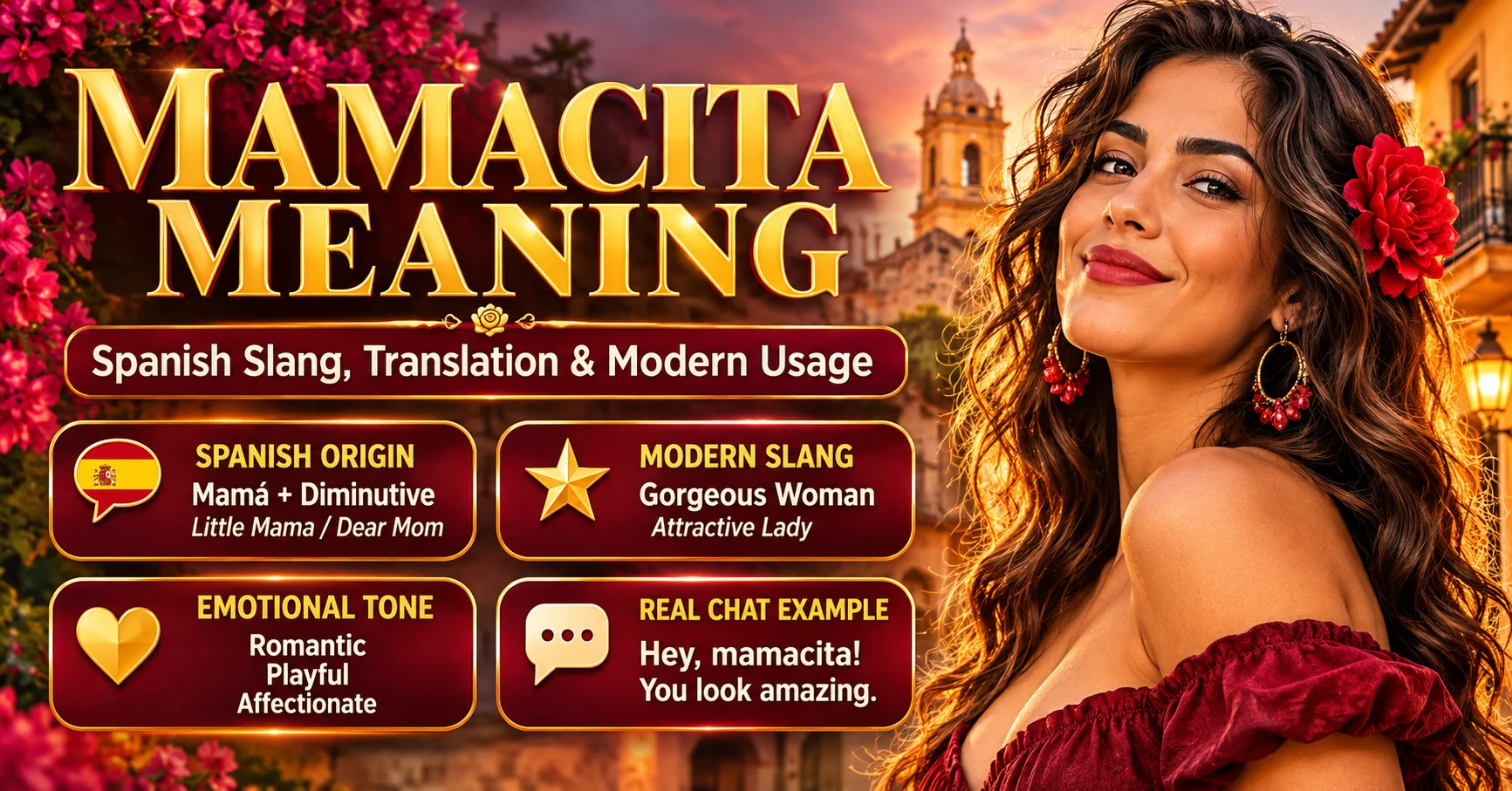
Mamacita meaning refers to an attractive woman, gorgeous lady, or affectionate nickname in Spanish. People also use it to address mothers or women they love. Depending on the speaker, relationship, and situation, the expression can sound romantic, playful, flattering, or overly familiar.
Mamacita meaning can change depending on who says it, where they use it, and the relationship between the people involved. In everyday American slang, it often describes a beautiful or attractive woman. However, its original Spanish roots connect the expression to motherhood and affection.
You might encounter this word in Instagram comments, TikTok videos, Snapchat messages, Latin music, and everyday conversations. Someone might call their girlfriend mamacita as a romantic nickname. Another person might use it as a playful compliment.
But does it always mean someone is beautiful? Not necessarily.
The expression carries several meanings across Spanish-speaking communities. Furthermore, its tone can change significantly between family conversations, romantic relationships, and interactions with strangers.
Understanding these differences helps you recognize its intended message. It also prevents awkward situations when using Spanish expressions in English conversations.
This guide explores its Spanish origins, modern slang meanings, social media usage, pronunciation, conversational examples, and appropriate responses.
Quick Answer Box
| Category | Explanation |
|---|---|
| Meaning | Gorgeous woman, attractive lady, or affectionate nickname |
| Context | Flirting, romance, family affection, and casual conversations |
| Primary Platforms | TikTok, Snapchat, Instagram, WhatsApp, and texting |
| Example | “Hey, mamacita! You look amazing tonight.” |
| Tone | Affectionate, playful, romantic, or potentially suggestive |
What Does Mamacita Meaning Mean?
The expression has Spanish origins and carries more than one interpretation.
In modern slang, people commonly use it to describe a physically attractive woman. It can also work as an affectionate way to address a mother, daughter, girlfriend, or female friend.
The intended meaning depends heavily on context.
For example:
- A boyfriend might call his girlfriend mamacita to express attraction.
- A parent might use it as a loving nickname for their daughter.
- A person might use it to compliment someone’s appearance.
- Two close female friends might use it playfully in certain Spanish-speaking communities.
In American English conversations, the expression often carries a flirtatious meaning. However, its Spanish usage has broader cultural and emotional dimensions.
The Literal Translation
The word comes from two Spanish language elements:
| Word Element | Meaning |
|---|---|
| Mamá | Mother or mom |
| Cita | Part of the diminutive ending |
| Mamacita | Little mama, dear mom, or an affectionate feminine expression |
Spanish uses diminutive endings to communicate affection, smallness, familiarity, or emotional warmth.
However, diminutives do not always describe physical size. They can also make a word sound sweeter or more affectionate.
Consequently, translating the expression word for word does not explain every situation in which Spanish speakers use it.
Spanish Origins and Linguistic Background
The expression develops from mamá with the feminine diminutive ending -cita.
Spanish commonly uses diminutives to add emotional meaning to everyday words.
For example:
- Casa becomes casita, meaning little house.
- Flor becomes florecita, meaning little flower.
- Mamá becomes mamacita, meaning little mama or an affectionate form of mom.
The Spanish spelling uses a C, not an S.
Therefore, mamacita is the standard spelling. Although some people write mamasita informally, the C reflects the word’s conventional Spanish formation.
The term also has different regional meanings. The Asociación de Academias de la Lengua Española documents its use for attractive women and affectionate forms of address in several Latin American countries. ASALE+1
How to Pronounce It Correctly
The usual Latin American pronunciation is:
Mah-mah-SEE-tah
The strongest emphasis falls on the third syllable.
Break it into four parts:
- Ma
- Ma
- Ci
- Ta
In most Latin American Spanish accents, the C sounds like an English S before the letter I.
Therefore, the pronunciation sounds like “mah-mah-see-tah.”
Spanish speakers in parts of Spain may pronounce the C differently, using a sound similar to the English TH in “think.”
What Does It Mean in American English?
In the United States, English speakers often borrow the expression from Spanish and Latin American popular culture.
It commonly means:
- Gorgeous woman
- Beautiful girl
- Hot babe
- Attractive lady
- Sweetheart
- Flirty nickname
However, these translations do not always communicate the same level of intimacy.
For example, calling a romantic partner gorgeous sounds like a compliment. Calling an unfamiliar woman mamacita can sound overly personal or suggestive.
The expression therefore carries more emotional weight than a simple description of someone’s appearance.
Contextual Dynamics & Nuances of the Term
Understanding the emotional tone matters just as much as understanding the dictionary definition.
The same expression can communicate affection in one conversation and unwanted attention in another.
Here are the most important contexts.
Romantic and Flirtatious Conversations
One of the most recognizable uses involves romantic attraction.
Someone might use the expression when talking to a girlfriend, wife, or woman they find attractive.
For example:
“Good morning, mamacita. I hope you have an amazing day.”
This sounds affectionate and romantic when two people already share that relationship.
Similarly, someone might comment:
“Looking beautiful, mamacita!”
This communicates attraction or admiration.
However, the relationship determines whether the compliment feels welcome.
Family Affection
The word can also appear in family conversations.
A Spanish-speaking parent might use it as an affectionate nickname for a daughter.
For example:
“Come here, mamacita. I have something for you.”
In this situation, the speaker expresses warmth rather than romantic attraction.
Consequently, interpreting every use as flirtation would be inaccurate.
Friendly Conversations Between Women
Some Spanish-speaking communities use the expression between female friends.
For example:
“Hola, mamacita! How was your weekend?”
This can communicate friendship, familiarity, and affection.
However, regional differences matter. Not everyone uses the expression this way, and some people may find it uncomfortable.
Compliments About Physical Appearance
Another common use involves describing an attractive woman.
For example:
“She looked like a mamacita at the party.”
Here, the speaker describes someone’s appearance rather than directly addressing that person.
The expression generally suggests physical attractiveness, although it can sometimes sound objectifying.
Playful Reactions and Surprise
Spanish speakers also use the phrase “¡Ay, mamacita!” as an emotional reaction.
Depending on the situation, it can express surprise, excitement, fear, or amazement.
For example:
“¡Ay, mamacita! That was a close call!”
The phrase works more like an expressive exclamation than a direct compliment.
This distinction is important because the speaker might not be describing anyone’s appearance at all. ASALE+1
Does It Always Sound Romantic?
No.
Its emotional meaning depends on several factors.
| Situation | Possible Meaning | Typical Tone |
|---|---|---|
| Boyfriend to girlfriend | Beautiful woman or sweetheart | Romantic |
| Parent to daughter | Dear child | Affectionate |
| Friend to friend | Honey or gorgeous | Playful |
| Stranger to woman | Attractive woman | Potentially inappropriate |
| Social media comment | Compliment or flirtation | Depends on context |
| Reaction to an accident | Surprise or fear | Expressive |
The safest approach is to consider the relationship and surrounding conversation before interpreting the expression.
Real-Life Conversation Examples Using Mamacita Meaning
Realistic conversations make slang easier to understand.
The following examples demonstrate how people might use the expression in different situations.
Example 1: Romantic Text Message
Situation: A boyfriend sends his girlfriend a sweet morning message.
Alex: Good morning, mamacita ❤️
Maria: Good morning, handsome!
Alex: Did you sleep well?
Maria: Yes! I was waiting for your message.
Meaning: Alex uses the expression as a romantic nickname. The heart emoji reinforces the affectionate tone.
Example 2: Compliment on Instagram
Situation: Someone comments on a friend’s vacation photograph.
Jessica: Finally enjoying my beach vacation! ☀️
Daniel: Looking gorgeous, mamacita!
Jessica: Haha, thank you!
Meaning: Daniel uses it as a playful compliment about Jessica’s appearance.
However, whether this comment feels appropriate depends on their relationship.
Example 3: Friendly Snapchat Conversation
Situation: Two close friends exchange pictures before going out.
Sofia: Girl, are you ready for tonight?
Isabella: Almost! Just choosing my outfit.
Sofia: Come on, mamacita. We’re going to be late!
Isabella: Two more minutes 😂
Meaning: The expression adds playful affection to a friendly conversation.
Example 4: A Family Conversation
Situation: A mother talks affectionately to her daughter.
Mom: Mamacita, did you finish your homework?
Daughter: Almost, Mom.
Mom: Good! Then we can watch a movie together.
Daughter: Yay!
Meaning: Here, it means something like “sweetheart” or “dear.”
There is no romantic intention.
Example 5: Flirting in a Casual Conversation
Situation: Two people who recently met exchange messages.
Chris: Hey, how was your weekend?
Laura: Pretty good! I went shopping with my friends.
Chris: Nice! You looked amazing in your pictures, mamacita.
Laura: Haha, thank you! That’s sweet.
Meaning: Chris uses the expression to communicate attraction and admiration.
Laura’s response suggests she receives the compliment positively.
However, people may react differently depending on their comfort level.
Platform-Specific Breakdown
Social media has helped Spanish expressions reach wider audiences.
American users frequently encounter them through music, short videos, comments, memes, and private messages.
Nevertheless, each platform creates slightly different communication patterns.
How It Is Used on Snapchat
Snapchat encourages informal communication through disappearing messages, pictures, videos, and private conversations.
People may use the expression when complimenting someone’s selfie or starting a playful conversation.
Common examples include:
- “Looking good, mamacita!”
- “Hey, mamacita ❤️”
- “Good night, beautiful.”
- “What’s up, mamacita?”
A person might also add heart, fire, or heart-eyes emojis.
| Snapchat Message | Possible Interpretation |
|---|---|
| Hey mamacita 😍 | Flirtatious greeting |
| Good morning mamacita ❤️ | Affectionate message |
| Looking amazing 🔥 | Compliment |
| What’s up, mamacita? | Casual or playful greeting |
Important: Snapchat does not assign a special technical meaning to this expression. Its interpretation comes from the sender’s language and relationship with the recipient.
The Role of Mamacita Meaning on TikTok
TikTok spreads slang through music, trends, comedy, dance videos, and creator interactions.
The expression frequently appears in content influenced by Latin music and popular culture.
Creators may use it in:
- Flirting and relationship skits.
- Funny conversations between couples.
- Beauty and fashion videos.
- Latin-inspired dance trends.
- Romantic captions and comments.
For example, someone might comment:
“That outfit is everything, mamacita!”
This communicates admiration for the creator’s appearance or style.
However, not every TikTok use has a serious romantic meaning.
Some creators use the expression humorously, exaggerate its pronunciation, or include it in entertaining conversations.
The surrounding video and tone help viewers understand the intended message.
Instagram and Texting Dynamics
Instagram comments and private messages provide another common setting.
Someone might use the expression when reacting to a photograph, story, or fashion post.
Examples include:
- “Beautiful as always, mamacita!”
- “You look stunning!”
- “Hola, mamacita ❤️”
- “That dress looks amazing on you.”
In private messages, the expression can sound more personal.
For example:
“Hey mamacita, how was your day?”
This could indicate romantic interest, friendly affection, or an established nickname.
The relationship between the sender and recipient provides the most useful clue.
WhatsApp and Everyday Messaging
WhatsApp conversations often resemble ordinary text messaging.
People use the expression in greetings, affectionate messages, and casual conversations.
For example:
“Don’t forget your jacket, mamacita. It’s cold outside.”
This sounds caring and affectionate.
Meanwhile:
“Hey mamacita, you looked incredible last night!”
This sounds more flirtatious.
Therefore, the words surrounding the expression often reveal its emotional purpose.
Alternative Meanings
Natural language processing systems examine how words connect through context, intent, tone, and related expressions.
This matters because one Spanish word can have several interpretations.
The following variations help explain its broader semantic relationships.
Common English Synonyms
| Alternative | Meaning | Typical Context |
|---|---|---|
| Gorgeous | Very beautiful | Compliments |
| Beautiful | Attractive or lovely | General conversation |
| Babe | Attractive or beloved person | Romantic slang |
| Sweetheart | Someone dear | Affection |
| Honey | Loving nickname | Relationships |
| Cutie | Cute or attractive person | Casual flirting |
| Hot mama | Attractive woman | Informal slang |
| Gorgeous girl | Beautiful woman | Compliments |
These alternatives share some meanings, but they are not exact translations.
For example, sweetheart generally expresses affection. By contrast, mamacita can emphasize physical attractiveness.
Mamacita vs. Mamita
Both expressions come from Spanish words connected to motherhood.
However, their everyday meanings can differ.
| Feature | Mamacita | Mamita |
|---|---|---|
| Origin | Mamá with a diminutive ending | Mamá with a diminutive ending |
| Literal sense | Little or dear mom | Little or dear mom |
| Slang usage | Often an attractive woman | Can mean an attractive woman |
| Family usage | Affectionate nickname | Affectionate nickname |
| Tone | Often playful or flirtatious | Often warm or affectionate |
Regional differences influence both expressions.
Consequently, neither word has one universal emotional meaning.
Mamacita vs. Mami
Mami is another popular Spanish expression.
It can mean mommy or mom in family conversations. However, people also use it as an affectionate or flirtatious nickname.
For example:
“Hey, mami! How are you?”
This might sound playful or romantic depending on the relationship.
The main difference is that mamacita contains a diminutive form of mamá, while mami is a shorter affectionate form.
Both expressions can appear in Latin music and informal conversations.
Mamacita vs. Señorita
These words have different meanings.
Señorita generally means “Miss” or “young lady.” It can function as a polite form of address.
Mamacita usually carries more personal, affectionate, or flirtatious associations.
For example:
“Excuse me, señorita. Can I help you?”
This sounds relatively polite.
“Hey, mamacita! You look beautiful.”
This sounds much more familiar and potentially flirtatious.
Related Spanish Expressions
Several other Spanish words appear in similar conversational situations.
| Spanish Expression | English Meaning | Common Use |
|---|---|---|
| Mi amor | My love | Romantic affection |
| Cariño | Darling or affection | Close relationships |
| Hermosa | Beautiful woman | Compliment |
| Bonita | Pretty | Compliment |
| Preciosa | Gorgeous or precious | Affection |
| Linda | Lovely or cute | Friendly compliment |
| Corazón | Sweetheart or heart | Affection |
| Mi vida | My life | Romantic affection |
These expressions provide useful alternatives when someone wants to communicate affection without emphasizing physical attractiveness.
Alternative Spellings and Search Variations
People sometimes search for or write the expression differently.
Common variations include:
- Mamasita
- Mamacita
- Mama cita
- Mamacitas
- Mamacita slang
- Mamacita Spanish meaning
- Mamacita translation
However, mamacita remains the standard spelling.
The plural form is mam acitas? No. The correct plural is mam acitas without a space: mamacitas.
The informal spelling mamasita appears because the C and S produce the same sound in many Spanish-speaking regions.
However, the standard written form uses C. Wikcionario, el diccionario libre+1
Misinterpretations
Understanding when not to use an expression is just as important as knowing its definition.
Although some people consider it a compliment, others may find it uncomfortable.
The difference often comes down to personal boundaries and cultural expectations.
Avoid Using It With Complete Strangers
Calling an unfamiliar woman mamacita can sound overly familiar.
For example:
“Hey, mamacita! Come over here.”
The speaker might intend to flirt. However, the recipient might interpret it as unwanted attention.
A respectful greeting works better when meeting someone for the first time.
Try:
“Hi, nice to meet you.”
This communicates friendliness without assuming familiarity.
Avoid Using It in Professional Conversations
Workplace communication requires appropriate language.
Calling a colleague mamacita can create an uncomfortable situation.
For example:
“Thanks for helping me, mamacita.”
Even if the speaker intends a friendly compliment, the expression may sound inappropriate in a professional setting.
Better alternatives include:
- Thanks for your help.
- I appreciate your support.
- You did a great job.
- Thank you so much.
Do Not Assume Every Spanish-Speaking Woman Likes It
Spanish-speaking communities have different cultural expectations.
Some people enjoy affectionate expressions. Others dislike terms that focus on physical appearance.
A 2019 linguistic study examining regional attitudes toward mamacita and mamita found differences across countries and individual responses. This reinforces the importance of cultural context rather than assuming universal acceptance. acta.bibl.u-szeged.hu
Avoid Using It Without Understanding the Relationship
A romantic nickname can sound sweet between partners.
However, the same expression might feel inappropriate between acquaintances.
Consider these examples:
| Situation | Better Choice |
|---|---|
| Speaking to your girlfriend | Mamacita, if she likes it |
| Greeting a new colleague | Hello or good morning |
| Talking to a stranger | Excuse me |
| Complimenting a friend | You look beautiful |
| Speaking to a customer | Thank you or ma’am, where appropriate |
Do Not Assume It Always Describes Physical Appearance
The family meaning remains important.
A mother might call her daughter mamacita without making any reference to beauty or attraction.
Similarly, friends might use it as a familiar nickname.
Always consider the complete sentence before interpreting its meaning.
How to Respond in Chat Comfortably
Your response should match the sender’s intention and your comfort level.
You do not need to respond romantically just because someone uses a flirtatious nickname.
Here are several natural responses.
If Someone Uses It as a Compliment
If you appreciate the compliment, respond positively.
Examples:
- “Thank you! That’s so sweet.”
- “Aww, thank you!”
- “You’re making me blush.”
- “That’s really kind of you.”
These responses acknowledge the compliment without making the conversation overly romantic.
If Your Romantic Partner Says It
You can respond with another affectionate nickname.
Examples:
- “Hey, handsome!”
- “Good morning, my love.”
- “You’re so sweet.”
- “Miss you already ❤️”
These replies maintain a romantic tone.
If a Friend Uses It Playfully
Keep your response relaxed.
Examples:
- “Haha, what’s up?”
- “Hey, girl!”
- “You always make me laugh.”
- “What’s happening?”
There is no need to make the conversation romantic.
If You Feel Uncomfortable
You can politely communicate your boundaries.
Try these responses:
- “I’d prefer you call me by my name.”
- “I’m not comfortable with that nickname.”
- “Please don’t call me that.”
- “Let’s keep things respectful.”
A respectful person should accept your preference.
If You Want to Flirt Back
If you enjoy the attention, you can respond playfully.
Examples:
- “Well, hello, handsome!”
- “Look who’s talking!”
- “You’re pretty charming yourself.”
- “Someone’s feeling romantic today!”
The best response depends on your relationship and the tone of the original message.
FAQs
1. What does mamacita mean in English?
Mamacita generally translates as “little mama” or “dear mom” in its literal Spanish form. In modern slang, it often describes a gorgeous or attractive woman. It can also serve as an affectionate nickname.
2. Is mamacita a compliment?
Yes, it can be a compliment when someone uses it to express admiration for a woman’s appearance. However, the expression can also sound overly familiar or suggestive, particularly when a stranger uses it without permission.
3. Does mamacita mean hot girl?
In informal slang, yes. People often use it to describe a physically attractive woman. However, its original Spanish meaning connects to motherhood and affectionate forms of address.
4. What does mamacita mean when a guy calls you that?
When a guy calls you mamacita, he may be expressing attraction, flirting, or giving you an affectionate nickname. If he already knows you romantically, it may communicate warmth. If he is a stranger, it could feel overly familiar.
5. Is mamacita romantic or friendly?
It can be both. Romantic partners may use it as a loving nickname. Some friends also use it casually. The speaker’s relationship with the recipient and their cultural background determine the intended tone.
6. Is mamacita a Spanish or Mexican word?
It is a Spanish word used in various Spanish-speaking communities, including Mexico and several Central and South American countries. Its precise meaning and social tone can vary by region.
7. What does mamacita mean on TikTok?
On TikTok, people commonly use it as a playful or flirtatious compliment. It can describe an attractive woman or appear in romantic videos, Latin music trends, fashion content, and comedy skits.
8. What is the difference between mami and mamacita?
Both expressions come from words associated with motherhood. Mami is a shorter affectionate form of mamá. Mamacita uses a diminutive construction and often carries a playful or flirtatious meaning in modern slang.
9. Is mamacita disrespectful?
Not automatically. It can sound affectionate between people who share a close relationship. However, using it toward an unfamiliar woman may seem disrespectful, objectifying, or intrusive. Personal boundaries always matter.
10. How do you spell and pronounce mamacita?
The standard spelling is mamacita. In most Latin American Spanish accents, people pronounce it “mah-mah-SEE-tah.” The stress falls on the third syllable.
Conclusion
Language constantly changes as people communicate across cultures, countries, and digital platforms.
Mamacita is an excellent example of how a traditional Spanish expression can develop broader meanings through everyday conversations and popular culture.
Its original connection to motherhood remains important. However, modern slang frequently uses it to describe a gorgeous woman or express romantic attraction.
People also use it as a playful nickname between friends and family members.
On TikTok, Instagram, Snapchat, and other platforms, the expression appears in comments, captions, messages, and entertaining videos.
Nevertheless, context determines its real meaning. A romantic partner might use it affectionately, while a stranger might unintentionally make someone uncomfortable.
The most important takeaway is simple: understand the relationship, recognize the tone, and respect personal boundaries.
When you consider these factors, you can understand the expression accurately without confusing its romantic, friendly, and traditional Spanish meanings.
Editorial accuracy note: The GSC related-search-query field was left as a placeholder, so this article incorporates relevant semantic variations rather than inventing search-query data.
