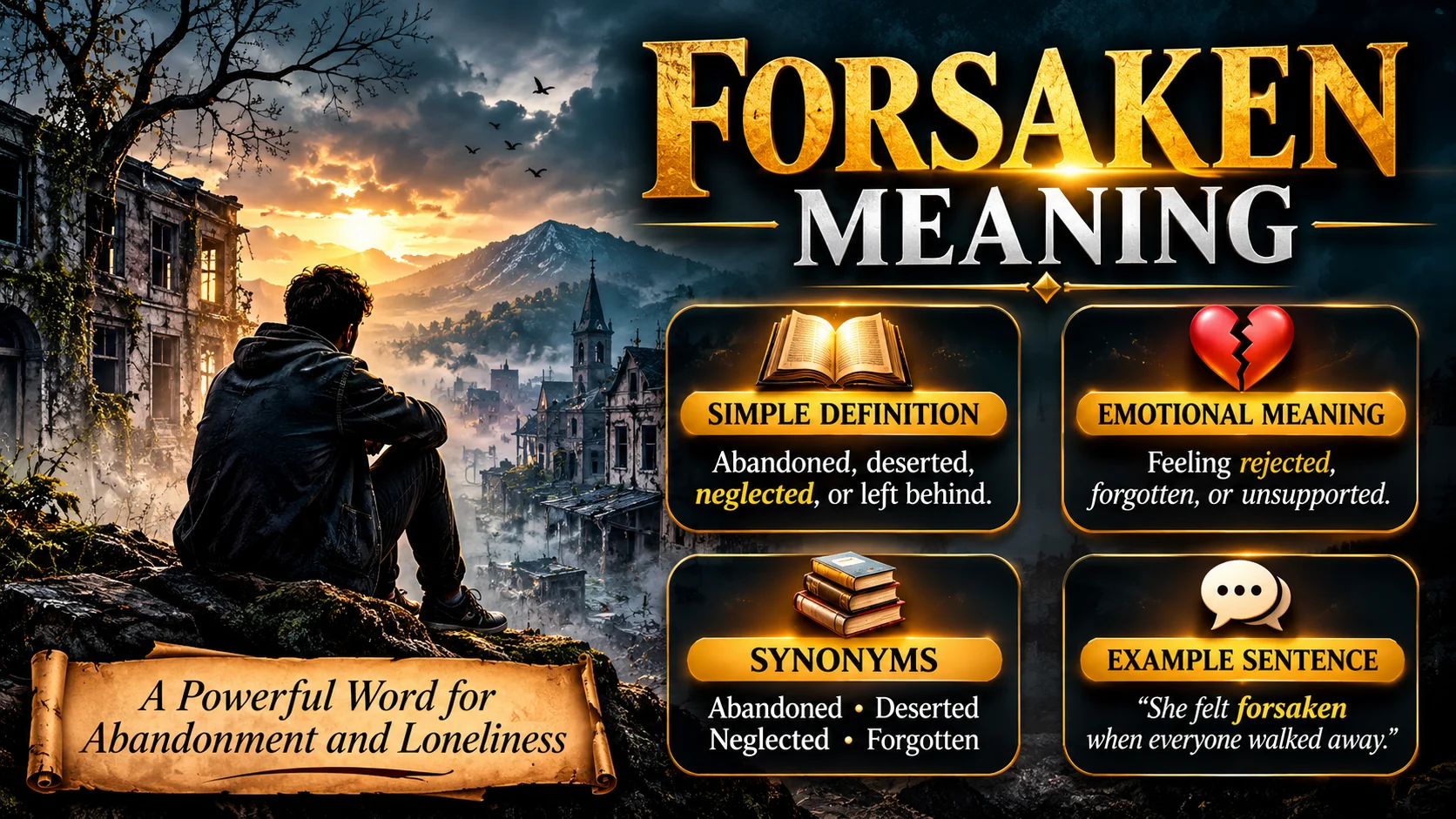
Forsaken means abandoned, deserted, or left behind by someone who once provided care, support, or protection. It often describes people, places, relationships, or situations that someone has neglected. The word carries a strong emotional tone of loneliness, rejection, or abandonment.
The forsaken meaning goes beyond simply being left alone. It describes the painful feeling of abandonment, neglect, or losing someone’s support when you need it most. People often use this word in literature, emotional conversations, religious discussions, movies, and everyday English.
For example, someone might describe an abandoned building as a forsaken place. Similarly, a person who feels forgotten by friends or family might say they feel forsaken.
However, the word does not always describe a person. It can also refer to forgotten responsibilities, neglected communities, abandoned dreams, or places that people no longer visit.
In modern American English, forsaken sounds more dramatic and emotional than ordinary words such as abandoned or forgotten. Consequently, writers often choose it to create a stronger emotional impression.
You might encounter this expression in novels, song discussions, movie dialogue, social media captions, and religious texts. Understanding its context helps you recognize whether someone describes physical abandonment, emotional pain, or a deeper spiritual experience.
Quick Answer: Definition and Usage
| Category | Explanation |
|---|---|
| Meaning | Abandoned, deserted, neglected, or left behind |
| Context | Emotional, literary, religious, and descriptive |
| Primary Platforms | Texting, Instagram, TikTok, Snapchat, and online discussions |
| Example | “She felt forsaken by everyone she trusted.” |
| Tone | Emotional, serious, dramatic, and sometimes spiritual |
| Part of Speech | Adjective and past participle |
| Pronunciation | for-SAY-kuhn |
| Synonyms | Abandoned, deserted, neglected, forgotten |
What Does Forsaken Mean? Definition and Origin
The word forsaken describes someone or something that another person has abandoned, neglected, or left without support.
It usually suggests more than physical separation. In many situations, it communicates emotional distance, loneliness, or the loss of protection.
The Simple Definition
Here are the most common interpretations:
- Abandoned: Someone has left a person or place behind.
- Neglected: Someone has stopped giving attention or care.
- Forgotten: Someone no longer remembers or considers another person.
- Deserted: A place or person has been left without company or support.
- Emotionally rejected: Someone feels unwanted or unsupported.
For example:
“After everyone moved away, the village became a forsaken place.”
This sentence describes a village that people have abandoned.
Similarly:
“He felt forsaken when his closest friends stopped contacting him.”
Here, the word communicates emotional abandonment rather than physical separation.
Word Origin and Etymology
Forsaken comes from the verb forsake, which has Old English roots.
The Old English verb forsacan carried the sense of rejecting, refusing, or renouncing something. Over time, its meaning developed to include abandoning someone or giving something up.
Today, forsaken functions as the past participle of forsake.
Consider these forms:
| Word Form | Example |
|---|---|
| Forsake | Never forsake your responsibilities. |
| Forsakes | He forsakes his old habits. |
| Forsook | She forsook her previous lifestyle. |
| Forsaken | They have forsaken their hometown. |
The word has maintained its connection to abandonment throughout its history. However, modern usage often emphasizes emotional or spiritual abandonment.
Is Forsaken an Adjective or a Verb?
It can function as both an adjective and a past participle.
As an adjective:
“The forsaken house stood at the end of the road.”
As a past participle:
“He has forsaken his former beliefs.”
The grammatical role depends on how the sentence uses the word.
How to Pronounce It
The standard American English pronunciation is:
For-SAY-kuhn
The stress falls on the second syllable.
You can remember it by breaking the word into three sounds:
- For
- Say
- Kuhn
This pronunciation makes it easier to recognize during conversations, audiobooks, movies, and podcasts.
Contextual Dynamics and Nuances of the Term
The meaning can change slightly depending on the situation. However, abandonment remains its central idea.
Understanding these differences helps readers interpret the emotional weight behind the expression.
Emotional Abandonment
This usage describes someone who feels unsupported, rejected, or forgotten.
For example:
“After her family stopped visiting, she felt completely forsaken.”
The sentence suggests emotional pain. It does not necessarily mean her family physically abandoned her.
People may use this expression when discussing:
- Broken friendships
- Family disagreements
- Relationship problems
- Social isolation
- Feelings of rejection
- Losing someone’s emotional support
However, the word sounds more intense than simply saying someone feels lonely.
Physical Abandonment
The expression can also describe buildings, towns, roads, and other locations.
For example:
“The old factory looked completely forsaken.”
This means the factory appeared deserted or neglected.
Other natural examples include:
- A forsaken village
- A forsaken house
- A forsaken road
- A forsaken battlefield
- A forsaken island
These descriptions often create an atmosphere of emptiness, mystery, or decay.
Spiritual and Religious Context
Religious writing frequently uses this word to discuss abandonment, suffering, faith, and separation from divine support.
For example, the phrase “Why have you forsaken me?” expresses a profound feeling of abandonment.
It appears in biblical passages associated with Psalm 22 and the crucifixion narratives in the New Testament.
However, the phrase carries religious significance beyond its ordinary dictionary definition. Its interpretation depends on the surrounding scripture and theological tradition.
In everyday conversations, someone might also use it to describe a period when they feel distant from their faith.
Literary and Cinematic Usage
Writers often choose this word because it creates a powerful emotional atmosphere.
For instance:
“She wandered through the forsaken streets, searching for a familiar face.”
The word helps readers imagine an empty environment and a character experiencing isolation.
Furthermore, filmmakers may use it in horror, survival, fantasy, and post-apocalyptic stories.
It can describe:
- Abandoned civilizations
- Forgotten kingdoms
- Empty hospitals
- Isolated characters
- Destroyed communities
- People who have lost everything
Consequently, the expression often appears in dramatic storytelling rather than casual everyday speech.
Real-Life Conversation Examples Using Forsaken
Although the word sounds formal, people can use it naturally in emotional conversations. It works particularly well when someone wants to express abandonment or describe a difficult experience.
Here are five realistic examples.
Example 1: Feeling Abandoned by Friends
Alex: Why haven’t you been hanging out with everyone lately?
Jordan: I stopped reaching out because nobody seemed interested.
Alex: That’s unfortunate. Did something happen?
Jordan: Not really. I just feel forsaken by the people I considered my closest friends.
Meaning: Jordan feels abandoned by friends who once provided companionship and support.
Example 2: A Difficult Relationship
Emma: You seem upset. Is everything okay?
Sophia: I don’t know anymore. He promised he would stay, but he left when things became difficult.
Emma: You deserve someone who supports you.
Sophia: I know. I’ve never felt so forsaken before.
Meaning: Sophia feels emotionally abandoned after her partner leaves.
Example 3: Describing an Abandoned Place
Mike: Have you ever visited that old town outside the city?
Chris: No. Is there anything interesting there?
Mike: Not anymore. Most people left years ago. The entire place looks forsaken.
Chris: That sounds like something from a horror movie!
Meaning: Mike describes a deserted town that people have abandoned.
Example 4: A Spiritual Conversation
Daniel: You’ve been quiet lately. Is something bothering you?
Ryan: I’ve been going through a difficult period. Sometimes I feel like God has forsaken me.
Daniel: I understand. Difficult experiences can make faith challenging.
Ryan: I’m trying to stay hopeful.
Meaning: Ryan describes a feeling of spiritual distance or abandonment. The statement expresses his personal emotions, not an established fact about divine action.
Example 5: Discussing a Movie
Lily: What did you think about the ending?
Mia: It was heartbreaking. The main character lost everything.
Lily: Exactly. He was completely alone.
Mia: That’s why the title fits. He seemed like a forsaken soul.
Meaning: Mia uses the word to describe a character who experiences extreme loneliness and abandonment.
Platform-Specific Breakdown
The word appears in online conversations, captions, comments, and entertainment discussions. However, it is important to distinguish ordinary vocabulary from actual internet slang.
There is no widely established Snapchat, TikTok, or Instagram slang definition that gives this word a special meaning. Its standard English meaning remains the same across platforms.
How It Is Used on Snapchat
Snapchat users often communicate through short messages, private conversations, stories, and captions.
Someone might use this expression to describe a personal experience or emotional situation.
For example:
- “Feeling forsaken tonight.”
- “Never leave someone feeling forsaken.”
- “This place looks completely forsaken.”
- “Sometimes silence makes you feel forsaken.”
These examples use standard English rather than platform-specific slang.
What does it communicate on Snapchat?
Depending on the conversation, it might express:
- Feeling ignored by friends.
- Experiencing relationship problems.
- Feeling emotionally disconnected.
- Describing an empty or abandoned location.
- Sharing a dramatic or reflective thought.
However, the surrounding conversation matters. A sad caption does not automatically mean someone wants sympathy or attention.
The Role of Forsaken on TikTok
TikTok features short videos about relationships, loneliness, storytelling, horror, spirituality, and personal experiences.
Consequently, the word can fit several types of content.
Common content contexts include:
| TikTok Content | Possible Usage |
|---|---|
| Relationship videos | Describing emotional abandonment |
| Horror edits | Showing deserted or frightening places |
| Sad storytelling | Expressing loneliness and rejection |
| Religious content | Discussing spiritual abandonment |
| Fantasy edits | Describing forgotten characters or kingdoms |
| Motivational videos | Discussing people who feel overlooked |
For example, a creator might write:
“POV: You return to the town everyone forsook.”
This caption uses forsook, the simple past form of forsake. It suggests that everyone abandoned the town.
Another creator might write:
“A forsaken world where nobody remembers the past.”
This creates a dramatic fictional atmosphere.
Importantly, these examples do not establish a separate TikTok definition. They demonstrate how creators use ordinary English vocabulary in different video contexts.
Instagram and Texting Dynamics
Instagram captions, comments, Stories, and direct messages offer different opportunities to use expressive vocabulary.
For example, someone might write:
“Even in the darkest moments, you are never truly forsaken.”
This sentence communicates hope and emotional reassurance.
Another person might post:
“Walking through a forsaken town feels like entering another world.”
Here, the word describes a deserted environment.
In private messages, it can communicate more personal feelings.
Example Instagram DM:
Person A: You haven’t talked to your friends recently?
Person B: No. I feel like everyone has forgotten me.
Person A: That’s difficult. Have you told them how you feel?
Person B: Not yet. I don’t want to sound dramatic.
The word works in this situation, but ordinary expressions such as “left out” or “forgotten” might sound more natural in casual American texting.
Alternative Meanings
Understanding related vocabulary helps you recognize subtle differences in meaning.
Although several English words describe abandonment, they do not always communicate the same emotional intensity.
Forsaken vs. Abandoned
Both words describe someone or something that another person has left behind.
However, abandoned works in more everyday situations. Forsaken often sounds more literary, emotional, or dramatic.
| Forsaken | Abandoned |
|---|---|
| More literary or expressive | More common in everyday English |
| Often suggests emotional isolation | Can describe physical or emotional separation |
| Sounds dramatic | Sounds neutral or serious |
| A forsaken soul | An abandoned building |
Example:
“She felt forsaken by everyone.”
“She felt abandoned by her friends.”
Both sentences communicate emotional abandonment. However, the first sounds more dramatic.
Forsaken vs. Forgotten
These words have different meanings.
Forgotten means someone or something has slipped from another person’s memory or attention.
Forsaken suggests abandonment, rejection, or the withdrawal of support.
For example:
“His birthday was forgotten.”
“His family forsook him during difficult times.”
The first sentence describes a failure to remember. The second suggests a deeper separation.
Forsaken vs. Deserted
Deserted usually describes places or situations without people.
For example:
- A deserted street.
- A deserted island.
- A deserted building.
The other word can describe places too, but it often carries a stronger emotional or literary tone.
Forsaken vs. Neglected
Neglect means failing to provide necessary attention, care, or maintenance.
For example:
“The neglected garden had become overgrown.”
“The forsaken garden looked completely lifeless.”
Both descriptions suggest a lack of care. However, the second creates a more dramatic impression.
Forsaken vs. Forlorn
Forlorn describes someone who feels lonely, unhappy, hopeless, or abandoned.
The two words overlap, but their focus differs.
- Forsaken: Emphasizes being abandoned or left behind.
- Forlorn: Emphasizes sadness, loneliness, or hopelessness.
Example:
“She looked forlorn after the argument.”
“She felt forsaken after everyone left.”
Common Synonyms and Antonyms
Here are useful alternatives for different writing situations.
| Synonyms | Antonyms |
|---|---|
| Abandoned | Supported |
| Deserted | Protected |
| Neglected | Cared for |
| Forgotten | Remembered |
| Rejected | Accepted |
| Left behind | Accompanied |
| Forsworn | Faithful |
One important distinction: forsworn is not a direct synonym in every context. It usually relates to breaking an oath or renouncing something.
Related Words and Expressions
These expressions help expand your vocabulary.
Godforsaken: A place or situation that seems extremely unpleasant, isolated, or neglected.
Example: “We ended up in a godforsaken little town.”
Forsake: To abandon someone or give something up.
Example: “He refused to forsake his family.”
Forsook: The simple past form of forsake.
Example: “She forsook her former lifestyle.”
Forsaking: The act of abandoning or giving something up.
Example: “He regretted forsaking his old friendships.”
Forsakenness: A noun describing the condition or feeling of being abandoned. It is uncommon and mainly appears in literary or specialized writing.
What Does Godforsaken Mean?
Godforsaken is a related expression that deserves special attention.
It usually describes an unpleasant, remote, neglected, or seemingly forgotten place.
For example:
“Why did you bring us to this godforsaken place?”
The speaker expresses frustration with an unpleasant location.
However, the word can carry religious implications depending on its context. It can also function as an informal expression of annoyance.
In American English, people sometimes use it humorously or dramatically.
Misinterpretations
Understanding when not to use a word matters just as much as understanding its definition.
Although this expression has several useful applications, it does not fit every situation.
Do Not Treat It as a Casual Synonym for Lonely
Loneliness and abandonment are related, but they are not identical.
Someone can feel lonely without experiencing abandonment.
For example:
“I feel lonely because my friends live far away.”
This sentence does not necessarily justify using the more dramatic expression.
However:
“I feel forsaken because my friends abandoned me when I needed them.”
Here, the stronger word makes sense.
Do Not Assume It Always Means Rejection
Sometimes a person leaves a place or gives something up for practical reasons.
For example:
“She forsook her career to pursue a different opportunity.”
This does not necessarily suggest rejection or emotional suffering.
It simply describes giving up one path for another.
Do Not Mistake It for Internet Slang
A common misunderstanding involves treating unusual English vocabulary as a new social media abbreviation.
Unlike expressions such as LOL, BRB, and IMO, this word is not a commonly recognized texting acronym.
Therefore, avoid interpreting it as a secret code or platform-specific phrase.
Avoid Using It in Every Casual Conversation
In everyday American English, simpler alternatives often sound more natural.
| Overly Dramatic | More Natural |
|---|---|
| I feel forsaken today. | I feel left out today. |
| My friends have forsaken me. | My friends have abandoned me. |
| This restaurant is forsaken. | This restaurant is deserted. |
| I feel completely forsaken. | I feel completely alone. |
The best choice depends on your intended tone.
Do Not Confuse Its Grammatical Forms
The forms forsake, forsook, and forsaken serve different grammatical purposes.
Incorrect: “She forsaken her family.”
Correct: “She forsook her family.”
Also correct: “She has forsaken her family.”
Learning these forms prevents common writing mistakes.
How to Respond in Chat Comfortably
If someone uses this word in a message, first understand the emotional or descriptive context.
They might be talking about a relationship, a difficult experience, a deserted place, or their religious beliefs.
Your response should match the situation rather than focus only on the vocabulary.
When Someone Says They Feel Forsaken
If someone writes:
“I feel forsaken by everyone.”
You can respond:
- “I’m sorry you’re feeling this way. I’m here for you.”
- “You don’t have to go through everything alone.”
- “What happened? Do you want to talk about it?”
- “I hope things get better for you.”
These responses show empathy without dismissing their feelings.
When Someone Uses It in a Relationship Context
Example message:
“I feel like you have forsaken me.”
Possible responses:
- “I’m sorry my actions made you feel that way.”
- “I didn’t mean to make you feel abandoned.”
- “Let’s talk about what happened.”
- “I still care about you, and I want to understand.”
However, choose an honest response. Do not make promises you cannot keep.
When Someone Uses It in a Religious Context
Example message:
“Sometimes I feel forsaken by God.”
Possible responses:
- “I’m sorry you’re going through such a difficult time.”
- “I hope you find comfort and peace.”
- “It’s okay to talk about difficult feelings.”
- “I’m here if you need someone to listen.”
Avoid making assumptions about someone’s beliefs or personal spiritual experience.
When Someone Describes an Abandoned Place
Example message:
“That old building looks completely forsaken.”
Natural responses include:
- “It really does look deserted.”
- “It has such an eerie atmosphere.”
- “I wouldn’t want to explore that place alone!”
- “It looks like something from a horror movie.”
When You Do Not Understand the Word
You can simply ask:
- “What do you mean by forsaken?”
- “Do you mean abandoned or forgotten?”
- “Are you talking about a place or a person?”
There is nothing wrong with asking for clarification. It is better than assuming someone means something they never intended.
FAQs
These frequently asked questions address common search intentions, vocabulary confusion, pronunciation, and practical usage.
1. What is the forsaken meaning in simple English?
It means abandoned, deserted, neglected, or left behind. It often describes someone who has lost another person’s support or a place that people no longer visit.
2. Does forsaken mean abandoned?
Yes. Abandoned is one of its closest synonyms. However, this expression can sound more emotional, literary, or dramatic than the everyday word abandoned.
3. Is forsaken a positive or negative word?
It generally carries a negative meaning because it suggests abandonment, neglect, loneliness, or rejection. However, it can appear in positive messages about overcoming difficult experiences, such as “You are never forsaken.”
4. What does forsaken mean in a relationship?
In relationships, it describes feeling abandoned, rejected, or emotionally unsupported by someone important. For example, “She felt forsaken when her partner stopped supporting her.”
5. What does forsaken mean in the Bible?
In biblical contexts, it generally refers to abandonment, being left, or experiencing separation. The exact interpretation depends on the passage and its religious context.
6. What is the difference between forsaken and forsook?
Both come from the verb forsake. However, forsook is its simple past form, while forsaken is its past participle.
For example:
- Past: “He forsook his old habits.”
- Present perfect: “He has forsaken his old habits.”
7. How do you pronounce forsaken?
The standard American pronunciation is /fərˈseɪ.kən/. It sounds like “for-SAY-kuhn.” The second syllable receives the main stress.
8. Is forsaken considered slang on social media?
No. It is a standard English word with literary and formal associations. People may use it in TikTok videos, Instagram captions, Snapchat messages, and online discussions, but it does not have a separate established slang definition.
9. What are the best synonyms for forsaken?
Common synonyms include abandoned, deserted, neglected, forgotten, rejected, and left behind. However, each word has slightly different nuances. Choose the one that best matches your sentence.
10. Can you use forsaken to describe a place?
Absolutely. You can describe an empty house, deserted village, abandoned factory, or isolated island as forsaken.
Example: “The explorers discovered a forsaken village surrounded by mountains.”
Conclusion
Understanding the forsaken meaning helps you recognize a powerful English expression associated with abandonment, neglect, and emotional separation.
Although people sometimes use it in modern digital conversations, it is not a newly created internet slang term. Instead, it is an established English word with historical roots and strong literary associations.
Its meaning depends on context. Someone might describe an abandoned building as forsaken, express emotional rejection in a relationship, or discuss spiritual struggles using the same word.
Furthermore, understanding its grammatical forms makes everyday communication easier.
Remember these important distinctions:
- Forsake: To abandon someone or give something up.
- Forsook: The simple past form of forsake.
- Forsaken: The past participle or an adjective describing abandonment.
- Godforsaken: An expression describing an unpleasant, isolated, or neglected place.
Ultimately, this vocabulary adds emotional depth to English communication. Whether you encounter it in a movie, book, religious passage, social media caption, or personal conversation, understanding its context helps you interpret its meaning accurately.
The simplest way to remember it: Forsaken means abandoned, left behind, or deprived of care and support.
