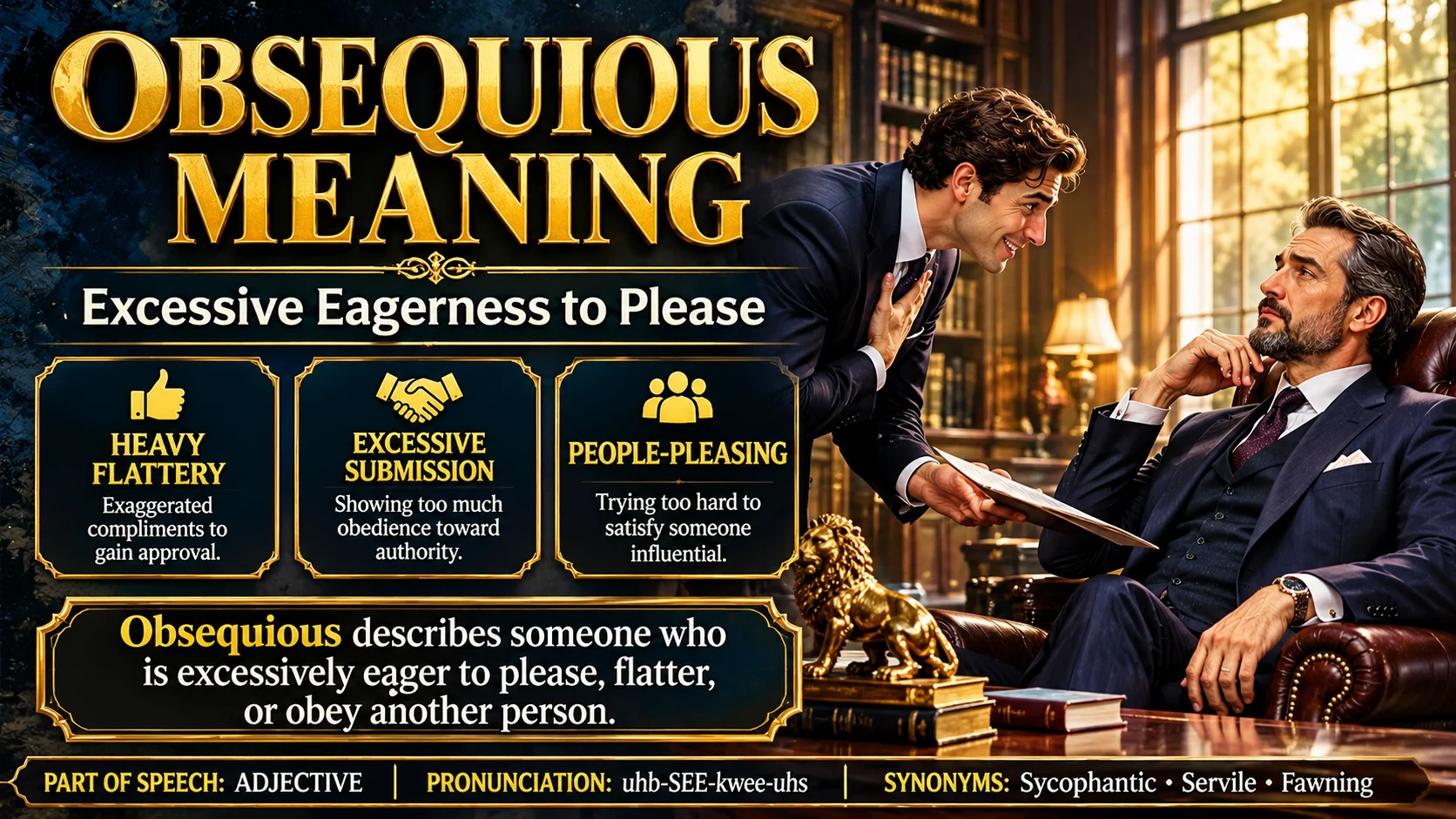
Obsequious means excessively eager to please, flatter, or obey someone, particularly a person with authority or influence. It describes behavior that goes beyond ordinary politeness and often involves exaggerated compliments, constant agreement, or unnecessary submission. The word generally carries a negative tone.
The obsequious meaning is closely connected to excessive flattery, unquestioning obedience, and an overwhelming desire to please someone. It describes a person who tries unusually hard to gain another person’s approval, especially when that person holds power or influence.
Imagine an employee who praises every decision their manager makes. Even when the manager makes an obvious mistake, the employee agrees and offers compliments. They may also volunteer for unnecessary tasks simply to remain in the manager’s good graces. Other employees might describe this behavior as obsequious.
However, being respectful does not make someone obsequious. Genuine respect allows people to express different opinions while maintaining good manners. The problem begins when someone sacrifices honesty or independence to gain approval.
This formal English adjective appears in literature, workplace discussions, political commentary, and conversations about human behavior. Understanding it can help you recognize excessive people-pleasing and describe it more accurately.
Obsequious Meaning, Definition, and Part of Speech
Obsequious is an adjective that describes someone who tries too hard to please another person. It often refers to excessive obedience, exaggerated respect, or insincere compliments.
Oxford classifies the word as formal and disapproving. Its definition focuses on trying too hard to please someone, particularly someone important. <Cite refs={[“turn876840search0”]}/>
Simple Definition
In everyday English, an obsequious person behaves as though gaining someone’s approval matters more than expressing an honest opinion.
For example:
“Mark became obsequious whenever the company director entered the room.”
This sentence suggests that Mark changes his behavior around an influential person. He may offer excessive compliments, agree with every statement, or show unnecessary submission.
Dictionary Definition
The word generally carries three connected ideas:
- Excessive eagerness to please someone.
- Unnecessary obedience toward a person in authority.
- Exaggerated flattery intended to gain approval or favor.
These ideas overlap, but they do not always appear together. Someone can behave obsequiously through constant agreement without offering direct compliments.
Key Information at a Glance
| Element | Details |
|---|---|
| Word | Obsequious |
| Part of speech | Adjective |
| Simple meaning | Excessively eager to please or obey |
| Pronunciation | /əbˈsiːkwiəs/ |
| Tone | Formal and generally disapproving |
| Common context | Workplace, relationships, politics, literature |
| Main synonyms | Servile, sycophantic, fawning, submissive |
| Related noun | Obsequiousness |
| Related adverb | Obsequiously |
Pronunciation: How to Say Obsequious
The American English pronunciation is:
/əbˈsiːkwiəs/
A simple way to remember it is:
uhb-SEE-kwee-uhs
Place the strongest emphasis on the second syllable, “SEE.” Cambridge lists the same basic pronunciation for American and British English. <Cite refs={[“turn876840search2”]}/>
Word Forms and Their Meanings
The adjective has two commonly used related forms.
| Word | Part of Speech | Meaning |
|---|---|---|
| Obsequious | Adjective | Excessively eager to please |
| Obsequiously | Adverb | In an excessively submissive manner |
| Obsequiousness | Noun | The quality of being excessively submissive |
Here are examples of each form:
Obsequious: His obsequious behavior irritated his coworkers.
Obsequiously: She smiled obsequiously at the wealthy guest.
Obsequiousness: His obsequiousness made ordinary conversations uncomfortable.
Notice how each form describes a different grammatical role while keeping the same central idea.
Origin and History of the Word
The word has Latin roots and originally carried a less negative meaning than it does today.
It comes from the Latin adjective obsequiosus, meaning compliant or obedient. That word developed from obsequium, which referred to compliance or dutiful service. The underlying verb obsequi means to follow or comply with someone’s wishes. <Cite refs={[“turn876840search1″,”turn876840search0”]}/>
How Its Meaning Changed Over Time
English adopted the word during the late 15th century. At first, it described someone who was dutiful, compliant, or ready to serve.
However, its meaning gradually developed a more critical tone. By the late 16th century, writers used it to describe excessive obedience, fawning behavior, and self-serving flattery. <Cite refs={[“turn876840search1”]}/>
Today, the negative sense dominates ordinary English usage.
For example, describing someone as obedient can be neutral or positive. Calling that person obsequious usually suggests that their behavior goes too far.
What Does Obsequious Behavior Look Like in Real Life?
The easiest way to understand this adjective is to examine everyday situations.
An obsequious person may not openly admit that they want someone’s approval. Nevertheless, their behavior can reveal an unusual eagerness to please.
In the Workplace
Imagine a new employee who wants to impress the company director.
The employee agrees with every suggestion, praises ordinary decisions, and constantly offers unnecessary assistance. Even when coworkers raise reasonable concerns, the employee supports the director without considering the facts.
This behavior may appear obsequious because the employee seems more interested in gaining favor than contributing honestly.
Among Friends
A person may constantly praise a popular friend because they want to remain part of that social circle.
They laugh at every joke, agree with every opinion, and avoid expressing disagreement.
However, genuine friendship does not require constant agreement. Friends should feel comfortable sharing different opinions.
In Politics
Political environments can also involve excessive flattery.
For example, an adviser might praise every decision made by a powerful political leader. They may avoid presenting criticism because they want to protect their position.
If their behavior involves exaggerated submission and flattery, observers might describe it as obsequious.
In Customer Service
Good customer service requires patience, courtesy, and attention.
However, there is a difference between helpful service and excessive submission.
A professional waiter can remain friendly without constantly flattering customers or treating them as superior individuals.
In fact, Oxford’s example of attentive service without an obsequious manner highlights this distinction. <Cite refs={[“turn876840search0”]}/>
Genuine Respect vs. Obsequious Behavior
One of the most important distinctions is the difference between respect and excessive submission.
Respect involves treating people appropriately while maintaining personal judgment. Obsequious behavior involves going too far to please someone.
| Situation | Genuine Respect | Obsequious Behavior |
|---|---|---|
| Compliments | Gives honest praise | Offers exaggerated compliments |
| Agreement | Agrees when convinced | Agrees with everything |
| Assistance | Helps when appropriate | Offers unnecessary favors |
| Communication | Speaks politely and honestly | Avoids disagreement |
| Authority | Respects professional roles | Treats powerful people as superior |
| Motivation | Values mutual respect | Seeks approval or personal favor |
Consider these two responses during a workplace meeting.
Genuine respect:
“Your proposal has some strong points. However, I think we should review the estimated costs.”
Obsequious behavior:
“Your proposal is absolutely perfect. I wouldn’t question anything you suggest.”
The first response shows professional respect and independent thinking. The second suggests excessive agreement.
Is Being Polite the Same as Being Obsequious?
No. Politeness and excessive submission are not interchangeable.
A polite person listens carefully, uses respectful language, and considers other people’s feelings. They can still disagree when necessary.
An obsequious person may avoid disagreement because they fear losing approval or upsetting someone influential.
For example, thanking your manager for helpful feedback is normal professional behavior. Praising every decision your manager makes, even when you disagree, may appear obsequious.
Is It Always an Insult?
The word generally expresses criticism, but context matters.
Writers sometimes use it to describe fictional characters, historical figures, or social behavior without directly insulting a real person.
It can also appear in humorous or sarcastic comments.
Nevertheless, calling someone obsequious during a serious conversation can sound harsh. It suggests that their behavior lacks independence or sincerity.
Real-Life Conversation Examples Using Obsequious
Examples make unfamiliar vocabulary easier to understand. The following conversations show how Americans might use the word in workplace discussions, friendships, and everyday situations.
Example 1: Talking About a Coworker
Alex: Why does Mark always agree with everything the manager says?
Sarah: He probably wants to impress him.
Alex: Even when the manager makes a bad decision?
Sarah: Exactly. His obsequious attitude is becoming obvious.
Explanation: Sarah describes Mark’s excessive agreement as an attempt to gain his manager’s approval.
Example 2: Discussing a Celebrity
Emma: Did you see how Daniel behaved around that actor?
Mia: Yes! He wouldn’t stop complimenting him.
Emma: It was almost uncomfortable to watch.
Mia: I thought the same thing. He seemed completely obsequious.
Explanation: Mia uses the word to describe exaggerated admiration toward a famous person.
Example 3: During a Business Meeting
Manager: What does everyone think about the new marketing strategy?
James: I like the direction, but I think the budget needs another review.
Robert: It’s absolutely perfect. I wouldn’t change anything.
James: You don’t have to agree with every suggestion just to impress the director.
Explanation: Robert’s unquestioning agreement makes his response appear excessively submissive.
Example 4: Discussing Social Media Behavior
Liam: Why does that influencer praise every single brand they mention?
Noah: Maybe they’re trying to attract more sponsorships.
Liam: Their compliments don’t even sound genuine.
Noah: That’s what makes the behavior seem obsequious.
Explanation: Noah connects exaggerated praise with a possible desire for personal benefits.
Example 5: Talking About a Relationship
Olivia: James never disagrees with his girlfriend.
Sophia: Maybe he just wants to avoid arguments.
Olivia: But he even changes his opinions whenever she speaks.
Sophia: That sounds like excessive people-pleasing. Depending on the situation, it could be obsequious.
Explanation: Sophia suggests that James may be sacrificing his personal opinions to gain approval.
Additional Example Sentences
Here are some shorter examples you can use to understand the word in different contexts.
- His obsequious compliments made the entire meeting uncomfortable.
- The assistant adopted an obsequious manner around the company president.
- She disliked his obsequious behavior toward wealthy customers.
- The politician surrounded himself with obsequious advisers.
- His obsequious attitude discouraged honest discussion.
- The waiter remained attentive without becoming obsequious.
- The director preferred confident employees over obsequious supporters.
- Her obsequious response sounded more flattering than sincere.
- He smiled obsequiously whenever the chairman entered the room.
- Nobody appreciated the employee’s constant and obsequious praise.
Obsequious Usage in Online Conversations and Social Media
Although obsequious is not traditional internet slang, people can use it to discuss behavior on social media.
The meaning does not change across platforms. However, the situations in which people use the word may differ.
Snapchat and Private Messages
Snapchat conversations usually involve casual language, short messages, and quick reactions.
Therefore, users might prefer simpler expressions such as “trying too hard to impress” rather than this formal adjective.
For example:
Friend 1: Why does Jake agree with everything his popular friends say?
Friend 2: He wants them to like him.
Friend 1: He’s trying way too hard.
Someone with a stronger vocabulary might describe Jake’s behavior as obsequious.
TikTok and Online Discussions
TikTok creators discuss personality, workplace relationships, celebrity culture, and social behavior.
The word can appear in educational videos or commentary about excessive admiration.
For example:
“There’s a difference between supporting someone and being obsequious.”
This statement highlights the difference between genuine support and exaggerated submission.
However, users should not confuse ordinary admiration with excessive flattery. Liking someone’s content or agreeing with a creator does not automatically qualify as obsequious behavior.
Instagram and Texting
Instagram encourages public compliments through comments, likes, and direct messages.
Most positive comments simply express appreciation. Nevertheless, repeated exaggerated praise can sometimes appear insincere.
For example:
Person A: Your photography is amazing!
Person B: Thank you!
Person A: Everything you create is perfect. You’re the greatest artist alive!
Person C: That’s becoming a little excessive.
A person might describe Person A’s behavior as obsequious if the praise seems motivated by a desire to gain favor.
Reddit and Online Communities
Online communities frequently discuss workplace politics, celebrity culture, and relationships with influential people.
The adjective can help describe someone who constantly praises a community leader or influential personality without considering their actions objectively.
For example:
“Some members seem more interested in pleasing the moderators than having an honest discussion.”
A writer could describe such behavior as obsequious if it involves excessive submission or flattery.
Important: Obsequious is a regular English adjective, not a Snapchat abbreviation, TikTok code, or Instagram-specific expression.
Synonyms and Antonyms of Obsequious
Learning related vocabulary helps you express similar ideas without repeating the same adjective.
However, not every synonym has exactly the same meaning. Some emphasize obedience, while others focus on flattery or the desire to gain approval.
Common Synonyms
| Synonym | Meaning | How It Differs |
|---|---|---|
| Sycophantic | Flattering influential people for personal gain | Emphasizes self-serving praise |
| Servile | Excessively submissive or obedient | Emphasizes obedience |
| Subservient | Acting as though someone else has greater authority | Emphasizes lower status |
| Fawning | Showing exaggerated admiration | Emphasizes excessive praise |
| Ingratiating | Trying to gain someone’s favor | Emphasizes winning approval |
| Groveling | Behaving in an extremely submissive way | Emphasizes humiliation |
| Bootlicking | Excessively flattering someone powerful | Informal and insulting |
| Unctuous | Excessively smooth or flattering | Suggests insincerity |
| Submissive | Willing to follow another person’s wishes | Does not necessarily imply flattery |
| Deferential | Showing respect toward another person | Can describe appropriate respect |
The Difference Between Obsequious and Sycophantic
These adjectives have closely related meanings. However, they emphasize different aspects of behavior.
An obsequious person shows excessive eagerness to please or obey someone.
A sycophantic person particularly uses flattery to gain advantages from someone influential.
Consider these examples:
“His obsequious response showed how eager he was to please the director.”
“The CEO surrounded himself with sycophantic advisers who praised every decision.”
The first sentence emphasizes excessive eagerness to please. The second focuses on self-serving flattery.
The Difference Between Obsequious and Servile
Servile describes someone who behaves in an excessively submissive or obedient manner.
Obsequious also involves submission, but it often highlights an unusual desire to please another person.
For example:
“His servile attitude made him appear unwilling to stand up for himself.”
“His obsequious compliments made the director uncomfortable.”
Both words criticize excessive submission, but their emphasis differs.
The Difference Between Obsequious and Deferential
This distinction is especially important because deferential does not always carry a negative meaning.
A deferential person shows respect toward someone because of their experience, position, or authority.
For example:
“She was deferential toward her professor because she respected his experience.”
However:
“She became obsequious whenever the professor entered the classroom.”
The first sentence describes appropriate respect. The second suggests exaggerated submission.
Antonyms: What Is the Opposite of Obsequious?
Antonyms describe the opposite behavior. They can help readers understand the difference between excessive submission and independent thinking.
| Antonym | Meaning |
|---|---|
| Assertive | Expressing opinions confidently |
| Independent | Thinking without unnecessary influence |
| Confident | Trusting your own abilities |
| Candid | Speaking openly and honestly |
| Frank | Communicating directly |
| Self-assured | Feeling secure in your judgment |
| Unpretentious | Avoiding exaggerated displays of importance |
| Unaffected | Remaining natural and genuine |
For example:
“Unlike his obsequious colleagues, David confidently questioned the proposal and explained his concerns.”
This sentence contrasts excessive agreement with independent thinking.
Common Misinterpretations and Usage Mistakes
Although the word has a fairly straightforward definition, people sometimes use it incorrectly.
Understanding what it does not mean is just as important as understanding its actual meaning.
Obsequious Does Not Simply Mean Polite
A polite person treats others with consideration. They listen, express appreciation, and communicate respectfully.
These behaviors do not suggest excessive submission.
For example, thanking a manager for useful advice is ordinary professional courtesy.
However, praising every decision your manager makes, regardless of its quality, may appear obsequious.
It Does Not Mean Every Person Who Agrees With You
Agreement alone does not demonstrate excessive submission.
Two colleagues might genuinely share the same opinion about a business decision.
The adjective becomes appropriate when someone repeatedly agrees to gain approval or avoid displeasing an influential person.
It Is Not a Synonym for Kindness
Kindness involves genuine concern for other people.
An individual can help coworkers, support friends, and show generosity without behaving submissively.
Therefore, describing every helpful person as obsequious would be inaccurate.
It Does Not Automatically Mean Dishonest
Obsequious behavior often appears insincere. However, the word does not prove that someone deliberately intends to deceive others.
A person may behave excessively politely because they feel anxious, insecure, or intimidated.
It is better to describe the observable behavior rather than assume someone’s private intentions.
It Is Not an Internet Abbreviation
Unlike expressions such as LOL, BRB, and IMO, obsequious is a standard English adjective.
It does not have a separate meaning on social media. Its definition remains consistent in everyday communication, literature, and professional writing.
Common Usage Mistakes
| Incorrect Understanding | Correct Explanation |
|---|---|
| Obsequious means friendly | It means excessively eager to please |
| Every polite person is obsequious | Ordinary courtesy does not qualify |
| It always means dishonest | It describes excessive submission or flattery |
| It is a noun | It is an adjective |
| It means intelligent | It has no connection to intelligence |
| It is internet slang | It is a formal English vocabulary word |
| It means respectful | It suggests more than ordinary respect |
How to Use Obsequious in Professional and Everyday English
The word can improve your writing when you need to describe excessive flattery or submission.
However, its formal and disapproving tone makes context important.
In Professional Writing
You can use the adjective in workplace reports, academic essays, business commentary, and discussions about leadership.
For example:
“The manager discouraged obsequious behavior and encouraged employees to share honest feedback.”
This sentence describes a workplace culture that values independent thinking.
Another example:
“The report criticized the board’s obsequious attitude toward senior executives.”
Here, the adjective expresses criticism of excessive submission.
In Everyday Conversation
The word is less common in casual speech than simpler expressions such as “sucking up” or “trying too hard to impress.”
Nevertheless, you can use it naturally when discussing someone’s behavior.
For example:
“Why are you being so obsequious around him? You can express your own opinion.”
This sentence sounds direct and slightly critical.
How to Respond When Someone Calls You Obsequious
If someone describes your behavior this way, consider what they mean before reacting.
They might be joking, offering criticism, or expressing genuine frustration.
Here are five possible responses.
Calm and professional:
“I appreciate your feedback. I’ll make sure my opinions come across more clearly.”
Friendly:
“Maybe I was trying a little too hard to be helpful!”
Confident:
“I respect other people’s opinions, but I still make my own decisions.”
Asking for clarification:
“What exactly made my behavior seem that way?”
Lighthearted:
“That’s a fancy way of saying I’m trying too hard to impress someone!”
How to Address Obsequious Behavior in Others
If someone constantly agrees with another person, avoid immediately attacking their character.
Instead, discuss the behavior.
You could say:
- “You don’t have to agree with everything they say.”
- “It’s okay to express a different opinion.”
- “Your compliments sound a little exaggerated.”
- “You can respect someone without constantly praising them.”
- “I think your honest opinion would be more helpful.”
These responses encourage better communication without turning the conversation into a personal argument.
Frequently Asked Questions
1. What does obsequious mean in simple English?
It means trying too hard to please someone, especially a person with authority or influence. It often involves excessive compliments, obedience, and agreement.
2. Is obsequious a positive or negative word?
It is generally negative. People use it to criticize behavior that appears excessively submissive, flattering, or insincere.
3. What is an example of an obsequious person?
An employee who constantly praises a manager, agrees with every decision, and offers unnecessary favors to gain approval may demonstrate this behavior.
4. What is the difference between obsequious and submissive?
Submissive describes someone who willingly follows another person’s wishes. Obsequious emphasizes excessive eagerness to please or obey, often through exaggerated attention or flattery.
5. Is obsequious the same as people-pleasing?
Not exactly. People-pleasing describes a broader tendency to seek approval or avoid disappointing others. Obsequious behavior specifically involves excessive submission, obedience, or flattery.
6. What is the opposite of obsequious?
Common opposites include assertive, independent, confident, candid, and self-assured. These words describe people who maintain their opinions and communicate honestly.
7. What does obsequious mean in a relationship?
It describes someone who excessively agrees with their partner, avoids expressing personal opinions, or constantly seeks approval.
However, not every accommodating partner behaves this way. Healthy relationships allow both people to express their opinions.
8. How do you pronounce obsequious?
The American English pronunciation is /əbˈsiːkwiəs/. A simple pronunciation guide is “uhb-SEE-kwee-uhs.” Place emphasis on the second syllable.
9. Is obsequious commonly used in everyday conversation?
It is relatively formal and less common than expressions such as “sucking up,” “people-pleasing,” or “trying too hard to impress.” However, it appears in literature, professional writing, and discussions about social behavior.
10. Can you use obsequious to describe someone’s compliments?
Yes. You can use it when compliments seem excessive, exaggerated, or intended to gain someone’s approval.
For example: “His obsequious compliments made the entire conversation uncomfortable.” excessive eagerness to please, flatter, or obey someone, particularly a person with authority.
Conclusion
Understanding the obsequious meaning helps you recognize a particular type of social behavior that goes beyond ordinary politeness.
The word describes someone who tries too hard to please another person, particularly someone with authority, influence, or social power.
It often involves exaggerated compliments, constant agreement, and unnecessary submission.
However, context matters. A respectful employee, supportive friend, or helpful customer service professional is not automatically obsequious. The term becomes appropriate when someone’s eagerness to please appears excessive.
Remember these three important points:
- Meaning: Excessively eager to please or obey someone.
- Tone: Formal and generally disapproving.
- Usage: Suitable for describing exaggerated flattery, submission, and approval-seeking behavior.
Ultimately, genuine respect does not require people to sacrifice their opinions or independence. Healthy communication allows people to appreciate others while remaining honest, confident, and respectful.
