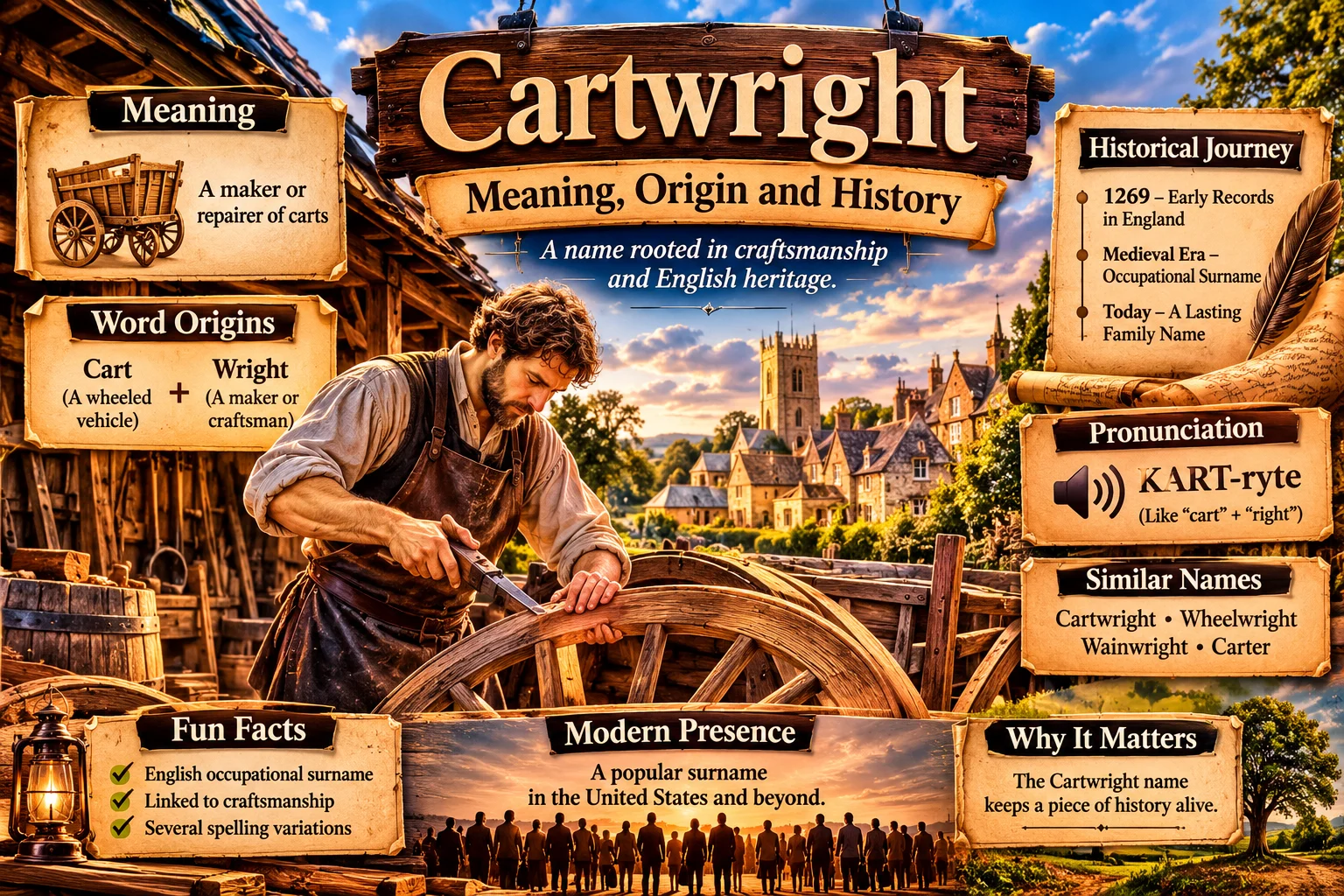
The Cartwright meaning comes from an old English occupational term for someone who made or repaired carts. Today, Cartwright is primarily an English surname with historical connections to craftsmanship, transportation, and traditional woodworking.
Many English surnames developed from the jobs people performed. For example, Smith referred to a metalworker, Baker described someone who made bread, and Taylor identified a person who made or repaired clothing. Similarly, Cartwright originally identified someone who built carts and wagons.
Although the occupation has become less common, the surname continues across generations. People in the United States often encounter it through family records, historical documents, and genealogy research.
Understanding this name involves more than knowing its basic definition. Its word roots reveal how English developed occupational surnames. Its historical records also provide clues about how people identified their professions centuries ago.
This guide explores the definition, pronunciation, English origins, historical occupation, surname variations, and family history associated with Cartwright.
Quick Answer: What Does Cartwright Mean?
| Detail | Answer |
|---|---|
| Meaning | A maker or repairer of carts |
| Origin | English |
| Name Type | Occupational surname |
| Language | Middle English |
| Word Elements | Cart + Wright |
| Pronunciation | KART-ryte |
| Historical Connection | Cart and wagon construction |
| Modern Usage | Primarily a family surname |
| Similar Names | Wainwright, Wheelwright, Wright |
What Does Cartwright Mean?
Cartwright refers to a person who traditionally made or repaired carts. The word combines two elements: cart, meaning a wheeled vehicle, and wright, meaning a maker or craftsperson.
Together, these elements describe someone who constructed carts for transportation and everyday work.
Before motor vehicles became common, carts played an essential role in daily life. Farmers used them to carry crops, merchants transported goods, and workers moved building materials.
Consequently, skilled cart makers provided an important service to their communities.
The Meaning Behind the Word
The word contains two distinct elements with historical roots in English.
Cart: This element refers to a wheeled vehicle used to carry people, products, or materials. English adopted the word from Old Norse kartr or a related Scandinavian source. It also has a connection with the Old English word cræt.
Wright: This element comes from Old English wyrhta, meaning a worker, maker, or craftsman. Historically, people used it to describe someone who constructed things.
The word wright survives in several English occupational terms, including Wheelwright, Shipwright, and Playwright.
Therefore, Cartwright literally describes a maker of carts.
Is Cartwright a Surname or an Occupation?
It can describe both, depending on the context.
Historically, a cartwright was a person whose profession involved building or repairing carts. Over time, the occupational term developed into a hereditary surname.
Today, most people encounter Cartwright as a family name rather than a job title.
For example:
- Surname: Sarah Cartwright works as a university professor.
- Historical occupation: The village cartwright repaired wooden wagons.
- Family history: The Cartwright family has English ancestral connections.
The surname does not mean that someone with this name must work in transportation or woodworking.
Cartwright Surname Origin and History
Cartwright has English occupational origins, particularly associated with the Midlands and northern England.
Historically, communities often identified people through their occupations. This practice helped distinguish individuals who shared common first names.
For example, a village might have several residents named John. Their professions, family connections, or places of residence helped people identify them.
A man who constructed carts could become known as John the Cartwright. Eventually, the occupational description developed into a permanent family surname.
Early Historical Records
The surname has a documented history extending back to medieval England.
The Anglo-Norman Dictionary records several historical forms of the name, including cartewrychgte, cartewryght, and cartwereste.
Its records include occupational references from 1269, 1274, 1275, and 1327. One later recorded form appears as Johannes le Cartwright in 1381.
These variations demonstrate how spelling changed before English surnames became standardized.
Historical writers and record keepers did not always use identical spellings. Consequently, the same family name could appear differently across documents.
Why Did Occupational Surnames Develop?
Occupational surnames became useful as populations grew and communities needed clearer ways to identify individuals.
People often received names connected to their professions.
Consider these examples:
| SurnameOriginal Occupational Meaning | |
|---|---|
| Smith | Metalworker |
| Baker | Bread maker |
| Taylor | Clothing maker or repairer |
| Miller | Person who operated a mill |
| Carpenter | Skilled woodworker |
| Cooper | Maker of wooden barrels |
| Cartwright | Maker or repairer of carts |
| Wheelwright | Maker or repairer of wheels |
These names preserved information about traditional professions.
However, an occupational surname does not prove that every descendant followed the same trade.
How the Profession Changed Over Time
Cartmaking became increasingly important as agriculture, trade, and transportation expanded.
A reliable cart helped farmers move crops and merchants transport products between villages and markets.
Cartwrights needed practical knowledge of materials, construction techniques, and mechanical components.
Later, industrial manufacturing changed how people produced transportation equipment. Factories began making standardized parts, while motor vehicles gradually replaced many traditional carts.
Despite these changes, the surname survived as a family identifier.
What Did a Traditional Cartwright Do?
A traditional cartwright specialized in constructing and maintaining carts.
The profession required practical woodworking skills, careful measurements, and an understanding of how different components supported one another.
A cart needed to carry heavy loads without breaking. Its wheels, frame, and connecting parts had to work together.
Building Wooden Carts
The cartwright selected suitable timber and shaped it into the required components.
These parts formed the main structure of the vehicle.
Depending on the design, the work could include:
- Preparing wooden frames.
- Constructing cart beds.
- Making and fitting wheels.
- Installing axles.
- Joining structural components.
- Repairing damaged wooden sections.
The quality of the construction affected the cart’s strength, stability, and usefulness.
Repairing Wheels and Frames
Carts experienced regular wear because people used them on rough roads and agricultural land.
Their wooden wheels could crack, joints could loosen, and supporting structures could become damaged.
A cartwright inspected these problems and repaired the affected components.
However, wheel construction could also involve a specialist called a wheelwright.
These two occupations often worked closely together.
Supporting Agriculture and Trade
Cartwrights contributed to local economies by helping people transport essential goods.
Farmers relied on carts to move harvested crops. Merchants needed them to carry products to markets. Builders used them to transport tools and construction materials.
Therefore, cartmaking supported several important industries before modern transportation became widespread.
How Do You Pronounce Cartwright?
The standard American English pronunciation is KART-ryte.
Its pronunciation contains two recognizable parts:
| Part | Pronunciation | Similar Sound |
|---|---|---|
| Cart | KART | Cart |
| Wright | RYTE | Right |
| Cartwright | KART-ryte | Cart + Right |
The surname has the IPA pronunciation /ˈkɑɹtˌɹaɪt/ in General American English.
British pronunciation can sound slightly different because of regional accent variations.
Is Wright Silent in Cartwright?
No. The word wright is pronounced like right.
The letters do not produce a silent ending. Instead, the complete surname sounds like two connected words.
This pronunciation also appears in related surnames such as Wainwright and Wheelwright.
Cartwright and Similar English Surnames
Several English surnames developed from traditional occupations involving construction, woodworking, and transportation.
Understanding their differences can help readers recognize the historical meaning of each name.
Cartwright vs. Wheelwright
Cartwright and Wheelwright describe related but different crafts.
A cartwright traditionally constructed or repaired carts. A wheelwright specialized in making and repairing wheels.
Their work sometimes overlapped because wooden carts depended on properly constructed wheels.
Cartwright vs. Wainwright
Wainwright traditionally referred to someone who made wagons or wains.
Both occupations involved building wooden transportation equipment. However, their traditional products differed.
The names share a similar occupational background without having exactly the same definition.
Cartwright vs. Carter
Carter and Cartwright both connect to traditional transportation.
However, a carter generally transported goods using a cart or wagon. A cartwright constructed or repaired the vehicle itself.
This distinction separates transportation work from vehicle craftsmanship.
Cartwright vs. Carpenter
A carpenter works with wood and constructs or repairs wooden structures.
A cartwright also works with wood but specializes in carts and related transportation equipment.
Their skills overlap, although their traditional areas of specialization differ.
Related Surnames at a Glance
| SurnameTraditional Meaning | |
|---|---|
| Cartwright | Cart maker |
| Wheelwright | Wheel maker |
| Wainwright | Wagon maker |
| Carter | Cart driver or transporter |
| Carpenter | Woodworker |
| Shipwright | Shipbuilder |
| Boatwright | Boat maker |
| Wright | Maker or craftsman |
Cartwright Name Variations and Alternative Origins
Historical spelling differences can make surname research challenging.
Before spelling conventions became consistent, clerks and record keepers sometimes wrote names according to local pronunciation.
Consequently, researchers may encounter different forms of the same surname.
Is Cartright Another Spelling of Cartwright?
Cartright appears as a variant spelling associated with Cartwright.
Both forms appear in surname references, making the alternative spelling useful when researching family records.
For example, a person might find an ancestor under Cartright in one document and Cartwright in another.
However, researchers should verify individual records rather than automatically treating every similar-looking name as belonging to the same family.
Is Courtright Related to Cartwright?
There is another interesting distinction.
Surname references identify Cartwright as a possible variant of Courtright, a surname of Dutch origin.
This does not mean that every Cartwright family has Dutch ancestry.
The English occupational surname has its own established history. Individual family connections require separate genealogical evidence.
Why Do Surname Spellings Change?
Several factors contributed to spelling differences in historical documents.
Regional pronunciation: People in different areas pronounced names differently.
Record keeping: Clerks sometimes wrote names according to how they heard them.
Migration: Families moving between countries could encounter different spelling conventions.
Standardization: Modern spelling became more consistent over time.
When searching historical records, checking alternative spellings can help uncover additional family information.
Cartwright Family History in the United States
Cartwright is an established surname in the United States, although its historical roots are English.
Families carried English surnames to North America through migration and settlement.
Over generations, descendants established family connections in different states and communities.
Today, people researching American Cartwright ancestry can explore historical documents to learn more about their relatives.
How to Research Your Cartwright Family
Start with information you already know about your family.
Names, birthplaces, approximate dates, and family relationships can help narrow your search.
Then explore reliable genealogical resources.
FamilySearch: Offers historical records, family trees, and genealogy research resources.
Ancestry: Provides searchable collections of census records, immigration documents, and birth, marriage, and death records.
National Archives: Offers access to selected historical government records and other archival resources.
Local historical societies: May hold regional documents, photographs, newspapers, and community records.
Which Historical Records Should You Check?
Different records can reveal different aspects of family history.
| Record Type | What It Can Reveal |
|---|---|
| Census records | Household members, locations, and occupations |
| Birth certificates | Birth dates and parental information |
| Marriage records | Spouses and family connections |
| Death certificates | Dates, locations, and family details |
| Immigration records | Migration routes and arrival information |
| Military records | Military service and related personal details |
| Wills and probate | Family relationships and inherited property |
| Church registers | Baptisms, marriages, and burials |
A surname’s origin provides a useful starting point, but historical documents offer stronger evidence about individual ancestors.
Famous People With the Cartwright Surname
The surname also appears in American and international public life.
Several individuals with this family name have worked in entertainment, sports, education, and other fields.
Here are a few examples:
Alexander Cartwright (1820–1892): An American baseball pioneer associated with the early development and codification of baseball rules.
Angela Cartwright: A British-born American actress known for her work in television and film.
Bill Cartwright: A former American professional basketball player who played in the NBA.
Veronica Cartwright: A British-American actress known for her performances in film and television.
These examples show how an occupational surname became part of modern personal and professional identities.
Having the surname does not necessarily indicate a direct family connection between these individuals.
Common Misconceptions About the Cartwright Surname
Some misunderstandings arise when people assume that a surname reveals more about an individual than it actually does.
Here are a few important distinctions.
Does Everyone With This Surname Have English Ancestry?
Not necessarily.
Cartwright has English occupational origins, but individual family histories can differ.
Migration, marriage, adoption, and changes in spelling can create different ancestral backgrounds.
Furthermore, the surname has a documented connection with the Dutch-origin Courtright surname as a possible variant.
Does the Surname Mean Someone Is a Cart Maker Today?
No.
The name preserves a historical occupational meaning. It does not describe the current profession of every person who carries it.
A modern Cartwright could work in education, medicine, technology, business, or any other field.
Does Cartwright Have a Special Personality Meaning?
There is no reliable evidence that the surname determines someone’s personality.
Its historical associations with craftsmanship and practical work may inspire symbolic interpretations.
However, these interpretations should not be confused with established linguistic or genealogical facts.
Is Cartwright a First Name?
It is primarily a surname.
Someone could choose Cartwright as a first name, but its established historical use is as a family name.
Frequently Asked Questions
1. What Does Cartwright Mean as a Last Name?
Cartwright is an English occupational surname that originally described someone who made or repaired carts. It combines the word cart with wright, meaning maker or craftsman.
2. Where Does the Cartwright Surname Come From?
The surname originated in England, particularly the Midlands and northern regions. Its linguistic roots come from Middle English occupational terminology.
3. What Is the Origin of the Word Wright?
Wright comes from Old English wyrhta, meaning worker, maker, or craftsman. It survives in compound words and surnames such as Cartwright, Wheelwright, and Shipwright.
4. How Do Americans Pronounce Cartwright?
Americans generally pronounce it KART-ryte. The first syllable sounds like the word cart, while the second sounds like right.
5. Is Cartwright a Rare Surname?
Cartwright is an established surname in several English-speaking countries. Its frequency differs by country and region. Genealogy databases contain substantial historical records for the name.
6. What Is the Difference Between a Cartwright and a Wheelwright?
A cartwright constructed or repaired carts, while a wheelwright specialized in making and repairing wheels. Both occupations supported traditional transportation.
7. Is Cartright a Variant of Cartwright?
Yes. Cartright appears as a recognized variant spelling. Researchers should search both forms when investigating historical family records.
8. Is Cartwright an Occupational Surname?
Yes. It belongs to the occupational surname category because it originally identified someone through their profession.
Other examples include Smith, Baker, Carpenter, and Wheelwright.
9. Does Cartwright Have a Dutch Origin?
The traditional Cartwright surname has English occupational roots. However, surname references also identify it as a possible variant of Courtright, which has Dutch origins. Individual family histories need separate verification.
10. What Surnames Are Similar to Cartwright?
Related occupational surnames include Wainwright, Wheelwright, Wright, Shipwright, Boatwright, and Carpenter. They share connections with traditional crafts, construction, or transportation.
Conclusion
The Cartwright surname preserves a connection to an important part of English working history.
Its original meaning describes someone who made or repaired carts. The name developed from Middle English occupational terminology and became a hereditary family surname over time.
Its history also reveals how traditional professions influenced English naming practices. Similar names, including Wheelwright, Wainwright, and Shipwright, preserve the language of earlier crafts.
Today, people encounter Cartwright primarily as a family name. Its historical meaning remains useful for anyone interested in English vocabulary, surname origins, or genealogy.
Whether you are researching your ancestors or simply exploring an unfamiliar last name, understanding its occupational roots provides a clearer picture of its history.
