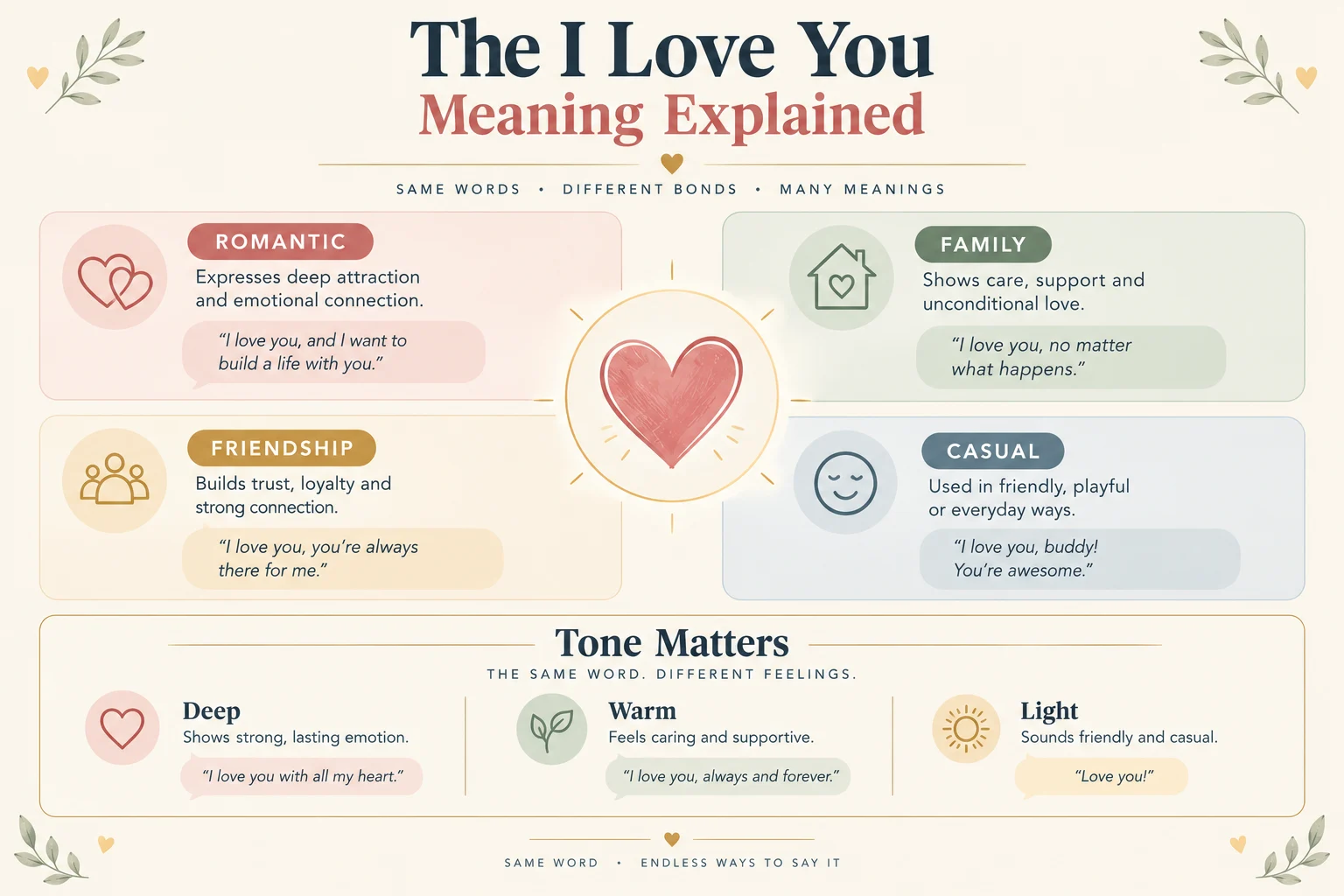
The i love you meaning describes deep affection, attachment, and commitment toward another person. Consequently, the phrase shifts across romance, family, and friendship. Furthermore, tone, timing, and relationship stage determine whether it signals devotion, comfort, or casual habit.
The i love you meaning carries more emotional weight than any other phrase in the English language. People search for this expression because three simple words never carry one simple message. Furthermore, context, timing, and relationship history all reshape what the phrase actually says. Consequently, the same sentence can signal lifelong devotion or casual habit. This guide breaks down every layer, from romantic confessions to family bonds to digital shorthand.
Quick Answer Box
| Meaning | Context | Primary Platforms | Example | Tone |
|---|---|---|---|---|
| Romantic devotion | Dating, marriage, commitment | Texting, Instagram | “I love you, always have” | Deep, Sincere |
| Family affection | Parents, siblings, relatives | WhatsApp, Calls | “Love you, Mom, goodnight” | Warm, Steady |
| Friendship loyalty | Close friends, long bonds | Snapchat, Texting | “Love you, bestie, thank you” | Playful, Bright |
| Casual sign off | Everyday habit, low stakes | Texting, DMs | “Love you, talk tomorrow” | Light, Routine |
What Does I Love You Meaning Mean?
The i love you meaning refers to a declaration of deep affection and emotional attachment. In romantic settings, the phrase signals commitment, exclusivity, and long term intention. Furthermore, psychology describes it as a bond rooted in trust, intimacy, and shared identity. Additionally, the phrase appears across languages and cultures with similar emotional weight. For example, parents say it to children as reassurance. Conversely, friends say it casually in modern American texting. Therefore, the i love you meaning depends entirely on who says it and when. It carries no universal definition, only a universal feeling.
Contextual Dynamics & Nuances of the Term
Context reshapes the i love you meaning in every conversation. For instance, a first confession raises anxiety because the speaker risks rejection. However, a decades long marriage uses the same words as quiet comfort. Furthermore, the timing matters enormously. Saying it after two dates feels rushed, while saying it after a crisis feels grounding. Additionally, tone of voice changes everything. A soft whisper signals intimacy, while a flat delivery signals habit. Moreover, the medium matters. A handwritten note carries more weight than a quick text. Consequently, listeners read intent through timing, tone, and history. Therefore, never separate the words from the moment they arrive.
Real-Life Conversation Examples Using I Love You Meaning
Scenario 1: The First Confession
Partner A: “I need to tell you something. I love you.”
Partner B: “I was hoping you would say that.”
Analysis: The speaker risks vulnerability. Consequently, the i love you meaning lands as a turning point in the relationship.
Scenario 2: The Parent’s Goodnight
Child: “I am scared of the dark.”
Parent: “I know. I love you, and I am right down the hall.”
Analysis: The phrase offers security. Furthermore, the i love you meaning reassures through presence rather than romance.
Scenario 3: The Casual Friend Text
Friend A: “Got the job! I am freaking out.”
Friend B: “Love you, you deserve this.”
Analysis: The phrase stays light and supportive. Additionally, the i love you meaning here signals celebration rather than deep attachment.
Scenario 4: The Troubled Marriage
Partner A: “Do you still love me?”
Partner B: “I love you. I just do not feel close to you right now.”
Analysis: The speaker separates feeling from action. Therefore, the i love you meaning shows affection and distance at once.
Scenario 5: The Long Distance Reassurance
Partner A: “Six months apart is brutal.”
Partner B: “I love you. Distance cannot touch that.”
Analysis: The pair uses the phrase as anchor. Consequently, the i love you meaning strengthens the bond across time and space.
Platform-Specific Breakdown
How It Is Used on Snapchat
Snapchat users share the i love you meaning through quick, casual signals. For example, someone might send a heart emoji with “love you” typed quickly. Furthermore, the disappearing format encourages spontaneous affection. Additionally, friends use it to react to funny moments or shared memes. Consequently, the phrase spreads through light daily exchanges. However, the platform’s casual tone keeps the meaning warm but low stakes.
The Role of I Love You Meaning on TikTok
TikTok has amplified the phrase through viral relationship content. For instance, creators post videos about the exact moment someone first says it. Furthermore, therapists explain the psychology of saying it too early. Additionally, comment sections fill with users sharing their own timeline. Consequently, the i love you meaning reaches millions through short form video. Moreover, the platform links the phrase to dating advice, breakup healing, and self love trends.
Instagram and Texting Dynamics
Instagram serves as a visual archive for the phrase. For example, users post anniversary tributes with captions built around those three words. Furthermore, couples share screenshots of sweet texts. Additionally, direct messages carry the most intimate daily uses. Consequently, the i love you meaning appears in morning texts and late night check ins. Moreover, Instagram Reels amplify the phrase through emotional storytelling.
Alternative Meanings
Natural Language Processing struggles with the i love you meaning because the phrase blends romance, family, friendship, and habit. For instance, an algorithm might tag it as positive sentiment. However, it misses the layers of anxiety, distance, or routine behind the words. Furthermore, different cultures attach different weight. For example, some cultures reserve the phrase for marriage, while others use it freely. Additionally, the phrase appears in song lyrics, film scripts, and advertising. Consequently, the same three words carry thousands of interpretations. Therefore, AI systems need emotional context to read it correctly.
Misinterpretations: When NOT to Use I Love You Meaning
The phrase carries risks when misapplied. For example, saying it too early can overwhelm a new partner. Furthermore, saying it out of habit can feel hollow to someone seeking sincerity. Additionally, manipulative people sometimes use it to lower defenses. Consequently, listeners should weigh action over words. Moreover, the phrase does not excuse poor behavior. Therefore, use it thoughtfully. Real love requires consistency, not just repetition.
How to Respond in Chat Comfortably
Responding to someone who shares the i love you meaning requires honesty and timing. If you feel the same, say it clearly without deflecting. For example, reply with “I love you too, and I have been wanting to say that.” However, if you feel unsure, avoid matching the words just to please. Furthermore, a gentle response like “That means a lot, and I care about you too” keeps honesty intact. Additionally, if a friend uses it casually, match the tone without overloading it. Consequently, you protect the relationship from confusion. Moreover, sincerity matters more than speed.
10 High-Intent FAQs About the Slang
What is the true i love you meaning?
It signals deep affection and attachment. Furthermore, the exact meaning depends on the relationship and context.
How do I know if someone means it romantically?
Look at timing, eye contact, and follow through actions. Furthermore, a romantic confession usually comes with vulnerability.
Is it too early to say it after one month?
Timing varies. However, experts suggest waiting until you feel secure. Consequently, pressure often backfires.
What does it mean in a friendship?
It signals loyalty and warmth. Furthermore, friends often use it casually in modern texting.
Can I love someone without being in love?
Yes. The phrase covers family, friendship, and deep care. Consequently, romantic love is one version among many.
What if my partner stops saying it?
Ask directly. Furthermore, silence can signal stress, distance, or routine drift. Communication matters more than guessing.
How do I respond if I am not ready to say it back?
Be gentle and honest. For example, say “I care about you, and I am still figuring out my feelings.”
Is saying I love you a big deal in American culture?
Yes. Most Americans treat the first romantic confession as a milestone. However, family and friendship uses stay casual.
What is the difference between love and in love?
Love describes deep care. Being in love describes romantic attraction. Consequently, the two overlap but are not identical.
What is the opposite of I love you?
Indifference or hatred stand as opposites. Additionally, silence in a close relationship often signals distance.
Conclusion:
The i love you meaning has traveled from whispered confessions to quick texts and viral videos. What began as a private declaration now appears in every corner of digital life. Furthermore, social media amplified the phrase through public tributes and casual shorthand. Consequently, people use it for romance, family, friendship, and habit. However, the core message remains simple.
These three words carry enormous emotional weight when spoken honestly. Therefore, whether you say it in person or send it in a text, sincerity matters most. Ultimately, the i love you meaning reminds us that love deserves words, actions, and clear intention.
