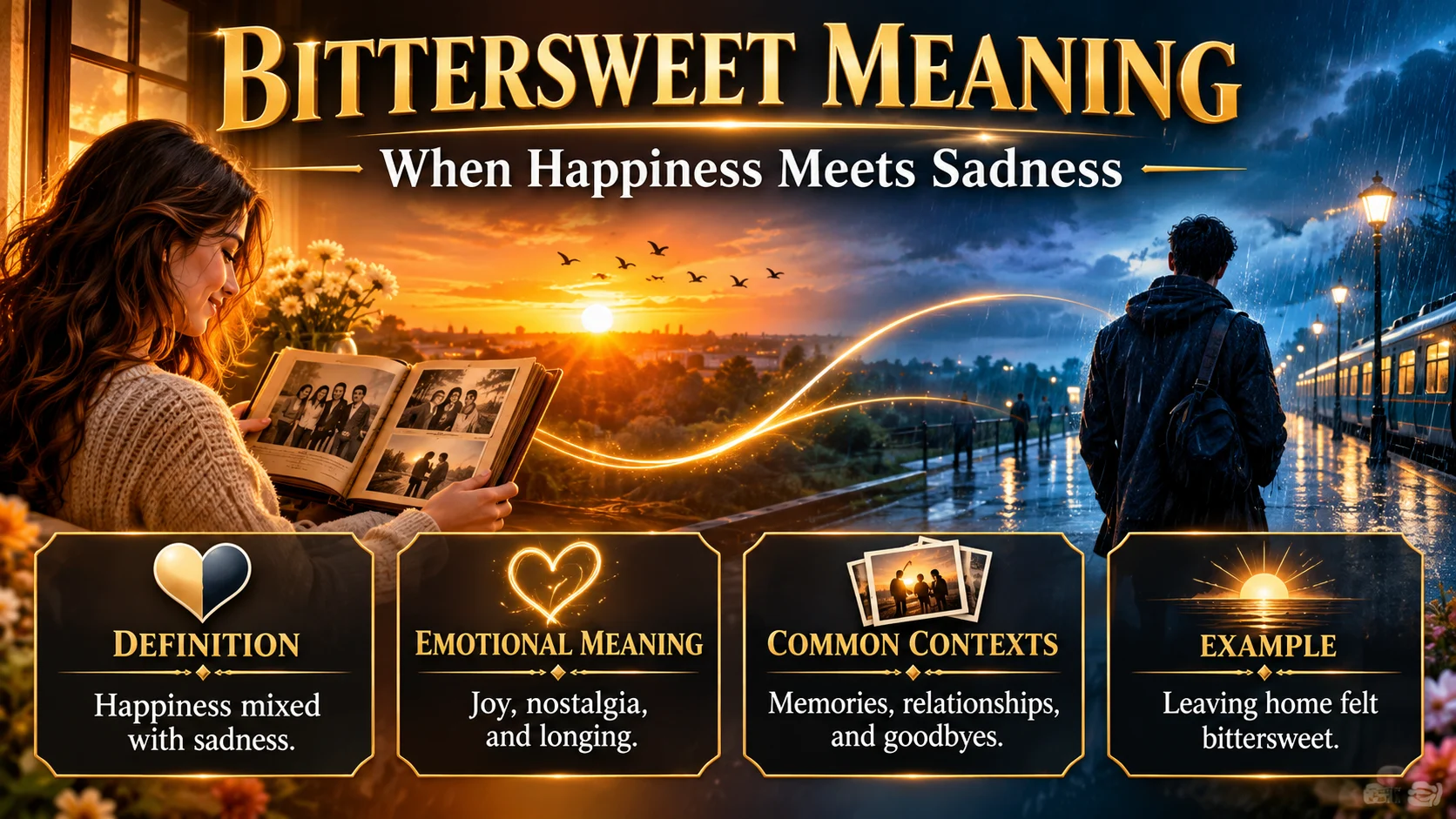
Bittersweet describes a feeling or experience that combines happiness with sadness. It often applies to meaningful memories, relationships, achievements, and goodbyes. For example, graduating from college feels bittersweet because you celebrate your success while missing the friends and experiences you’re leaving behind.
Bittersweet meaning describes the feeling of experiencing happiness and sadness at the same time. People use this word when something brings joy but also reminds them of a loss, change, or emotional goodbye.
Think about leaving your childhood home after spending years there. You’re excited about starting a new chapter, but you also miss the familiar rooms, family gatherings, and memories connected to that place. You feel happy about the future while feeling sad about the past.
That’s what makes the experience bittersweet.
The word appears in everyday conversations, relationship discussions, social media captions, text messages, books, and movies. It helps people describe emotions that aren’t entirely happy or sad.
You might use it when talking about graduation, moving abroad, ending a relationship, remembering childhood, or saying goodbye to someone you love.
This guide explains the definition, emotional significance, common uses, synonyms, and practical examples. You’ll also learn how to use the word naturally in conversations.
Quick Answer: Meaning, Context, and Examples
| Element | Explanation |
|---|---|
| Meaning | A combination of happiness and sadness |
| Part of Speech | Adjective |
| Common Contexts | Memories, relationships, achievements, and goodbyes |
| Social Media | Snapchat, TikTok, Instagram, and Facebook |
| Example | Leaving college feels bittersweet because I’ll miss my friends. |
| Emotional Tone | Nostalgic, emotional, reflective, and sometimes hopeful |
What Does Bittersweet Mean?
Bittersweet describes something that brings both pleasant and unpleasant feelings. It combines the emotional ideas of sweetness and bitterness to express a complicated experience.
The sweet side represents happiness, love, success, or beautiful memories. The bitter side represents sadness, disappointment, separation, or longing.
When these feelings exist together, people describe the experience as bittersweet.
The Dictionary Definition
According to its standard English usage, bittersweet is an adjective describing something that is pleasant but also involves sadness or pain.
Here are a few examples:
- Her wedding day was bittersweet because her father couldn’t attend.
- Moving to another country was a bittersweet experience.
- He has bittersweet memories of his childhood.
- Their final conversation was beautiful but bittersweet.
Notice that none of these examples describes an entirely negative experience. Each situation includes something meaningful or positive alongside an emotional difficulty.
Where Does the Word Bittersweet Come From?
The word combines two familiar English terms: bitter and sweet.
Both words originally describe different tastes. Something sweet usually tastes pleasant, while something bitter has a sharp or less pleasant flavor.
English speakers eventually began using this combination figuratively to describe experiences with contrasting emotional qualities.
The idea is easy to understand. A wonderful memory can make you smile, but remembering that those days have passed may also make you sad.
The combination of these feelings gives the word its distinctive meaning.
Is Bittersweet a Positive or Negative Word?
Bittersweet is neither completely positive nor completely negative. It describes a mixture of emotions, and the situation determines which feeling is stronger.
| Situation | Positive Feeling | Negative Feeling |
|---|---|---|
| Graduation | Pride and excitement | Leaving friends |
| Moving abroad | New opportunities | Missing home |
| Retirement | Freedom and relaxation | Leaving colleagues |
| Childhood memories | Happiness | Missing the past |
| Relationship ending | Personal growth | Losing someone |
| Family wedding | Celebration | Missing loved ones |
For example, a person might feel genuinely happy about getting married while wishing a deceased family member could attend.
The occasion remains joyful, but the absence creates sadness.
Contextual Dynamics and Emotional Nuances
The meaning of bittersweet becomes clearer when you examine the situation in which someone uses it.
People often choose this word when ordinary expressions such as happy, sad, or excited don’t fully explain their feelings.
Bittersweet Feelings in Relationships
Relationships create many situations involving mixed emotions.
Two people might care deeply about each other but realize that continuing their relationship isn’t the right decision. Ending things can bring relief, yet their shared memories may still matter.
For example:
“Our breakup was bittersweet. We knew it was the right decision, but saying goodbye wasn’t easy.”
This sentence communicates emotional acceptance without suggesting that the relationship was entirely negative.
People also use the word when:
- An old friend moves to another country.
- A former partner gets married.
- Two friends meet after several years.
- A long-distance relationship comes to an end.
- Someone remembers a meaningful first date.
- A family member moves away.
In these situations, the word acknowledges that good memories and difficult emotions can exist together.
Bittersweet Memories and Nostalgia
Memories are among the most common reasons people experience bittersweet emotions.
An old photograph, familiar song, childhood toy, or favorite location can bring back moments from the past.
You might smile while remembering those experiences. However, you may also miss the people and circumstances that made them special.
For example:
“Looking through our old family pictures brings back bittersweet memories.”
The sentence communicates affection for the past alongside sadness about how much life has changed.
School reunions, childhood friendships, family traditions, and old vacation photographs can all create similar feelings.
Life Changes and New Beginnings
Major life transitions often involve excitement and sadness.
Imagine receiving your dream job in another state. You’re happy about the opportunity, but leaving your family and friends makes the decision difficult.
Other examples include:
- Graduating after years of studying.
- Leaving a job after building strong friendships.
- Selling a family home.
- Watching your children become independent.
- Moving to a new city.
- Retiring after a long career.
These experiences involve more than one emotion. You appreciate what you’ve achieved while recognizing what you’re leaving behind.
Bittersweet Endings
An ending doesn’t always mean something has gone wrong.
Sometimes, people must leave familiar situations to create better opportunities for themselves.
Graduating from high school, for instance, closes an important chapter. At the same time, it opens the door to university, employment, and independence.
A television series can also have a bittersweet ending. Viewers may appreciate the conclusion while feeling sad that they won’t see their favorite characters again.
This explains why the word works so well when discussing meaningful endings.
Real-Life Conversation Examples Using Bittersweet
The easiest way to understand a word is to see how people use it in everyday conversations.
These examples show natural American English dialogue across different situations.
Example 1: Leaving College
Alex: Are you excited about graduating next week?
Sarah: Definitely! I’m proud of myself, but it feels bittersweet.
Alex: Why? You’ve worked so hard for this.
Sarah: I know. I’ll miss everyone and all the memories we made here.
Meaning: Sarah feels proud of her achievement but sad about leaving her friends and college life.
Example 2: Ending a Relationship
Jake: How are you feeling after the breakup?
Emily: Honestly, it’s bittersweet.
Jake: Do you regret ending things?
Emily: No. I think we made the right decision, but I still care about him.
Meaning: Emily accepts the breakup but still values the relationship and its memories.
Example 3: Moving to Another Country
Mike: When are you moving to California?
David: Next month! I’m really looking forward to it.
Mike: That’s exciting. Are you going to miss New York?
David: Of course. It’s bittersweet because I’ve spent my entire life here.
Meaning: David feels excited about his new opportunity but sad about leaving his hometown.
Example 4: Remembering Childhood
Emma: I found our old school pictures yesterday.
Olivia: Really? Those were such good times!
Emma: I know. Looking at them feels bittersweet.
Olivia: Same here. I wish we could experience those days again.
Meaning: Both friends enjoy remembering their childhood but miss the time they shared.
Example 5: A Family Celebration
Daniel: How was your sister’s wedding?
Chris: Beautiful! Everyone was so happy.
Daniel: Then why do you look emotional?
Chris: It was bittersweet. Our grandmother wasn’t there to celebrate with us.
Meaning: Chris enjoyed the wedding but felt sad because an important family member was missing.
More Everyday Sentence Examples
Here are additional examples that show how to use the word naturally:
- Watching my youngest daughter leave for college was bittersweet.
- The final episode was bittersweet because I loved the characters.
- Winning the championship felt bittersweet after our teammate got injured.
- I have bittersweet memories of my first apartment.
- Today marks the end of an amazing chapter.
- Her retirement party was a bittersweet celebration.
- We shared a bittersweet goodbye at the airport.
- Hearing that old song brings back bittersweet memories.
- I’m happy about the new job, but leaving my coworkers feels bittersweet.
- Their reunion was bittersweet because so many years had passed.
How People Use Bittersweet on Social Media
Bittersweet isn’t exclusive to internet culture. It’s a standard English adjective that people also use frequently in digital conversations.
On social media, users often choose it for short captions, personal updates, nostalgic photographs, and emotional videos.
The meaning stays consistent across platforms, although the context may change.
How It Is Used on Snapchat
Snapchat users often share personal memories, temporary stories, and messages with close friends.
The word fits naturally into these conversations, especially when someone wants to describe an emotional moment without writing a long explanation.
Common examples include:
- “This memory is so bittersweet.”
- “Bittersweet goodbye!”
- “Last day together. Feeling emotional.”
- “Can’t believe summer is over.”
- “So many bittersweet memories with these people.”
Imagine receiving an old photograph from a friend with the caption:
“Two years ago today. Bittersweet memories.”
The sender probably feels happy about remembering that experience but misses the people or circumstances associated with it.
Importantly, this expression doesn’t automatically suggest romantic interest. It can describe friendships, family relationships, and personal experiences.
The Meaning of Bittersweet on TikTok
TikTok creators often use emotional storytelling, nostalgic videos, and personal experiences to connect with viewers.
The word works particularly well in videos about growing up, graduation, relationships, and personal transformation.
For example, someone might create a video showing their first day at school followed by their graduation ceremony.
The caption could read:
“Growing up is bittersweet.”
This communicates pride in personal growth while expressing sadness about leaving childhood behind.
Other common TikTok themes include:
Childhood nostalgia: Old toys, family photographs, school memories, and childhood locations.
Relationship endings: Former partners, emotional goodbyes, and lessons learned from past relationships.
Graduation: Celebrating achievements while remembering friendships and unforgettable experiences.
Family memories: Reflecting on childhood homes, family traditions, and loved ones.
Personal growth: Looking back at difficult experiences while appreciating how far you’ve come.
Instagram and Texting Examples
Instagram users include the word in captions, Stories, Reels, comments, and personal messages.
For example:
- “A bittersweet end to an unforgettable summer.”
- “Some memories will always stay with me.”
- “Growing up is beautiful and bittersweet.”
- “One last picture before we all go our separate ways.”
- “A bittersweet reminder of how far we’ve come.”
In text messages, the word can communicate mixed emotions without requiring a lengthy explanation.
| Text MessageIntended Meaning | |
|---|---|
| It’s bittersweet, honestly. | I’m experiencing mixed emotions. |
| That song brings back bittersweet memories. | I remember the past with affection and sadness. |
| I’m happy for you, but this feels bittersweet. | I’m pleased for you, although the situation makes me emotional. |
| A bittersweet chapter has ended. | Something meaningful has come to an end. |
| I’ll miss these days. So bittersweet. | I appreciate these memories but feel sad they’re over. |
Alternative Meanings, Synonyms, and Related Expressions
Several English words describe emotions similar to those associated with bittersweet.
However, each alternative has a slightly different meaning. Choosing the right word helps communicate your feelings more accurately.
Common Synonyms
| Synonym | Meaning | Best Used For |
|---|---|---|
| Nostalgic | Feeling affection or longing for the past | Childhood memories |
| Melancholic | Experiencing thoughtful sadness | Quiet emotional moments |
| Poignant | Emotionally touching or moving | Powerful memories |
| Wistful | Feeling longing for something unavailable | Lost opportunities |
| Sentimental | Showing strong personal emotions | Family memories |
| Heartwarming | Creating affection and happiness | Positive experiences |
| Heartbreaking | Causing deep emotional pain | Loss and separation |
| Ambivalent | Having conflicting feelings or attitudes | Difficult decisions |
| Reflective | Thinking deeply about experiences | Personal growth |
Not every synonym is interchangeable. For example, heartwarming usually emphasizes positive emotions, while heartbreaking focuses on sadness.
Bittersweet vs. Nostalgic
These two words often appear in similar situations, but they aren’t identical.
Nostalgic describes affection or longing for the past. Bittersweet describes a combination of pleasant and unpleasant feelings.
Nostalgic: “This old song makes me nostalgic for high school.”
Bittersweet: “Remembering high school feels bittersweet because those were wonderful years, but everyone has moved on.”
The second example communicates both happiness and sadness.
Bittersweet vs. Melancholy
Melancholy generally describes a quiet, thoughtful sadness.
Bittersweet includes both positive and negative emotions.
Melancholy: “The rainy weather makes me feel melancholy.”
Bittersweet: “Graduating feels bittersweet because I’m excited about my future but sad about leaving my friends.”
The distinction is important because the second sentence expresses two contrasting feelings.
Bittersweet vs. Poignant
Poignant describes something that creates a strong emotional response.
For example:
“Her final letter was poignant.”
This means the letter was deeply touching or emotionally moving.
However:
“Her final letter was bittersweet.”
This suggests the letter brought both pleasant and painful emotions.
Common Expressions and Variations
People frequently use the adjective in different phrases.
| Expression | Meaning |
|---|---|
| Bittersweet feeling | Happiness mixed with sadness |
| Bittersweet memories | Pleasant memories accompanied by sadness |
| Bittersweet ending | A conclusion with positive and negative emotions |
| Bittersweet goodbye | An emotional farewell |
| Bittersweet experience | An experience involving joy and pain |
| Bittersweet moment | A meaningful moment with mixed emotions |
| Bittersweet nostalgia | Fond memories accompanied by longing |
| Bittersweet happiness | Happiness accompanied by sadness |
Is Bittersweet the Same as Happy-Sad?
Not exactly.
Happy-sad is an informal expression that describes mixed emotions. Bittersweet is an established English adjective with a more nuanced emotional meaning.
For example:
“I’m happy-sad about moving.”
This sounds casual and conversational.
“Moving away feels bittersweet.”
This sounds more natural in reflective writing and emphasizes the emotional value of what someone is leaving behind.
When Not to Use Bittersweet: Common Misinterpretations
Although the word works in many emotional situations, using it incorrectly can make your message confusing.
Here are some common mistakes to avoid.
When Something Is Completely Happy
If an experience brings only happiness, this adjective may not describe it accurately.
Less appropriate: “Getting my dream car was bittersweet because I’m extremely happy.”
Better: “Getting my dream car was incredible!”
However, if buying the car meant giving up something meaningful, the original expression could make sense.
When Something Is Completely Sad
The word generally requires a positive emotional element.
For example:
“My pet died yesterday. It was bittersweet.”
This sentence may confuse readers unless the situation also involves meaningful memories or something positive.
A clearer alternative would be:
“Losing my pet was heartbreaking, but I’m grateful for the wonderful memories we shared.”
When Assuming Romantic Interest
Someone describing an experience with an ex-partner as bittersweet doesn’t necessarily want to restart the relationship.
For example:
“Seeing my ex again was bittersweet.”
This could simply mean that the person remembered good times while recognizing that the relationship belongs in the past.
Always consider the surrounding conversation before interpreting the message.
When You Actually Mean Sarcasm
Bittersweet doesn’t inherently mean sarcasm.
For example:
“Well, that’s just bittersweet!”
Depending on the speaker’s tone, the statement might sound humorous or sarcastic. However, the word itself describes mixed emotions rather than sarcasm.
Avoid Repeating It Too Often
Using the same adjective in every paragraph can make your writing repetitive.
Instead, choose suitable alternatives such as nostalgic, poignant, wistful, sentimental, or emotional.
This improves vocabulary variety without changing the intended meaning.
How to Respond When Someone Says It’s Bittersweet
When someone describes an experience as bittersweet, acknowledge both sides of their emotions.
Avoid focusing exclusively on the positive or negative aspects. A thoughtful response shows that you understand their situation.
If Someone Says “It’s Bittersweet”
You can reply:
- “I completely understand. Some moments are beautiful and difficult at the same time.”
- “I’m glad you have those memories, even if moving on feels hard.”
- “That makes sense. Change can bring mixed emotions.”
- “I hope this new chapter brings you happiness.”
- “It’s okay to feel both ways.”
If Someone Shares Old Memories
Try these natural responses:
Friendly: “Those really were unforgettable times!”
Emotional: “Some memories stay with us forever.”
Supportive: “I’m glad you got to experience something so meaningful.”
Nostalgic: “I wish we could go back and relive those moments.”
Thoughtful: “Maybe that’s what makes those memories so special.”
If Someone Says Goodbye
A farewell can feel emotional even when both people look forward to the future.
You could respond:
- “I’ll miss you, but I’m excited for everything ahead of you.”
- “It’s hard saying goodbye, but I’m grateful for our time together.”
- “This isn’t the end of our friendship.”
- “Wishing you nothing but happiness in your next chapter.”
If Someone Uses It After a Breakup
Be considerate when responding to relationship-related messages.
Person: “Seeing our old pictures feels bittersweet.”
Your response: “I understand. We shared some beautiful moments, and it’s natural to remember them.”
This response acknowledges the person’s emotions without suggesting that they should return to the relationship.
Frequently Asked Questions
What does bittersweet mean in simple words?
It means feeling happy and sad at the same time. For example, graduating feels bittersweet because you celebrate your achievement while missing your friends and school memories.
Is bittersweet a positive or negative emotion?
It represents both positive and negative emotions. An experience usually contains something enjoyable alongside something sad or difficult to accept.
What does bittersweet mean in texting?
In texting, people use the word to describe mixed feelings about memories, relationships, endings, achievements, and life changes. It often communicates happiness combined with nostalgia or sadness.
What does bittersweet mean in a relationship?
It describes a relationship experience that creates happiness and sadness together. For example, ending a relationship can feel bittersweet when two people appreciate their memories but know they must move forward.
What do bittersweet memories mean?
Bittersweet memories are experiences that bring happiness when remembered but also create sadness because the past cannot be repeated. Childhood memories and old friendships are common examples.
Is bittersweet the same as nostalgic?
No. Nostalgic describes affection or longing for the past. Bittersweet describes a combination of positive and negative emotions. However, nostalgia can create a bittersweet feeling.
What is another word for bittersweet?
Common alternatives include poignant, wistful, nostalgic, melancholic, sentimental, and mixed feelings. Each expression has a slightly different meaning.
What does a bittersweet ending mean?
A bittersweet ending concludes an experience with both happiness and sadness. For example, a movie might have a hopeful ending while showing that a beloved character has sacrificed something important.
Can bittersweet describe a happy moment?
Yes. A happy moment can feel bittersweet when it also involves sadness, separation, nostalgia, or the realization that something meaningful has ended.
How do you use bittersweet in a sentence?
Use it as an adjective before a noun or after a linking verb.
Examples:
- “It was a bittersweet goodbye.”
- “Graduation feels bittersweet.”
- “She has bittersweet memories of childhood.”
- “Their final meeting was bittersweet.”
Conclusion
Bittersweet describes something that brings happiness and sadness together. It gives people a simple way to express emotions that are more complicated than feeling happy or unhappy.
You might experience it when graduating, moving away, ending a relationship, remembering childhood, or saying goodbye to someone important.
Although social media platforms have made emotional expressions more visible, bittersweet isn’t newly invented internet slang. It’s an established English adjective that remains useful in everyday conversations, personal writing, and digital communication.
The next time someone describes a moment as bittersweet, remember that they aren’t necessarily unhappy. They may simply appreciate something beautiful while recognizing that it has changed or come to an end.
Sometimes, the most meaningful moments in life carry happiness and sadness together. That’s exactly what makes them bittersweet.
